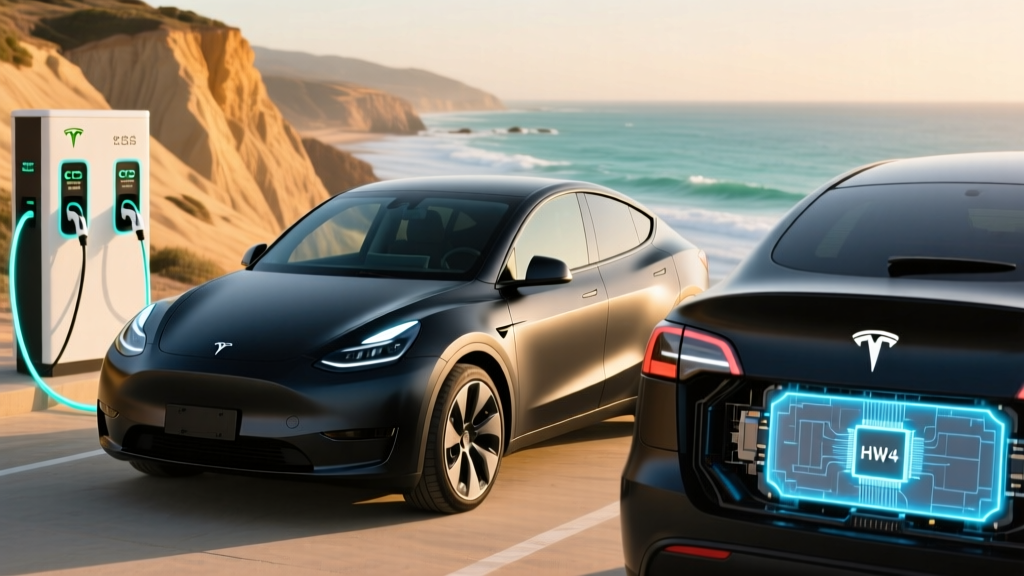
The phrase Tesla chips gets thrown around in forums and spec sheets, but what these silicon packages actually do inside a Model Y directly affects your daily driving experience — from how far you can go on a charge to how the infotainment system responds to whether the car can navigate a construction zone on Autopilot. In the 2026 Model Y, two chip families do the heavy lifting: the Hardware 4 (HW4) computer that runs Tesla's vision-based driver-assistance stack, and the AMD Ryzen infotainment processor that powers the 15-inch center touchscreen. This review breaks down what those chips enable, then grounds the conversation in the numbers that matter to buyers: real-world range, charging speed, pricing, and federal tax credit eligibility.
2026 Tesla Model Y: Core Specs at a Glance
| Spec | Value |
|---|---|
| EPA Estimated Range | 320 miles |
| Battery Capacity (usable) | ~75 kWh (NMC) |
| Max DC Fast Charge Rate | 250 kW (peak) |
| 10–80% DC Fast Charge Time | ~25 minutes |
| Level 2 Home Charging (11.5 kW / 48A) | ~37 miles per hour |
| 0–60 mph | 4.8 seconds |
| Horsepower | 384 hp (dual motor AWD) |
| EPA Efficiency | 111 MPGe combined / 28 kWh/100 mi |
| Cargo Volume (rear seats up / folded) | 30.2 cu ft / 72.0 cu ft |
| Base MSRP (Long Range AWD) | $44,990 |
| Battery & Drive Unit Warranty | 8 years / 120,000 miles |
What Tesla Chips Actually Do in the 2026 Model Y
When Tesla owners say "Tesla chips," they're usually referring to one of two compute platforms:
Hardware 4 (HW4) — the Autopilot/FSD computer. Introduced in 2023 and carried into the 2026 Model Y, HW4 replaced the older HW3 computer with higher-resolution camera support (up to 5 megapixels per camera versus HW3's 1.2 MP), a wider field of view on the front-facing camera, and roughly double the inference compute throughput. HW4 processes input from Tesla's eight-camera surround-vision suite in real time, feeding the neural networks that power Autosteer, Navigate on Autopilot, Smart Summon, and the optional FSD (Supervised) package. The practical result: better detection of small or distant obstacles, faster lane-change decisions, and more confident behavior in complex intersections.
AMD Ryzen infotainment processor. Since the 2022 refresh, Tesla has used an AMD Ryzen-based SoC (system on a chip) paired with an RDNA 2 GPU for the Model Y's center display. This chip handles navigation rendering, media playback, the vehicle settings UI, Tesla's built-in web browser, and AAA-class gaming while parked. Compared to the older Intel Atom-based MCU2, the Ryzen chip delivers noticeably faster map panning, near-instant app switching, and the ability to run graphics-intensive games like Cyberpunk 2077 without stuttering.
Real-World Range: Beyond the 320-Mile EPA Sticker
EPA sticker: 320 miles
Real-world highway (70–75 mph, mild weather): ~265–285 miles
Real-world mixed city/highway (moderate climate): ~280–305 miles
Cold weather (below 30°F, highway): ~210–245 miles (30–35% reduction)
Hot weather with heavy A/C (above 95°F): ~270–295 miles
The 2026 Model Y Long Range AWD carries an EPA-estimated 320 miles of range, but as with every EV, that number reflects a laboratory test cycle — not your Tuesday commute or your summer road trip to the mountains. In our experience and consistent with third-party testing from outlets like fueleconomy.gov, sustained highway driving at 75 mph drops usable range to roughly 265–285 miles. The Model Y's aerodynamic efficiency (0.23 Cd drag coefficient) helps, but physics still wins at speed.
Cold weather is the bigger range killer. In temperatures below 30°F, expect a 30–35% reduction in range due to battery internal resistance and cabin heating demands. The Model Y's standard heat pump mitigates this significantly compared to older resistance-heater EVs, but it doesn't eliminate the penalty. If you live in Minnesota or Maine, plan around ~220 miles of usable winter range on the highway and precondition the battery while plugged in to recover some efficiency.
Charging Speed: DC Fast, Level 2, and the Curve Reality
| Charging Level | Power (kW) | Miles Added per Hour | Notes |
|---|---|---|---|
| Level 1 (120V, 12A) | ~1.4 kW | ~3–5 mi/hr | Emergency/trickle only |
| Level 2 (240V, 48A) | 11.5 kW | ~37 mi/hr | Home Wall Connector; ~8.5 hrs for full charge |
| DC Fast (V3 Supercharger) | Up to 250 kW peak | ~162 mi in 15 min (Tesla est.) | 10–80% in ~25 min; tapers sharply above 80% |
| DC Fast (V4 Supercharger) | Up to 250 kW (current vehicles) | Same as V3 for Model Y | V4 hardware supports higher rates for future platforms |
The Model Y Long Range AWD peaks at 250 kW on a V3 or V4 Tesla Supercharger, but — and this is critical — that peak only holds between roughly 10% and 30% state of charge. The charging curve tapers progressively: by 50% SoC you're typically seeing 150–170 kW, and above 80% it drops below 50 kW. This is why Tesla (and every experienced EV owner) recommends charging to 80% on road trips and only topping up beyond that if you genuinely need the extra range. A 10–80% session takes about 25 minutes under good thermal conditions; a 10–100% session can stretch past 45 minutes.
At home, the Tesla Wall Connector at 48 amps delivers 11.5 kW, adding roughly 37 miles of range per hour of charging. An overnight session (8–10 hours) easily refills the battery from near-empty. Installation typically requires a 60-amp dedicated circuit; expect $800–$2,000 for a professional install depending on your panel's proximity to the garage and whether a panel upgrade is needed. Always have a licensed electrician assess your home's capacity before purchasing equipment.
The Model Y uses the NACS (North American Charging Standard) connector natively — the same plug used across the Tesla Supercharger network. As of 2026, most major automakers have adopted NACS, and adapters are widely available for CCS-equipped public chargers from networks like Electrify America and EVgo.
Performance, Efficiency, and Practicality
The 2026 Model Y Long Range AWD uses a dual-motor setup — a permanent-magnet motor on the rear axle and an induction motor up front that can freewheel when not needed to reduce drag. Combined output is 384 horsepower, delivering a 4.8-second 0–60 mph time. That's quick enough to merge confidently onto any highway and overtake without drama, though the Performance trim (4.3 seconds, 455 hp) exists for those who want more.
EPA-rated efficiency lands at 111 MPGe combined, which translates to roughly 28 kWh per 100 miles. In real-world mixed driving, expect 27–32 kWh/100 mi depending on speed, terrain, and climate use. At the national average electricity rate of ~$0.17/kWh, that works out to approximately $0.047 per mile — roughly a third of what a comparable gasoline crossover costs at $3.30/gallon and 28 MPG combined.
Inside, the Model Y offers 30.2 cubic feet of cargo space behind the second row and 72.0 cubic feet with the rear seats folded. Rear legroom measures 40.5 inches — adequate for adults on longer trips. The front trunk (frunk) adds 4.1 cubic feet of secure, weatherproof storage. The minimalist interior remains polarizing: no physical instrument cluster, no stalks (turn signals are on the steering wheel), and virtually all controls live on the 15-inch center touchscreen. You either adapt to this quickly or you don't.
Pricing, Trims, and Federal Tax Credit Eligibility
| Trim | Base MSRP | Est. Price After §30D Credit | Drivetrain |
|---|---|---|---|
| Long Range RWD | $42,990 | ~$35,490* | Rear-wheel drive |
| Long Range AWD | $44,990 | ~$37,490* | Dual motor AWD |
| Performance AWD | $48,990 | ~$41,490* | Dual motor AWD |
*Tax-credit-adjusted prices assume full $7,500 §30D credit eligibility. Your actual credit depends on income, battery sourcing, and MSRP compliance. See eligibility details below.
The 2026 Model Y starts at $42,990 for the Long Range RWD and climbs to $48,990 for the Performance. Adding FSD (Supervised) costs $8,000 upfront or $99/month. Premium interior colors, 20-inch wheels, and tow hitch are extra-cost options that can push an as-tested price above $55,000.
- MSRP cap: SUVs/crossovers must be priced at or below $80,000 (all Model Y trims qualify)
- Buyer income cap: AGI ≤ $150,000 (single), $225,000 (head of household), $300,000 (joint)
- Battery sourcing: Required percentages of critical minerals and battery components must be sourced from the U.S. or FTA partners — Tesla has progressively shifted supply chains, but verify current-year compliance at IRS.gov
- Point-of-sale transfer: Eligible buyers can apply the $7,500 credit as an immediate discount at purchase rather than waiting for tax filing
- Tax liability: The credit is non-refundable — you must owe at least $7,500 in federal taxes to claim the full amount (unless transferred at point of sale)
Always confirm eligibility with a tax professional before purchase. Rules and sourcing requirements change periodically.
Tesla Model Y vs. Key Competitors: Is It Still the One to Beat?
| Spec | Tesla Model Y LR AWD | Hyundai Ioniq 5 Limited AWD | Ford Mustang Mach-E Extended Range AWD |
|---|---|---|---|
| EPA Range | 320 mi | 290 mi | 310 mi |
| Battery (usable) | ~75 kWh (NMC) | 77.4 kWh (NMC) | 91 kWh (NMC) |
| Max DC Charge | 250 kW | 240 kW | 150 kW |
| 10–80% Time | ~25 min | ~20 min | ~38 min |
| 0–60 mph | 4.8 sec | 5.1 sec | 5.1 sec |
| Cargo (rear up) | 30.2 cu ft | 27.2 cu ft | 29.7 cu ft |
| Base MSRP | $44,990 | $52,600 | $48,995 |
| Charging Network | Supercharger (native NACS) | NACS adapter / Ioniq 5 native NACS in 2026 | NACS adapter required |
The Model Y's strongest advantages in 2026 remain its efficiency (more miles from fewer kWh), access to the Supercharger network without adapters, and the lowest starting price in this comparison. The Ioniq 5 charges faster on the 10–80% curve thanks to its 800V architecture and offers a more conventional interior with physical buttons. The Mach-E provides the largest battery and a more traditional driving feel but charges significantly slower on DC. None of the competitors currently match Tesla's FSD capability in terms of geographic coverage, though whether that capability is worth $8,000 or $99/month is a personal calculation.
Pros, Cons, and Who Should Buy the Model Y
- Class-leading efficiency (111 MPGe combined)
- Supercharger network access — most reliable DC charging in the U.S.
- Strong cargo capacity (72 cu ft max) with usable frunk
- Competitive base price under $45,000 before credits
- HW4 computer enables the most widely deployed Level 2 ADAS in the U.S.
- Over-the-air updates continuously add features
- Minimalist interior not for everyone — no physical buttons or gauges
- Turn signals on steering wheel require adaptation
- DC charging tapers sharply above 80% — don't plan on fast top-ups
- FSD (Supervised) costs extra and remains Level 2, not autonomous
- Insurance premiums tend to run higher than segment average
- Service center wait times can stretch weeks in high-demand metro areas
- Commuters with home charging: 320 miles of range means charging once or twice a week on a Level 2 home setup. Low running costs shine on daily drives.
- Families needing cargo space: 72 cu ft with seats down handles strollers, groceries, and weekend-trip luggage. Available third-row seat (small children only) adds flexibility.
- Road trippers who value charging infrastructure: The Supercharger network remains the most reliable and densest DC fast-charging system in the U.S. — a genuine advantage on cross-country drives.
- Tech-forward buyers: If you want the most advanced ADAS deployment, regular OTA updates, and a responsive infotainment system, the Model Y's chip stack delivers.
Look elsewhere if: you need a truck bed, require physical buttons and a traditional instrument cluster, frequently tow heavy loads (3,500-lb max), or want Level 4 autonomy today (it doesn't exist in any consumer vehicle).
Frequently Asked Questions
What is the real-world range of the 2026 Tesla Model Y?
The EPA rates the Model Y Long Range AWD at 320 miles. In real-world highway driving at 70–75 mph, expect 265–285 miles. In cold weather (below 30°F), plan for 210–245 miles. City driving with regenerative braking recovers energy and often exceeds the EPA estimate in mild weather.
How fast does the Model Y charge at home and on the road?
At home on a 48-amp Level 2 Tesla Wall Connector (11.5 kW), the Model Y adds roughly 37 miles of range per hour, fully recharging overnight. On a 250 kW DC Supercharger, a 10–80% session takes approximately 25 minutes, with the charge rate tapering significantly above 80% SoC.
How much does the Model Y cost after the federal tax credit?
The 2026 Model Y Long Range AWD starts at $44,990. If you qualify for the full $7,500 §30D federal tax credit (based on income limits, battery sourcing compliance, and MSRP under $80,000), the effective price drops to approximately $37,490. Verify current-year eligibility at IRS.gov or with a tax professional.
Does the Model Y qualify for the $7,500 federal EV tax credit in 2026?
All Model Y trims fall under the $80,000 SUV MSRP cap. Eligibility then depends on your adjusted gross income (≤$150K single / ≤$300K joint), whether the vehicle's battery meets critical-mineral and component-sourcing thresholds, and whether you have sufficient tax liability. Tesla has worked to localize battery supply chains, but sourcing rules tighten annually — always check the IRS qualified vehicles list before purchasing.
Is the Model Y worth buying over the Ioniq 5 or Mach-E?
If you prioritize efficiency, lowest price, and charging-network reliability, the Model Y remains the benchmark. If you prefer a more conventional interior with physical controls and faster 10–80% DC charging, the Ioniq 5 is compelling. If you want the largest battery and a more traditional crossover driving feel, the Mach-E is worth a test drive. Cross-shop all three and weigh what matters most to your daily routine.
What do Tesla's HW4 chips actually enable for drivers?
HW4 processes higher-resolution camera data with greater compute throughput than the previous HW3 computer. For drivers, this means Autopilot and FSD (Supervised) can detect smaller objects at greater distances, make faster lane-change decisions, and handle complex driving scenarios more smoothly. It does not make the car self-driving — the driver remains responsible at all times under SAE Level 2 classification.
What is the Model Y's battery warranty?
Tesla covers the Model Y's battery pack and drive units for 8 years or 120,000 miles, whichever comes first, with a guaranteed minimum 70% capacity retention over that period. This is competitive with Hyundai's 10-year/100,000-mile battery warranty and Ford's 8-year/100,000-mile coverage.