Why Your Tesla App Throws a 500 Server Error (and How to Fix It)
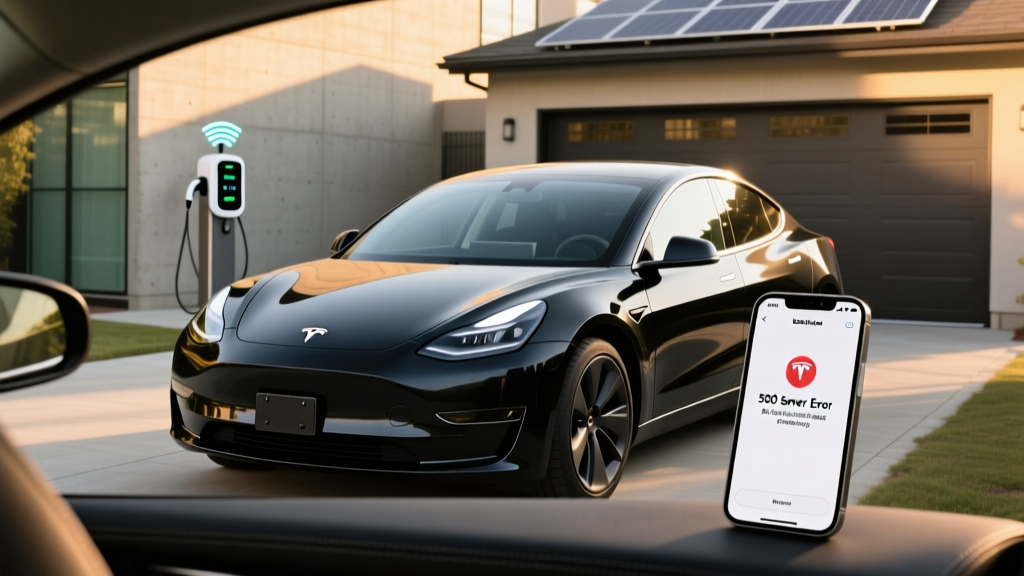
If you've ever tapped your Tesla app only to be greeted by a blank screen or a cryptic Tesla app 500 server error, you're not alone. This is one of the most common issues Tesla owners report, and it typically points to a server-side problem on Tesla's end — not your phone or your car. A 500 Internal Server Error means Tesla's backend couldn't process your request, often during peak usage times, after an app update, or during a broader Tesla service outage.
Before you panic about losing access to your vehicle's climate controls, charging status, or location tracking, run through these proven fixes:
- Force-close and relaunch the app. On iOS, swipe up from the app switcher; on Android, use the recent apps menu. This clears the app's cached session.
- Check Tesla's service status. Visit status.tesla.com (or search "Tesla status" on Downdetector) to confirm whether there's a known outage affecting API connectivity.
- Toggle your phone's network. Switch between Wi-Fi and cellular data. Some 500 errors stem from DNS resolution failures on specific networks.
- Update the Tesla app. Tesla pushes app updates frequently. An outdated version may send malformed API requests that trigger server errors.
- Log out and log back in. Go to the app's settings, sign out, then re-authenticate. This refreshes your OAuth token.
- Reinstall the app entirely. If nothing else works, delete and reinstall. You won't lose any vehicle data — it's all tied to your Tesla account.
In most cases, the Tesla app 500 server error resolves within 15–30 minutes if it's a Tesla-side issue. Your car remains fully drivable — the app error doesn't affect your key fob, phone-as-key (via Bluetooth), or the in-car touchscreen. You can still charge, precondition, and drive normally. The app is a remote convenience layer, not a vehicle dependency.
With that troubleshooting out of the way, let's talk about the car you're trying to connect to. If you own or are considering a 2026 Tesla Model 3, here's the comprehensive, numbers-driven review you need.
2026 Tesla Model 3: Range, Battery, and Real-World Efficiency
The current-generation Model 3 (refreshed for 2024 and carried into 2026 with minor updates) is offered in three primary configurations in the U.S. market. Here's the core spec breakdown:
| Spec | Model 3 RWD | Model 3 Long Range AWD | Model 3 Performance AWD |
|---|---|---|---|
| EPA Range | 272 mi | 363 mi | 315 mi |
| Battery (usable) | ~60 kWh (LFP) | ~79 kWh (NMC) | ~79 kWh (NMC) |
| Drivetrain | Rear-Wheel Drive | Dual-Motor AWD | Dual-Motor AWD |
| Horsepower | 271 hp | 384 hp | 510 hp |
| 0-60 mph | 5.8 sec | 4.2 sec | 2.9 sec |
| EPA Efficiency | 132 MPGe (25 kWh/100mi) | 131 MPGe (26 kWh/100mi) | 119 MPGe (28 kWh/100mi) |
| Top Speed | 125 mph | 125 mph | 163 mph |
The RWD trim uses a lithium iron phosphate (LFP) battery pack, which trades some energy density for superior cycle life and thermal stability. Tesla recommends charging LFP packs to 100% regularly — unlike NMC packs, which benefit from staying between 20–80% for daily use. The Long Range and Performance trims use nickel manganese cobalt (NMC) chemistry, offering higher energy density (hence the longer range) but requiring more careful state-of-charge management for long-term health.
Charging Speed: DC Fast, Level 2, and the Charge Curve Reality
Charging speed is where the Model 3's engineering shows its maturity. Tesla's Supercharger network remains the gold standard for public DC fast charging reliability, and the Model 3 takes full advantage.
| Charging Level | Power (kW) | Speed | Notes |
|---|---|---|---|
| Level 1 (120V household) | ~1.4 kW | ~3–4 mi/hr | Emergency/trickle only |
| Level 2 (240V home/J1772) | 11.5 kW (48A) | ~44 mi/hr | Full charge in ~7–9 hrs depending on trim |
| DC Fast (Supercharger V3/V4) | Peak 250 kW | 10–80% in ~25 min (Long Range) | Speed tapers significantly above 80% |
| DC Fast (NACS at non-Tesla) | Up to 250 kW | Varies by station | Model 3 uses native NACS connector |
A critical detail many buyers miss: peak charge rate is not sustained charge rate. The Model 3 Long Range peaks at 250 kW only at a low state of charge (around 10–20% SoC) and tapers progressively. By 60% SoC, you're likely pulling 100–120 kW; by 80%, it drops to roughly 50–60 kW. This is why the 10–80% metric matters more than peak kW. The RWD model with its smaller LFP pack peaks around 170 kW on DC fast charging, so its 10–80% time stretches to roughly 30 minutes.
For home charging, a Level 2 wall connector on a 60-amp circuit (delivering 48 amps continuous) adds about 44 miles of range per hour. An overnight charge (8 hours) easily replenishes 300+ miles — more than enough for daily driving. If your home has a 200-amp electrical panel, a Level 2 install is straightforward. Older 100-amp panels may require an upgrade ($1,500–$3,000 depending on your electrician and local code), so factor that into your purchase budget.
Pricing, Tax Credits, and the Real Cost to Buy
Tesla's pricing shifts periodically — sometimes weekly — but here are the approximate MSRPs for the 2026 Model 3 lineup as of early 2026:
| Trim | Base MSRP | §30D Federal Credit | Effective Price |
|---|---|---|---|
| Model 3 RWD | ~$38,990 | $3,750 (partial) | ~$35,240 |
| Model 3 Long Range AWD | ~$45,240 | $3,750 (partial) | ~$41,490 |
| Model 3 Performance AWD | ~$52,990 | $3,750 (partial) | ~$49,240 |
Federal tax credit nuance: Under current IRS §30D rules, the Model 3 qualifies for a partial credit of $3,750 — not the full $7,500. This is because while Tesla's U.S.-assembled vehicles meet the final-assembly requirement, certain battery critical-mineral and component sourcing thresholds shift annually, and the Model 3 currently satisfies one of the two prongs (critical minerals) but not the battery-component requirement for the full amount. The credit is available as a point-of-sale transfer, meaning the dealer (or Tesla directly) applies it at purchase, reducing your out-of-pocket cost immediately.
Key eligibility caveats for the buyer:
- Income caps: Modified adjusted gross income must not exceed $150,000 (single), $225,000 (head of household), or $300,000 (joint filers).
- MSRP cap: The vehicle's MSRP must not exceed $55,000 for sedans (the Performance trim at ~$52,990 clears this, but adding options could push it over — verify your build).
- Vehicle must be new and placed in service by the buyer (not resold).
Always confirm eligibility at fueleconomy.gov before purchasing, as sourcing rules and eligible amounts can change with little notice.
Interior, Cargo, Tech, and Driver Assistance
The refreshed Model 3 interior is a meaningful step up from the pre-2024 versions. Tesla added ventilated front seats, ambient lighting, rear-seat ventilation, acoustic glass all around, and a redesigned center console. The minimalist philosophy remains — there are no physical buttons, and even the turn signals are now on the steering wheel (a polarizing choice).
Cargo and passenger dimensions:
- Rear legroom: 35.3 inches
- Front headroom: 40.3 inches
- Cargo volume (rear trunk): 21.0 cu ft
- Front trunk (frunk): 3.1 cu ft
- Total cargo: ~24.1 cu ft (seats up), ~64 cu ft (rear seats folded)
The infotainment system runs on a 15.4-inch center touchscreen with a responsive interface, integrated navigation with real-time Supercharger routing, and streaming apps (Netflix, YouTube, Spotify) usable while parked. There's no Apple CarPlay or Android Auto — Tesla's native system is the only option, which is either a pro or a con depending on your preference.
Driver assistance: Every Model 3 comes with Tesla's Basic Autopilot (traffic-aware cruise control and lane-keeping). Full Self-Driving (Supervised) is an $8,000 option or $99/month subscription. FSD (Supervised) handles city streets, stoplights, and highway lane changes — but it remains an SAE Level 2 system, meaning the driver must remain fully attentive with hands on the wheel at all times. It is not autonomous driving.
Warranty, Reliability, and Ownership Costs
Tesla's warranty structure is competitive with the broader EV market:
- Basic Vehicle Limited Warranty: 4 years / 50,000 miles
- Battery & Drive Unit Warranty (RWD): 8 years / 100,000 miles, minimum 70% capacity retention
- Battery & Drive Unit Warranty (Long Range & Performance): 8 years / 120,000 miles, minimum 70% capacity retention
The 70% retention threshold is industry-standard — Hyundai, Ford, and GM use similar benchmarks. Real-world data from high-mileage Tesla owners and fleet analyses suggest NMC Model 3 packs typically retain 88–92% capacity at 100,000 miles when not routinely charged to 100%. LFP packs show even slower degradation curves, often retaining 90%+ at equivalent mileage thanks to the chemistry's inherent stability.
Insurance costs remain a consideration: the Model 3 carries higher premiums than comparably priced gas sedans, averaging $2,200–$2,800/year nationally depending on trim, location, and driver profile. Tesla's own insurance product (available in most states) uses real-time driving data and can be competitive for safe drivers.
Pros, Cons, and the Competition
Pros
- Class-leading efficiency (25–28 kWh/100mi)
- Access to Tesla Supercharger network — most reliable DC fast-charging infrastructure in the U.S.
- Native NACS connector — no adapter needed at Tesla chargers
- Strong over-the-air updates that add features post-purchase
- LFP option (RWD) offers excellent battery longevity
- Best-in-class regenerative braking and one-pedal driving
Cons
- Turn signals on steering wheel are unintuitive for roundabouts
- No Apple CarPlay or Android Auto
- Rear visibility is limited; relies heavily on cameras
- FSD (Supervised) is expensive and still requires full driver attention
- Tesla app outages (including 500 server errors) can temporarily remove remote access
- Higher insurance costs than comparable sedans
Key competitors: The Hyundai Ioniq 6 (EPA 361 mi, ~$38,000) matches the Model 3 on range and offers CarPlay, but charges slower on non-Tesla DC networks. The BMW i4 eDrive40 (EPA 301 mi, ~$52,000) delivers a more premium cabin and conventional controls at a higher price. The Chevrolet Equinox EV undercuts on price (~$33,000) but offers less range and slower charging. Against this field, the Model 3's Supercharger access and efficiency remain its strongest differentiators for road-trip-heavy buyers.
Who Should Buy the 2026 Tesla Model 3?
The Model 3 is best suited for:
- Daily commuters who can charge at home and want minimal running costs (~$0.04–$0.06/mile on residential electricity vs. $0.12–$0.15/mile for gas)
- Tech-forward buyers comfortable with a touchscreen-only interface and OTA-driven feature evolution
- Road trippers who value the Supercharger network's reliability and integrated route planning over maximum interior space
- Single drivers or couples — rear seat space is adequate but not generous for adults on long trips
It's less ideal for families needing easy rear car-seat access (the door openings are narrow), buyers who demand Apple CarPlay, or those in areas with limited home-charging options who would rely solely on public infrastructure.
Frequently Asked Questions
What causes the Tesla app 500 server error?
A 500 error is a server-side issue on Tesla's infrastructure. It can be triggered by Tesla server outages, app version incompatibilities, expired authentication tokens, or network DNS failures. Your car is unaffected — you can still drive, charge, and use the touchscreen normally. Force-closing the app, switching networks, or reinstalling usually resolves it within minutes.
What is the real-world range of the 2026 Tesla Model 3?
The Long Range AWD has an EPA rating of 363 miles. Real-world highway driving at 75 mph yields roughly 290–320 miles. In cold weather (below freezing), expect 250–290 miles. The RWD model's EPA 272 miles translates to roughly 220–240 miles on the highway and 200–220 miles in winter conditions.
How fast does the Model 3 charge at home and on the road?
At home on a Level 2 (240V, 48A) charger, the Model 3 adds approximately 44 miles of range per hour — a full overnight charge covers most weekly driving. On a Tesla Supercharger (DC fast), the Long Range model charges from 10–80% in roughly 25 minutes, peaking at 250 kW before tapering.
Does the 2026 Tesla Model 3 qualify for the federal EV tax credit?
Yes, but for a partial amount of $3,750 under current IRS §30D rules, not the full $7,500. Eligibility depends on your income (under $150K single / $300K joint), the vehicle's MSRP (under $55K for sedans), and battery sourcing compliance. The credit can be applied at the point of sale. Always verify at fueleconomy.gov and consult a tax professional.
Is the Tesla Model 3 worth buying over competitors?
If Supercharger access, best-in-class efficiency, and a mature software ecosystem are your priorities, yes. If you prefer physical controls, CarPlay integration, or a more traditional dealership experience, the Hyundai Ioniq 6 or BMW i4 may suit you better. The Model 3's total cost of ownership remains among the lowest in its class when factoring in electricity savings and lower maintenance.