Quick Verdict: The Wagon That Charges Like Nothing Else
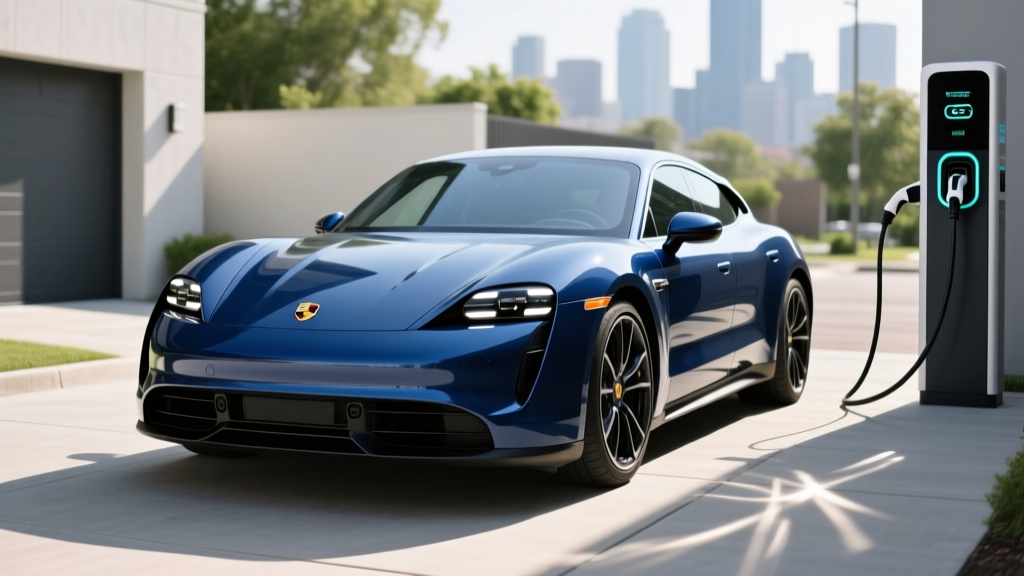
The Porsche Taycan Sport Turismo occupies a rare slot in the EV market: a luxury shooting-brake wagon with sports-car reflexes and class-leading DC fast-charging capability. For 2026, Porsche has refined the Taycan lineup with a larger battery, faster charging architecture, and improved efficiency across the board. The Sport Turismo body style adds practical cargo volume and rear headroom over the sedan, making it the most livable Taycan variant for daily use.
If you prioritize driving dynamics and charging speed over maximum range-per-dollar, the Taycan Sport Turismo is difficult to beat. But at a starting price well into six figures — and with federal tax credit eligibility that excludes most buyers — this is a deliberate choice for enthusiasts who want an EV that behaves like a Porsche first and a battery-powered car second.
| EPA Range | 277 miles (4S AWD) |
| Battery | 108.9 kWh gross / ~97 kWh usable, NMC lithium-ion, 800V architecture |
| Max DC Fast Charge | 320 kW peak (10-80% in ~18 minutes) |
| Level 2 Home Charging | 11 kW onboard charger (~33 mi/hr); optional 22 kW |
| 0-60 mph | 3.5 seconds (4S with Launch Control) |
| Horsepower | 509 hp (4S, overboost with Launch Control) |
| Drivetrain | Dual-motor AWD, 2-speed rear transmission |
| Efficiency | 85 MPGe combined / 40 kWh/100mi |
| Cargo Volume | 15.7 cu ft (rear seats up) / 42.8 cu ft (rear seats folded) |
| Rear Legroom | 32.7 inches |
| Base MSRP (4S) | $113,100 (before destination) |
| Battery/Powertrain Warranty | 8 years / 100,000 miles (battery capacity ≥70%) |
Real-World Range: What the EPA Number Doesn't Tell You
The EPA rates the 2026 Taycan 4S Sport Turismo at 277 miles of combined range. The base rear-wheel-drive Taycan Sport Turismo achieves up to 310 miles EPA, while the performance-oriented GTS variant drops to approximately 260 miles. These figures represent a meaningful improvement over the pre-2025 Taycan generation, thanks to the larger 108.9 kWh Performance Battery Plus and improved thermal management.
The EPA combined figure blends city and highway driving. In real-world highway testing at 70-75 mph, expect 240-255 miles from the 4S AWD variant. In cold weather (below 32°F), range can drop an additional 15-25%, bringing highway range to roughly 190-215 miles in winter conditions. City driving with regenerative braking recovery gets closer to the EPA sticker, often matching or exceeding 280 miles in mild temperatures. Porsche's 800V architecture and heat pump (standard on 2026 models) help mitigate cold-weather losses compared to older EVs, but physics still applies.
According to fueleconomy.gov, the Taycan 4S Sport Turismo returns 85 MPGe combined. In practice, efficiency hovers around 38-42 kWh/100mi depending on driving style. Aggressive acceleration and sustained high-speed cruising push consumption above 45 kWh/100mi, while careful city driving with regen can drop it below 35 kWh/100mi.
Charging Speed: The Taycan's Strongest Argument
The 2026 Taycan Sport Turismo's 800-volt electrical architecture remains one of its defining technical advantages. While most competitors use 400V systems (limiting peak charge rates), the Taycan's 800V platform enables DC fast-charging speeds that genuinely reduce road-trip downtime.
| Level | Max Power | Miles Added | Typical Use Case |
|---|---|---|---|
| Level 1 (120V) | ~1.4 kW | ~4 mi/hr | Emergency/trickle only |
| Level 2 (240V, 48A) | 11 kW | ~33 mi/hr | Home overnight / workplace |
| Level 2 (optional 22 kW) | 22 kW | ~66 mi/hr | Requires 100A circuit + 3-phase power |
| DC Fast Charge | 320 kW peak | ~180 mi in 10 min | Road trips (350 kW capable stations) |
DC Fast Charging in Practice: The 320 kW peak rate is achievable at 350 kW-capable Electrify America or Ionity stations. The charge curve is impressively flat: the Taycan sustains above 250 kW from roughly 10% to 55% State of Charge, then gradually tapers. The 10-80% charge takes approximately 18 minutes under optimal conditions (battery preconditioned, ambient temperature 65-85°F). Above 80%, charging slows significantly — expect 80-100% to take an additional 20+ minutes. Always plan road-trip stops around the 10-80% window.
Home Charging: The standard 11 kW onboard charger fully replenishes the 108.9 kWh battery in about 10 hours on a 48-amp Level 2 circuit (hardwired, 60A breaker). This is adequate for overnight charging but slower than some competitors offering 19.2 kW onboard chargers. The optional 22 kW onboard charger cuts this to ~5 hours but requires a commercial-grade 100-amp circuit and three-phase power — uncommon in US residential settings. Most buyers will install a standard 48A or 60A Level 2 wallbox (such as a ChargePoint Home Flex or Porsche Mobile Charger Connect) and wake to a full battery each morning.
Connector: The 2026 Taycan uses the CCS1 connector in North America. With Porsche joining the NACS (Tesla Supercharger) alliance, a NACS adapter is available, and future model years are expected to ship with native NACS ports. For now, CCS-to-NACS adapters enable access to Tesla's Supercharger network, significantly expanding route flexibility on road trips.
Performance: A Porsche First, an EV Second
The Taycan Sport Turismo lineup spans five trims for 2026, each with distinct power outputs and character:
| Trim | Drivetrain | HP (Overboost) | 0-60 mph | Top Speed | Base MSRP |
|---|---|---|---|---|---|
| Taycan (base) | RWD | 402 hp | 4.6 sec | 143 mph | $101,000 |
| Taycan 4S | AWD | 509 hp | 3.5 sec | 155 mph | $113,100 |
| Taycan GTS | AWD | 690 hp | 3.1 sec | 162 mph | $149,500 |
| Taycan Turbo | AWD | 872 hp | 2.5 sec | 162 mph | $175,200 |
| Taycan Turbo GT | AWD | 1,019 hp | 2.1 sec | 180 mph | $234,000 |
All trims share the 108.9 kWh Performance Battery Plus (NMC chemistry). The Taycan's unique 2-speed rear transmission — a first in the EV world — provides aggressive initial acceleration in first gear, then shifts to a taller second gear for efficient high-speed cruising. This engineering choice explains why the Taycan sustains its performance at highway speeds better than single-speed competitors, which often lose punch above 80 mph.
Regenerative braking delivers up to 290 kW of recuperation, enabling genuine one-pedal driving in most conditions. However, Porsche's regen tuning is more progressive than Tesla's aggressive lift-off deceleration, which some drivers prefer for its natural feel and others find insufficient for full one-pedal use.
Pricing, Trims & Federal Tax Credit Eligibility
The 2026 Taycan Sport Turismo starts at $101,000 for the base RWD model and climbs to $234,000 for the Turbo GT. Porsche's options list is famously extensive — a well-equipped 4S with Premium Plus package, adaptive air suspension, rear-axle steering, and 21-inch wheels can easily reach $130,000-$140,000 before delivery.
The Porsche Taycan Sport Turismo does not qualify for the $7,500 federal EV tax credit under IRS §30D rules. Two factors eliminate eligibility:
- MSRP Cap: The §30D credit applies only to sedars/wagons priced below $55,000 MSRP. Every Taycan trim exceeds this cap.
- Income Cap: Even if the MSRP qualified, buyers with modified AGI above $150,000 (single) or $300,000 (joint) are ineligible.
- Battery Sourcing: The Taycan's battery is manufactured by CATL/LG in partnership with Porsche, and critical mineral sourcing may not meet §30D requirements. Per IRS qualifying vehicle lists, Porsche Taycan models are not listed as eligible.
State-level incentives may apply (California's CVRP, for example, has its own income and price caps). Consult a tax professional for your specific situation.
Interior, Cargo & Daily Livability
The Sport Turismo wagon body adds genuine utility over the Taycan sedan. The roofline extends rearward, creating a more practical cargo area and improved rear headroom. Cargo volume measures 15.7 cubic feet behind the rear seats — comparable to a compact SUV — and expands to 42.8 cubic feet with the 60/40 split rear seats folded. The front trunk (frunk) adds 2.9 cubic feet for charging cables or a small bag.
Rear legroom at 32.7 inches is tight for a vehicle in this price range. Adults over 6 feet will find knee room limited on longer trips. The Taycan Cross Turismo (a lifted variant with more rear headroom and optional roof rails) may suit taller passengers better. Front seats are deeply bolstered, supportive, and available with 18-way power adjustment, ventilation, and massage.
The interior features Porsche's latest PCM (Porsche Communication Management) infotainment system with a 12.6-inch curved instrument cluster, a 10.9-inch central touchscreen, and an optional 10.9-inch passenger display. Wireless Apple CarPlay and Android Auto are standard. A head-up display with augmented-reality navigation is available. Build quality, material selection, and switchgear feel commensurate with the price — real metal, leather, and optional carbon fiber or open-pore wood trim.
Driver Assistance & Safety Technology
The 2026 Taycan comes equipped with Porsche InnoDrive as standard, which includes adaptive cruise control with stop-and-go, lane-keeping assist, traffic sign recognition, and predictive cruise (using navigation data to adjust speed for upcoming curves and intersections). This is an SAE Level 2 system — the driver must keep hands on the wheel and eyes on the road at all times. It is not autonomous driving.
Porsche InnoDrive is a capable highway companion but does not offer hands-free driving, automatic lane changes, or navigation-on-autopilot features found in GM Super Cruise or Ford BlueCruise. The Taycan will not steer itself through highway interchanges or navigate city streets autonomously. Expect SAE Level 2 functionality — excellent adaptive cruise and lane centering, but constant driver supervision required.
Safety ratings are strong. The Taycan earned a 5-star overall rating from NHTSA and Good ratings across IIHS crash tests. Standard safety equipment includes forward collision warning with automatic emergency braking, blind-spot monitoring, rear cross-traffic alert, and surround-view cameras.
Pros and Cons: The Honest Assessment
- Best-in-class DC fast charging (320 kW, 10-80% in 18 min)
- Exceptional driving dynamics — steering feel, chassis balance, brake modulation
- 800V architecture enables sustained performance without thermal throttling
- 2-speed rear transmission preserves highway acceleration
- Wagon practicality with 42.8 cu ft max cargo
- Standard heat pump for cold-weather efficiency
- Premium interior build quality and material selection
- EPA range lags competitors (277 mi vs. Lucid Air's 400+ mi, Tesla Model S's 405 mi)
- Rear legroom is tight (32.7 in) for the price class
- No federal tax credit eligibility (MSRP exceeds $55K cap)
- Options add up quickly — $130K+ for a well-equipped 4S
- ADAS features trail Tesla, GM, and Ford in capability
- 11 kW onboard charger is slow vs. 19.2 kW competitors
- CCS1 connector requires adapter for Tesla Supercharger access
Who Should Buy the Taycan Sport Turismo?
Choose the Taycan Sport Turismo if: You prioritize driving engagement, charging speed, and build quality over maximum range. You have reliable home Level 2 charging. You want a wagon with sports-car reflexes and don't mind paying a premium for the Porsche badge and engineering.
Look elsewhere if: Range-per-dollar is your top priority (consider the Lucid Air Pure or Tesla Model S). You need spacious rear seating for adults (the Mercedes EQE SUV or BMW i5 offer more room). You want cutting-edge autonomous driving features (Tesla FSD Supervised or GM Super Cruise are more advanced, though still Level 2). You rely on the federal tax credit to justify the purchase.
Best use cases: The Taycan Sport Turismo excels as a daily-driver sports wagon for enthusiasts who take weekend road trips and value the ability to DC fast-charge quickly. It works well for couples or small families (one or two children in car seats) who don't regularly carry rear-seat adults. The charging speed makes it viable for 300-400 mile road trips with one 20-minute stop — a meaningful advantage over competitors that require 35-45 minute charging breaks.
Frequently Asked Questions
What is the real-world highway range of the Taycan 4S Sport Turismo?
In steady 70-75 mph highway driving at moderate temperatures (55-75°F), expect approximately 240-255 miles from a full charge. In cold weather (below freezing), that drops to roughly 190-215 miles. City driving with regenerative braking recovery typically yields 270-290 miles.
Does the Taycan Sport Turismo qualify for the $7,500 federal EV tax credit?
No. Every Taycan trim exceeds the $55,000 MSRP cap for sedans/wagons under IRS §30D rules. Additionally, battery sourcing requirements may not be met. State incentives may still apply — check your local DMV or energy office. Always consult a tax professional before relying on credit eligibility.
How long does it take to charge the Taycan at home overnight?
On a standard 48-amp Level 2 home charger (11 kW), a full 0-100% charge takes approximately 10 hours. Most owners arrive home with 30-50% remaining and wake to a full battery in 5-7 hours. The optional 22 kW onboard charger can cut this to ~5 hours but requires expensive electrical upgrades uncommon in US homes.
Is the Taycan Sport Turismo better than the Tesla Model S?
They serve different priorities. The Model S offers significantly more range (405 mi EPA), more interior space, access to the Supercharger network natively, and a lower starting price. The Taycan offers superior driving dynamics, faster peak DC charging (320 kW vs. ~250 kW), a more premium interior, and a wagon body style. Neither is objectively "better" — the choice depends on whether you value range and tech (Model S) or driving feel and charging speed (Taycan).
What is the battery warranty on the 2026 Taycan?
Porsche covers the high-voltage battery for 8 years or 100,000 miles, whichever comes first. The warranty guarantees the battery will retain at least 70% of its original capacity during that period. If capacity falls below 70%, Porsche will repair or replace the battery at no cost. The powertrain (motors, inverters, transmission) is also covered for 8 years/100,000 miles.
Can I use Tesla Superchargers with the Taycan?
Yes, with an adapter. The 2026 Taycan ships with a CCS1 connector. Porsche offers a CCS-to-NACS adapter that enables access to Tesla's Supercharger network. This significantly expands charging options on road trips, as Tesla has the most extensive and reliable DC fast-charging infrastructure in North America. Future model years are expected to adopt the NACS port natively.