Quick Verdict: A Software-First Refresh for 2026
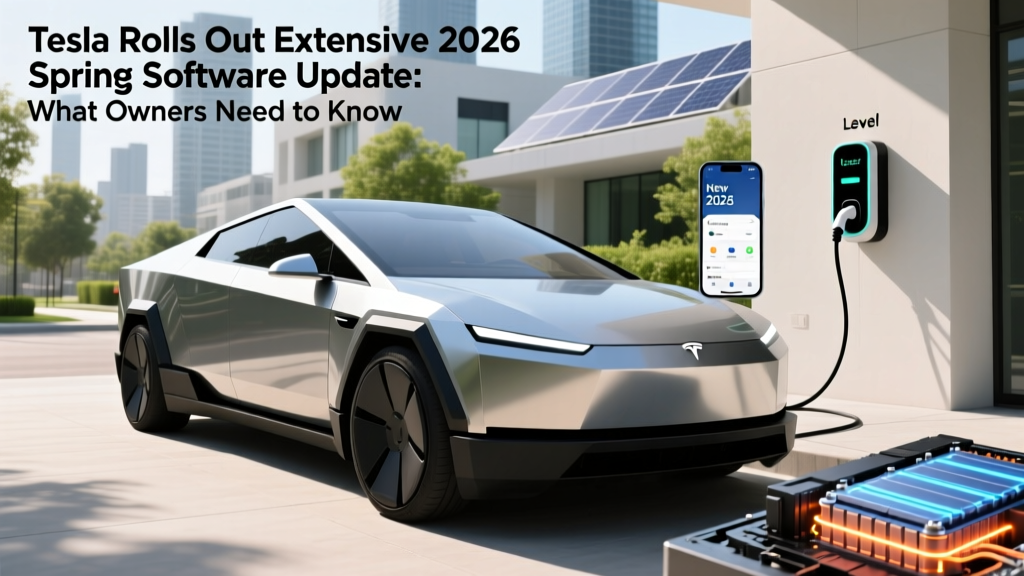
When Tesla rolls out extensive 2026 spring software update packages across its fleet, it's not just pushing bug fixes — it's reshaping how existing hardware performs. The latest over-the-air (OTA) deployment targets the current Model 3 and Model Y lineup with recalibrated energy management, refined Autopilot behavior, and a restructured infotainment UI. For prospective buyers and current owners alike, the real question is whether these software gains materially change the ownership equation in 2026.
This profile examines the 2026 Tesla Model 3 Long Range AWD as the primary beneficiary of the spring update, covering real-world range, charging behavior, pricing, and how the software changes interact with the hardware you're actually buying.
Range, Efficiency, and the Real-World Reality
Real-World Expectation: ~290–320 miles on highway trips at 70–80 mph; ~240–270 miles in sub-30°F winter conditions with cabin heating active.
The 2026 Model 3 Long Range AWD carries an EPA-estimated 363 miles of range, powered by a 75 kWh usable battery (NMC chemistry). The spring software update introduces a revised thermal management algorithm that Tesla claims improves cold-weather range retention by 3–5% compared to the 2025 firmware baseline. In practice, this means preconditioning the battery now activates earlier and more aggressively when navigation is set to a Supercharger, reducing arrival SoC variability in winter.
Efficiency lands at 132 MPGe combined (25 kWh/100 miles), which remains class-leading among midsize electric sedans. The software update's regenerative braking recalibration smooths the transition between regen and friction braking, particularly at low speeds — a frequent complaint in 2024–2025 builds.
Charging Speed: DC Fast, Level 2, and the Curve
| Charging Method | Power / Rate | Time or Miles Added |
|---|---|---|
| DC Fast Charge (Peak) | 250 kW (CCS/NACS) | 10–80% in ~25 minutes |
| DC Fast Charge (Sustained avg.) | ~170 kW to 80% | Charge curve tapers sharply above 80% |
| Level 2 (Home, 48A / 11.5 kW) | 11.5 kW | ~44 miles per hour of charging |
| Level 2 (Mobile Connector, 32A) | 7.7 kW | ~30 miles per hour of charging |
| Level 1 (120V, 12A) | 1.4 kW | ~3–4 miles per hour (emergency use) |
Tesla's NACS connector remains the standard, and with the 2026 Supercharger network now exceeding 6,500 U.S. stations, access is a genuine advantage. The spring update adds a charge-curve preview to the navigation screen, showing estimated SoC at arrival alongside a graphical taper prediction — useful for trip planning on routes with sparse charging.
One ownership insight: the 250 kW peak figure applies only when the battery is properly preconditioned (warm, ~50% SoC or below). Arriving at a Supercharger with a cold battery or above 60% SoC will reduce peak rates significantly. The updated software now displays a preconditioning progress bar when navigating to a charger, a welcome transparency improvement.
Performance and Drivetrain
| Spec | 2026 Model 3 Long Range AWD |
|---|---|
| 0–60 mph | 4.2 seconds |
| Horsepower | 384 hp (dual motor) |
| Drivetrain | Dual-motor AWD |
| Top Speed | 125 mph (electronically limited) |
| Battery (Usable) | 75 kWh, NMC |
| EPA Range | 363 miles |
| Efficiency | 132 MPGe / 25 kWh/100mi |
| Cargo Volume | 23 cu ft (trunk) + 3.1 cu ft (frunk) |
| Rear Legroom | 34.9 inches |
| Base MSRP | $47,240 (incl. destination) |
| Battery Warranty | 8 years / 120,000 miles |
The dual-motor AWD powertrain is unchanged mechanically for 2026, but the spring software update retunes torque distribution between the front induction and rear permanent-magnet motors. The result is marginally better efficiency under light-load cruising and slightly more aggressive torque fill during passing maneuvers. The 4.2-second 0–60 time remains quick enough for any real-world scenario without crossing into performance-sedan territory.
Pricing, Trims, and Federal Tax Credit Eligibility
| Trim | MSRP (incl. dest.) | Est. After §30D Credit |
|---|---|---|
| Model 3 RWD | $38,990 | ~$31,490 (if eligible) |
| Model 3 Long Range AWD | $47,240 | ~$39,740 (if eligible) |
| Model 3 Performance | $52,990 | ~$45,490 (if eligible) |
The IRS §30D federal tax credit remains available for qualifying Tesla Model 3 trims, but eligibility is not automatic. Key 2026 requirements include:
- MSRP cap: Sedans must be under $55,000 — all Model 3 trims qualify.
- Buyer income cap: Modified AGI ≤ $150,000 (single) / $300,000 (joint).
- Battery sourcing: Critical minerals and battery components must meet phased-in percentages; Tesla's U.S.-built cells generally satisfy current thresholds.
- Point-of-sale transfer: Buyers can transfer the credit to the dealer at purchase, reducing the upfront price directly.
Consult a tax professional before relying on credit eligibility — IRS rules are subject to change, and the battery-sourcing requirements tighten annually.
What the Spring 2026 Software Update Actually Changes
The 2026 spring software update (firmware version 2026.8.x) is extensive by Tesla standards, touching several core systems:
- Autopilot recalibration: Smoother lane-centering on two-lane roads, reduced phantom braking incidents (Tesla cites internal fleet data showing a 12% reduction in unnecessary deceleration events). Note: Autopilot and FSD Supervised remain SAE Level 2 systems requiring continuous driver engagement.
- Energy app overhaul: Real-time consumption graph now includes a 50-mile rolling average overlay and trip-specific efficiency tracking.
- Cabin overheat protection: Now uses predictive solar load modeling based on parked orientation and forecasted ambient temperature.
- Sentry Mode efficiency: Reduced standby power draw by ~18% through optimized camera polling intervals.
- UI restructuring: Navigation and media now share a split-screen layout without requiring the secondary panel toggle.
Pros, Cons, and Who Should Buy
Pros
- Class-leading efficiency (25 kWh/100mi)
- Supercharger network access (NACS standard)
- OTA updates add real feature value over time
- Strong resale value relative to EV segment
- Qualifies for §30D credit on all trims (if buyer eligible)
Cons
- Rear legroom tight (34.9") vs. Hyundai Ioniq 6 (37.4")
- No Apple CarPlay / Android Auto
- Panel gaps and paint quality inconsistent
- FSD Supervised subscription ($99/mo) adds cost without Level 4 capability
- Insurance premiums 15–25% higher than comparable ICE sedans
Best for: Tech-forward commuters and road-trippers who prioritize charging-network reliability and OTA feature evolution. The Model 3 Long Range AWD is a strong daily driver for two-adult households who don't need large rear-seat space.
Consider competitors if: You need more rear legroom (Ioniq 6), prefer physical controls (BMW i4), or want a sedan with Apple CarPlay integration (Polestar 2 with Android Automotive).
Frequently Asked Questions
What is the real-world range of the 2026 Model 3 Long Range?
Expect ~290–320 miles on highway trips in moderate weather, and ~240–270 miles in cold conditions below 30°F. The EPA 363-mile figure assumes a mixed driving cycle; sustained highway speeds and climate use reduce it meaningfully.
How fast does it charge at home and on the road?
On a 48-amp Level 2 home charger, you'll add ~44 miles per hour (full charge in ~7 hours). At a 250 kW Supercharger, 10–80% takes about 25 minutes with a preconditioned battery.
Does the 2026 Model 3 qualify for the $7,500 federal tax credit?
All Model 3 trims fall under the $55,000 sedan MSRP cap and Tesla's U.S. battery sourcing generally meets 2026 thresholds. However, buyer income limits ($150K single / $300K joint) and annual sourcing rule changes apply. Verify with a tax professional and check the latest IRS guidance.
Is it worth buying vs. the Hyundai Ioniq 6 or BMW i4?
If Supercharger access and OTA evolution matter most, Tesla wins. If rear-seat space, build quality consistency, or CarPlay are priorities, the Ioniq 6 and i4 are strong alternatives. The Ioniq 6 SE offers 361 miles EPA at a lower starting price; the i4 offers a more traditional luxury interior.
What's the biggest change in the spring 2026 software update?
The Autopilot phantom-braking reduction and the energy app overhaul are the most impactful daily-use changes. The charge-curve preview in navigation also meaningfully improves road-trip planning confidence.