When Tesla overhauled the Model 3 for 2024 under the "Highland" codename, buyers wondered when the higher-volume Model Y would follow. The answer arrived in early 2025 with the "Juniper" refresh. Now that both sedans and SUVs have cycled through their most significant mid-cycle updates in years, it's time to audit exactly what changed — and whether the 2025 lineup justifies its pricing against a field of increasingly credible rivals.
This profile covers every meaningful Tesla 2025 change across the Model 3 and Model Y sold in the U.S., including updated EPA range figures, battery chemistry, charging curves, pricing after the federal §30D credit, and the tech that still sets Tesla apart (and where it's falling behind).
2025 Tesla Model 3: The Highland Year Two
The Model 3 Highland debuted for the 2024 model year, so the 2025 version carries over with only minor pricing and packaging adjustments. The structural, acoustic, and suspension improvements remain the story: a stiffer body, laminated glass all around, a rear touchscreen for passengers, ventilated front seats, ambient lighting, and a significantly quieter cabin than the pre-2024 car. Tesla also removed the ultrasonic parking sensors in favor of Tesla Vision camera-based estimation — a controversial move that still draws complaints in tight garages.
For 2025, the Long Range RWD trim was quietly reintroduced in some markets and remains the efficiency king of the lineup. The Performance variant gets the same track-oriented suspension tuning and 20" wheels introduced with the 2024 refresh.
| Spec | RWD | Long Range AWD | Performance AWD |
|---|---|---|---|
| EPA Range | 272 mi | 363 mi | 315 mi |
| Battery (usable) | ~57 kWh (LFP) | ~75 kWh (NMC) | ~75 kWh (NMC) |
| Drivetrain | RWD, single motor | AWD, dual motor | AWD, dual motor |
| Horsepower | 271 hp | 346 hp | 510 hp |
| 0–60 mph | 5.8 sec | 4.2 sec | 2.9 sec |
| MPGe (combined) | 142 MPGe | 132 MPGe | 121 MPGe |
| Efficiency | 24 kWh/100 mi | 26 kWh/100 mi | 28 kWh/100 mi |
| Max DC Fast Charge | 170 kW | 250 kW | 250 kW |
| 10–80% DC Time | ~25 min | ~25 min | ~25 min |
| Level 2 (11.5 kW AC) | ~44 mi/hr | ~44 mi/hr | ~44 mi/hr |
| Cargo Volume | 23 cu ft (trunk + frunk combined) | ||
| Rear Legroom | 35.2 in | ||
| Base MSRP | $38,990 | $44,990 | $52,990 |
| Battery Warranty | 8 yr / 100,000 mi | 8 yr / 120,000 mi | |
Source: fueleconomy.gov and Tesla's U.S. spec pages.
2025 Tesla Model Y: The Juniper Refresh Arrives
The Model Y Juniper is the headline Tesla 2025 change. After years of incremental tweaks, the 2025 Model Y received the full treatment: a redesigned front and rear fascia with a full-width light bar, ventilated front seats, rear passenger touchscreen, acoustic glass, retuned suspension, and a new interior trim palette. Tesla also introduced a launch "Launch Series" trim (fully loaded, AWD) before settling into the familiar Long Range and Performance structure.
Notably, Tesla dropped the base RWD Model Y from the U.S. lineup at launch — a move that raised the effective entry price but pushed every buyer toward the dual-motor Long Range.
| Spec | Long Range AWD | Performance AWD |
|---|---|---|
| EPA Range | 320 mi | 285 mi |
| Battery (usable) | ~75 kWh (NMC) | ~75 kWh (NMC) |
| Drivetrain | AWD, dual motor | AWD, dual motor |
| Horsepower | 384 hp | 510 hp |
| 0–60 mph | 4.1 sec | 3.5 sec |
| MPGe (combined) | 122 MPGe | 111 MPGe |
| Efficiency | 28 kWh/100 mi | 30 kWh/100 mi |
| Max DC Fast Charge | 250 kW | 250 kW |
| 10–80% DC Time | ~27 min | ~27 min |
| Level 2 (11.5 kW AC) | ~37 mi/hr | ~37 mi/hr |
| Cargo Volume (rear seats up) | 30.2 cu ft | |
| Cargo Volume (rear seats folded) | 72.1 cu ft | |
| Rear Legroom | 41.6 in | |
| Base MSRP | $46,630 | $52,490 |
| Battery Warranty | 8 yr / 120,000 mi | |
Source: fueleconomy.gov and Tesla's U.S. spec pages.
Charging Speed and Network Access
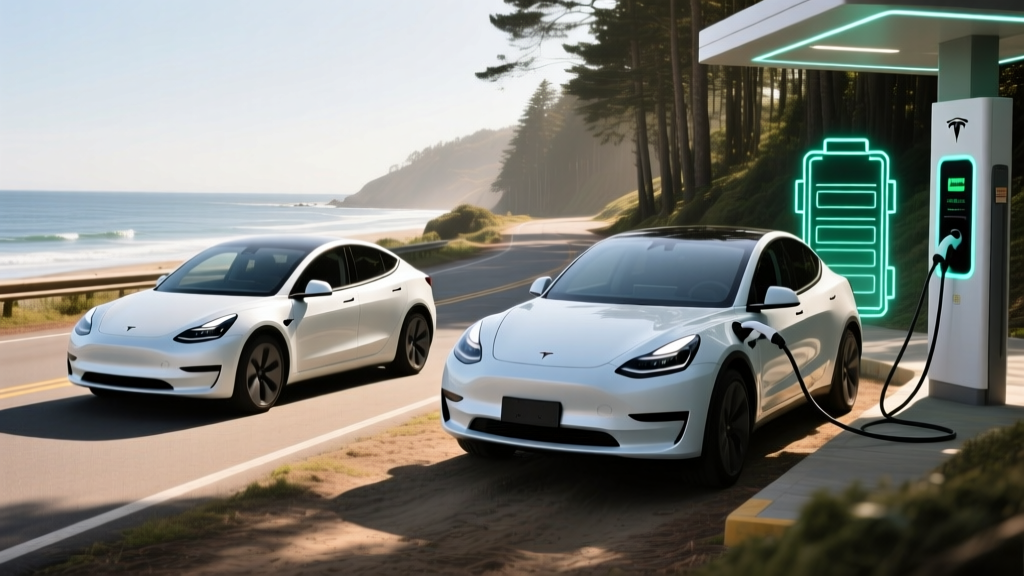
Charging remains Tesla's strongest ownership advantage, though the gap has narrowed as Electrify America, EVgo, and Ionity deploy 350 kW hardware. Both the 2025 Model 3 Long Range and Model Y Long Range peak at 250 kW on V3 Superchargers. The 10–80% charge takes roughly 25–27 minutes, but sustained rate matters more than peak: Tesla's charge curve holds above 150 kW through about 55% SoC before tapering to ~60 kW near 80%. That taper is the reason the last 20% can take nearly as long as the first 60%.
On a Level 2 home charger at 48 amps (11.5 kW), the Model 3 adds roughly 44 miles of range per hour; the Model Y, being less efficient, adds about 37 miles per hour. A full overnight charge from 20% to 80% takes roughly 5–6 hours on a properly installed 60-amp circuit.
With the NACS connector now the industry standard (adopted by Ford, GM, Rivian, Hyundai, and others starting 2025), Tesla's Supercharger network is opening to non-Tesla EVs — but Tesla owners still get priority pricing, native navigation integration, and the most reliable plug-and-charge experience on the road.
Pricing and Federal Tax Credit Eligibility
Tesla's pricing has been volatile over the past three years, but the 2025 lineup has stabilized. Here's how the numbers land before and after the federal §30D tax credit:
| Model / Trim | Base MSRP | Federal Credit (§30D) | Effective Price |
|---|---|---|---|
| Model 3 RWD | $38,990 | Up to $7,500 (if eligible) | ~$31,490 |
| Model 3 Long Range AWD | $44,990 | Up to $7,500 (if eligible) | ~$37,490 |
| Model 3 Performance | $52,990 | Up to $7,500 (if eligible) | ~$45,490 |
| Model Y Long Range AWD | $46,630 | Up to $7,500 (if eligible) | ~$39,130 |
| Model Y Performance | $52,490 | Up to $7,500 (if eligible) | ~$44,990 |
Eligibility is not automatic. The §30D credit phases based on three requirements per the IRS clean vehicle rules:
- Buyer income caps: Modified AGI ≤ $150,000 (single), $225,000 (head of household), $300,000 (joint).
- MSRP caps: Sedans (Model 3) must be ≤ $55,000; SUVs/trucks (Model Y) ≤ $80,000. All current trims clear these.
- Battery sourcing: Critical minerals and battery components must meet escalating North American / FTA-partner thresholds. The Model 3 RWD's LFP battery (sourced from CATL in China) has periodically failed the critical-minerals test, reducing its credit to $3,750 or $0 in some delivery windows. The Long Range and Performance NMC packs have generally qualified for the full $7,500, but Tesla's own website now lists credit amounts per build — always confirm before ordering.
- Point-of-sale transfer: Since 2024, buyers can transfer the credit to the dealer at purchase, reducing the out-of-pocket price immediately rather than waiting for tax filing.
Tax situations vary. Consult a tax professional before relying on the credit — and screenshot the Tesla checkout page showing credit eligibility at the time of your order.
Tech, Driver Assistance, and SAE Automation Level
The 2025 Teslas ship with Tesla's current infotainment stack: a 15.4" center touchscreen (Model 3) or 15.4" center screen plus 8" rear screen, no physical instrument cluster, and over-the-air updates that still add meaningful features quarterly. The removal of radar and ultrasonic sensors in favor of Tesla Vision remains a polarizing choice — automatic parking and Summon work, but inconsistently compared to ultrasonic-equipped competitors.
On the highway, Autopilot remains one of the smoothest lane-centering and adaptive cruise systems available. FSD Supervised is genuinely impressive on rural two-lane roads and suburban arterials but still requires intervention in construction zones, unprotected left turns, and heavy rain. Buyers should treat FSD as a convenience upgrade, not an autonomy purchase.
How the 2025 Teslas Compare to Key Rivals
The 2025 Tesla 2025 changes did not happen in a vacuum. The Hyundai Ioniq 6 (EPA 361 mi, starting ~$37,500) undercuts the Model 3 Long Range on price while matching its range. The Ford Mustang Mach-E and Chevrolet Blazer EV challenge the Model Y on interior space and starting price, though neither matches Tesla's Supercharger network access or efficiency. The BMW i4 and Hyundai Ioniq 5 N compete on driving dynamics against the Model 3 Performance.
Tesla's advantages in 2025 remain: best-in-class DC efficiency (kWh/100 mi), the lowest cost-per-mile on electricity, OTA updates that add features post-purchase, and the Supercharger network. Its disadvantages: a minimalist interior that not every buyer loves, panel-gap quality that still trails legacy OEMs, and a service-center network that can take weeks for bodywork in major metros.
Pros, Cons, and Who Should Buy
Pros
- Class-leading efficiency (kWh/100 mi) on both Model 3 and Model Y
- Supercharger network — still the most reliable DC fast-charging ecosystem
- Highland/Juniper cabin is dramatically quieter and better-damped than pre-2024 cars
- LFP RWD option allows daily 100% charging without degradation concerns
- OTA updates continue to add features post-delivery
- Strong resale value relative to non-Tesla EVs
Cons
- Removal of ultrasonic sensors makes low-speed parking assist less reliable
- No physical instrument cluster or stalks (turn signals are steering-wheel buttons)
- Model 3 rear seat is tight for adults over 6' on long trips
- Service wait times in major metros can stretch weeks for collision repair
- Model Y Juniper dropped the lower-priced RWD trim, raising effective entry cost
- FSD ($8,000) remains a Level 2 system — expensive relative to what it delivers
- Choose the Model 3 RWD if you have home charging, a commute under 60 miles round-trip, and want the lowest entry price with LFP battery longevity.
- Choose the Model 3 Long Range if you road-trip regularly and need 300+ real-world miles between stops.
- Choose the Model Y Long Range if you need SUV cargo space, child-seat room, and family practicality — it remains the default EV for suburban households.
- Look at the Ioniq 6, Ioniq 5, or Mach-E instead if you prefer a traditional instrument cluster, physical controls, or a dealer service network in rural areas.
Frequently Asked Questions
What is the real-world range of the 2025 Tesla Model 3 and Model Y?
The Model 3 Long Range AWD delivers roughly 310–330 miles in mixed driving at moderate temperatures, dropping to 270–290 on sustained highway trips and 240–270 in deep winter. The Model Y Long Range AWD nets about 270–290 mixed, 250–270 highway, and 220–240 in freezing conditions. The RWD Model 3's smaller LFP pack yields roughly 230–250 real-world miles.
How fast do the 2025 Teslas charge at home and on the road?
On a V3 Supercharger (250 kW peak), both Long Range models charge 10–80% in about 25–27 minutes, with the curve tapering significantly above 55% SoC. At home on a 48-amp (11.5 kW) Level 2 charger, the Model 3 adds ~44 miles per hour and the Model Y adds ~37 miles per hour — enough to fully replenish overnight.
Do 2025 Teslas qualify for the $7,500 federal tax credit?
It depends on your income, the trim, and the battery's critical-mineral sourcing at time of delivery. Model 3 Long Range and Performance, and all Model Y trims, have generally qualified for the full $7,500. The Model 3 RWD's LFP battery has been in and out of eligibility due to China-sourced minerals — always verify on Tesla's configurator and with the IRS §30D guidance before ordering.
Is the 2025 Model Y Juniper worth buying over the prior version?
If you value cabin quietness, rear-seat comfort, and modernized styling, yes — the acoustic glass, retuned suspension, and ventilated seats are meaningful daily upgrades. If you're purely price-driven and can find a discounted 2024, the powertrain and range are nearly identical.
What are the biggest drawbacks of the 2025 Teslas?
The turn-signal buttons on the steering wheel (no stalks), absence of an instrument cluster, reliance on Tesla Vision for parking assist, and FSD's $8,000 price for a Level 2 system are the most common owner complaints. Service wait times for body damage also remain a pain point in dense metro areas.
How does the Tesla Supercharger network compare to competitors in 2025?
With NACS now adopted by Ford, GM, Rivian, Hyundai, and others, Superchargers are no longer Tesla-exclusive — but Tesla owners retain native navigation integration, automatic billing, and priority pricing. Reliability uptime still leads the industry, though Electrify America and EVgo have closed the gap on hardware speed (350 kW stalls).
Specifications reflect U.S.-market 2025 model year data as published by Tesla and the EPA. Pricing excludes destination fees and is subject to change. Always confirm tax credit eligibility with a qualified tax professional and current IRS guidance.