The refreshed Tesla Model 3 (internally dubbed "Highland") brought meaningful upgrades to the sedan's cabin — softer materials, acoustic glass, ventilated front seats, and a rear touchscreen for passengers. But the question that keeps surfacing in forums and showroom visits remains stubbornly specific: how does the Tesla Model 3 interior back seat actually perform for real passengers on real trips?
As a compact luxury electric sedan, the Model 3 competes against the Hyundai Ioniq 6, BMW i4, and Polestar 2. Each of those rivals takes a different approach to rear-seat packaging. This review examines the Model 3's rear-seat dimensions, comfort, and technology in the context of its full ownership proposition — range, charging, pricing, and federal tax-credit eligibility — so you can decide whether it fits your household.
Tesla Model 3 Rear Seat Dimensions and Passenger Space
Let's start with the numbers that matter most for back-seat buyers. The current-generation Model 3 provides the following EPA-listed interior dimensions:
| Measurement | Front | Rear |
|---|---|---|
| Headroom | 40.3 in | 37.8 in |
| Legroom | 42.7 in | 35.2 in |
| Shoulder Room | 56.3 in | 54.0 in |
| Hip Room | 53.4 in | 52.4 in |
At 35.2 inches of rear legroom, the Model 3 falls slightly short of the Hyundai Ioniq 6 (38.4 in) and BMW i4 (38.6 in), but roughly matches the Polestar 2 (35.6 in). For context, a six-foot adult sitting behind a six-foot driver will find about one to two inches of knee clearance — adequate, but not generous.
Seat Comfort and Cushion Design
The Highland refresh addressed one of the pre-2024 Model 3's most common complaints: flat, firm rear cushions. Tesla reshaped the rear seat with slightly more bolstering and a marginally longer seat-bottom cushion. The seatback angle remains fairly upright — roughly 25 degrees from vertical — which works well for shorter commutes but can feel fatiguing on multi-hour road trips. There is no recline adjustment, unlike the BMW i4's available rear-seat comfort package.
The center rear position is best reserved for children or short trips. The floor tunnel hump (housing battery structural elements) intrudes on foot placement, and the center cushion is noticeably firmer and higher than the outboard positions.
Rear-Seat Technology and Amenities
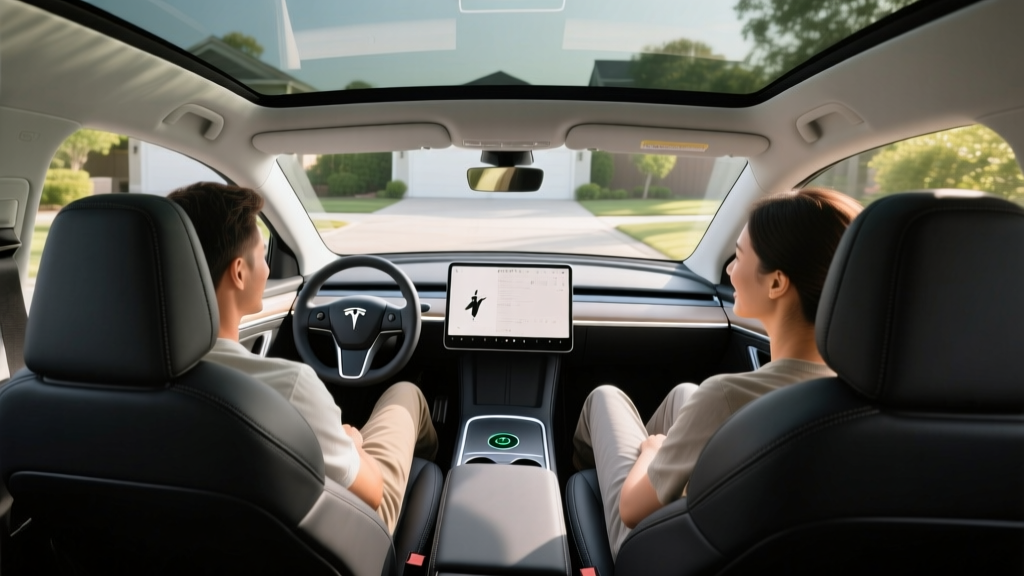
One of the Highland model's standout additions is an 8.0-inch rear touchscreen mounted on the back of the center console. Rear passengers can control climate settings, adjust heated seat temperatures (standard on all positions in the current Model 3), play media, and even view navigation. This is a genuine differentiator — neither the Ioniq 6 nor the Polestar 2 offers a dedicated rear entertainment and control screen at this price point.
Additional rear-seat amenities include:
- Two USB-C ports (up to 65W each, sufficient for fast-charging a laptop)
- Heated outboard rear seats (standard)
- Center armrest with cupholders (Long Range and Performance trims)
- Ambient lighting strips along door panels
- Acoustic laminated glass on all windows (significant road-noise reduction over pre-2024 models)
Range, Battery, and Efficiency
The Model 3 is available in three trims, each with a different battery and drivetrain configuration. Here is the complete powertrain breakdown:
| Spec | RWD (Base) | Long Range AWD | Performance AWD |
|---|---|---|---|
| EPA Range | 272 mi | 363 mi | 315 mi |
| Battery Capacity (usable) | ~60 kWh | ~75 kWh | ~75 kWh |
| Battery Chemistry | LFP (Lithium Iron Phosphate) | NMC (Nickel Manganese Cobalt) | NMC |
| Drivetrain | Rear-Wheel Drive | Dual-Motor AWD | Dual-Motor AWD |
| Horsepower | 271 hp | 346 hp | 510 hp |
| 0-60 mph | 5.8 sec | 4.2 sec | 2.9 sec |
| EPA Efficiency | 132 MPGe (25 kWh/100mi) | 130 MPGe (26 kWh/100mi) | 116 MPGe (29 kWh/100mi) |
Real-World Range Expectations
EPA Sticker: 272 mi (RWD) / 363 mi (Long Range) / 315 mi (Performance)
Real-World Highway (70-75 mph, moderate weather): Expect approximately 240-250 mi (RWD), 310-330 mi (Long Range), and 270-285 mi (Performance). The Model 3's efficiency drops roughly 10-15% at sustained highway speeds compared to mixed city driving, consistent with most EVs.
Cold-Weather Impact (below 32°F): LFP-equipped RWD models may see a 20-30% range reduction in freezing temperatures due to both cabin heating demand and LFP chemistry's lower cold-weather performance. NMC Long Range models typically lose 15-25%. Preconditioning via the Tesla app while plugged in significantly mitigates this loss. Source: fueleconomy.gov EV technology guide.
LFP vs. NMC: What It Means for Owners
The base RWD Model 3 uses a CATL-supplied lithium iron phosphate (LFP) battery, while the Long Range and Performance trims use nickel manganese cobalt (NMC) packs. The practical differences:
| Factor | LFP (Base RWD) | NMC (Long Range / Performance) |
|---|---|---|
| Energy Density | Lower — smaller capacity for same weight | Higher — enables 363-mi range |
| Cycle Life | Excellent — 3,000+ cycles to 80% SoH | Good — 1,500-2,000 cycles to 80% SoH |
| Recommended SoC | 100% daily charging is fine | 80% daily recommended; 100% for trips |
| Cold-Weather Performance | Weaker — more range loss below freezing | Better — less cold-weather degradation |
| Cost | Lower — contributes to lower MSRP | Higher — reflected in Long Range pricing |
If you charge at home nightly and rarely road-trip, the LFP pack's longevity and 100% charging tolerance make the RWD model a pragmatic choice. If you need maximum range or live in cold climates, the NMC Long Range is the stronger fit.
Charging Speed and Infrastructure
Charging speed remains one of the Model 3's strongest competitive advantages, thanks in part to Tesla's Supercharger network — now increasingly open to other brands but still offering the most reliable plug-and-charge experience in the U.S.
| Charging Level | Power | Rate / Time | Notes |
|---|---|---|---|
| Level 1 (120V household) | ~1.4 kW | ~3-4 mi/hr | Emergency/trickle only |
| Level 2 (240V home) | 11.5 kW (48A) | ~44 mi/hr (Long Range); ~35 mi/hr (RWD) | Full charge overnight in 7-9 hours |
| DC Fast Charge (V3 Supercharger) | Peak 170 kW (RWD) / 250 kW (LR/Perf) | 10-80% in ~25 min (RWD) / ~18 min (LR) | Charge curve tapers significantly above 80% |
| DC Fast Charge (V4 Supercharger) | Up to 250 kW | Similar to V3 for current Model 3 | V4 hardware supports higher rates for future vehicles |
Charging-curve reality check: The 250 kW peak on Long Range and Performance models is sustained only between roughly 10-30% state of charge. By 60%, the rate drops to approximately 120 kW, and above 80% it falls below 50 kW. This is why Tesla's quoted 10-80% time is the relevant metric — charging to 100% on DC fast charge adds another 20-25 minutes and is generally not recommended for battery longevity.
The RWD model's LFP battery tops out at a lower peak charge rate (~170 kW), but because the total battery is smaller (60 kWh vs. 75 kWh), the absolute charging time difference is modest. A typical 10-80% session still completes in about 25 minutes.
The Model 3 uses the NACS (North American Charging Standard) connector natively — no adapter needed at Tesla Superchargers. For CCS-equipped public chargers (Electrify America, EVgo, etc.), Tesla sells a CCS adapter (~$250), and newer Model 3 vehicles may ship with one included depending on delivery date.
Pricing, Tax Credits, and Total Cost
| Trim | Base MSRP | §30D Credit Eligibility | Effective Price (if eligible) |
|---|---|---|---|
| RWD (Base) | $38,990 | Up to $7,500 (subject to income, sourcing rules) | ~$31,490 |
| Long Range AWD | $47,740 | Up to $7,500 (subject to income, sourcing rules) | ~$40,240 |
| Performance AWD | $54,990 | Up to $7,500 (subject to income, sourcing rules) | ~$47,490 |
Federal tax credit caveats (IRS §30D): The $7,500 credit is not universal. Eligibility requires:
- Income caps: Modified AGI ≤ $150,000 (single), $225,000 (head of household), $300,000 (married filing jointly)
- MSRP cap: Sedans must be ≤ $55,000 — the RWD and Long Range qualify; the Performance model exceeds the cap and does NOT qualify
- Battery sourcing: Critical minerals and battery components must meet phased-in domestic/free-trade-agreement sourcing thresholds. Tesla's U.S. production and supply chain have generally met these requirements, but eligibility can shift annually. Always verify current-year rules at IRS.gov §30D page.
- Point-of-sale transfer: As of 2024, buyers can transfer the credit to the dealer at purchase, reducing the upfront price rather than waiting for a tax refund. This applies to Tesla's direct sales model.
The Model 3 RWD at approximately $31,500 after the federal credit (for eligible buyers) is one of the most affordable premium electric sedans on the market. Factor in fuel savings (electricity at ~$0.13/kWh vs. gasoline at ~$3.50/gallon) and reduced maintenance, and the five-year total cost of ownership undercuts comparable BMW 3 Series and Mercedes C-Class models by a significant margin.
Cargo Space and Practicality
The Model 3 offers 23 cubic feet of total cargo volume (15.6 cu ft trunk + 3.1 cu ft rear under-floor storage + 4.1 cu ft frunk). This is competitive for the segment — the Ioniq 6 offers 12.3 cu ft (trunk only), while the Polestar 2 provides 14.4 cu ft trunk + 4.1 cu ft frunk.
The Model 3's trunk opening is a traditional sedan notchback, which limits the size of bulky items you can load compared to a hatchback or liftback like the Model Y or Ioniq 5. The rear seats fold in a 60/40 split, creating a nearly flat load floor for longer items.
For families with rear-facing child seats, the 35.2 inches of rear legroom means a front passenger will need to move their seat forward slightly — manageable for most adults under 6'2" but potentially uncomfortable for taller drivers on long trips.
Warranty and Long-Term Ownership
| Component | Coverage |
|---|---|
| Basic Vehicle | 4 years / 50,000 miles |
| Battery & Drive Unit (RWD) | 8 years / 100,000 miles (70% minimum retention) |
| Battery & Drive Unit (Long Range / Performance) | 8 years / 120,000 miles (70% minimum retention) |
Tesla's battery warranty guarantees that the pack will retain at least 70% of its original capacity during the warranty period. Real-world data from high-mileage Model 3 owners suggests typical degradation of 8-12% over the first 100,000 miles, with the curve flattening significantly thereafter. LFP packs in the RWD model have shown particularly strong longevity in fleet data, with many units retaining over 90% capacity at 80,000 miles.
For safety ratings, the Model 3 has earned a 5-star overall rating from NHTSA and a Top Safety Pick+ designation from IIHS when equipped with acceptable headlights.
Driver Assistance and Technology
Every Model 3 includes Tesla Autopilot as standard — a Level 2 driver-assistance system providing adaptive cruise control, lane-centering, and automatic emergency braking. The optional Full Self-Driving (Supervised) package adds automatic lane changes, traffic light and stop sign recognition, and navigate-on-autopilot for $8,000 (or $99/month subscription).
SAE Automation Level: Level 2
Both Autopilot and FSD (Supervised) are SAE Level 2 systems. This means the driver must remain fully engaged, hands on or near the wheel, eyes on the road, and ready to take over at any moment. These are NOT self-driving systems. Tesla's steering-wheel torque monitoring and cabin camera attention alerts enforce this requirement. True driverless operation (Level 4) is currently available only in limited commercial robotaxi services like Waymo.
What FSD (Supervised) Does NOT Do
- Drive without an attentive human driver present
- Reliably handle construction zones, unmapped roads, or severe weather
- Eliminate the driver's legal responsibility for the vehicle
- Guarantee availability in all geographic areas
The Model 3's 15.4-inch center touchscreen handles all infotainment, climate, and vehicle controls. There is no instrument cluster — speed and navigation information appear in the upper-left corner of the center display. This minimalist approach divides opinion: some owners find it clean and distraction-free, while others miss a dedicated speedometer directly in their sightline.
Notable tech features include over-the-air software updates (which regularly add new functionality), a built-in dashcam and Sentry Mode security system, and the Tesla mobile app for remote preconditioning, location tracking, and charging management.
Pros, Cons, and Verdict
Pros
- Class-leading efficiency — 132 MPGe on RWD translates to low per-mile electricity cost
- Supercharger network access — the most reliable DC fast-charging ecosystem in the U.S.
- Rear touchscreen is a genuine differentiator at this price point
- LFP battery on RWD offers exceptional cycle life and 100% daily charging tolerance
- Strong safety ratings (NHTSA 5-star, IIHS TSP+)
- Over-the-air updates continuously improve the vehicle post-purchase
- Excellent 0-60 performance across all trims
Cons
- Rear legroom (35.2 in) trails key competitors — tight for tall adults on long trips
- No physical instrument cluster — all info on center screen
- No rear-seat recline adjustment
- Turn-signal stalks removed — signals are now on the steering wheel face (controversial)
- Traditional trunk opening limits cargo flexibility vs. liftback rivals
- FSD (Supervised) costs $8,000 extra and remains Level 2
- RWD LFP battery has notable cold-weather range loss
Is the Tesla Model 3 Right for You?
Choose the Model 3 RWD if: You commute under 40 miles daily, charge at home, live in a moderate climate, and want the lowest entry price with the longest-lasting battery chemistry. The back seat works for children or occasional adult passengers.
Choose the Model 3 Long Range if: You take regular road trips, live in a cold-weather state, need AWD, or regularly carry adult rear-seat passengers who value the extra range buffer and faster DC charging.
Look at the Hyundai Ioniq 6 or BMW i4 instead if: Rear-seat legroom is a top priority (both offer 3+ more inches), you prefer a traditional instrument cluster, or you want a more conventionally styled interior with physical controls.
Frequently Asked Questions
Can two adults sit comfortably in the Tesla Model 3 back seat?
Yes, for commutes and trips up to about an hour. Adults up to roughly 5'10" will find adequate legroom and headroom. Taller passengers (6'0"+) may feel cramped on longer journeys due to the 35.2-inch legroom and fairly upright seatback angle. For comparison, the Hyundai Ioniq 6 offers 38.4 inches of rear legroom, which is noticeably more accommodating for tall adults.
Does the Tesla Model 3 qualify for the $7,500 federal tax credit?
The RWD ($38,990) and Long Range AWD ($47,740) trims fall under the $55,000 MSRP cap for sedans and are potentially eligible for the full $7,500 credit under IRS §30D, provided the buyer meets income requirements (≤$150K single / $300K married filing jointly) and the vehicle's battery components meet current-year sourcing thresholds. The Performance trim ($54,990) exceeds the sedan MSRP cap and does not qualify. Always verify current rules at IRS.gov before purchasing.
How fast does the Tesla Model 3 charge at home?
On a 240V Level 2 home charger at 48 amps (11.5 kW), the Long Range adds approximately 44 miles of range per hour — a full charge from empty takes about 8 hours. The RWD model charges at a slightly lower rate due to its smaller battery. Most owners install a Tesla Wall Connector ($475 for the unit) plus $500-$2,000 for electrician labor depending on panel capacity and run length.
Is the Model 3 back seat suitable for child car seats?
Yes. The Model 3 has standard LATCH anchors on the two outboard rear seats and a top tether on the center seat. Rear-facing infant seats fit well, though a tall front-seat passenger may need to slide forward slightly. The relatively low ride height makes loading children easier than in an SUV. IIHS rates the LATCH system as "Acceptable" for ease of use.
How does the Model 3 back seat compare to the Model Y?
The Model Y, being a compact SUV on a similar platform, offers significantly more rear headroom (39.4 in vs. 37.8 in) and a higher, more natural seating position. However, rear legroom is similar (35.2 in for the Model 3 vs. 41.6 in for the Model Y — a substantial difference). If rear-seat space is your primary concern and budget allows, the Model Y is the more family-friendly option, though it costs approximately $5,000-$8,000 more and sacrifices some efficiency.
What is the real-world highway range of the Model 3 Long Range?
In mixed highway driving at 70-75 mph in moderate temperatures (55-75°F), expect approximately 310-330 miles from the Long Range AWD, compared to the EPA sticker of 363 miles. In cold weather (below 32°F) with cabin heating, that figure can drop to 260-290 miles. Preconditioning the battery while plugged in and using seat heaters instead of cabin heat can recover 15-20 miles of that loss.