Quick Verdict: The Mach-E Premium Still Anchors Ford's EV Lineup
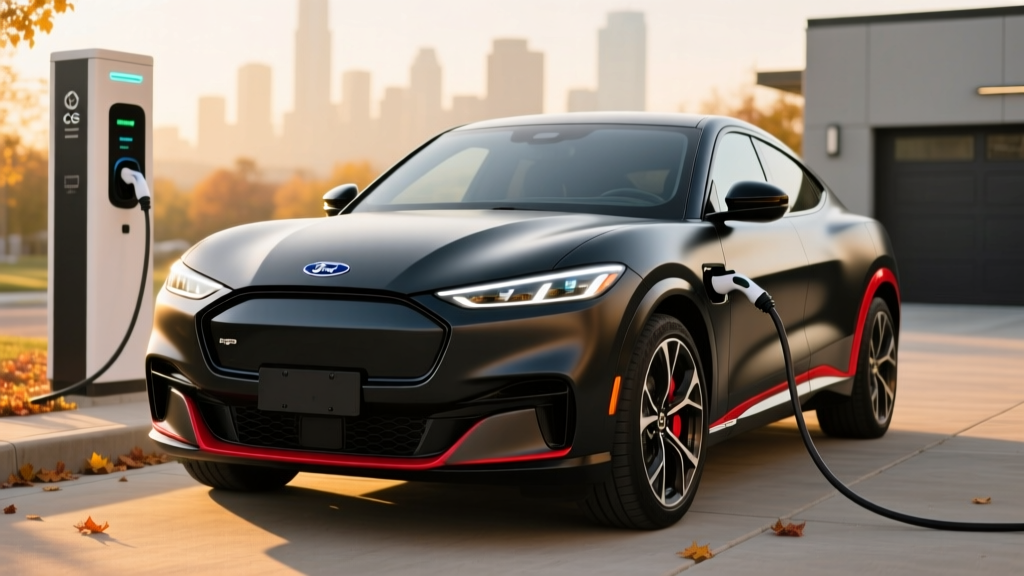
The 2026 Ford Mustang Mach-E Premium occupies a specific niche in the midsize electric crossover segment: it offers extended-range capability, a well-equipped interior, and access to the Tesla Supercharger network via its factory NACS port — all without the price premium of a GT or Rally variant. After spending time with the current-generation Mach-E Premium in both Select and Premium trims, the value proposition is clearest at the Premium level, where you gain the larger battery, heated seats, panoramic roof, and upgraded audio as standard.
This review breaks down the numbers that actually matter for purchase decisions — real-world range versus the EPA sticker, DC fast-charging behavior past 80% state of charge, and exactly what the federal tax credit looks like under current §30D rules.
Range, Battery, and Real-World Efficiency
The 2026 Mach-E Premium comes standard with Ford's Extended Range battery pack. This is an NMC (nickel manganese cobalt) lithium-ion pack with a usable capacity of approximately 91 kWh (gross capacity is roughly 98 kWh, with a buffer to protect long-term health). The rear-wheel-drive (RWD) Premium achieves an EPA-estimated 320 miles of range, while the eAWD (dual-motor all-wheel-drive) Premium drops to approximately 290 miles.
EPA 320 mi (RWD) / 290 mi (eAWD). In mixed highway driving at 70-75 mph, expect roughly 265–285 miles from the RWD model. In cold weather (below 32°F), plan for a 20–30% reduction — meaning 220–255 miles is realistic for winter highway trips. City driving with frequent regenerative braking can match or slightly exceed the EPA number.
Efficiency for the RWD Premium lands around 98 MPGe combined, or roughly 34 kWh per 100 miles, per fueleconomy.gov. The eAWD version runs closer to 90 MPGe combined. These figures place the Mach-E Premium in line with the Hyundai Ioniq 5 and slightly behind the Tesla Model Y Long Range in efficiency terms, though the difference translates to only a few dollars per charge in practical terms.
| Spec | Premium RWD | Premium eAWD |
|---|---|---|
| EPA Range | 320 miles | 290 miles |
| Battery (usable) | 91 kWh (NMC) | 91 kWh (NMC) |
| Horsepower | 290 hp | 365 hp |
| Torque | 317 lb-ft | 428 lb-ft |
| 0-60 mph | ~6.3 sec | ~5.0 sec |
| Max DC Charge Rate | 150 kW | 150 kW |
| EPA Efficiency | 98 MPGe / 34 kWh/100mi | 90 MPGe / 37 kWh/100mi |
| Base MSRP | ~$48,995 | ~$51,995 |
Charging Speed: DC Fast, Level 2, and the NACS Advantage
The 2026 Mach-E Premium ships with a native NACS (North American Charging Standard) port, meaning direct access to Tesla Supercharger V3 and V4 stalls without an adapter. This is a significant practical advantage that Ford began implementing for the 2025 model year, and it continues to pay dividends as the Supercharger network remains the most reliable DC fast-charging infrastructure in the U.S.
| Level | Power | Speed | Notes |
|---|---|---|---|
| Level 1 (120V) | ~1.4 kW | ~3–4 mi/hr | Emergency/trickle only |
| Level 2 (240V, 48A) | 11.5 kW | ~28 mi/hr | Full overnight charge in ~9 hrs |
| DC Fast (peak) | 150 kW | 10–80% in ~36 min | Tapers significantly above 80% |
The 150 kW peak DC charge rate is the Mach-E Premium's most common criticism versus rivals. The Hyundai Ioniq 5 and Kia EV6 can peak above 230 kW on 800V architectures, completing a 10-80% session in roughly 18 minutes. Ford's 400V architecture tops out lower, and the charge curve tapers noticeably after 65% state of charge. On a road trip, this means you'll spend roughly 15–20 minutes longer at a charging stop compared to the fastest-charging competitors.
For home Level 2 charging, the onboard 11.5 kW charger is competitive. A full charge from 10% to 100% takes about 8–9 hours on a 48-amp Level 2 station, which is standard overnight behavior. Ford's Mobile Power Cord is included and can handle both 120V and 240V outlets, though a dedicated wall connector (such as the Ford Charge Station Pro or a third-party unit like the ChargePoint Home Flex) is recommended for daily use.
Performance and Driving Dynamics
The RWD Premium's 290 horsepower and 317 lb-ft of torque deliver a 0-60 mph time around 6.3 seconds — quick enough for confident highway merging but not in the same bracket as the GT variant's sub-4-second sprints. The eAWD model bumps output to 365 hp and 428 lb-ft, cutting the 0-60 time to approximately 5.0 seconds.
Where the Mach-E Premium earns praise is ride quality and steering feel. The suspension tuning is firmer than the Ford Escape but compliant over rough pavement, and the steering offers more feedback than most electric crossovers in this price range. The low center of gravity from the floor-mounted battery pack keeps body roll controlled through corners. One-pedal driving mode is available and aggressive enough for most stop-and-go situations, though it doesn't quite bring the vehicle to a complete hold at 0 mph without brake intervention — a behavior that differs from Tesla's and GM's one-pedal implementations.
Interior, Cargo, and Technology
The Mach-E Premium cabin distinguishes itself from the Select trim with standard ActiveX synthetic leather upholstery, heated front seats, a heated steering wheel, a panoramic fixed-glass roof, and a 10-speaker B&O sound system. The centerpiece is a 15.5-inch vertical touchscreen running Ford's latest SYNC 4A software, which supports wireless Apple CarPlay and Android Auto, over-the-air updates, and natural-language voice commands.
Practical dimensions matter for crossover buyers:
- Cargo volume (behind rear seats): 29.7 cu ft
- Cargo volume (rear seats folded): 59.7 cu ft
- Front trunk (frunk): 4.7 cu ft (drainable, useful for wet items)
- Rear legroom: 38.9 inches
- Front headroom: 40.4 inches (with panoramic roof)
These cargo figures trail the Tesla Model Y (30.2 / 76.2 cu ft) and the Hyundai Ioniq 5 (27.2 / 59.3 cu ft is comparable). The frunk is smaller than the original 2021 Mach-E's due to packaging changes but remains a useful feature that the Model Y and Ioniq 5 lack entirely.
On the driver-assistance front, the Mach-E Premium includes Ford Co-Pilot360 Active 2.0, which bundles adaptive cruise control with stop-and-go, lane centering, and speed sign recognition. BlueCruise — Ford's hands-free highway driving system — is available on mapped divided highways (over 130,000 miles of qualified roads as of 2026). BlueCruise is a SAE Level 2 system, meaning the driver must remain attentive and a camera monitors eye gaze. It is not autonomous driving.
BlueCruise operates only on pre-mapped divided highways. It will prompt the driver to take over for construction zones, complex interchanges, and adverse weather. The driver monitoring camera will issue warnings and can bring the vehicle to a stop if engagement is not confirmed. This is not a substitute for an attentive driver.
Pricing, Tax Credits, and Ownership Costs
The 2026 Mach-E Premium RWD starts at an MSRP of approximately $48,995 (including destination). The eAWD Premium adds roughly $3,000, landing at $51,995. Common options — such as the BlueCruise subscription (included free for a trial period, then approximately $75/month or $800/year) and premium paint colors — can push an as-tested price to $53,000–$55,000.
| Trim | Base MSRP | Est. After §30D Credit* |
|---|---|---|
| Premium RWD | $48,995 | ~$41,495 (if $7,500 credit applies) |
| Premium eAWD | $51,995 | ~$44,495 (if $7,500 credit applies) |
*Federal tax credit eligibility under IRS §30D depends on multiple factors that change frequently:
- MSRP cap: SUVs/crossovers must have an MSRP at or below $80,000 — the Mach-E Premium clears this easily.
- Buyer income cap: Modified AGI must not exceed $150,000 (single), $225,000 (head of household), or $300,000 (joint filers).
- Battery sourcing: A percentage of critical minerals and battery components must be sourced from the U.S. or free-trade-agreement partners. Ford has worked to localize supply chains, but the exact credit amount ($3,750 partial or $7,500 full) depends on the specific build date and battery cell origin. Check the latest DOE/FuelEconomy eligible vehicle list at time of purchase.
- Point-of-sale transfer: As of 2024, buyers can transfer the credit to the dealer at purchase, reducing the upfront price rather than waiting for a tax refund. Confirm with your dealer at time of order.
Always verify current eligibility with a tax professional before relying on credit assumptions. Rules have shifted annually since the Inflation Reduction Act took effect.
How It Compares: Mach-E Premium vs. Key Rivals
The Mach-E Premium's competitive set includes the Tesla Model Y Long Range, Hyundai Ioniq 5 (Preferred/Limited AWD), and Kia EV6 (Wind/Light Long Range). Here's how the critical numbers stack up:
| Spec | Mach-E Premium RWD | Model Y LR | Ioniq 5 Limited AWD |
|---|---|---|---|
| EPA Range | 320 mi | ~320 mi | ~290 mi |
| Peak DC Charge | 150 kW | ~250 kW | ~235 kW |
| 10-80% DC Time | ~36 min | ~25 min | ~18 min |
| 0-60 mph | 6.3 sec | ~5.0 sec (AWD) | ~5.1 sec (AWD) |
| Base MSRP | ~$48,995 | ~$47,990 | ~$52,500 |
| NACS Native | Yes | Yes | No (CCS/adapter) |
The Mach-E Premium's most significant disadvantage is DC charging speed. If you road-trip frequently and prioritize minimizing charging-stop time, the Ioniq 5's 800V architecture is measurably faster. The Model Y remains the efficiency and charging-network benchmark. But the Mach-E counters with a more traditional crossover aesthetic, a physical instrument cluster behind the wheel (which some buyers prefer over Tesla's minimalist approach), and strong dealer support for service.
Pros
- 320-mile EPA range (RWD) is competitive
- Native NACS port = direct Supercharger access
- Comfortable ride quality and quiet cabin
- BlueCruise hands-free on 130K+ miles of highway
- Well-equipped Premium trim at a reasonable price point
- Drainable frunk for wet/grocery storage
Cons
- 150 kW peak DC charging lags 800V rivals significantly
- No front trunk on some newer packaging revisions (check build)
- SYNC 4A software can be slow to respond vs. Tesla's UI
- Rear visibility is compromised by thick C-pillars
- BlueCruise requires ongoing subscription after trial
Who Should Buy the Mach-E Premium?
The 2026 Mach-E Premium is best suited for buyers who:
- Prioritize comfort and conventional crossover ergonomics over the tech-forward minimalism of a Tesla.
- Have reliable home Level 2 charging and primarily use DC fast charging for road trips a few times per year (where the 150 kW charge speed is less of a daily concern).
- Want Supercharger access without relying on adapters or third-party networks of variable reliability.
- Value a strong dealer network for service, warranty work, and trade-in convenience.
It is less ideal for high-mileage road warriors who charge publicly multiple times per week — the slower DC charging will add up over hundreds of sessions. Those buyers should test-drive the Ioniq 5 or EV6.
Warranty and Long-Term Ownership
Ford backs the Mach-E's high-voltage battery with an 8-year / 100,000-mile warranty (whichever comes first), covering defects and capacity loss below 70% of original capacity. The electric powertrain components (motor, inverter, reduction gear) carry the same 8-year/100,000-mile coverage. The basic vehicle warranty is 3 years / 36,000 miles, which is industry-standard but not generous compared to Hyundai/Kia's 5-year/60,000-mile bumper-to-bumper.
NMC battery chemistry in the Mach-E has shown moderate degradation in real-world fleet data — typically 5–8% capacity loss over the first 100,000 miles. Ford's 70% retention threshold is consistent with industry norms but less protective than some competitors' 65% thresholds. For buyers planning to keep the vehicle 150,000+ miles, budgeting for potential battery service outside the warranty window is prudent. Full battery replacement costs for the Extended Range pack have been estimated in the $15,000–$20,000 range, though this figure should decrease as the supply chain matures.
Frequently Asked Questions
What is the real-world range of the Mach-E Premium?
The EPA rates the RWD Premium at 320 miles and the eAWD at 290 miles. In real-world highway driving at 70-75 mph, expect 265–285 miles (RWD). Cold weather below freezing can reduce range by 20–30%, bringing usable range down to 220–255 miles on winter road trips. City driving with regenerative braking often matches or exceeds EPA estimates.
How fast does the Mach-E Premium charge?
On DC fast charging, the Mach-E Premium peaks at 150 kW and takes approximately 36 minutes to go from 10% to 80% state of charge. Charging speed tapers significantly above 80%, adding another 20–25 minutes to reach full. At home on a 48-amp Level 2 charger (11.5 kW), a full charge takes about 8–9 hours, or roughly 28 miles of range per hour of charging.
Does the 2026 Mach-E Premium qualify for the federal EV tax credit?
The Mach-E Premium's MSRP falls well under the $80,000 SUV cap. Eligibility for the full $7,500 §30D credit depends on the buyer's income (AGI limits apply), the battery's critical-mineral and component sourcing at time of manufacture, and whether the buyer has not exceeded the lifetime credit limit. Ford has been working to qualify for the maximum credit, but exact eligibility varies by build date. Verify on fueleconomy.gov and consult a tax professional before purchase. The credit can be transferred to the dealer at point of sale to reduce the purchase price directly.
Is the Mach-E Premium worth buying over the Tesla Model Y or Ioniq 5?
It depends on your priorities. Choose the Mach-E Premium if you want a traditional crossover feel, native NACS/Supercharger access, and strong dealer service support. Choose the Model Y if efficiency, charging speed, and cargo space are paramount. Choose the Ioniq 5 if DC fast-charging speed (18-minute 10-80%) is your top road-trip priority. All three are capable vehicles — the decision comes down to which trade-offs you're willing to accept.
What is BlueCruise and does it come with the Mach-E Premium?
BlueCruise is Ford's SAE Level 2 hands-free driving assist, available on over 130,000 miles of pre-mapped divided highways. It includes a driver-facing camera that monitors attention. The Mach-E Premium includes a trial period; after that, it requires a subscription (~$75/month or ~$800/year). It is not autonomous driving — the driver remains legally responsible for vehicle operation at all times.
What is the battery warranty on the Mach-E Premium?
Ford covers the high-voltage battery for 8 years or 100,000 miles, whichever comes first. The warranty guarantees the battery will retain at least 70% of its original capacity during that period. Electric powertrain components share the same 8-year/100,000-mile coverage.