What Tesla Actually Showed at the 10/7 Event
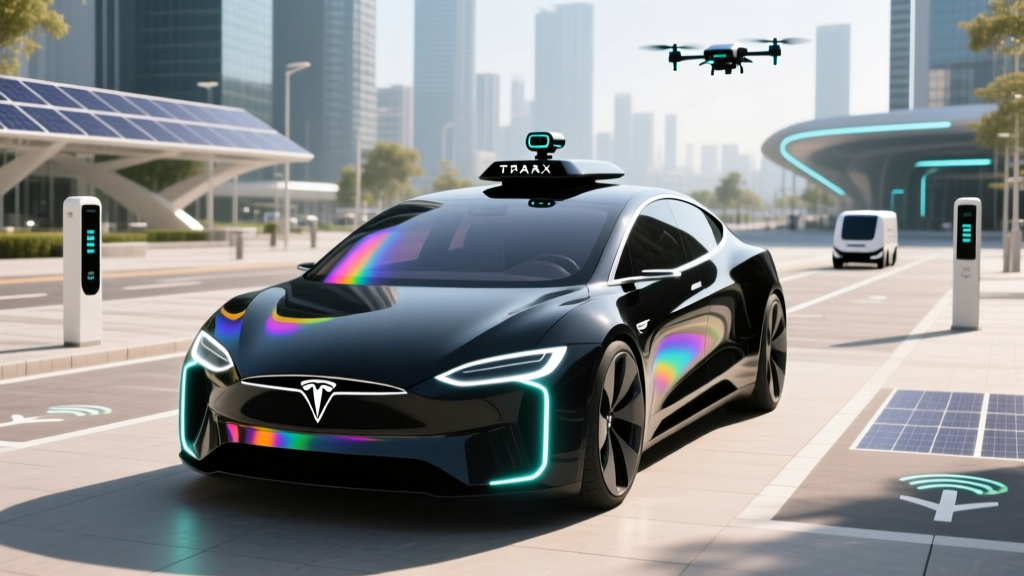
The Tesla 10/7 event — held at Warner Bros. Studios in Burbank — was billed as a Robotaxi reveal, and Tesla delivered a concept-heavy showcase anchored by the Cybercab, a two-passenger autonomous vehicle with no steering wheel or pedals. Alongside it, Tesla displayed the Robovan (a 20-passenger autonomous shuttle) and a refreshed Optimus humanoid robot. What the event did not deliver was a vehicle you can order today with a firm delivery date.
As of early 2026, the Cybercab remains in pre-production. Tesla CEO Elon Musk targeted a production start in late 2026, but Tesla's historical timeline slippage — recall the Roadster 2.0, announced in 2017 and still undelivered — means buyers should treat this as an announced platform, not a purchase option. Below, we separate what Tesla claimed at the 10/7 event from what's verifiable, and we benchmark it against the Tesla models you can actually buy right now.
Cybercab: Announced Specs and What We Know
The Cybercab is a compact, two-seat vehicle designed exclusively for autonomous ride-hailing. Tesla showed a butterfly-door prototype with a minimalist interior — a single bench seat and a large central touchscreen, but no manual driving controls. Here is what Tesla stated on stage and in the accompanying press materials:
| Attribute | Claimed / Estimated |
|---|---|
| EPA Range | ~250 mi (est., not EPA-certified) |
| Battery Capacity | ~50 kWh usable (est.), LFP chemistry expected |
| DC Fast Charge (peak) | Not disclosed; wireless inductive charging shown |
| 10–80% Charge Time | Not disclosed |
| 0–60 mph | Not disclosed |
| Drivetrain | Dual-motor AWD (likely, unconfirmed) |
| Seating | 2 passengers |
| Manual Controls | None (no steering wheel, no pedals) |
| Autonomy Level | SAE Level 4 (targeted, geofenced) |
| Projected Cost Per Mile | $0.20/mi (Tesla claim, pre-validation) |
| Estimated Vehicle Price | <$30,000 (fleet sale, not consumer retail) |
| Production Target | Late 2026 (unconfirmed) |
What You Can Actually Buy: 2026 Tesla Lineup Benchmarks
Since the Cybercab is not a purchase option, here's how Tesla's current production lineup stacks up for buyers who need a vehicle now. These are verified, EPA-certified figures from fueleconomy.gov and Tesla's official configurator.
| Spec | Model 3 LR AWD | Model Y LR AWD | Model S LR | Cybertruck AWD |
|---|---|---|---|---|
| EPA Range | 341 mi | 311 mi | 402 mi | 318 mi |
| Battery (kWh) | ~75 kWh (NMC) | ~75 kWh (NMC) | ~95 kWh (NMC) | ~123 kWh (NMC) |
| Peak DC Charge | 250 kW | 250 kW | 250 kW | 350 kW |
| 10–80% Time | ~27 min | ~27 min | ~33 min | ~24 min |
| 0–60 mph | 4.2 sec | 4.8 sec | 3.1 sec | 4.1 sec |
| MPGe (combined) | 131 MPGe | 122 MPGe | 120 MPGe | 77 MPGe |
| Base MSRP | $47,740 | $49,630 | $79,990 | $79,990 |
| Battery Warranty | 8 yr / 120,000 mi | 8 yr / 120,000 mi | 8 yr / 150,000 mi | 8 yr / 120,000 mi |
Real-world range reality check: The EPA numbers above assume a mix of city and highway driving at moderate temperatures. On sustained highway travel at 75 mph, expect roughly 10–15% less range than the EPA sticker. In freezing temperatures (below 32°F / 0°C), range can drop 20–30% due to cabin heating demands and reduced battery chemistry efficiency — even with Tesla's standard heat pump. A Model Y Long Range rated at 311 miles EPA may deliver closer to 220–240 miles on a cold-weather highway trip.
• Model 3 LR: EPA 341 mi → expect ~290–310 mi highway, ~240–270 mi in cold weather
• Model Y LR: EPA 311 mi → expect ~265–285 mi highway, ~220–250 mi in cold weather
• Model S LR: EPA 402 mi → expect ~340–370 mi highway, ~290–330 mi in cold weather
• Cybertruck AWD: EPA 318 mi → expect ~260–290 mi highway, ~210–240 mi in cold weather
Figures based on real-world owner reports and independent testing. Actual results vary with speed, terrain, temperature, and payload.
Charging Speed and Infrastructure: What Tesla Owners Actually Experience
Tesla's Supercharger network remains its strongest ownership advantage. As of 2026, Tesla operates over 6,500 Supercharger stations in North America, with the majority of stalls capable of 250 kW (V3) or the newer 350 kW (V4) architecture. Here's what charging looks like across levels:
| Charge Level | Power (kW) | Miles Added per Hour | Best For |
|---|---|---|---|
| Level 1 (120V household) | 1.4 kW | 3–5 mi/hr | Overnight trickle |
| Level 2 (240V home wall connector) | 11.5 kW | 30–44 mi/hr | Daily home charging |
| DC Fast (V3 Supercharger) | Up to 250 kW | Up to 1,000 mi/hr (peak) | Road trips |
| DC Fast (V4 Supercharger) | Up to 350 kW | Up to 1,200 mi/hr (peak) | Cybertruck, future models |
Charging curve reality: Peak kW rates are sustained only between roughly 10–50% State of Charge (SoC). Above 60%, the charge rate tapers significantly to protect battery health. A Model 3 Long Range hitting a V3 Supercharger at 10% will peak near 250 kW but will average closer to 140–160 kW across the full 10–80% session. Always precondition your battery by navigating to a Supercharger in the Tesla app — this warms the pack and enables faster charge acceptance, particularly in cold weather.
The Cybercab's wireless inductive charging, as shown at the 10/7 event, would eliminate plug-in for fleet operations. However, inductive charging typically operates at lower power levels (est. 11–20 kW based on industry standards), meaning overnight depot charging rather than rapid mid-day top-ups. Tesla did not disclose the inductive charge rate.
Tax Credits and Pricing: What the IRS Actually Allows
Under IRS §30D, the federal clean vehicle credit provides up to $7,500 for qualifying new EVs. However, eligibility is constrained by three simultaneous requirements, and Tesla's lineup has a mixed qualification record in 2026:
- MSRP Cap: Vans, SUVs, and pickups must be under $80,000 MSRP; sedans under $55,000. The Model 3 qualifies; the Model Y (classified as an SUV) qualifies at base trim. The Model S and Cybertruck exceed their respective caps.
- Buyer Income Cap: Modified Adjusted Gross Income (MAGI) must not exceed $150,000 (single), $225,000 (head of household), or $300,000 (joint).
- Battery Sourcing: Critical minerals and battery components must meet phased-in domestic/free-trade sourcing thresholds. Tesla's shift toward LFP batteries from CATL (China) for standard-range models has complicated eligibility for those trims. Long Range models using NMC cells from Panasonic at the Nevada Gigafactory generally qualify.
- Point-of-Sale Transfer: As of 2024, buyers can transfer the credit to the dealer at purchase, reducing the out-of-pocket price directly rather than waiting for a tax refund.
| Model / Trim | Base MSRP | §30D Credit | Effective Price | Credit Status |
|---|---|---|---|---|
| Model 3 LR AWD | $47,740 | $7,500 | $40,240 | Qualifies (NMC, under cap) |
| Model 3 RWD (LFP) | $38,990 | $0–$3,750 | $35,240–$38,990 | Partial/none (sourcing) |
| Model Y LR AWD | $49,630 | $7,500 | $42,130 | Qualifies (NMC, under cap) |
| Model S LR | $79,990 | $0 | $79,990 | Exceeds sedan MSRP cap |
| Cybertruck AWD | $79,990 | $0 | $79,990 | Exceeds pickup MSRP cap |
Note: Tax credit eligibility is subject to change based on IRS guidance, battery sourcing updates, and annual income verification. Consult a tax professional and verify current status at irs.gov before purchasing.
Cybercab vs. Waymo: Where Robotaxi Reality Stands
The Cybercab's competitive benchmark is not another consumer EV — it's Waymo's operational Level 4 robotaxi service, currently running in Phoenix, San Francisco, Los Angeles, and expanding to additional metro areas. Waymo's 6th-generation vehicle (based on the Geely/Zeekr platform) has completed over 10 million paid autonomous trips with a documented safety record that NHTSA continues to monitor.
Tesla's FSD (Supervised) — available on all current Tesla vehicles — remains an SAE Level 2 system requiring constant driver attention. Tesla has not received regulatory approval for a driverless Level 4 service anywhere in the United States. The Cybercab's path to deployment requires: (1) state-by-state regulatory approval for driverless operation, (2) demonstrated safety data exceeding human-driver benchmarks, and (3) insurance and liability frameworks. None of these are guaranteed, and the timeline is measured in years, not months.
For consumers, the practical takeaway is this: Tesla's current value proposition rests on its production vehicles (Model 3/Y/S/X/Cybertruck), the Supercharger network, and FSD Supervised as a premium driver-assist feature ($8,000 one-time or $99/month). The Cybercab is a fleet/ride-hailing concept that will not be available for individual ownership in its announced form.
Tech, Interior, and Ownership Experience
Current Tesla models share a common tech architecture built around a 15.4-inch central touchscreen (Model 3/Y) or 17-inch screen (Model S/X), running Tesla's proprietary infotainment OS. There is no Apple CarPlay or Android Auto — a deliberate choice that frustrates some buyers but keeps the interface tightly integrated with navigation, charging, and vehicle controls.
Standout features across the 2026 lineup:
- Over-the-air (OTA) software updates that add features post-purchase
- Tesla Vision (camera-only, no radar/lidar) for Autopilot and FSD Supervised
- Sentry Mode and Dashcam with 360° camera coverage
- Heat pump standard on all models (improves cold-weather range by 10–15% vs. resistive heating)
- Frunk (front trunk) on Model 3/Y in addition to rear cargo
Notable drawbacks:
- No CarPlay/Android Auto — a dealbreaker for some buyers accustomed to phone projection
- Minimalist interior lacks physical buttons for climate, mirrors, and glovebox (all screen-controlled)
- Panel gap and paint quality inconsistency reported by owners, though improved in 2025–2026 production
- FSD Supervised requires constant driver engagement despite the "Full Self-Driving" name — the marketing has drawn criticism from the NHTSA and consumer safety advocates
- Insurance premiums tend to run 15–25% higher than comparable non-Tesla EVs due to repair costs and parts pricing
Cargo and passenger space (2026 models):
- Model 3: 23 cu ft rear cargo + 3.1 cu ft frunk; rear legroom 35.2 in
- Model Y: 30.2 cu ft rear cargo (behind 2nd row) + 4.1 cu ft frunk; rear legroom 41.6 in (best-in-class for compact EV SUVs)
- Model S: 28 cu ft rear cargo + 5.3 cu ft frunk; rear legroom 35.4 in
- Cybertruck: 34.2 cu ft bed (6-ft vault) + 7.1 cu ft frunk; rear legroom 41.7 in
Who Should Buy a Tesla Today — And Who Should Wait
Buy a Model 3 Long Range if: You want the best efficiency-to-price ratio in Tesla's lineup, qualify for the $7,500 federal credit, commute 30–60 miles daily, and value Supercharger access for road trips. Effective price after credit: ~$40,240.
Buy a Model Y Long Range if: You need SUV cargo space and rear-seat room for a family, want the same powertrain as the Model 3 in a taller package, and plan to use a home Level 2 charger nightly. Effective price after credit: ~$42,130.
Consider Model S if: You need 400+ miles of range for frequent long-distance travel, want premium interior materials, and the $80K price (no federal credit) fits your budget. Best for executive commuters and road-trip-heavy buyers.
Wait on the Cybercab if: You were excited by the 10/7 event but need a personal vehicle now. The Cybercab is not a consumer purchase — it's a fleet robotaxi concept with no confirmed production date, no consumer pricing, and no regulatory approval for driverless operation. Revisit in 2027 when production and regulatory timelines are clearer.
Look at competitors if: You want CarPlay, physical buttons, or a more traditional dealership experience. The Hyundai Ioniq 5, Ford Mustang Mach-E, and Chevrolet Equinox EV all offer competitive range, DC fast charging, and broader federal credit eligibility at lower price points.
- Supercharger network — largest and most reliable in North America
- Industry-leading efficiency (MPGe) across Model 3/Y
- OTA updates continuously improve the vehicle post-purchase
- Strong resale value relative to most EVs
- Heat pump standard — better cold-weather range retention
- FSD Supervised is among the most capable Level 2 systems on highways
- No Apple CarPlay or Android Auto
- Screen-dependent controls frustrate some drivers
- Higher insurance costs than comparable EVs
- FSD name is misleading — still requires full driver attention (Level 2)
- Panel gap and service center wait times remain common complaints
- Cybercab/Robotaxi promises have no confirmed timeline
Frequently Asked Questions
What is the real-world range of the Tesla Cybercab announced at the 10/7 event?
Tesla did not provide an official EPA range figure for the Cybercab. Based on the estimated ~50 kWh battery and compact form factor, industry analysts project approximately 200–250 miles of range. However, because the Cybercab is designed for urban fleet use with inductive charging between rides, range is less critical than it would be for a consumer vehicle. This vehicle is not EPA-certified and is not available for purchase.
How fast does a Tesla charge at home and on the road?
At home on a Level 2 Tesla Wall Connector (240V, 48A), a Model 3 or Model Y adds approximately 30–44 miles of range per hour — a full overnight charge from 20% to 80% takes roughly 5–6 hours. On the road, Tesla's V3 Superchargers deliver up to 250 kW peak, achieving a 10–80% charge in approximately 27 minutes for the Model 3/Y. The Cybertruck supports up to 350 kW on V4 Superchargers, reducing its 10–80% time to around 24 minutes. Remember: peak kW only applies at low SoC — the charge curve tapers significantly above 60%.
How much does a Tesla cost after federal tax credits?
The 2026 Model 3 Long Range AWD starts at $47,740 and qualifies for the full $7,500 federal credit (assuming buyer income is under the cap), bringing the effective price to approximately $40,240. The Model Y Long Range AWD at $49,630 drops to ~$42,130 with the credit. The Model S and Cybertruck exceed their respective MSRP caps and do not qualify for the new-vehicle credit. Always verify current eligibility at irs.gov, as battery sourcing requirements and income thresholds apply.
Is a Tesla worth buying vs. competitors like the Ioniq 5 or Mustang Mach-E?
Tesla's advantages are the Supercharger network, efficiency (best-in-class MPGe), and software integration. Competitors like the Hyundai Ioniq 5 offer faster peak charging (up to 350 kW on 800V architecture), Apple CarPlay, more physical controls, and competitive range at similar or lower prices. The Ford Mustang Mach-E offers a more traditional SUV driving position and dealer service network. If Supercharger access is your top priority and you're comfortable with Tesla's screen-centric interface, the Model 3/Y remain top picks. If you want CarPlay and more conventional controls, test-drive the Ioniq 5 and Mach-E before committing.
Does the Tesla Cybercab qualify for the federal EV tax credit?
No. The Cybercab is not available for consumer purchase and therefore cannot qualify for the IRS §30D clean vehicle credit. It is designed as a fleet-operated robotaxi. Additionally, vehicles without manual driving controls may face regulatory classification questions that have not yet been resolved. For Tesla vehicles you can buy today, the Model 3 LR and Model Y LR qualify for the full $7,500 credit subject to income and sourcing rules.
What are the biggest pros and cons of buying a Tesla in 2026?
The biggest pros: access to the largest DC fast-charging network in North America, class-leading efficiency, continuous OTA improvements, and strong long-term battery durability data (most Tesla packs retain 90%+ capacity at 100,000 miles). The biggest cons: no phone projection (CarPlay/Android Auto), higher-than-average insurance premiums, FSD Supervised marketing that overpromises relative to its Level 2 reality, and service center wait times that can stretch weeks in some metro areas.
What did the Tesla 10/7 event mean for current Tesla owners?
For current owners, the 10/7 event was primarily forward-looking. No immediate software updates, hardware upgrades, or new features for existing vehicles were announced. The Cybercab and Robovan concepts signal Tesla's long-term bet on autonomous fleet services, which could theoretically increase the value of Tesla's FSD data and neural network training — but this has no near-term impact on the ownership experience of a Model 3, Y, S, or X. Current owners benefit most from Tesla's continued Supercharger expansion and OTA updates, not from concept-vehicle announcements.
Sources: EPA fuel economy data from fueleconomy.gov; IRS §30D credit rules from irs.gov; Tesla vehicle specifications from tesla.com; safety ratings from nhtsa.gov and iihs.org.