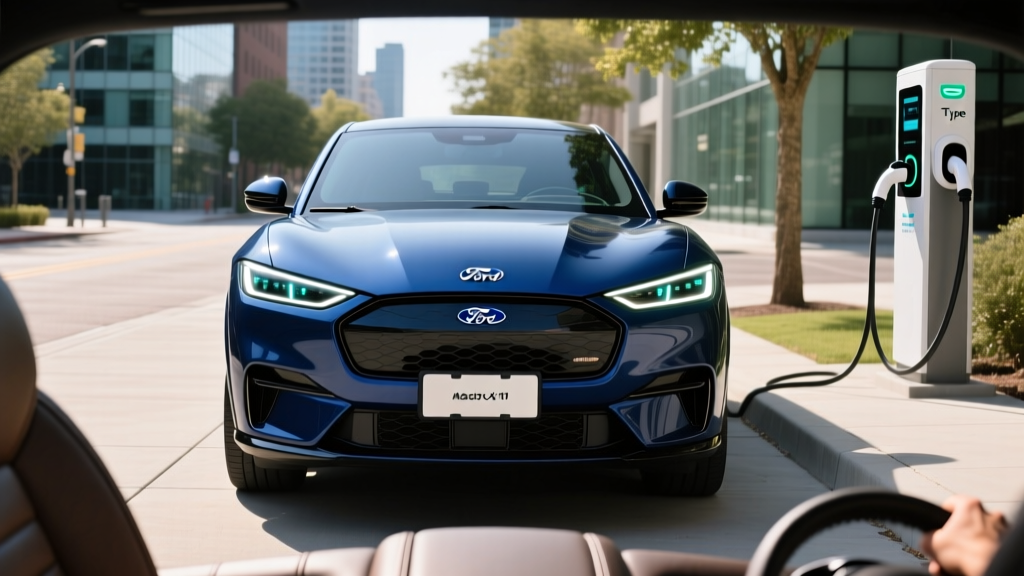
The Ford Mustang Mach-E remains one of the most accessible electric SUVs on the market, but the sticker price is just the starting point. When buyers search for "electric mustang cost," they're usually asking a more complex question: what does this vehicle actually cost to own over time? Between federal tax credits, home charging economics, higher insurance premiums, and depreciation curves, the real ownership math requires a detailed breakdown.
This guide walks through the 2026 Mustang Mach-E's total cost of ownership (TCO) over five years and 75,000 miles — the typical ownership window — using current EPA data, IRS §30D rules, and real-world charging costs. We'll show where the Mach-E saves money versus a gas-powered equivalent (like the Ford Edge or gas Mustang), and where it costs more.
2026 Mustang Mach-E: Purchase Price and Trim Breakdown
Before calculating ownership costs, we need a baseline. The 2026 Mustang Mach-E is available in Select, Premium, GT, and Rally trims. Prices below include destination charge:
| Trim | Drivetrain | Battery (kWh usable) | EPA Range | MSRP (2026) |
|---|---|---|---|---|
| Select | RWD | 72 kWh (LFP) | 250 mi | $42,495 |
| Premium | AWD (eAWD) | 91 kWh (NMC) | 320 mi | $50,495 |
| GT | AWD | 91 kWh (NMC) | 290 mi | $58,995 |
| Rally | AWD | 91 kWh (NMC) | 275 mi | $61,995 |
Federal Tax Credit: Do You Qualify for §30D?
The federal EV tax credit under IRS §30D can reduce your effective purchase price by up to $7,500 — but eligibility is not automatic. The rules have tightened significantly since 2023, and battery sourcing requirements continue to phase in through 2026. Here's what you must satisfy:
- MSRP cap: SUVs/wagons must have an MSRP ≤ $80,000; sedans ≤ $55,000. All Mach-E trims qualify as an SUV.
- Buyer income cap: Modified AGI must not exceed $300,000 (joint filers), $225,000 (head of household), or $150,000 (single). Based on current or prior tax year — whichever is lower.
- Battery critical minerals: A percentage of critical minerals must be sourced from the U.S. or a free-trade-agreement partner. This threshold increases annually. Ford has sourced LFP cells from CATL (China) for the Select trim, which may affect the critical-minerals half ($3,750) of the credit.
- Battery component assembly: A percentage of battery components must be manufactured or assembled in North America. This threshold also increases yearly.
- Point-of-sale transfer: As of 2024, you can transfer the credit to the dealer at purchase, reducing your out-of-pocket cost immediately rather than waiting to claim it on your tax return. The dealer must be registered with the IRS Energy Credits portal.
- Final assembly: Vehicle must undergo final assembly in North America. The Mach-E is assembled in Cuautitlán, Mexico — which qualifies under USMCA.
Source: IRS §30D Clean Vehicle Credit. Rules are subject to legislative change. Consult a tax professional for your specific situation.
What this means for Mach-E buyers: The Premium, GT, and Rally trims with North American-assembled NMC battery packs are more likely to qualify for the full $7,500 (both the $3,750 critical-minerals and $3,750 battery-components halves). The Select trim's LFP battery, sourced from CATL, may only qualify for the battery-components half ($3,750) if the critical-minerals requirement isn't met. Always verify current eligibility on fueleconomy.gov before purchasing.
Charging Cost vs. Gas: The Per-Mile Math
The single largest operating-cost advantage of the Mach-E comes from fuel. But the savings depend entirely on how and where you charge. Let's compare the Mach-E Premium AWD (91 kWh, 320 mi EPA, ~97 MPGe combined) against a reasonable gas alternative — the 2026 Ford Edge AWD (24 MPG combined).
| Metric | Mach-E Premium AWD | Ford Edge AWD (Gas) |
|---|---|---|
| Energy/Fuel Cost | $0.14/kWh (home avg) / $0.40/kWh (DCFC avg) | $3.40/gallon |
| Efficiency | 3.5 mi/kWh (EPA combined) | 24 MPG combined |
| Cost per mile (home charging) | $0.040 | — |
| Cost per mile (50% DCFC mix) | $0.065 | — |
| Cost per mile (gas) | — | $0.142 |
| Annual cost (15,000 mi) | $600 (home) / $975 (mixed) | $2,125 |
| 5-year fuel cost | $3,000–$4,875 | $10,625 |
Home charging setup cost: A Level 2 home charger (48A, ~11.5 kW) with professional installation typically runs $800–$2,000 depending on your electrical panel. If you need a 200A panel upgrade, add $1,500–$3,000. Many utilities offer rebates of $250–$500 for charger installation — check with your local provider.
Public DC fast charging reality: The Mach-E peaks at 150 kW on DC fast chargers, achieving a 10-80% charge in roughly 36-40 minutes. However, charging speed tapers significantly above 80% to protect battery health. For road trips, plan stops at 20-25% SoC and charge to 80% to optimize time. Networks like Electrify America and EVgo charge $0.35–$0.48/kWh in most metro areas.
Maintenance: Where EVs Quietly Save Thousands
The Mach-E's electric powertrain eliminates the most common maintenance items on gas vehicles. Over five years, the difference is substantial:
| Maintenance Item | Gas Vehicle (5-yr cost) | Mach-E (5-yr cost) |
|---|---|---|
| Oil changes (synthetic, every 7,500 mi) | $500–$750 | $0 |
| Transmission fluid/service | $200–$400 | $0 (single-speed reduction gear) |
| Brake pads and rotors | $800–$1,500 | $200–$500 (regen extends pad life 2-3x) |
| Spark plugs, coils | $300–$600 | $0 |
| Engine air filter | $100–$150 | $0 |
| Coolant flush | $150–$250 | $150–$250 (battery thermal loop) |
| Cabin air filter | $100–$150 | $100–$150 |
| Tire rotation/alignment | $300–$500 | $300–$500 (EVs can wear tires faster due to weight/torque) |
| Total estimated | $2,450–$4,300 | $750–$1,400 |
The Mach-E saves roughly $1,700–$2,900 in maintenance over five years. One caveat: EV tires tend to wear faster due to the vehicle's heavier weight (~4,800 lbs for the Premium AWD) and instant torque delivery. Budget for a tire replacement around year 3-4 — expect $800–$1,200 for a set of EV-optimized touring tires.
Insurance: The Cost That Catches EV Buyers Off Guard
Insurance is where the Mach-E's ownership cost runs higher than a comparable gas vehicle. Based on national averages and insurer data:
- Mach-E Premium AWD: $1,800–$2,400/year (average ~$2,100)
- Ford Edge AWD (gas): $1,400–$1,800/year (average ~$1,600)
Why EVs cost more to insure:
- Higher repair costs: Battery packs, power electronics, and specialized high-voltage components are expensive to replace after a collision. A minor rear-end impact that damages the battery enclosure can total the vehicle.
- Specialized labor: Fewer body shops are certified for high-voltage system repairs, driving up labor rates.
- Higher vehicle value: The Mach-E's MSRP is higher than many gas equivalents, increasing comprehensive and collision premiums.
- Parts availability: EV-specific parts (inverter, onboard charger, battery modules) may have longer lead times, increasing rental-car reimbursements that insurers factor in.
Over five years, expect to pay roughly $2,500 more in insurance for the Mach-E compared to the gas Edge. Shop quotes from EV-friendly insurers (Geico, Progressive, and State Farm have competitive EV rates) and ask about low-mileage or garaged-vehicle discounts.
Depreciation and Resale Value
EV depreciation has been volatile. After aggressive price cuts by Tesla and others in 2023-2024, used EV values dropped significantly. The Mach-E was not immune — early models (2021-2022) depreciated faster than gas counterparts. However, the market has stabilized as EV adoption has matured.
Current 5-year depreciation estimates (2026 outlook):
- Mach-E Premium AWD: ~45-55% depreciation over 5 years (residual value: $22,700–$27,800 from a $50,495 MSRP)
- Ford Edge AWD (gas): ~40-50% depreciation over 5 years
Factors working in the Mach-E's favor: Ford's established dealer network, over-the-air update capability, and an 8-year/100,000-mile battery warranty (covering capacity below 70% of original). Factors working against it: rapid EV technology advancement making older models feel dated, and some buyer hesitation around long-term battery replacement costs (though rarely needed within the warranty period).
If depreciation is a top concern, leasing the Mach-E transfers residual-value risk to the lessor — and the $7,500 federal credit can often be passed through as a lease incentive (since the leasing company claims the commercial credit under §45W and typically reflects it in the lease terms).
Total Cost of Ownership: 5-Year Breakdown
Here's the full picture for the 2026 Mach-E Premium AWD versus the gas Ford Edge AWD, assuming 15,000 miles/year, home-primary charging, and the full $7,500 federal credit applied to the Mach-E:
| Cost Category | Mach-E Premium AWD | Ford Edge AWD (Gas) |
|---|---|---|
| Purchase Price (MSRP) | $50,495 | $43,000 |
| Federal Tax Credit | −$7,500 | $0 |
| Effective Purchase Price | $42,995 | $43,000 |
| Home Charger Install (one-time) | $1,200 | $0 |
| Fuel/Energy (5 years) | $3,500 | $10,625 |
| Maintenance (5 years) | $1,100 | $3,400 |
| Insurance (5 years) | $10,500 | $8,000 |
| Total Cost Before Depreciation | $59,295 | $65,025 |
| Estimated Resale Value (Year 5) | $25,000 | $23,650 |
| Net 5-Year Cost of Ownership | $34,295 | $41,375 |
Note: This analysis does not include state/local incentives, which can further reduce costs. For example, Colorado offers a $5,000 state EV credit, California's CVRP provides up to $7,000 for income-qualified buyers, and many utilities offer $250–$1,000 in charger rebates or discounted EV electricity rates. Check AFDC's state incentive database for your region.
Frequently Asked Questions
How much does it really cost to own a Mustang Mach-E over 5 years?
After the federal tax credit, the 2026 Mach-E Premium AWD's net 5-year cost of ownership is approximately $34,000–$36,000 (including depreciation), depending on your electricity rates, insurance profile, and local incentives. This is roughly $5,000–$8,000 less than a comparably equipped gas SUV over the same period.
Do I qualify for the full $7,500 federal EV tax credit?
You qualify if your modified AGI is under the income caps ($300K joint / $150K single), the vehicle MSRP is under $80,000 for SUVs (all Mach-E trims qualify), and the battery meets 2026 critical-minerals and component-sourcing thresholds. The Select trim's LFP battery may only qualify for $3,750 due to Chinese mineral sourcing. Verify at irs.gov and with your dealer before purchase.
How much do I save on fuel and maintenance with the Mach-E?
Combined fuel and maintenance savings total approximately $9,400–$10,500 over five years compared to a gas SUV averaging 24 MPG, assuming primarily home charging at $0.14/kWh and $3.40/gallon gas. These savings are the primary financial argument for the Mach-E.
Are EVs more expensive to insure than gas cars?
Yes, typically 20-35% more. The Mach-E averages $2,100/year nationally versus ~$1,600 for the gas Edge. Higher repair costs, specialized labor, and the vehicle's higher MSRP drive the premium increase. Shop multiple insurers and ask about EV-specific discounts.
How well does the Mustang Mach-E hold its value?
The Mach-E retains approximately 45-55% of its value after five years, slightly below the gas SUV average of 50-60%. However, the gap has narrowed since 2024 as the used EV market stabilized. Ford's 8-year/100,000-mile battery warranty provides residual-value support. Leasing is a viable alternative if depreciation is a primary concern.
What about state and local EV incentives?
Incentives vary significantly by state and utility. Common offerings include state tax credits ($1,000–$7,000), utility charger rebates ($250–$1,000), HOV lane access, and reduced EV electricity rates. These stack with the federal credit in many cases. Consult your state's energy office and local utility for current programs.