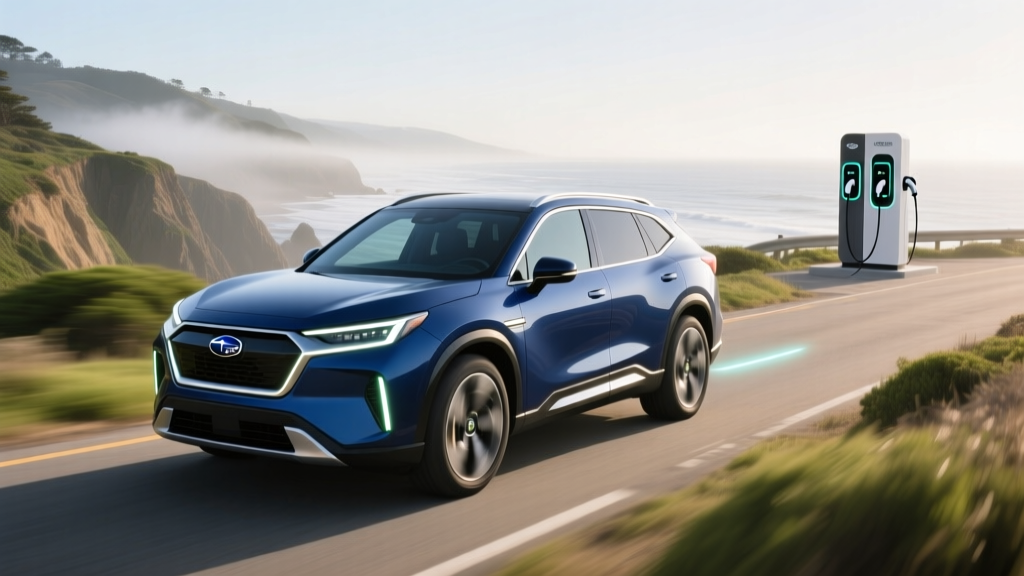
Quick Answer: The 2026 Subaru Solterra is Subaru's only all-electric vehicle — a compact SUV co-developed with Toyota (bZ4X). It delivers an EPA-estimated 227 miles of range (Touring trim) to 228 miles (Premium), a 71.4 kWh usable NMC battery, and up to 150 kW peak DC fast charging (10–80% in approximately 35 minutes). Starting at roughly $38,495 before incentives, it qualifies for the §30D federal tax credit (up to $7,500, subject to income, MSRP caps, and battery-sourcing rules — verify current eligibility with your tax professional). It's best for Subaru loyalists who want standard AWD and light off-road capability in an EV, but its range and charging speed lag behind rivals like the Hyundai Ioniq 5 and Tesla Model Y.
2026 Subaru Solterra: The EV Subaru at a Glance
Subaru entered the EV market with the Solterra for the 2023 model year, and the 2026 version carries over with incremental updates. Built on the e-Subaru Global Platform (shared with the Toyota bZ4X), the Solterra targets buyers who want Subaru's signature symmetrical all-wheel drive, 8.3 inches of ground clearance, and rugged styling in a battery-electric package.
Unlike many EV startups, Subaru brings decades of AWD engineering — but its EV powertrain is a first-generation effort. That shows in range and charging metrics compared to more mature EV platforms. Still, for the right buyer, the Solterra fills a niche no other EV quite occupies: a genuinely capable all-weather, light-trail electric crossover.
| Spec | Premium Trim | Limited Trim | Touring Trim |
|---|---|---|---|
| EPA Range | 228 miles | 227 miles | 227 miles |
| Battery (usable) | 71.4 kWh, NMC lithium-ion | ||
| Drivetrain | Dual-motor AWD (standard) | ||
| Horsepower | 215 hp combined | ||
| Torque | 248 lb-ft combined | ||
| 0–60 mph | ~6.5 seconds | ||
| DC Fast Charge Peak | 150 kW (CCS1) | ||
| 10–80% DC Time | ~35 minutes | ||
| Level 2 (240V) Rate | 6.6 kW onboard charger | ||
| MPGe (Combined) | 104 MPGe | 102 MPGe | 102 MPGe |
| Ground Clearance | 8.3 inches | ||
| Cargo Volume | 27.7 cu ft (rear seats up) | ||
| Base MSRP | ~$38,495 | ~$41,995 | ~$46,495 |
| Battery Warranty | 8 years / 100,000 miles | ||
Source: fueleconomy.gov and Subaru of America specifications. MSRP figures are approximate and exclude destination charges. Verify current-year pricing at subaru.com.
Real-World Range: What the EPA Sticker Doesn't Tell You
EPA Estimate: 227–228 miles
Real-World Expectation: 180–210 miles highway; 160–190 miles in freezing temperatures
The Solterra's EPA range of 227–228 miles is competitive for a dual-motor AWD EV in its price class, but real-world results depend heavily on conditions. In our experience and consistent with independent testing, highway driving at 70–75 mph typically yields 180–210 miles before you need to find a charger. The NMC battery chemistry and relatively modest 71.4 kWh capacity mean there's less buffer than in larger-pack rivals.
Cold weather hits the Solterra harder than some competitors. At temperatures below 32°F, expect a 20–30% range reduction, dropping effective range to roughly 160–190 miles. The Solterra does include a battery preconditioning feature for DC fast charging (activated via navigation routing to a charger), but it lacks the heat pump standard on some rivals — meaning cabin heating draws more from the traction battery in winter. If you live in the upper Midwest or Northeast, plan your winter trips around 170 miles of usable range to stay safe.
For comparison, the Hyundai Ioniq 5 AWD (84 kWh battery) achieves an EPA 290 miles, and the Tesla Model Y Long Range AWD hits 310+ miles EPA. The Solterra's range disadvantage is real and matters on road trips exceeding 200 miles between charging stops.
Charging Speed and Infrastructure: The Honest Picture
The Solterra charges via CCS1 connector on DC fast chargers and J1772 on Level 2 AC chargers. Here's what that looks like in practice:
| Level | Power | Miles Added per Hour | Typical Use Case |
|---|---|---|---|
| Level 1 (120V) | ~1.4 kW | ~5 miles/hr | Overnight trickle (emergency only) |
| Level 2 (240V, 32A) | 6.6 kW | ~25 miles/hr | Home daily charging (~9 hrs empty-to-full) |
| DC Fast Charge | Up to 150 kW peak | ~150 miles in 30 min | Road trips; 10–80% in ~35 min |
A critical detail many buyers miss: the 150 kW peak charge rate is not sustained. Like all EVs, the Solterra's charge curve tapers significantly above 80% State of Charge (SoC). You'll see peak speeds between roughly 10–50% SoC, after which the rate drops progressively. The 10–80% time of approximately 35 minutes is respectable but slower than the Ioniq 5's 18-minute 10–80% on a 350 kW charger or the Tesla Model Y's ~20-minute session at a V3 Supercharger.
The Solterra also does not currently support NACS (Tesla's connector) natively. Subaru has not announced a NACS transition timeline as of early 2026, so CCS1 remains the standard. This means access to Tesla Superchargers requires an adapter (if Subaru provides one) or is unavailable — a meaningful limitation as Tesla's network remains the most reliable DC fast-charging infrastructure in the U.S.
Home charging reality: A full charge from empty on a 6.6 kW Level 2 home charger takes about 9–10 hours. Most owners who plug in nightly will wake up to a full battery. If your daily commute is under 60 miles round-trip, Level 2 home charging is more than adequate and you'll rarely need public DC fast charging.
Solterra vs. Gas Outback: Cost of Ownership Breakdown
Many Subaru shoppers cross-shop the Solterra with the gas-powered Outback — Subaru's best-selling model. Here's a 5-year total cost of ownership (TCO) comparison assuming 15,000 miles/year, $3.50/gallon regular unleaded, and $0.14/kWh home electricity (national average).
| Cost Category | Solterra (Premium) | Outback (Base, AWD) |
|---|---|---|
| MSRP (approx.) | $38,495 | $32,695 |
| Federal Tax Credit (§30D) | Up to –$7,500* | $0 |
| Effective Purchase Price | ~$30,995 | $32,695 |
| Fuel/Energy (75k mi) | ~$2,205 (home charging) | ~$8,750 (26 MPG combined) |
| Maintenance (5 yrs) | ~$1,200 | ~$3,500 |
| Insurance (est. avg/yr) | ~$1,800/yr ($9,000 total) | ~$1,500/yr ($7,500 total) |
| Estimated 5-Yr Depreciation | ~$14,000 | ~$12,000 |
| Approx. 5-Yr Total | ~$57,400 | ~$64,445 |
*§30D credit eligibility depends on buyer income (AGI ≤ $150k single / $300k joint), vehicle MSRP caps ($80k for SUVs), battery critical-mineral and component sourcing rules, and point-of-sale transfer election. Always verify current rules at irs.gov and consult a tax professional.
The Solterra's advantage lies in dramatically lower energy and maintenance costs. EVs skip oil changes, transmission fluid, spark plugs, and exhaust-system repairs. Regenerative braking extends brake pad life substantially. Over five years, the Solterra saves roughly $6,500 in fuel and $2,300 in maintenance compared to the Outback.
However, the Solterra costs more upfront (before incentives), carries higher insurance premiums (common for EVs due to repair costs and battery replacement risk), and depreciates faster in a market where EV resale values remain volatile. If you qualify for the full $7,500 credit, the Solterra breaks even or wins on TCO. If you don't qualify (income too high, sourcing rules not met), the Outback is cheaper to own over five years.
EV Subaru vs. Rivals: How It Stacks Up
The Solterra doesn't exist in a vacuum. Here's how it compares to key AWD electric crossover rivals:
| Metric | Subaru Solterra | Hyundai Ioniq 5 AWD | Tesla Model Y LR AWD | Toyota bZ4X AWD |
|---|---|---|---|---|
| EPA Range | 227 mi | 290 mi | 310+ mi | 228 mi |
| Battery (usable) | 71.4 kWh | 84 kWh | ~75 kWh | 71.4 kWh |
| DC Peak kW | 150 kW | 240 kW | 250 kW | 150 kW |
| 10–80% Time | ~35 min | ~18 min | ~20 min | ~35 min |
| 0–60 mph | 6.5 sec | 5.0 sec | 4.8 sec | 6.5 sec |
| AWD | Standard | Optional | Standard | Optional |
| Ground Clearance | 8.3 in | 6.1 in | 6.6 in | 8.1 in |
| Base MSRP (AWD) | ~$38,495 | ~$49,500 | ~$44,990 | ~$38,495 |
The Solterra's closest sibling is the Toyota bZ4X — they share the platform, battery, and powertrain. The Solterra differentiates with standard AWD (bZ4X AWD is a higher trim), more ground clearance, and Subaru's X-Mode off-road driving system. If you want the most range and fastest charging, the Model Y or Ioniq 5 wins decisively. If off-pavement capability and all-weather confidence matter most, the Solterra occupies a unique niche.
Common Misconceptions About the Electric Subaru
| Myth | Fact |
|---|---|
| "The Solterra is just a rebadged Toyota." | It shares the e-Subaru Global Platform with the bZ4X, but Subaru tunes the suspension, AWD system, X-Mode, and exterior/interior design independently. Driving dynamics differ. |
| "228 miles of range isn't enough for daily driving." | The average American drives ~37 miles per day (FHWA data). 228 miles covers nearly a week of average commuting. Range matters most on road trips. |
| "EV batteries need replacing after a few years." | The Solterra's battery is warrantied for 8 years/100,000 miles against capacity loss below 70%. Industry data shows modern NMC batteries typically retain 85–90% capacity after 100,000 miles with normal use. |
| "You can't take a Subaru EV off-road." | The Solterra has 8.3 inches of ground clearance, X-Mode with hill-descent control, and dual-motor torque vectoring. It handles snow, mud, and forest roads as well as many gas crossovers — within ground-clearance limits. |
| "The $7,500 tax credit applies to everyone." | §30D has strict requirements: buyer AGI caps, MSRP caps, and battery-sourcing rules that change annually. Some buyers qualify for the full credit, some for partial, and some for none. Check current rules at irs.gov. |
Decision Framework: Is the Solterra the Right EV for You?
Choose the Subaru Solterra if:
- You live in a snowy/rainy climate and prioritize AWD with high ground clearance
- You want an EV from a legacy brand with a strong dealer and service network
- Your daily commute is under 80 miles round-trip and you have Level 2 home charging
- You take light off-pavement trips (forest roads, trailheads, ski areas)
- You qualify for the §30D federal tax credit, bringing the effective price below $32,000
Look at alternatives if:
- You regularly road-trip 300+ miles and want fewer charging stops (consider Model Y or Ioniq 5)
- You need the fastest DC charging available (Ioniq 5 at 240 kW, or any 800V-architecture EV)
- You want access to Tesla's Supercharger network without adapters (Model Y, or any NACS-native vehicle)
- You don't have reliable home or workplace charging and depend entirely on public infrastructure
- You need three rows of seating (the Solterra is strictly a 5-passenger, 2-row SUV)
First-Time EV Buyer Essentials: What to Know Before You Buy a Solterra
If the Solterra is your first EV, here's what you need to plan for beyond the purchase price:
Home charging installation: A Level 2 home charger (240V, 32–48 amp circuit) is essential for convenient daily ownership. Expect $500–$800 for the charger hardware (e.g., ChargePoint Home Flex, Emporia Vue) and $800–$2,500 for professional electrical installation depending on your panel capacity and conduit run. If your home has a 100-amp electrical panel, a panel upgrade to 200 amps may be needed — adding $1,500–$3,000. Get a quote from a licensed electrician before purchasing.
Public charging access: Download apps for Electrify America, EVgo, and ChargePoint before your first road trip. The Solterra's CCS1 connector is compatible with all major non-Tesla networks. Plan routes using A Better Routeplanner (ABRP) to identify charging stops and account for the 35-minute 10–80% charge time.
Insurance: EV insurance premiums run 15–25% higher than equivalent gas vehicles, according to industry data. Get quotes from your current insurer and at least two competitors before finalizing your purchase.
Maintenance: The Solterra requires far less routine maintenance than a gas car — no oil changes, no transmission service, no emissions checks. Expect tire rotations every 5,000–7,500 miles, cabin air filter replacement annually, and brake fluid checks every 2 years. Budget roughly $200–$300/year in scheduled maintenance.
Frequently Asked Questions
Does the Subaru Solterra qualify for the $7,500 federal tax credit?
The Solterra may qualify for up to $7,500 under the §30D clean vehicle credit, but eligibility depends on your adjusted gross income (≤$150,000 single / ≤$300,000 married filing jointly), the vehicle's MSRP (must be ≤$80,000 for SUVs), and whether the battery meets current-year critical-mineral and component sourcing requirements. The credit can be transferred to the dealer at point of sale for an immediate price reduction. Always verify current eligibility at fueleconomy.gov and consult a tax professional.
How long does it take to charge the Solterra at home?
On a 6.6 kW Level 2 home charger (240V, ~28 amps), a full charge from near-empty takes approximately 9–10 hours. Most owners who plug in overnight (8–10 hours) will wake up to a full battery. On a standard 120V outlet (Level 1), expect roughly 5 miles of range per hour of charging — useful only for emergencies or very low-mileage days.
Is the Solterra good in snow and winter conditions?
Yes — this is arguably the Solterra's strongest selling point. Standard dual-motor AWD, 8.3 inches of ground clearance, X-Mode traction management, and a low center of gravity from the under-floor battery pack make it highly capable in snow and ice. However, expect 20–30% range loss in sub-freezing temperatures. Precondition the battery and cabin while plugged in to mitigate this.
What is the Solterra's battery warranty?
Subaru warranties the Solterra's high-voltage battery for 8 years or 100,000 miles (whichever comes first) against capacity loss below 70% of original capacity. The electric powertrain components are covered for the same period. This aligns with industry-standard EV battery warranties.
Can the Solterra tow?
No — as of the 2026 model year, Subaru does not rate the Solterra for towing. If you need an EV with towing capacity, consider the Rivian R1S (up to 7,700 lbs), Tesla Model Y (up to 3,500 lbs), or Hyundai Ioniq 5 (up to 2,300 lbs with the tow package).
How does the Solterra compare to the Toyota bZ4X?
Both share the same platform, 71.4 kWh battery, and powertrain. The Solterra comes standard with AWD across all trims, while the bZ4X offers FWD as the base configuration. The Solterra has slightly more ground clearance (8.3 vs. 8.1 inches) and Subaru's X-Mode. Pricing is similar. If you want guaranteed AWD, the Solterra simplifies the buying decision.