Quick Answer: Does an Electric VW GTI Exist Yet?
As of early 2026, no production electric VW GTI is available for purchase. Volkswagen unveiled the ID. GTI Concept at the IAA Mobility show in September 2023, and VW executives have confirmed a production version is planned as part of the ID. 2all family (built on the MEB+ platform). The production model is expected to debut in 2026 or 2027, with first deliveries likely in Europe before any U.S. confirmation. If you're searching for an electric VW GTI today, the closest current VW EV is the ID.4 SUV, and the closest electric hot hatch on the U.S. market is the Hyundai Ioniq 5 N.
For decades, the Volkswagen GTI has defined the hot hatch segment: affordable performance, practical cargo space, and that signature plaid interior. As VW electrifies its lineup under the ID. banner, enthusiasts have one persistent question — will there be an electric VW GTI? This guide breaks down everything confirmed about the ID. GTI, what we can reasonably project based on VW's MEB+ architecture, and how a future electric GTI would compare to both the outgoing gas GTI and current electric performance alternatives.
What Is the ID. GTI Concept?
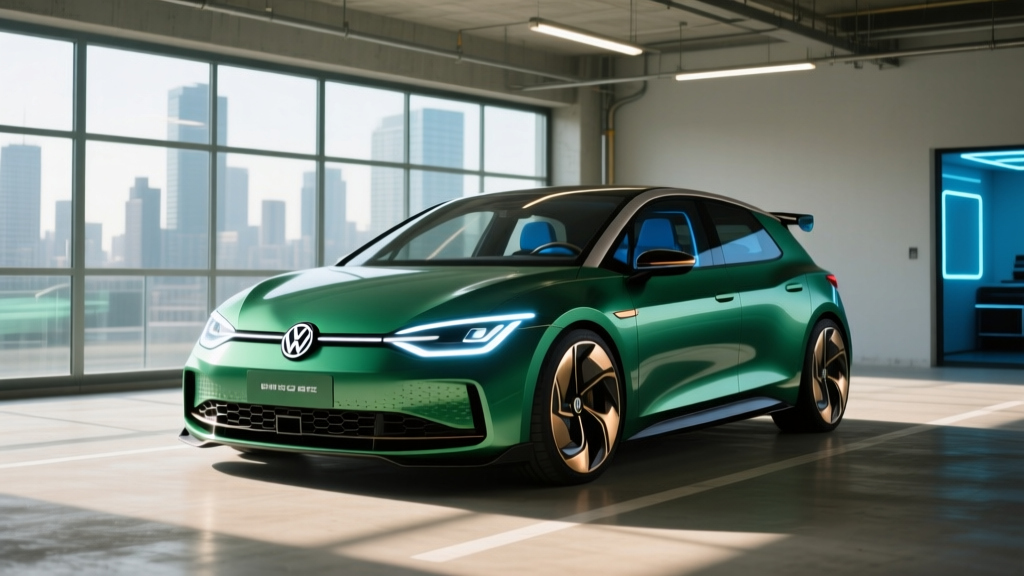
The Volkswagen ID. GTI Concept was revealed in Munich as a near-production vision of what an electric hot hatch wearing the GTI badge could look like. Key design cues from the concept include:
- A low-slung, five-door hatchback silhouette closely echoing the Mk8 GTI's proportions
- A reinterpreted GTI front grille with a red accent line and integrated LED matrix lighting
- Signature GTI plaid seat pattern updated with recycled materials
- A digital "GTI driver display" with performance telemetry (lateral G, lap timer, power distribution)
- 20-inch alloy wheels with a design nod to the classic GTI "Denver" wheels
VW has stated the concept previews a production model that will sit atop the ID. 2all range — a front-wheel-drive compact EV built on the updated MEB+ (MEB Entry Plus) platform. Unlike the current ID.4, which uses a larger version of the original MEB architecture, the MEB+ platform is designed for smaller vehicles and supports both front- and all-wheel-drive configurations.
Projected Specs: What an Electric VW GTI Could Deliver
VW has not released final production specifications for an electric GTI. However, based on the ID. 2all platform details, supplier disclosures, and the ID. GTI Concept presentation, here are reasonable projections for a production model:
| Specification | Projected Electric VW GTI | 2025 Gas VW GTI (Mk8.5) |
|---|---|---|
| Powertrain | Single front motor (est.) | 2.0L turbo I-4, FWD |
| Horsepower | ~220-260 hp (est.) | 241 hp |
| Torque | ~250-295 lb-ft (est.) | 273 lb-ft |
| 0-60 mph | ~6.0-6.5 sec (est.) | 5.6 sec (DSG) |
| Battery Capacity | ~58-65 kWh usable (est.) | N/A (14.5 gal tank) |
| Battery Chemistry | Likely NMC (performance focus) | N/A |
| EPA Range | ~220-260 miles (est.) | ~380 miles (26/34 mpg) |
| DC Fast Charge (Peak) | ~130-150 kW (est.) | N/A |
| 10-80% DC Charge | ~25-30 min (est.) | ~3 min (gas fill) |
| Base MSRP | ~$38,000-$44,000 (est.) | $33,940 |
Important caveats: These figures are projections based on available platform data, not confirmed production numbers. VW's MEB+ platform is expected to support faster charging and improved energy density compared to the original MEB, but final U.S. specs may differ from European versions. VW has not confirmed U.S. availability for any ID. 2all variant.
Electric GTI vs. Gas GTI: The Ownership Cost Reality
If VW brings the electric GTI to the U.S., buyers will face a familiar EV-vs-gas calculus. Here's how a projected electric GTI would compare to the current gas GTI over five years of ownership, assuming 12,000 miles/year:
| Cost Category (5 Years) | Electric VW GTI (Projected) | 2025 Gas VW GTI |
|---|---|---|
| Purchase Price (base, before incentives) | ~$42,000 | $33,940 |
| Federal Tax Credit (§30D) | $0-$7,500 (see eligibility below) | $0 |
| Fuel / Electricity (60,000 mi total) | ~$2,400-$3,600 (home + public mix) | ~$7,200 (30 mpg avg, $3.60/gal) |
| Maintenance | ~$600-$900 (tire rotation, cabin filter, fluid top-off) | ~$2,500-$3,200 (oil changes, brakes, filters) |
| Insurance (avg.) | ~$8,500-$10,500 | ~$7,000-$8,500 |
| Estimated 5-Year Total Cost | ~$44,500-$49,600 (before credit) | ~$50,640-$52,640 |
The electric GTI's higher sticker price is partially offset by lower fuel and maintenance costs. Over five years, the EV saves roughly $3,600-$5,800 on fuel and $1,600-$2,600 on maintenance. If the vehicle qualifies for the full $7,500 federal tax credit (a significant "if" — see below), the total cost of ownership becomes competitive with or lower than the gas GTI.
Fuel Cost Per Mile: Electric vs. Gas GTI
| Scenario | Cost Per Mile |
|---|---|
| Electric GTI — Home charging (Level 2, $0.14/kWh avg, 3.5 mi/kWh) | ~$0.04/mi |
| Electric GTI — Public DC fast charging ($0.40/kWh avg) | ~$0.11/mi |
| Gas GTI — 30 mpg combined, $3.60/gallon | ~$0.12/mi |
Home charging is where EV economics win decisively. If you lack access to reliable Level 2 home charging, the cost advantage shrinks significantly, and public DC fast charging can approach or exceed gasoline costs per mile.
Federal Tax Credit: Will the Electric GTI Qualify?
Whether a future electric VW GTI qualifies for the IRS §30D federal tax credit depends on several factors that are difficult to predict for an unreleased vehicle. Current rules for 2026 include:
- MSRP cap: Sedans/hatchbacks must have an MSRP of $55,000 or less (SUVs/trucks: $80,000). A GTI hatchback would fall under the $55,000 cap.
- Buyer income limits: Modified AGI cannot exceed $150,000 (single), $225,000 (head of household), or $300,000 (joint).
- Battery component sourcing: Increasing percentages of battery components must be manufactured or assembled in North America (80% for 2026).
- Critical minerals: Increasing percentages of critical minerals must be sourced from the U.S. or FTA partners (80% for 2026).
- FEOC exclusion: Vehicles with battery components from a "foreign entity of concern" (e.g., certain Chinese suppliers) are disqualified.
- Point-of-sale transfer: Eligible buyers can transfer the credit to the dealer at purchase, reducing the sale price directly.
The challenge for VW: Volkswagen's current U.S.-market ID.4 is assembled in Chattanooga, Tennessee, but its battery cells are sourced from SK On (South Korea). The MEB+ platform vehicles planned for Europe may use different supply chains. Whether a future U.S.-market electric GTI meets the increasingly strict sourcing requirements is uncertain. Always verify eligibility on the official fueleconomy.gov tax credit page once the vehicle is released.
Charging Reality: What to Expect from MEB+
The original MEB platform (used in the ID.4) drew criticism for its relatively modest DC fast-charging speeds — peaking around 135 kW and tapering significantly above 80% State of Charge. VW has stated that MEB+ will bring improvements, but the compact ID. 2all platform may face physical constraints compared to larger MEB vehicles.
| Charging Level | Power | Estimated Miles Added Per Hour |
|---|---|---|
| Level 1 (120V household outlet) | ~1.4 kW | ~4-5 miles/hr |
| Level 2 (240V home/public, 48A) | ~11.5 kW | ~35-40 miles/hr |
| DC Fast Charge (projected peak) | ~130-150 kW | ~400-500 miles/hr (at peak, not sustained) |
Real-World Range Expectations
If the production electric GTI carries a ~60 kWh usable battery and achieves ~3.5 miles/kWh efficiency (reasonable for a sporty compact), the EPA range would land around 210-240 miles. In real-world driving, expect:
- Highway (70-75 mph): ~180-200 miles (aerodynamic drag reduces efficiency ~15-20%)
- Cold weather (below 32°F): ~150-180 miles (cabin heating and battery thermal losses reduce range 20-30%)
- Mixed city/suburban: Close to EPA estimate, potentially slightly above due to regenerative braking
The charge curve matters as much as peak kW. Most EVs sustain peak charge rate only between roughly 10-40% SoC, then taper progressively. A 130 kW peak might average 80-90 kW across a full 10-80% session, meaning a real-world 10-80% charge in roughly 25-30 minutes at a capable DC fast charger. This is adequate for road trips but noticeably slower than 800V-architecture competitors like the Hyundai Ioniq 5 (which peaks at 240 kW and charges 10-80% in ~18 minutes).
Should You Wait for the Electric VW GTI? A Decision Framework
Wait for the Electric VW GTI If:
- You're not in a rush to buy — production is likely 2027+ for U.S. markets (if confirmed)
- You have reliable Level 2 home charging (a 240V/48A setup costs ~$500-$1,500 to install)
- Your daily commute is under 80 miles round-trip (covers ~80% of U.S. drivers)
- You value the GTI's practical hatchback form factor and want it electrified
- You live in a region with moderate winters (cold-weather range loss hits smaller batteries harder)
Look at Alternatives Now If:
- You need a vehicle in the next 6-12 months — the electric GTI is not available
- You lack home charging access and rely solely on public infrastructure
- You regularly drive 300+ miles between stops (the ~220-mile projected range limits road-trip flexibility)
- You want maximum performance today — the Hyundai Ioniq 5 N (601 hp, 220-mile EPA range, ~$66,000) is the current electric hot hatch benchmark
- Budget is tight — the current gas GTI at ~$34,000 remains an excellent value
Current Alternatives to the Electric VW GTI
If the wait for an electric GTI isn't practical, here's how current options compare:
| Vehicle | Power | EPA Range / MPG | Base Price | Notes |
|---|---|---|---|---|
| 2025 VW GTI (gas) | 241 hp | 26/34 mpg | $33,940 | The benchmark hot hatch; no EV credit |
| 2025 Hyundai Ioniq 5 N | 601 hp (N Grin Boost) | 220 mi | $66,150 | 800V architecture, 240 kW DC charging, track-capable |
| 2025 VW ID.4 Pro S | 282 hp (RWD) | 275 mi | $44,040 | Closest current VW EV; SUV, not a hatchback |
| 2025 Mini Cooper SE (Electric) | 215 hp | ~200 mi (est.) | ~$32,000 | Compact electric hatch; less cargo space than GTI |
Common Misconceptions About an Electric GTI
| Myth | Fact |
|---|---|
| "The electric GTI will feel exactly like a gas GTI." | Instant torque will make it feel quicker off the line, but EVs are heavier. The GTI's agility comes partly from its light weight (~3,100 lbs). An electric version will likely weigh 3,600-3,800 lbs, changing handling dynamics. |
| "It'll have 300+ miles of range." | Unlikely on the compact MEB+ platform with a performance-oriented battery. Expect 220-260 miles EPA — comparable to other electric hot hatches but less than efficiency-focused sedans. |
| "It'll definitely qualify for the $7,500 tax credit." | Not guaranteed. Battery sourcing rules under §30D are strict and tighten yearly. VW's supply chain for MEB+ vehicles hasn't been confirmed for U.S. compliance. |
| "I can charge it at any public charger." | VW has not confirmed the connector type for U.S. models. The industry is shifting to NACS (Tesla-style), and MEB+ vehicles may adopt it, but CCS is also possible depending on timing. |
Frequently Asked Questions
Is VW making an electric GTI?
VW has confirmed that a production version of the ID. GTI Concept is planned as part of the ID. 2all family on the MEB+ platform. However, no production date, final specs, or U.S. availability has been officially announced as of early 2026.
When will the electric VW GTI be available?
The production ID. 2all is expected to debut in Europe in 2026, with a GTI variant likely following. U.S. availability, if it happens, would be no earlier than 2027-2028. VW has been scaling back some U.S. EV plans, so confirmation is not guaranteed.
How much will the electric VW GTI cost?
No official pricing exists. Based on VW's European pricing strategy and the ID. 2all's positioning as an affordable compact EV, a reasonable U.S. estimate is $38,000-$44,000 for a GTI variant — before any federal or state incentives.
Will the electric GTI be fast?
VW's concept suggests performance in line with or slightly above the current gas GTI (~240 hp). It won't match dedicated performance EVs like the Ioniq 5 N, but instant electric torque should deliver strong real-world acceleration, particularly in city driving.
What's the best electric hot hatch I can buy right now?
The Hyundai Ioniq 5 N is the current benchmark electric performance vehicle in hatch/crossover form, offering 601 hp, simulated gear shifts, and 240 kW DC charging. For a more affordable and compact option, the Mini Cooper SE provides an electric hatchback experience, though with less range and cargo space than a GTI would offer.
Should I buy a gas GTI now or wait for the electric version?
If you need a car now and enjoy the engagement of a manual or DSG-equipped gas hot hatch, the current Mk8.5 GTI is excellent and may be one of the last generations of gas GTIs VW produces. If you can wait 2+ years, have home charging, and prefer lower running costs, the electric GTI could be worth the patience — but U.S. availability isn't confirmed.