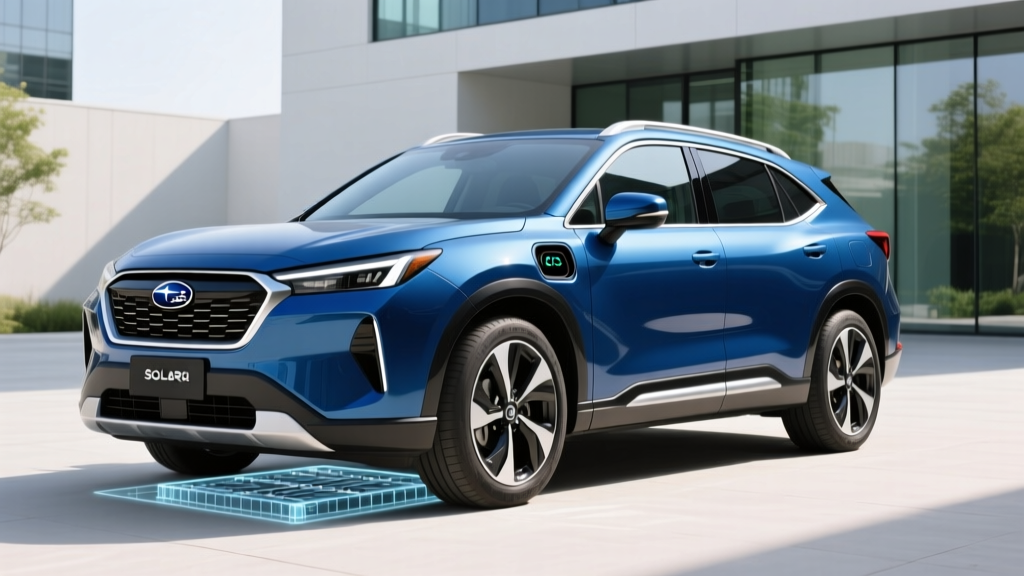
The Subaru Solterra occupies a unique niche in the electric SUV market: it's a genuine off-road-capable EV with standard all-wheel drive and 8.3 inches of ground clearance, yet it also serves as a practical daily driver for families. If you're researching Subaru Solterra dimensions to figure out whether this EV fits your garage, your family, or your lifestyle, this review breaks down every measurement that matters—along with real-world range data, charging speeds, and ownership costs for the 2026 model year.
Built on the Toyota/Subaru co-developed e-TNGA platform (sharing its bones with the Toyota bZ4X), the Solterra has matured since its 2023 launch. For 2026, Subaru has refined charging hardware, expanded trim availability, and the EV now benefits from a broader DC fast-charging network thanks to the industry's NACS transition. Let's get into the numbers.
Exterior Dimensions and Ground Clearance
The Solterra is classified as a compact electric SUV, but its footprint is closer to a midsize crossover when you factor in interior volume. Here are the key exterior measurements for the 2026 Subaru Solterra:
| Dimension | Measurement |
|---|---|
| Wheelbase | 112.2 in (2,850 mm) |
| Overall Length | 184.6 in (4,690 mm) |
| Overall Width (w/o mirrors) | 73.2 in (1,860 mm) |
| Overall Height | 65.0 in (1,650 mm) |
| Ground Clearance | 8.3 in (211 mm) |
| Curb Weight (approx.) | 4,365–4,520 lbs (varies by trim) |
| Approach / Departure Angle | 18.2° / 25.2° |
That 8.3-inch ground clearance is the Solterra's calling card. Most electric crossovers in this class—like the Hyundai Ioniq 5 (6.1 in) or Volkswagen ID.4 (6.7 in)—sit noticeably lower. If your commute includes unpaved roads, snow-covered driveways, or trailheads, the Solterra's ride height is a genuine functional advantage, not just a styling choice.
At 184.6 inches long, the Solterra will fit comfortably in a standard single-car garage (typically 20 feet deep), leaving roughly 18 inches of clearance front and back. Width-wise, it's comparable to a Toyota RAV4, so tight parking spaces and narrow urban streets are manageable.
Interior Space: Cargo, Passenger Volume, and Practicality
Subaru's e-TNGA platform pushes the wheels to the corners, creating a long wheelbase relative to overall length. That translates directly to interior room:
| Interior Dimension | Measurement |
|---|---|
| Front Headroom | 39.9 in |
| Rear Headroom | 38.8 in |
| Front Legroom | 42.1 in |
| Rear Legroom | 35.7 in |
| Front Shoulder Room | 57.2 in |
| Rear Shoulder Room | 55.7 in |
| Cargo Volume (behind rear seats) | 23.8 cu ft |
| Cargo Volume (rear seats folded) | 56.9 cu ft |
The 23.8 cu ft cargo area behind the second row is competitive with the Ioniq 5 (27.2 cu ft) and slightly smaller than the ID.4 (30.3 cu ft). It handles a week's worth of groceries, two large suitcases, or a full-size dog crate without trouble. Fold the 60/40 rear bench and you get a flat 56.9 cu ft—enough for camping gear, a bicycle (front wheel removed), or a pair of kayaks stacked crosswise.
One notable omission: the Solterra does not have a frunk (front trunk). The space under the hood houses the power electronics and HVAC components. If you're coming from a Tesla Model Y or Rivian R1S, you'll miss the extra sealed cargo space up front.
Rear legroom at 35.7 inches is adequate for adults on shorter trips but tighter than the Ioniq 5's generous 39.4 inches. Families with rear-facing child seats will find it workable, though front passengers may need to slide forward slightly.
Battery, Range, and Real-World Efficiency
The 2026 Solterra uses a 72.8 kWh usable lithium-ion battery pack (NMC chemistry—nickel manganese cobalt). Subaru quotes a peak system output of 215 horsepower and 249 lb-ft of torque from its dual-motor Symmetrical All-Wheel Drive setup.
EPA Estimated Range: 227 miles (Touring/Higher trims with 20" wheels); 242 miles (Premium trim with 18" wheels)
Real-World Range Notes: In mixed driving at moderate temperatures (60–75°F), expect roughly 210–230 miles from the 227-mile trim and 225–240 from the 242-mile trim. On sustained highway driving at 70+ mph, range drops to approximately 180–200 miles. In cold weather (below 30°F), expect a 20–30% reduction, bringing effective range to 160–180 miles on higher trims. The Solterra's standard heat pump helps mitigate winter losses compared to EVs without one, but the boxy shape and AWD system's parasitic drag keep efficiency below segment leaders.
Efficiency is rated at approximately 104 MPGe combined (roughly 32 kWh/100 miles) for the 227-mile trim, per fueleconomy.gov. That's noticeably less efficient than the Ioniq 5 Long Range AWD (110 MPGe combined) or the Tesla Model Y Long Range (122 MPGe combined). The Solterra's higher weight, taller profile, and permanent AWD system all contribute to higher energy consumption.
If your daily commute is under 40 miles round-trip and you have home charging, the Solterra's range is more than sufficient—you'll charge every 3–4 days. For road trips, plan stops every 160–180 miles to stay comfortable and avoid running the battery below 10%.
Charging Speeds: DC Fast, Level 2, and Level 1
Subaru upgraded the Solterra's DC fast-charging capability for the 2025 model year, and the 2026 model carries forward that improved hardware. Here's what you can expect at each charging tier:
| Charging Level | Power / Rate | Time / Speed |
|---|---|---|
| Level 1 (120V household) | ~1.4 kW | ~3–4 miles per hour of charging |
| Level 2 (240V home/public) | Up to 7.2 kW (onboard charger) | ~24–26 miles per hour; full charge in ~10 hours |
| DC Fast Charge (CCS/NACS adapter) | Peak ~100 kW (sustained ~75 kW avg.) | 10–80% in approximately 35 minutes |
The Solterra's DC fast-charging curve is its most debated spec. While the peak rate reaches approximately 100 kW under ideal battery temperatures, the charge curve tapers earlier than competitors. The Hyundai Ioniq 5, for comparison, sustains 200+ kW through much of its 10–80% curve, completing the session in about 18 minutes. The Solterra's 35-minute 10–80% time is closer to the Toyota bZ4X and the base-range VW ID.4.
For daily ownership, the 7.2 kW Level 2 rate is the number that matters most. A home Level 2 charger (like a ChargePoint Home Flex or Emporia Level 2) on a 240V/40A circuit will fully replenish the Solterra overnight—roughly 10 hours from near-empty. Most owners will plug in at 30–50% state of charge and wake up at 100% every morning.
One practical note: the 2026 Solterra ships with a CCS1 connector. However, as the North American Charging Standard (NACS) becomes the dominant connector at Tesla Superchargers and other networks, Subaru provides a NACS adapter (or the vehicle may include a native NACS port depending on production date). Always confirm connector compatibility with your local charging infrastructure before purchase.
Performance and Drivetrain
Every Solterra comes with Subaru's dual-motor Symmetrical All-Wheel Drive as standard equipment—no single-motor, front-wheel-drive base model exists. Here's the performance snapshot:
| Performance Spec | Value |
|---|---|
| Powertrain | Dual-motor AWD (e-TNGA) |
| System Horsepower | 215 hp |
| System Torque | 249 lb-ft |
| 0–60 mph | ~6.5 seconds |
| Top Speed | ~107 mph (electronically limited) |
| Towing Capacity | Not rated for towing |
| Drive Modes | Eco, Normal, Power, Snow/Dirt, Deep Snow/Mud |
The 6.5-second 0–60 time is adequate for merging and passing but won't feel quick compared to a Tesla Model Y Long Range (5.0 seconds) or even an Ioniq 5 AWD (5.8 seconds). The Solterra's character is about capability, not acceleration. The X-MODE system—carried over from Subaru's gas vehicles—manages torque distribution across the axles for low-traction surfaces, and it works well in snow, mud, and on gravel forest roads.
Regenerative braking includes adjustable levels via steering-wheel paddles, but the Solterra does not offer true one-pedal driving that brings the vehicle to a complete stop. You'll still use the friction brake at low speeds. This is a common Subaru trait and a deliberate engineering choice to maintain a familiar brake-pedal feel for ICE-to-EV transitioners.
Pricing, Trims, and Federal Tax Credit Eligibility
The 2026 Subaru Solterra is offered in three trims. Here's the pricing breakdown:
| Trim | Base MSRP | Est. Price After §30D Credit* |
|---|---|---|
| Premium | $39,995 | ~$32,495 |
| Limited | $44,495 | ~$36,995 |
| Touring | $47,195 | ~$39,695 |
*Destination charge (~$1,420) not included in MSRP above. Tax credit estimates assume full $7,500 eligibility under IRS §30D.
- MSRP Cap: The Solterra qualifies as an SUV under IRS classifications, so the MSRP cap is $80,000. All trims clear this threshold.
- Buyer Income Limits: Modified adjusted gross income must not exceed $150,000 (single), $225,000 (head of household), or $300,000 (married filing jointly).
- Battery Sourcing: The §30D credit is split into two halves—$3,750 for critical minerals and $3,750 for battery component sourcing. Sourcing requirements tighten annually. Consult the IRS §30D guidance and Subaru's official battery sourcing documentation for the specific production batch you're purchasing.
- Point-of-Sale Transfer: As of 2024+, eligible buyers can transfer the credit to the dealer at purchase, reducing the out-of-pocket price immediately rather than waiting for a tax refund.
- Verification: Always confirm eligibility with your tax professional and check the vehicle's VIN on the IRS portal before finalizing a purchase.
At the Premium trim level, the Solterra undercuts many AWD electric SUV competitors when the full tax credit applies. A $32,495 effective price (before state incentives) for a dual-motor AWD EV with a heat pump and genuine off-road capability is compelling value.
Technology, Driver Assistance, and Standout Features
The 2026 Solterra runs Subaru's latest Starlink infotainment system on a 12.3-inch touchscreen (Limited and Touring trims; 8.0-inch on Premium). Wireless Apple CarPlay and Android Auto are standard. The Touring trim adds a panoramic fixed glass roof, heated and ventilated front seats, a heated steering wheel, and a 360-degree camera system.
Subaru's EyeSight driver-assistance suite comes standard on every trim and includes:
- Adaptive cruise control with lane centering
- Pre-collision braking with pedestrian detection
- Lane departure warning and lane keep assist
- Blind-spot detection with rear cross-traffic alert
- Rear automatic emergency braking
This is a SAE Level 2 driver-assistance system—it provides steering and speed support, but the driver must remain fully engaged and hands-on (or eyes-on, depending on configuration). The Solterra does not offer a hands-free driving system like GM's Super Cruise or Ford's BlueCruise. Subaru's approach is conservative: EyeSight is reliable and well-calibrated, but it's not designed for highway automation beyond basic lane-centering and adaptive cruise.
• No hands-free driving capability (Level 2 only—driver must remain engaged at all times)
• No frunk (front trunk) for additional storage
• No towing rating—this EV is not designed to pull a trailer
• DC fast-charging speed trails competitors (35 min vs. 18 min for Ioniq 5, 10–80%)
• Rear legroom is tighter than key rivals
One standout feature: the Solterra's standard roof rails with integrated crossbar mounting points. Subaru designed these to accept aftermarket crossbars without additional hardware, making roof-box and bike-rack installation straightforward. Combined with the 8.3-inch ground clearance and X-MODE, this reinforces the Solterra's identity as an outdoor-lifestyle EV.
Warranty and Long-Term Ownership
Subaru backs the Solterra with competitive warranty coverage:
| Coverage | Terms |
|---|---|
| Basic Vehicle Warranty | 3 years / 36,000 miles |
| Powertrain Warranty | 5 years / 60,000 miles |
| EV Battery Warranty | 8 years / 100,000 miles (minimum 70% capacity retention) |
| Corrosion Perforation | 5 years / unlimited miles |
| Roadside Assistance | 3 years / 36,000 miles |
The 8-year/100,000-mile battery warranty guarantees that the pack will retain at least 70% of its original capacity. This is the industry-standard threshold and matches coverage from Toyota, Hyundai, and Volkswagen. NMC chemistry in the Solterra has shown moderate degradation in early model-year data—roughly 5–8% loss over the first 50,000 miles based on owner reports, which is within normal expectations.
Long-term replacement cost for the full battery pack is estimated at $12,000–$18,000 out of warranty, though most owners will never need a full replacement within the warranty period. Module-level repair may be available for isolated cell failures at lower cost.
How the Solterra Compares: Key Competitors
| Spec | 2026 Subaru Solterra (Touring) | 2026 Hyundai Ioniq 5 AWD | 2026 VW ID.4 AWD Pro S |
|---|---|---|---|
| EPA Range | 227 mi | 290 mi | 275 mi |
| Battery (usable) | 72.8 kWh (NMC) | 77.4 kWh (NMC) | 82 kWh (NMC) |
| DC Fast Charge (10–80%) | ~35 min | ~18 min | ~28 min |
| Ground Clearance | 8.3 in | 6.1 in | 6.7 in |
| Cargo (rear seats up) | 23.8 cu ft | 27.2 cu ft | 30.3 cu ft |
| 0–60 mph | 6.5 sec | 5.8 sec | 6.7 sec |
| Base MSRP (AWD) | $39,995 | $47,500 | $45,790 |
| AWD Standard? | Yes (all trims) | No (AWD is optional) | No (AWD is a trim) |
The Solterra trades range and charging speed for off-road capability, standard AWD across all trims, and a lower entry price. If your priority is maximizing range and minimizing charge stops on road trips, the Ioniq 5 is the stronger pick. If you need cargo volume above all, the ID.4 wins. But if you live where snow, dirt roads, or trailheads are part of your routine, the Solterra is the only one in this group that was genuinely engineered for that use case.
Who Should Buy the 2026 Subaru Solterra?
- You need AWD and ground clearance for snow, gravel, or light off-road use
- Your daily commute is under 60 miles round-trip with reliable home charging
- You want an EV priced under $40K (after credit) with standard AWD
- You value Subaru's safety reputation and EyeSight driver-assist suite
- You regularly carry roof-mounted gear (kayaks, skis, cargo boxes)
Look elsewhere if:
- You regularly drive 200+ miles between charging stops on road trips
- Fast DC charging speed is a top priority (road-trip heavy lifestyle)
- You need maximum cargo volume or rear-seat legroom for tall adults
- You want hands-free highway driving capability
- You need to tow a trailer (the Solterra is not tow-rated)
Frequently Asked Questions
What is the real-world range of the 2026 Subaru Solterra?
Expect 210–230 miles in mixed driving for the 227-mile EPA-rated trims, and 225–240 miles for the 242-mile Premium trim. Highway-only driving at 70+ mph reduces this to roughly 180–200 miles. In sub-freezing temperatures, plan for 160–180 miles of usable range. The standard heat pump helps, but the Solterra's efficiency is below segment average.
How fast does the Solterra charge at home and on the road?
On a Level 2 home charger (240V, 7.2 kW), the Solterra gains about 24–26 miles of range per hour and fully charges in roughly 10 hours. On a DC fast charger, it peaks at approximately 100 kW and reaches 10–80% in about 35 minutes. That's slower than rivals like the Ioniq 5 (18 minutes) but adequate if you're not road-tripping frequently.
Does the 2026 Subaru Solterra qualify for the $7,500 federal EV tax credit?
The Solterra is eligible for up to $7,500 under IRS §30D, subject to buyer income limits ($150K single / $300K joint), MSRP caps ($80K for SUVs—all trims qualify), and battery-sourcing requirements that tighten yearly. The credit can be transferred to the dealer at point of sale, reducing your purchase price immediately. Always verify your specific eligibility via the IRS portal and your tax professional before purchasing.
Is the Solterra worth buying over the Toyota bZ4X or Ioniq 5?
It depends on your priorities. The Solterra offers standard AWD, higher ground clearance, and a lower starting price than the bZ4X AWD and Ioniq 5 AWD. But the Ioniq 5 delivers substantially more range (290 vs. 227 miles) and faster charging. The bZ4X is mechanically similar but offers slightly less ground clearance. For outdoor-oriented buyers in snow-belt states, the Solterra is the strongest fit.
What are the biggest pros and cons of the Solterra?
Pros: Standard AWD on every trim; 8.3 inches of ground clearance; competitive pricing after tax credit; X-MODE for off-road traction; standard heat pump; strong safety suite; roof rails designed for crossbars.
Cons: Below-average EPA range for the class; slow DC fast-charging vs. rivals; no frunk; tight rear legroom; no tow rating; no hands-free driving system.
Can I charge the Solterra at Tesla Superchargers?
The 2026 Solterra uses a CCS1 connector natively. As Tesla's Supercharger network opens to non-Tesla EVs, you can use a NACS-to-CCS adapter (provided or available from Subaru) at compatible stations. Confirm adapter availability with your dealer and check station compatibility on the Tesla app or PlugShare before relying on Superchargers for road trips.
How much does it cost to charge a Solterra at home?
At the US average residential electricity rate of ~$0.17/kWh, fully charging the 72.8 kWh battery costs approximately $12.40. That's roughly equivalent to $0.05–0.06 per mile driven—about one-third the per-mile cost of a 25 MPG gas vehicle at $3.50/gallon. Your actual cost depends on your local utility rate and whether you have access to off-peak/TOU pricing, which can drop charging costs to $8–$10 per full charge.
Sources: EPA fueleconomy.gov, IRS §30D Tax Credit Guidance, Subaru of America official specifications.