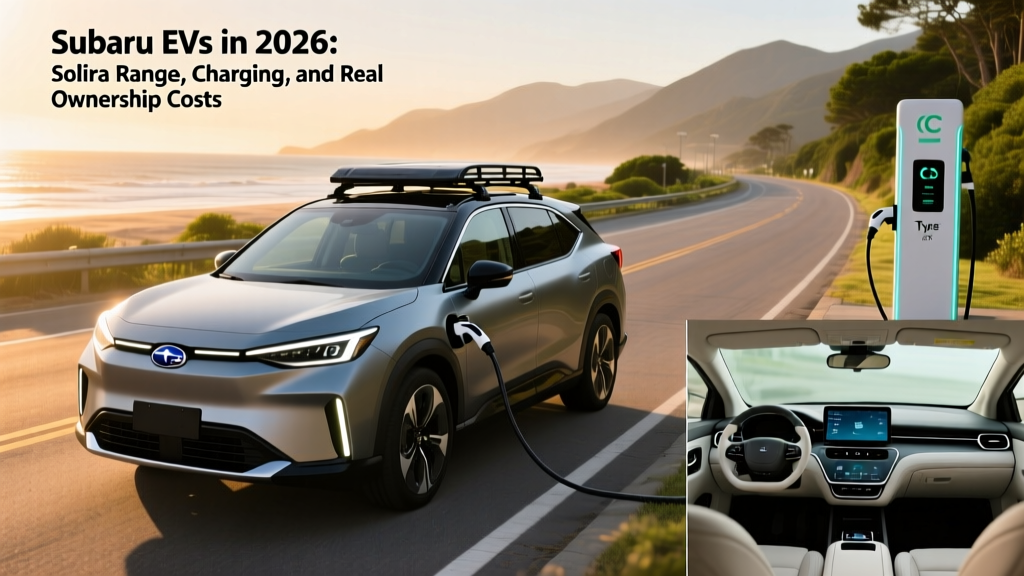
If you're researching Subaru EVs, the 2026 Subaru Solterra is currently the brand's only all-electric vehicle available in the US. It's a compact electric SUV with standard all-wheel drive, an EPA-estimated range of approximately 285 miles (in the highest-efficiency trim), and DC fast charging that peaks around 150 kW. Pricing starts near $39,000 before incentives, and it may qualify for up to $7,500 in federal tax credits under IRS §30D depending on your income, the vehicle's MSRP cap compliance, and battery-sourcing requirements. For buyers loyal to Subaru's outdoorsy, AWD-focused identity, the Solterra delivers that DNA in electric form — but with real-world range closer to 230–250 miles on the highway and notable cold-weather losses that every prospective buyer should factor in.
Quick Answer: Are Subaru EVs Worth It?
The 2026 Solterra is a solid electric SUV for Subaru loyalists who need AWD, reasonable ground clearance (8.3 inches), and a practical daily driver. Its 285-mile EPA range and 150 kW DC fast charging are competitive but not class-leading. Real-world highway range drops to ~230–250 miles, and cold weather can cut that further by 20–30%. If you can charge at home and your daily commute is under 100 miles round-trip, the Solterra offers lower running costs than a gas Outback. If you frequently drive 300+ mile trips in winter or lack home charging access, consider a longer-range rival or a Subaru PHEV like the Crosstrek Hybrid instead.
2026 Subaru Solterra: Range, Battery, and Efficiency Specs
The Solterra shares its e-TNGA platform with the Toyota bZ4X, but Subaru tunes the powertrain and thermal management differently. Here are the numbers that matter:
| Spec | 2026 Solterra (Premium / Limited / Touring) |
|---|---|
| EPA Range | ~285 mi (Premium) / ~260 mi (Touring, larger wheels) |
| Battery Capacity | 72.8 kWh (usable), NMC lithium-ion |
| Drivetrain | Dual-motor AWD, 215 hp, 248 lb-ft torque |
| 0–60 mph | ~6.5 seconds |
| MPGe (combined) | ~104 MPGe (Premium) |
| Efficiency | ~32 kWh/100 mi |
| DC Fast Charge (peak) | ~150 kW |
| 10–80% DC Charge Time | ~35 minutes |
| Level 2 Charge Rate | ~7.2 kW (approx. 9 hours 0–100%) |
| Ground Clearance | 8.3 inches |
| Cargo Volume | ~24 cu ft (rear seats up) |
| Base MSRP | ~$39,000 (Premium) – ~$46,500 (Touring) |
| Battery Warranty | 8 years / 100,000 miles (capacity retention ≥70%) |
Real-World Range Reality Check
The EPA sticker says ~285 miles for the Premium trim, but real-world results vary significantly. In mixed driving at moderate temperatures (60–75°F), expect 250–270 miles. On sustained highway driving at 70+ mph, range drops to roughly 220–245 miles. In freezing conditions (below 32°F), cabin heating and battery thermal management can reduce range by 20–30%, bringing realistic winter range to 180–220 miles. The Solterra's heat pump (standard on most trims) helps mitigate this loss compared to resistive heating, but physics still applies. If your typical weekly driving exceeds 200 miles between charges, plan your charging routine carefully.
Charging the Solterra: Home Setup and Public Networks
Charging speed is where the Solterra is adequate but not exceptional. The 150 kW peak DC fast-charging rate means you'll add roughly 150 miles of range in about 25 minutes at a compatible station, but the charge curve tapers significantly above 80% state of charge (SoC) — a common trait in NMC batteries to protect longevity. Expect 80–100% to take an additional 20+ minutes, so plan to charge to 80% on road trips for efficiency.
At home on a Level 2 (240V) charger delivering 7.2 kW, a full 0–100% charge takes approximately 9 hours. Most owners who plug in overnight will wake up to a full battery every morning. Note: kW (kilowatts) measures power — how fast energy flows into the battery. kWh (kilowatt-hours) measures energy — the total capacity of the battery. The Solterra's 72.8 kWh battery charged at 7.2 kW takes ~10 hours mathematically; charging inefficiencies add ~10% overhead.
| Charging Level | Power (kW) | Miles Added per Hour | Typical Use Case |
|---|---|---|---|
| Level 1 (120V outlet) | ~1.4 kW | ~4–5 miles/hr | Emergency / overnight trickle |
| Level 2 (240V home charger) | ~7.2 kW | ~23–25 miles/hr | Daily home charging |
| DC Fast Charging | Up to 150 kW | ~300+ miles/hr (peak) | Road trips, quick top-ups |
For home Level 2 installation, budget $500–$2,500 depending on your electrical panel's capacity. If your panel needs an upgrade to 200A (common in older homes), costs can reach $3,000–$5,000. Always consult a licensed electrician for a site-specific quote. The Solterra uses the J1772 connector for Level 2 and CCS1 for DC fast charging. As of 2026, Subaru has not transitioned to NACS (Tesla's connector), so Supercharger access requires an adapter — and not all Supercharger stalls support CCS-adapted vehicles yet.
Solterra vs. Gas Outback: Real Cost of Ownership
The most common cross-shopping question: does the Solterra save money compared to the gas-powered Subaru Outback, the brand's bestseller? Here's a 5-year cost comparison assuming 15,000 miles/year, $3.50/gallon gas, and $0.14/kWh home electricity:
| Cost Category | 2026 Solterra (Premium) | 2026 Outback (2.5i Premium) |
|---|---|---|
| Base MSRP | ~$39,000 | ~$34,000 |
| Federal Tax Credit (§30D) | Up to $7,500 (if eligible) | $0 |
| Effective Purchase Price | ~$31,500 (with credit) | $34,000 |
| Fuel/Energy (5 yrs, 75k mi) | ~$3,675 (home charging) | ~$9,640 (26 MPG combined) |
| Maintenance (5 yrs) | ~$1,200 (no oil changes, fewer fluids) | ~$3,500 |
| Insurance (5 yrs est.) | ~$9,500 (EV premium ~10–15%) | ~$8,200 |
| 5-Year Total (est.) | ~$45,875 | ~$55,340 |
The Solterra wins on total cost over 5 years if you qualify for the full $7,500 federal tax credit and charge primarily at home. The energy savings alone (~$5,965 over 5 years) are substantial. However, if you don't qualify for the credit (due to income limits, MSRP cap, or battery-sourcing rules), the math tightens considerably. Check current IRS §30D guidelines before purchasing, as sourcing requirements and eligible vehicle lists update regularly.
Also factor in depreciation: EVs have historically depreciated faster than comparable gas vehicles, though this gap is narrowing. The Outback holds strong resale value, which may offset some of the Solterra's fuel savings at trade-in time.
Tax Credit Eligibility: What You Actually Need to Know
The federal clean vehicle credit under §30D is not a guaranteed $7,500 for every buyer. Here's the 2026 eligibility checklist:
- Income caps: Modified adjusted gross income (MAGI) must not exceed $150,000 (single), $225,000 (head of household), or $300,000 (joint filers)
- MSRP cap: SUVs must have an MSRP at or below $80,000; sedans below $55,000. The Solterra qualifies as an SUV under this rule
- Battery sourcing: Increasing percentages of critical minerals and battery components must be sourced from the US or free-trade-agreement countries. The exact percentage thresholds increase annually — verify current-year requirements on irs.gov
- Point-of-sale transfer: As of 2024+, you can transfer the credit to the dealer at purchase, reducing your out-of-pocket cost immediately rather than waiting for tax filing
- Assembly: Vehicle must undergo final assembly in North America. The Solterra is assembled in Japan — this is a critical issue. Verify current eligibility status, as this may disqualify the Solterra from the §30D credit entirely
The Japan assembly point is the biggest caveat for Subaru EV buyers. If the Solterra does not meet the North American final assembly requirement, it is ineligible for the §30D credit, regardless of other factors. This dramatically changes the cost equation. Always confirm eligibility via the DOE's fueleconomy.gov tax credit tool before signing a purchase agreement.
Common Misconceptions About Subaru EVs
| Myth | Fact |
|---|---|
| "The Solterra has 300+ miles of range." | EPA max is ~285 mi (Premium). Touring trim with larger wheels drops to ~260 mi. Real-world highway driving yields 220–250 mi. |
| "It charges as fast as a Tesla or Hyundai Ioniq 5." | At 150 kW peak, the Solterra is slower than the Ioniq 5 (up to 240 kW) and Tesla Model Y (up to 250 kW). 10–80% takes ~35 min vs ~18 min for the fastest rivals. |
| "I'll save $7,500 on every Subaru EV." | The §30D credit has income, MSRP, sourcing, and assembly requirements. Japan-assembled Solteras may not qualify. Always verify. |
| "EV batteries need replacing every few years." | Subaru warranties the Solterra battery for 8 years/100,000 miles with ≥70% capacity retention. Industry data shows NMC batteries typically retain 85–90% capacity after 100,000 miles with normal use. |
| "I can't take a Subaru EV off-road or in snow." | The Solterra has 8.3 inches of ground clearance, X-MODE AWD, and a low center of gravity from the battery pack. It handles snow and light off-road trails competently, though it's not a dedicated off-roader like a lifted Wrangler. |
Decision Framework: Is the Solterra Right for You?
Choose the Solterra If:
- You have home charging access (garage or driveway with 240V outlet capability)
- Your daily round-trip commute is under 120 miles
- You need AWD for snow, rain, or light trails
- You're a current Subaru owner who values brand loyalty and dealer familiarity
- You want lower running costs and qualify for available incentives
Look Elsewhere If:
- You regularly drive 300+ mile trips and don't want to plan around DC charging stops
- You live in an apartment or lack reliable home/work charging access
- You need maximum cargo space (the Solterra's 24 cu ft trails the Outback's 32.5 cu ft)
- You want the fastest possible DC charging — consider the Hyundai Ioniq 5 or Kia EV6 instead
- The §30D tax credit is essential to your budget and the Solterra doesn't qualify due to assembly rules
What's Next for Subaru EVs Beyond 2026?
Subaru has announced plans to expand its EV lineup, including a larger three-row electric SUV (expected around 2027–2028) and potentially a compact electric crossover. These are announced/preliminary models — final specs, pricing, and availability are not yet confirmed. Subaru is also investing in solid-state battery research through partnerships, but production-ready solid-state EVs remain several years away industry-wide. For now, the Solterra is the only Subaru EV you can actually buy.
Frequently Asked Questions
Can the Subaru Solterra tow?
Yes, but modestly. The Solterra has a maximum towing capacity of 2,000 pounds when properly equipped. That's enough for a small utility trailer or a pair of dirt bikes, but not a boat or camper. The gas Outback tows up to 2,700–3,500 pounds depending on the engine.
Does the Solterra work with Tesla Superchargers?
Not natively. The Solterra uses CCS1 for DC fast charging. As of 2026, Subaru has not adopted NACS (Tesla's connector). You may be able to use a CCS-to-NACS adapter at some Supercharger locations, but compatibility is not universal and charging speeds may be limited. The Electrify America, EVgo, and ChargePoint networks are your primary public DC options.
How does the Solterra compare to the Toyota bZ4X?
They share the e-TNGA platform and 72.8 kWh battery, but the Solterra has standard AWD (the bZ4X offers FWD or AWD), slightly different suspension tuning, Subaru's X-MODE for traction, and marginally different EPA range figures. The bZ4X FWD variant achieves slightly higher range (~288 mi EPA), while the Solterra prioritizes all-weather capability. Pricing is similar.
What happens if the battery degrades?
Subaru's battery warranty guarantees ≥70% capacity retention for 8 years or 100,000 miles. If capacity drops below that threshold within the warranty period, Subaru will repair or replace the battery at no cost. Out of warranty, a full battery replacement could cost $12,000–$18,000 based on current industry estimates, though partial module replacements may be cheaper. Real-world degradation data from early Solterra owners is still accumulating.
Is the Solterra good in cold weather?
It's competent but range suffers. The heat pump helps, but expect 20–30% range loss in sustained sub-freezing temperatures. That means a 285-mile EPA rating could realistically deliver 180–220 miles in winter. Preconditioning the battery while plugged in (using the Subaru app) helps recover some efficiency and enables faster DC charging in cold weather. If you live in Minnesota or Maine and drive long distances in winter, plan charging stops conservatively.
Should I buy a Solterra or wait for Subaru's next EV?
If you need an EV now and the Solterra fits your driving patterns, it's a capable vehicle with genuine Subaru character. If you can wait 2–3 years and want a larger SUV, longer range, or potentially better charging speeds, Subaru's announced future models may be worth the delay. Just remember: announced vehicles are not guaranteed in spec or timeline.
For official EPA efficiency data, visit fueleconomy.gov. For safety ratings, check IIHS and NHTSA as test results become available for the 2026 model year.