The 2023 Chevrolet Bolt EV and Bolt EUV occupy a unique space in the used-EV market: affordable, practical, and range-competitive — but hobbled by charging speeds that betray their older architecture. With the Bolt nameplate discontinued after 2023 (pending a next-generation revival on GM's Ultium platform), the 2023 model year represents the final iteration of GM's first-generation mass-market EV. For buyers shopping the used market in 2026, the Bolt remains a compelling budget option — provided you understand its strengths and compromises.
This review focuses heavily on the 2023 Chevy Bolt interior — the cabin space, materials, tech, and cargo practicality that daily owners live with — while delivering the full picture on range, charging, pricing, and tax-credit eligibility you need to make an informed purchase.
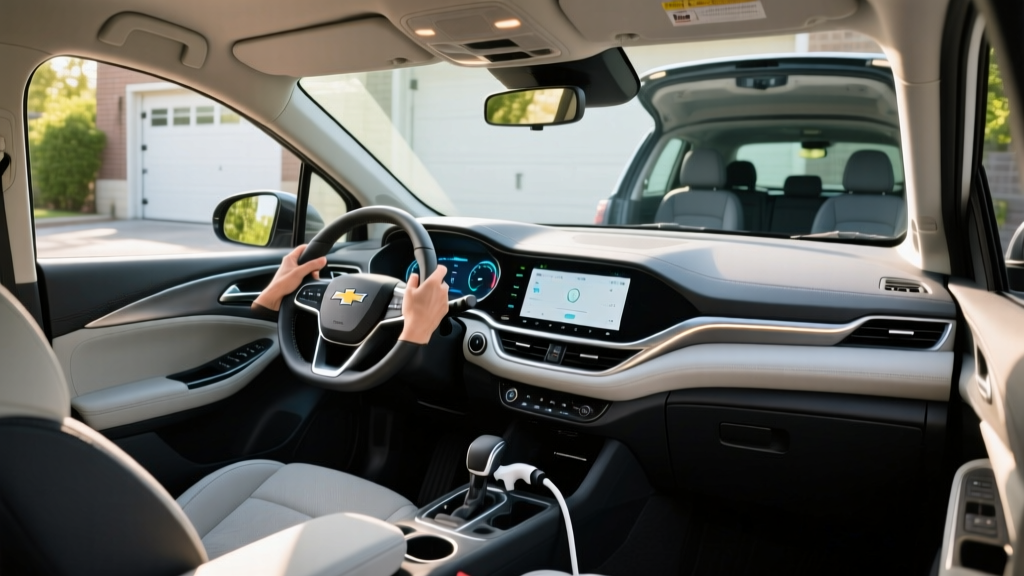
2023 Chevy Bolt Interior: Cabin Space, Materials, and Daily Livability
The 2023 Bolt EV is a subcompact hatchback, and the EUV (Electric Utility Vehicle) is its stretched crossover sibling. Both share the same BEV2 platform, but the EUV adds 6.3 inches of wheelbase, translating directly to rear-seat legroom.
Passenger Space by the Numbers
| Dimension | Bolt EV (Hatchback) | Bolt EUV (Crossover) |
|---|---|---|
| Front Headroom | 40.2 in | 40.0 in |
| Front Legroom | 42.1 in | 42.1 in |
| Rear Headroom | 37.8 in | 38.1 in |
| Rear Legroom | 35.6 in | 39.1 in |
| Cargo (rear seats up) | 16.6 cu ft | 16.3 cu ft |
| Cargo (rear seats folded) | 56.6 cu ft | 56.9 cu ft |
The EUV's 39.1 inches of rear legroom is genuinely generous — enough to comfortably seat adults on longer trips, a common complaint against the standard Bolt EV's tighter 35.6-inch rear. If you regularly carry rear passengers, the EUV is the clear pick.
Materials and Build Quality
Inside, the 2023 Bolt uses hard-touch plastics on the lower door panels and dashboard, consistent with its sub-$30,000 original MSRP positioning. The seats are cloth on 1LT (Bolt EV) and LT (EUV) trims, with leatherette available on 2LT and Premier trims. The steering wheel is wrapped in leatherette across all trims.
Build quality is solid for the segment. Panel gaps are consistent, and the cabin doesn't produce excessive rattles — though road noise at highway speeds is more noticeable than in the Hyundai Kona Electric or Volkswagen ID.4. The Bolt's interior prioritizes function over luxury, and that's appropriate given the price point.
Infotainment and Tech
Every 2023 Bolt features a 10.2-inch diagonal touchscreen running Chevrolet Infotainment 3 Plus, with wireless Apple CarPlay and Android Auto. The system is responsive, logically laid out, and includes built-in Google Maps navigation on upper trims. A 8-inch digital driver display replaces traditional gauges, showing speed, range, energy flow, and regen status.
Available tech includes:
- Wireless phone charging pad (Premier / 2LT)
- Bose 7-speaker premium audio (Premier)
- Wi-Fi hotspot (4G LTE, subscription required)
- USB-A and USB-C ports (front); USB-A (rear, EUV only)
Range, Battery, and Real-World Efficiency
Bolt EV: EPA-estimated 259 miles | Expect ~220–240 miles highway, ~180–200 miles in freezing weather
Bolt EUV: EPA-estimated 247 miles | Expect ~210–230 miles highway, ~170–190 miles in freezing weather
Highway driving at 70+ mph and cold temperatures (below 32°F) reduce range by 10–30%. The Bolt lacks a heat pump, so cabin heating draws directly from the traction battery, compounding winter range loss.
Both the Bolt EV and EUV use a 65 kWh lithium-ion battery pack (approximately 60 kWh usable) with NMC (nickel manganese cobalt) cell chemistry supplied primarily by LG Energy Solution. This is not an LFP battery — meaning you'll want to follow the 80% daily charge guideline to minimize long-term degradation, reserving 100% charges for road trips.
Efficiency on the EPA's fueleconomy.gov listing shows the Bolt EV at 120 MPGe combined (131 city / 109 highway), or approximately 28 kWh per 100 miles. The EUV drops slightly to 115 MPGe combined due to its heavier curb weight and less aerodynamic profile.
Spec Table: 2023 Chevy Bolt EV & EUV
| Specification | Bolt EV (1LT / 2LT) | Bolt EUV (LT / Premier) |
|---|---|---|
| EPA Range | 259 miles | 247 miles |
| Battery (Usable) | ~60 kWh (NMC) | ~60 kWh (NMC) |
| Battery (Total) | 65 kWh | 65 kWh |
| Motor Output | 200 hp / 266 lb-ft | 200 hp / 266 lb-ft |
| Drivetrain | FWD (single motor) | FWD (single motor) |
| 0–60 mph | ~6.5 seconds | ~7.0 seconds |
| Max DC Fast Charge | 55 kW | 55 kW |
| 10–80% DC Time | ~60 minutes | ~60 minutes |
| Level 2 Charge Rate | 11.5 kW | 11.5 kW |
| Level 2 (0–100%) | ~7 hours | ~7 hours |
| Efficiency (Combined) | 120 MPGe / 28 kWh/100mi | 115 MPGe / 29 kWh/100mi |
| Cargo (seats up) | 16.6 cu ft | 16.3 cu ft |
| Base MSRP (2023) | $26,500 | $27,800 |
Charging Speeds: The Bolt's Biggest Compromise
If there's one area where the 2023 Bolt shows its age, it's DC fast charging. The Bolt maxes out at 55 kW on a DC fast charger — a figure that was acceptable in 2017 but feels painfully slow in an era where the Hyundai Ioniq 5 peaks at 240 kW and even the budget Chevrolet Equinox EV hits 150 kW.
| Charging Level | Power / Rate | Miles Added per Hour | Best Use Case |
|---|---|---|---|
| Level 1 (120V household) | ~1.4 kW | ~4 miles/hr | Overnight top-up, emergencies |
| Level 2 (240V home) | 11.5 kW | ~39 miles/hr | Daily home charging |
| DC Fast Charge | 55 kW peak | ~180 miles/hr (peak) | Road trips (with patience) |
On a road trip, a 10–80% charge takes approximately 60 minutes at a 50+ kW DC station. The charge curve is relatively flat — the Bolt sustains close to its 55 kW peak through roughly 60% SoC before tapering — but the low ceiling means you'll spend more time at chargers than competitors.
Practical implication: If 90% of your driving is within a 100-mile daily radius and you charge at home overnight, the 55 kW limit is a minor inconvenience you'll rarely encounter. But if you road-trip frequently — say, 300+ miles multiple times a month — the Bolt's charging speed becomes a genuine friction point. Plan for one full-hour stop per 150–180 miles of highway driving.
The Bolt uses a CCS1 (Combined Charging System) connector for DC fast charging and a J1772 inlet for Level 1 and Level 2 AC charging. It does not have a native NACS (Tesla) port, though CCS-to-NACS adapters are available for accessing Tesla Superchargers that support non-Tesla vehicles.
Performance and Driving Dynamics
The 2023 Bolt's single front-mounted permanent-magnet motor produces 200 horsepower and 266 lb-ft of torque. That torque is available instantly from 0 RPM, giving the Bolt a punchy, responsive feel around town that belies its modest horsepower figure.
The Bolt EV hits 0–60 mph in approximately 6.5 seconds; the heavier EUV takes about 7.0 seconds. Neither is a performance EV, but both feel quicker than their numbers suggest in stoplight-to-stoplight city driving.
Regenerative braking is adjustable via two modes:
- Drive (D): Mild regen, similar to engine braking in a gas car. Coast-friendly.
- Low (L) + Regen on Demand paddle: Strong regen approaching one-pedal driving. The steering-wheel paddle lets you modulate regen intensity on the fly — a feature many Bolt owners prefer over binary one-pedal systems.
The Bolt is front-wheel drive only. There is no AWD option. In snow and ice, the instant torque and low center of gravity (battery pack mounted under the floor) help, but winter tires are recommended for owners in cold climates.
Pricing, Trims, and Federal Tax Credit (2026 Used Market)
When new, the 2023 Bolt EV started at an extraordinarily competitive $26,500 MSRP (1LT trim), making it the least expensive EV with 250+ miles of range on the U.S. market. The Bolt EUV started at $27,800 (LT trim).
| Trim | Original MSRP (2023) | Est. Used Price (2026) | Key Features |
|---|---|---|---|
| Bolt EV 1LT | $26,500 | $16,000–$19,000 | 10.2" screen, wireless CarPlay/AA, cloth seats |
| Bolt EV 2LT | $29,900 | $18,000–$22,000 | Leatherette, heated seats/steering, Bose audio |
| Bolt EUV LT | $27,800 | $17,000–$20,000 | Extra rear legroom, roof rails, same tech as 1LT |
| Bolt EUV Premier | $32,400 | $20,000–$24,000 | Leather, panoramic sunroof, adaptive cruise, Super Cruise avail. |
Federal Tax Credit for Used EVs (§25E)
Because the 2023 Bolt is now purchased as a used vehicle in 2026, the relevant federal incentive is the §25E Used Clean Vehicle Credit, not the new-vehicle §30D credit. Per IRS guidelines, the §25E credit provides:
- Up to $4,000 or 30% of the sale price (whichever is less)
- Vehicle must be purchased from a licensed dealer (private-party sales excluded)
- Sale price must be $25,000 or less
- Buyer income caps: $75,000 single / $112,500 head of household / $150,000 joint (modified AGI)
- Vehicle must be at least 2 model years old (2023 Bolts qualify in 2025+)
- Credit is non-refundable — you must have federal tax liability to benefit
- Available once per buyer every 3 years
For a used 2023 Bolt EV 1LT purchased from a dealer at $18,000, a qualifying buyer could claim $4,000 (30% of $18,000 = $5,400, but capped at $4,000), bringing the effective cost to approximately $14,000 — an extraordinary value for a 259-mile EV.
Driver Assistance and Safety
The 2023 Bolt comes standard with Chevy Safety Assist, which includes:
- Automatic Emergency Braking with pedestrian detection
- Forward Collision Alert
- Lane Keep Assist with Lane Departure Warning
- Following Distance Indicator
- IntelliBeam automatic high beams
Available on the EUV Premier trim is Super Cruise — GM's hands-free Level 2 driver-assistance system that operates on over 400,000 miles of pre-mapped divided highways in the U.S. and Canada.
Super Cruise is a driver-assistance system, not a self-driving system. The driver must remain attentive, and an infrared camera monitors head/eye position. Hands-free does not mean attention-free. You are legally and operationally responsible for the vehicle at all times.
The 2023 Bolt EV earned a 5-Star Overall Safety Rating from NHTSA, with 5 stars in frontal and side crash tests. The IIHS rated it "Good" in moderate overlap front and side tests (for the structurally identical prior-year models tested).
Battery Warranty and Longevity
GM provides an 8-year / 100,000-mile battery and powertrain warranty for the 2023 Bolt, covering defects and capacity loss below 60% of original capacity (i.e., if your 65 kWh pack drops below ~39 kWh within the warranty period, GM will repair or replace it).
NMC battery packs of this generation typically degrade 8–12% over the first 100,000 miles based on fleet data and owner reports. A 2023 Bolt with 40,000 miles in 2026 should still retain approximately 93–96% of its original capacity — translating to roughly 245–250 miles of range for the EV model.
Longevity tips for Bolt owners:
- Set daily charge limit to 80% (configurable in the MyChevrolet app)
- Avoid frequent DC fast charging when Level 2 is available
- Minimize sitting at 100% SoC for extended periods (especially in heat)
- Precondition the battery in cold weather before fast charging
Pros and Cons: The Honest Assessment
✅ Pros
- 259-mile EPA range at a bargain used price
- Spacious EUV rear seat (39.1" legroom)
- Punchy 266 lb-ft instant torque
- Wireless CarPlay/Android Auto standard
- Up to $4,000 used-EV tax credit (§25E)
- Solid 5-star NHTSA safety rating
- Super Cruise available on EUV Premier
❌ Cons
- 55 kW DC fast charging — painfully slow for road trips
- No heat pump (significant winter range loss)
- Hard-touch interior plastics throughout
- CCS1 connector (needs adapter for Tesla Superchargers)
- FWD only — no AWD option
- Discontinued model (long-term parts uncertainty)
- Road noise at highway speeds
Who Should Buy the 2023 Chevy Bolt?
✅ Choose the 2023 Bolt EV if:
- You want the most affordable 250+ mile EV on the used market
- Your daily commute is under 100 miles round-trip
- You have reliable home Level 2 charging
- You rarely take road trips exceeding 200 miles
- You qualify for the §25E used-EV credit (income under $75K/$150K)
✅ Choose the 2023 Bolt EUV if:
- You need adult-friendly rear seating
- You want Super Cruise for highway commuting
- You prefer a crossover ride height
❌ Look elsewhere if:
- You road-trip frequently and can't tolerate 60-minute charge stops
- You need AWD for snowy climates (consider the Hyundai Ioniq 5 or VW ID.4 AWD)
- You want the latest charging architecture (150+ kW DC)
- You tow — the Bolt is not rated for towing
Frequently Asked Questions
What is the real-world range of the 2023 Chevy Bolt?
The EPA rates the Bolt EV at 259 miles and the EUV at 247 miles. In real-world highway driving at 70 mph, expect approximately 220–240 miles (EV) or 210–230 miles (EUV). In freezing temperatures (below 32°F), range drops to roughly 180–200 miles due to resistive cabin heating and reduced battery efficiency. The Bolt lacks a heat pump, which exacerbates cold-weather losses compared to EVs that have one.
How fast does the 2023 Bolt charge?
On a DC fast charger, the Bolt peaks at 55 kW, taking approximately 60 minutes for a 10–80% charge. At home on a 240V Level 2 charger (11.5 kW), a full 0–100% charge takes about 7 hours, adding roughly 39 miles of range per hour. On a standard 120V outlet (Level 1), expect about 4 miles per hour — useful for overnight top-ups but impractical as a primary charging method.
Does the 2023 Chevy Bolt qualify for a federal tax credit?
As a used vehicle purchased in 2026, the Bolt qualifies for the §25E Used Clean Vehicle Credit — up to $4,000 or 30% of the sale price (whichever is less). Eligibility requires purchase from a licensed dealer, a sale price under $25,000, buyer income under $75,000 (single) or $150,000 (joint), and the credit is non-refundable (you must owe federal taxes to benefit). Consult a tax professional and review IRS §25E guidelines for your specific situation.
Is the 2023 Bolt worth buying vs. competitors?
At used prices of $16,000–$24,000 (before tax credit), the Bolt is the value king for range-per-dollar. The Hyundai Kona Electric (258 miles EPA) and Nissan Leaf Plus (212–226 miles) are direct competitors, but the Leaf's CHAdeMO connector is becoming obsolete and the Kona typically costs more used. If fast charging is a priority, the VW ID.4 (125 kW DC) or Hyundai Ioniq 5 (240 kW DC) are far better road-trip vehicles — but cost $8,000–$15,000 more on the used market.
What's the biggest drawback of the 2023 Bolt?
The 55 kW DC fast-charging speed is the Bolt's single most significant limitation. On a 400-mile road trip, you'll spend roughly 2–2.5 hours at chargers — nearly double what you'd spend in an Ioniq 5 or Tesla Model 3. For daily commuters who charge at home, this is irrelevant. For road-trippers, it's a dealbreaker.
Will Chevy still support the Bolt with parts and service?
GM has committed to supporting discontinued models with parts and service for a minimum of 10 years after production ends. The Bolt shares many non-powertrain components with other GM vehicles, and the EV powertrain is well-established. Third-party repair networks and independent EV shops are also increasingly capable of servicing Bolts. The larger risk is software updates and proprietary diagnostics, which remain GM-dependent.