Viral dashcam clips of a sleeping Tesla driver slumped behind the wheel of a moving Model Y or Model 3 have become a recurring spectacle on social media. These videos aren't just clickbait—they highlight a dangerous misunderstanding of what Tesla's Autopilot and Full Self-Driving (FSD) Supervised systems can and cannot do. In this review, we break down the 2026 Tesla Model Y's real capabilities, its actual EPA and real-world range, charging speeds, pricing after federal tax credits, and the critical safety context every buyer needs before getting behind the wheel.
The Sleeping Tesla Driver Problem: What Autopilot Actually Is
Tesla Autopilot and FSD (Supervised) are SAE Level 2 driver-assistance systems. The driver must remain fully attentive, keep hands on the wheel, and be prepared to take over instantly. These systems are not self-driving. Only Level 4 services like Waymo operate without a human driver. Sleeping, reading, or using a phone while Autopilot is engaged is illegal, extremely dangerous, and can result in catastrophic crashes.
Tesla's steering-wheel torque sensor and cabin camera monitor driver engagement, but determined users have found workarounds—defeating the very safeguards meant to keep them alive. NHTSA has opened multiple investigations into Autopilot-related crashes, and the consequences of inattention at highway speeds are severe. The sleeping Tesla driver phenomenon isn't a feature showcase; it's a public-safety failure rooted in marketing ambiguity and user overtrust.
2026 Tesla Model Y: Full Spec Breakdown
| Specification | Long Range AWD | Performance |
|---|---|---|
| EPA Range | 320 miles | 295 miles |
| Battery (usable) | ~75 kWh, NMC | ~75 kWh, NMC |
| Drivetrain | Dual-Motor AWD | Dual-Motor AWD |
| Horsepower | 384 hp | 456 hp |
| 0–60 mph | 4.8 sec | 3.5 sec |
| Max DC Fast Charge | 250 kW | 250 kW |
| 10–80% DC Time | ~22 min | ~22 min |
| Level 2 Home Charge | 11.5 kW (~44 mi/hr) | 11.5 kW (~44 mi/hr) |
| Efficiency | 122 MPGe / 28 kWh/100mi | 111 MPGe / 30 kWh/100mi |
| Cargo Volume | 30.2 cu ft (rear up) / 72.0 cu ft (folded) | 30.2 cu ft / 72.0 cu ft |
| Base MSRP | $44,990 | $48,990 |
| Battery Warranty | 8 yr / 120,000 mi | 8 yr / 120,000 mi |
Real-World Range: What the EPA Sticker Doesn't Tell You
Real-world highway (70 mph, 68°F): ~265–285 miles
Cold weather (32°F, highway): ~220–245 miles
City / stop-and-go with regen: ~300–330 miles
Tesla's efficiency is among the best in the EV segment, thanks to a heat pump (standard on all 2026 trims), excellent aerodynamics (Cd 0.23), and sophisticated thermal management. However, sustained highway driving at 70+ mph and cold temperatures both cut into range meaningfully. On a 300-mile road trip in winter conditions, expect to stop and charge. The Model Y's regenerative braking recovers significant energy in city driving, which is why urban range often exceeds the EPA figure.
The battery uses NMC (nickel manganese cobalt) chemistry, which offers higher energy density than LFP but degrades slightly faster over time. Tesla recommends daily charging to 80–90% for NMC packs and 100% only for trips—unlike LFP packs (found in the RWD trim) which tolerate daily 100% charges. This distinction matters for long-term battery health and usable daily range.
Charging Speed: DC Fast, Home, and the Supercharger Advantage
| Charging Level | Power | Speed | Notes |
|---|---|---|---|
| Level 1 (120V) | 1.4 kW | ~3–4 mi/hr | Emergency / overnight trickle only |
| Level 2 (240V, 48A) | 11.5 kW | ~44 mi/hr | Full overnight charge (~7–8 hrs) |
| DC Fast (Supercharger V3) | 250 kW peak | ~175 mi in 15 min | Tapers above 60%; 10–80% ~22 min |
| DC Fast (V4 Supercharger) | Up to 325 kW* | Faster initial ramp | *Vehicle-limited to 250 kW on 2026 Model Y |
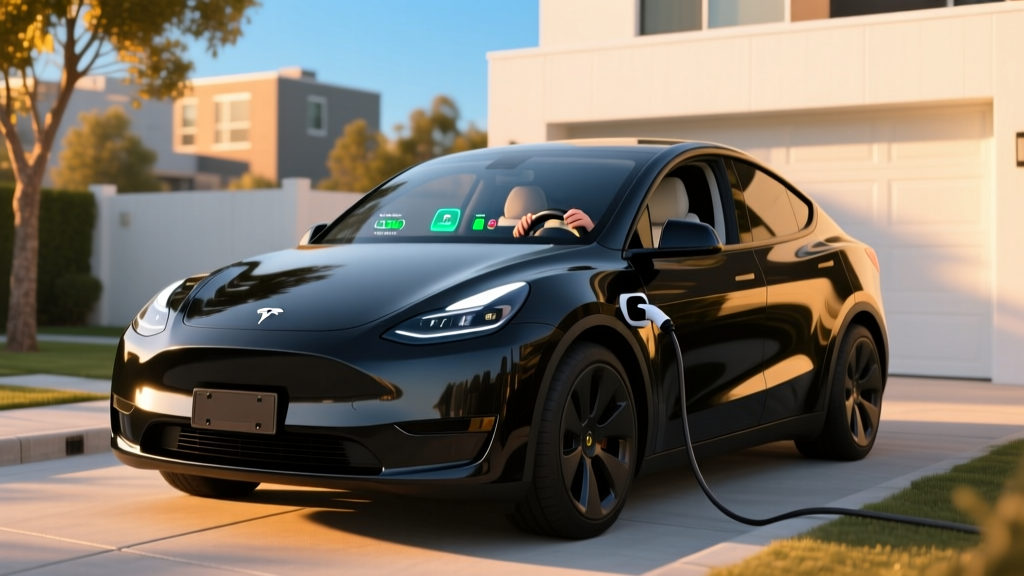
The Model Y charges via the NACS (North American Charging Standard) connector natively—Tesla's proprietary plug now adopted by Ford, GM, Rivian, and others. At a V3 Supercharger, preconditioning the battery (automatic when navigating to a charger) unlocks the full 250 kW peak, but sustained rate averages closer to 150–170 kW across the 10–80% window due to charge-curve taper. Above 80%, charging slows dramatically to protect the cells—plan to unplug at 80% on road trips unless you need the extra range.
Home charging at 11.5 kW requires a Tesla Wall Connector or equivalent NACS-compatible Level 2 unit on a 60A circuit. Expect installation costs of $500–$1,500 depending on panel proximity and local permit fees. A full charge from 10% to 100% takes roughly 7–8 hours—perfect for overnight replenishment.
Pricing, Tax Credits, and Total Cost
| Trim | Base MSRP | Potential §30D Credit | Est. Net Price |
|---|---|---|---|
| Long Range AWD | $44,990 | Up to $7,500 | ~$37,490 |
| Performance | $48,990 | Up to $7,500 | ~$41,490 |
Federal tax credit eligibility under IRS §30D is not guaranteed for every buyer. The 2026 Model Y qualifies under the MSRP cap ($80,000 for SUVs), but buyers must meet income thresholds (≤$150,000 single / ≤$300,000 joint filers) and the vehicle must satisfy critical-mineral and battery-component sourcing requirements that tighten annually. The credit can now be transferred at point of sale as an immediate discount. Always verify current eligibility on the IRS website and consult a tax professional before relying on the credit in your purchase decision.
Destination fees, FSD add-on ($8,000 one-time or $99/month), and premium paint or wheel options push as-tested prices to $50,000–$58,000. Insurance costs for the Model Y run 15–30% higher than comparable gas-powered SUVs due to repair complexity and collision frequency data.
Autopilot, FSD Supervised, and Driver Monitoring
- They do not drive the car autonomously—you are the driver at all times.
- They do not reliably detect stopped emergency vehicles, construction zones, or debris.
- They do not function safely in heavy rain, snow, or poorly marked roads.
- Sleeping while engaged is illegal and has caused fatal crashes investigated by NHTSA.
Tesla's cabin camera monitors eye direction and head position. If the system detects inattention, it issues escalating warnings and eventually disengages, applying hazard lights and slowing the vehicle. However, users have circumvented these checks with weights on the steering wheel or by positioning themselves to fool the camera. Tesla's FSD (Supervised) adds city-street capability—handling traffic lights, stop signs, and turns—but remains a Level 2 system requiring constant oversight. The naming convention ("Full Self-Driving") has drawn criticism from safety advocates and regulators for implying capabilities the system does not possess.
Interior, Tech, and Practicality
The refreshed Model Y interior features a 15.4-inch center touchscreen, ventilated front seats, a rear-seat entertainment screen, and ambient lighting. Cargo space is generous at 30.2 cubic feet behind the second row and 72.0 cubic feet with seats folded—competitive with the Hyundai Ioniq 5 and Ford Mustang Mach-E. Rear legroom measures 41.6 inches, adequate for adults on longer trips. The front trunk (frunk) adds 4.1 cubic feet for charging cables or small bags.
The minimalist cabin eliminates physical stalks and buttons—turn signals are on the steering wheel, and gear selection is via the touchscreen. This design polarizes buyers; test drives are strongly recommended. Over-the-air updates continuously add features, but some core functions (like windshield wiper controls buried in menus) remain ergonomic pain points.
Pros, Cons, and the Verdict
- Class-leading efficiency (122 MPGe)
- Supercharger network reliability (17,000+ U.S. stations)
- Strong 0–60 performance across trims
- Spacious cargo area + frunk
- Continuous OTA improvements
- Competitive pricing after tax credit
- FSD naming creates dangerous overtrust
- No physical controls (stalks, buttons)
- Higher insurance premiums
- NMC battery requires 80% daily charge limit
- Ride quality firm on rough pavement
- Repair costs and wait times post-collision
The 2026 Model Y remains one of the most capable and efficient electric SUVs available. Its Supercharger access, efficiency, and practicality are genuine advantages. But the sleeping Tesla driver narrative is a symptom of marketing that outpaces engineering reality. This is an excellent EV—treat it like one, not like a robotaxi.
Who Should Buy the 2026 Model Y?
- You need a practical family EV with strong range and cargo space
- You road-trip frequently and value Supercharger network coverage
- You want quick acceleration and responsive handling in an SUV
- You can charge at home with Level 2 overnight
- You want a true self-driving vehicle (none exist for consumer purchase at Level 4)
- You prefer physical buttons and traditional controls
- You need LFP chemistry for worry-free daily 100% charging (consider the RWD trim or a Hyundai Ioniq 5)
- You prioritize the lowest possible insurance costs
Frequently Asked Questions
Is it legal to sleep while Tesla Autopilot is driving?
No. Tesla Autopilot and FSD (Supervised) are SAE Level 2 systems requiring full driver attention. Sleeping at the wheel is illegal in every U.S. state and has resulted in fatal crashes and criminal charges. The driver is always responsible for the vehicle.
What is the real-world range of the 2026 Model Y Long Range?
The EPA rates it at 320 miles. In real-world highway driving at 70 mph in moderate temperatures, expect 265–285 miles. In freezing weather, that drops to roughly 220–245 miles. City driving with regenerative braking can exceed the EPA estimate.
How fast does the Model Y charge at home and on the road?
At home on a 240V Level 2 charger (11.5 kW), it adds roughly 44 miles of range per hour, fully charging overnight in 7–8 hours. On a Tesla V3 Supercharger (250 kW peak), it charges from 10% to 80% in approximately 22 minutes, adding up to 175 miles in 15 minutes under ideal conditions.
Does the 2026 Tesla Model Y qualify for the $7,500 federal tax credit?
It can, but eligibility depends on your income (≤$150K single / ≤$300K joint), the vehicle's MSRP (under the $80K SUV cap), and battery-sourcing requirements that change annually. The credit can be applied at point of sale. Verify current rules at IRS.gov and consult a tax professional.
How does the Model Y compare to the Hyundai Ioniq 5 or Ford Mustang Mach-E?
The Model Y leads in efficiency (122 MPGe vs. 114 MPGe for the Ioniq 5) and charging-network reliability (Supercharger vs. mixed third-party networks). The Ioniq 5 offers faster peak charging (350 kW on 800V architecture, 10–80% in ~18 min) and more physical controls. The Mach-E offers a more traditional interior and available LFP battery options. All three are strong choices—test-drive each.
What is Tesla's battery warranty on the Model Y?
Tesla covers the battery and drive unit for 8 years or 120,000 miles (whichever comes first) with a minimum 70% capacity retention threshold. If degradation exceeds 30% within that period, Tesla will repair or replace the battery to restore capacity above the threshold.