Silverado EV Towing Capacity and Quick Verdict
The 2026 Chevrolet Silverado EV slots into the electric truck arena with a headline number that demands attention: a maximum towing capacity of 12,500 pounds when properly equipped with the available Max Trailering package on the RST and LT trims. That figure places it near the top of the current EV truck segment, trailing only the Rivian R1T's updated rating and rivaling the Ford F-150 Lightning's extended-range maximum of 10,000 pounds.
But towing capacity is only part of the story for buyers cross-shopping electric pickups. The Silverado EV also brings a massive 200+ kWh Ultium battery pack, an EPA-estimated range reaching up to 440 miles on select trims, and available four-wheel steering via the e4WD system. After spending time with the specs, charging data, and real-world ownership variables, here's what actually matters if you're considering this truck.
| Spec | WT (Work Truck) | LT | RST |
|---|---|---|---|
| EPA Range | ~370 mi | ~390 mi | ~440 mi |
| Battery (usable) | ~200 kWh (NMC) | ~200 kWh (NMC) | ~200 kWh (NMC) |
| Horsepower | 510 hp | 645 hp | 754 hp |
| 0-60 mph | ~5.5 sec | ~4.5 sec | ~4.0 sec |
| Max Towing Capacity | 10,000 lbs | 12,500 lbs* | 12,500 lbs* |
| Payload | 1,800 lbs | 1,600 lbs | 1,400 lbs |
| Max DC Fast Charge | 350 kW | 350 kW | 350 kW |
| Base MSRP | ~$55,000 | ~$70,000 | ~$87,300 |
*Requires available Max Trailering package. Standard towing rated at 10,000 lbs on LT and RST.
Real-World Range: What the EPA Number Doesn't Tell You
Chevrolet achieves the Silverado EV's range figures by packing in one of the largest battery packs in any consumer vehicle: approximately 200 kWh of usable capacity built on GM's Ultium platform using NMC (nickel manganese cobalt) chemistry. NMC offers high energy density, which is essential for a full-size truck platform pushing over 8,000 pounds of curb weight.
The Work Truck and LT trims, with slightly different tuning and wheel configurations, sacrifice some range for utility. The WT's 370-mile EPA figure remains impressive for a commercial-grade truck, and real-world highway driving should yield roughly 280–310 miles in moderate temperatures.
According to fueleconomy.gov, the Silverado EV RST achieves approximately 63 MPGe combined (equivalent), translating to roughly 53–56 kWh per 100 miles in mixed driving. That's thirstier than a Tesla Model Y or even the Rivian R1T, but expected given the Silverado's mass and frontal area. When towing, efficiency drops to an estimated 90–110 kWh/100mi depending on trailer weight and aerodynamics.
Charging Speed: DC Fast and Home Level 2
The Silverado EV's 800-volt architecture enables peak DC fast-charging rates up to 350 kW — among the fastest in the truck segment. At a compatible 350 kW station (like Electrify America's latest stalls), Chevy estimates a 10–80% charge in approximately 25–30 minutes. That translates to roughly 100 miles of range added in about 10 minutes under ideal conditions.
| Charging Level | Power | Rate / Time | Notes |
|---|---|---|---|
| Level 1 (120V) | ~1.4 kW | ~3 mi/hr | Emergency/trickle only |
| Level 2 (240V, 48A) | 11.5 kW | ~23 mi/hr | Standard home charging |
| Level 2 (240V, 80A) | 19.2 kW | ~38 mi/hr | Optional high-power home |
| DC Fast (peak) | 350 kW | 10-80% in ~25 min | Requires 800V-capable station |
| DC Fast (typical 150 kW) | 150 kW | 10-80% in ~45 min | Most common public DC speed |
A critical detail for home charging: the Silverado EV's enormous battery means Level 2 charging from empty to full takes a long time. On a standard 11.5 kW Level 2 connection, a full 0–100% charge requires roughly 17–18 hours. Most owners will charge incrementally (20–80% daily), which takes about 10 hours at 11.5 kW — fine for overnight top-ups.
If you opt for the available 19.2 kW onboard charger and install a matching 80-amp Level 2 circuit, that full charge drops to roughly 10–11 hours. This requires a 100-amp dedicated circuit and likely a panel upgrade in older homes — budget $1,500–$3,500 for the electrician work, depending on your existing electrical service. The truck ships with a NACS (Tesla-style) charge port for 2026, granting access to the Tesla Supercharger network via native plug.
Towing Performance: What 12,500 Pounds Actually Looks Like
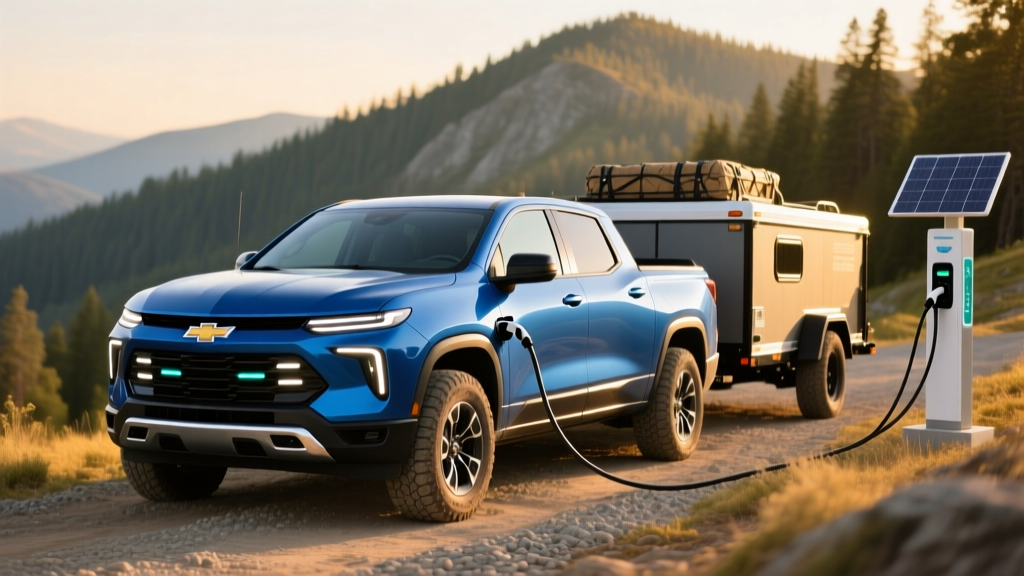
The Silverado EV's maximum 12,500-pound towing capacity requires the Max Trailering package, which includes an upgraded rear axle ratio, enhanced cooling, integrated trailer brake controller, and Chevy's Advanced Trailering System with up to 10 camera views. On the RST, the dual-motor e4WD powertrain delivers 754 horsepower and an estimated 785 lb-ft of torque — more than enough to get heavy loads moving confidently.
The low center of gravity from the floor-mounted battery pack gives the Silverado EV a stability advantage over gas trucks when towing. The independent rear suspension (a first for any Silverado) also improves ride quality with a trailer hitched. However, the physics of moving 8,500+ pounds of truck plus 7,000+ pounds of trailer means energy consumption roughly doubles or triples.
Plan for 150–200 miles of range when towing at highway speeds with a mid-weight trailer (5,000–7,000 lbs). Heavier loads near the max rating will compress that further to 120–160 miles. This makes the Silverado EV best suited for towing within a defined radius — boat to the lake, equipment to a job site — rather than cross-country trailer hauls where DC fast-charging infrastructure for trucks with trailers remains sparse.
Pricing, Trims, and Federal Tax Credit Eligibility
The 2026 Silverado EV lineup has expanded since its initial RST launch, now spanning from the fleet-oriented Work Truck to the premium RST. Here's how pricing breaks down:
| Trim | Base MSRP | As-Tested Range | §30D Credit Eligible? |
|---|---|---|---|
| WT (Fleet/Commercial) | ~$55,000 | $55,000–$65,000 | Yes (if under $80k MSRP cap) |
| LT | ~$70,000 | $70,000–$82,000 | Yes (if under $80k MSRP cap) |
| RST | ~$87,300 | $87,300–$97,000 | No (exceeds $80k truck cap) |
Federal tax credit rules (§30D) for 2026: The Silverado EV qualifies as a truck, meaning the MSRP cap is $80,000 (versus $55,000 for sedans). Buyer income caps apply: $300,000 joint / $225,000 head of household / $150,000 single. Additionally, battery component and critical mineral sourcing requirements must be met for the full $7,500 credit. GM's Ultium batteries are assembled in the U.S., which generally helps with domestic content requirements, but critical mineral sourcing rules tighten annually.
The WT and LT trims (in base configuration) fall under the $80,000 truck cap and should qualify for at least a partial credit for eligible buyers. The RST at $87,300+ exceeds the cap and does not qualify for the federal purchase credit regardless of buyer income. Always verify current eligibility at IRS.gov before purchasing, as sourcing requirements and eligible model lists update periodically.
The point-of-sale transfer option (available since 2024) lets buyers apply the credit as an immediate discount at the dealership rather than waiting to claim it on their tax return — a meaningful cash-flow advantage.
Interior, Cargo, and Technology
The Silverado EV's cabin takes full advantage of its dedicated EV platform. The absence of a transmission tunnel creates a flat floor, and the crew cab configuration offers generous rear legroom — approximately 43.4 inches for rear passengers. The front trunk (frunk) provides roughly 10.7 cubic feet of lockable, weatherproof storage — large enough for tools, groceries, or charging cables.
The bed measures approximately 5 feet 11 inches in length (shorter than a standard gas Silverado short bed), but the available Multi-Flex Midgate lets you fold down the partition between cab and bed, extending usable cargo length to over 9 feet with the tailgate down. This is a genuine differentiator for hauling lumber, kayaks, or ladders.
On the tech front, the RST features a 17.7-inch diagonal infotainment touchscreen paired with an 11-inch driver display running GM's latest Ultifi software platform. Wireless Apple CarPlay and Android Auto are standard. Available Super Cruise — GM's Level 2 hands-free driver assistance system — works on over 750,000 miles of compatible roads and can now handle trailer-assisted towing on approved highways.
Ownership Costs, Warranty, and Who Should Buy
Chevrolet backs the Silverado EV with a 3-year/36,000-mile bumper-to-bumper warranty and an 8-year/100,000-mile battery and powertrain warranty, covering the Ultium pack against defects and excessive degradation (typically defined as falling below 70% state of health within the warranty period). GM has not published a specific degradation curve for the Silverado EV's pack yet, but Ultium-based vehicles in the broader fleet have shown modest degradation of 2–5% over the first 30,000 miles.
Operating costs favor the Silverado EV significantly over its gas counterparts. At the national average electricity rate of ~$0.16/kWh and an efficiency of ~55 kWh/100mi, you're spending roughly $8.80 per 100 miles on electricity — versus $16–$20 per 100 miles for a gas Silverado at 18 MPG and $3.30/gallon. Over five years and 75,000 miles, that's a fuel savings of approximately $5,400–$8,400, depending on local electricity and gas prices.
Pros
- Up to 12,500-lb towing capacity leads the segment
- 440-mile EPA range (RST) is best-in-class for trucks
- 350 kW peak DC charging on 800V architecture
- Multi-Flex Midgate extends cargo length to 9+ feet
- Super Cruise hands-free driving with trailer assist
- Massive frunk (10.7 cu ft) for secure storage
Cons
- RST exceeds $80k — no federal tax credit
- Range drops to ~150 mi when towing heavy loads
- Bed is shorter than gas Silverado standard bed
- Curb weight exceeds 8,500 lbs — tire and efficiency penalty
- 17+ hour full charge on standard Level 2
- Premium trims are very expensive before incentives
Who the Silverado EV Suits Best
Buy it if: You need serious towing capacity for local or regional work (job sites, boat launches, equipment hauling within a ~150-mile radius), want a daily-driver truck with low running costs, and have reliable home Level 2 charging. The WT and LT trims offer the best value proposition with potential tax credit eligibility.
Look elsewhere if: You regularly tow long distances cross-country, need a full 6.5- or 8-foot bed, or want a truck that qualifies for the full $7,500 federal credit in a premium configuration. The Rivian R1T or Ford F-150 Lightning may better serve those use cases.
Silverado EV vs. Key Competitors
| Spec | Silverado EV RST | F-150 Lightning Ext. Range | Rivian R1T Dual Max |
|---|---|---|---|
| EPA Range | ~440 mi | ~320 mi | ~410 mi |
| Max Towing | 12,500 lbs | 10,000 lbs | 11,000 lbs |
| Battery | ~200 kWh NMC | ~131 kWh NMC | ~149 kWh NMC |
| Peak DC Charge | 350 kW | 150 kW | 220 kW |
| Horsepower | 754 hp | 580 hp | 850 hp |
| 0-60 mph | ~4.0 sec | ~4.5 sec | ~3.0 sec |
| Base MSRP | ~$87,300 | ~$72,000 | ~$89,000 |
The Silverado EV's combination of maximum towing and maximum range is currently unmatched. The F-150 Lightning remains the value and fleet-sales leader with lower pricing and widespread dealer support, while the Rivian R1T wins on performance, build quality, and adventure-oriented features. For pure towing numbers, the Silverado EV stands alone.
Frequently Asked Questions
What is the real-world range of the Silverado EV?
The EPA rates the RST at 440 miles and the LT at approximately 390 miles. In real-world highway driving at 70-75 mph, expect 320–360 miles from the RST and 280–310 from the LT. Cold weather (below 30°F) can reduce range by 20–30% without battery preconditioning. When towing, plan for 150–200 miles depending on trailer weight.
How fast does the Silverado EV charge at home and on the road?
On a DC fast charger rated at 350 kW, the Silverado EV can charge from 10–80% in approximately 25–30 minutes. At a more common 150 kW public charger, expect 40–45 minutes for the same range. At home on a standard 48-amp Level 2 (11.5 kW), you'll add about 23 miles per hour, requiring roughly 17–18 hours for a full charge. The available 19.2 kW charger cuts that to about 10–11 hours.
Does the Silverado EV qualify for the $7,500 federal tax credit?
It depends on the trim. The WT (~$55,000) and LT (~$70,000) fall under the $80,000 MSRP cap for trucks and should qualify for eligible buyers meeting income requirements ($300k joint / $150k single). The RST at ~$87,300+ exceeds the cap and does not qualify. Battery sourcing requirements also apply and tighten annually — always verify at IRS.gov before purchase.
Is the Silverado EV worth buying over the F-150 Lightning or Rivian R1T?
If maximum towing capacity and maximum range are your top priorities, the Silverado EV leads both categories. The F-150 Lightning is more affordable with broader dealer support and still offers strong capability for most buyers. The Rivian R1T delivers superior acceleration, ride refinement, and adventure features at a similar price to the RST. Your choice should hinge on whether towing range (Silverado), value (Lightning), or performance (R1T) matters most.
How much does it cost to charge a Silverado EV?
At the national average residential rate of $0.16/kWh and the truck's ~55 kWh/100mi efficiency, a full "tank" (200 kWh) costs roughly $32 at home — delivering 350+ real-world miles. Public DC fast charging is typically more expensive at $0.30–$0.48/kWh, putting a 10–80% charge at approximately $35–$55 depending on the network and location.
Can the Silverado EV power my home or tools?
Yes. The Silverado EV supports bidirectional charging capabilities including V2L (vehicle-to-load) for powering tools and appliances via bed outlets, and available V2H (vehicle-to-home) integration through GM's Energy Transfer system, which can supply backup power to your home during outages — potentially providing days of essential power from the 200 kWh battery.