Quick Answer: Should I Charge My EV to 80% Every Night?
For most EVs with NMC/NCA batteries (Tesla Model 3 Long Range, Hyundai Ioniq 5, Ford Mustang Mach-E): Yes, setting a daily charge limit of 80% is the optimal balance between usable range and long-term battery health. Charging to 80% nightly is perfectly fine — it's sitting at 100% for extended periods that accelerates degradation. However, if your EV has an LFP (lithium iron phosphate) battery (Tesla Model 3 RWD, some BYD models), manufacturers actually recommend charging to 100% at least once a week to maintain battery calibration.
The short version: know your battery chemistry, then set your limit accordingly.
Why the 80% Rule Exists: Battery Chemistry Explained
The "charge to 80%" guidance isn't arbitrary — it's rooted in how lithium-ion cells handle voltage stress. Most EVs on the road in 2026 use one of two cathode chemistries:
| Factor | NMC / NCA | LFP (LiFePO4) |
|---|---|---|
| Common in | Tesla LR/Performance, Ioniq 5, Mach-E, BMW i4, Rivian | Tesla Model 3/Y RWD, BYD, base Nissan Leaf (2025+) |
| Energy density | Higher (more range per kg) | Lower (heavier pack for same range) |
| High SoC stress | Significant — degrades faster above 80% | Minimal — stable at 100% SoC |
| Daily charge recommendation | 80% limit | 100% is fine; do it weekly minimum |
| Cycle life (typical) | 1,000–2,000 full cycles to 80% SoH | 3,000–5,000+ full cycles to 80% SoH |
| Cold-weather performance | Better low-temp output | Reduced performance below 32°F |
| Cost per kWh (pack level) | ~$130–$150 | ~$90–$110 |
With NMC cells, holding a battery at 100% state of charge (SoC) keeps the cathode at its maximum voltage — typically around 4.2V per cell. This accelerates electrolyte oxidation and causes micro-cracking in the cathode structure over hundreds of cycles. Limiting to 80% SoC keeps cell voltage around 3.9–4.0V, dramatically reducing these degradation mechanisms.
LFP cells, by contrast, have a flatter voltage curve and a more stable olivine crystal structure. They tolerate 100% SoC with far less degradation, which is why Tesla's manual for LFP-equipped Model 3 RWD explicitly states to charge to 100% regularly.
Real Degradation Data: What 80% vs 100% Actually Costs You
Theoretical chemistry is useful, but owners want numbers. Here's what real-world data and accelerated aging studies show:
- NMC charged to 100% daily: Expect roughly 10–15% capacity loss over 150,000 miles (roughly 8–10 years of average driving).
- NMC charged to 80% daily: Expect roughly 5–8% capacity loss over the same 150,000 miles.
- LFP charged to 100% daily: Expect roughly 4–7% capacity loss over 150,000 miles.
To put that in concrete terms: a 2026 Hyundai Ioniq 5 Long Range with a 77.4 kWh usable battery and an EPA range of 305 miles would see that range drop to approximately 275–280 miles after 150,000 miles with 80% daily charging, versus 260–270 miles if charged to 100% every night. The difference is real but not catastrophic.
According to data aggregated by fueleconomy.gov, modern EV battery management systems (BMS) include top and bottom buffers — typically 2–5% of gross capacity that the car never lets you access. This means your "100%" on the dash is already slightly below the cell's true maximum, and your "0%" is above true empty. These buffers protect the battery even when you don't manually limit charge.
The Nightly Charging Question: Is Plugging In Every Night Bad?
Here's the misconception that trips up many new EV owners: plugging in every night is not the same as charging every night.
When you plug in and your car is already at or near its charge limit, the vehicle simply maintains the battery at that level with tiny top-up charges. Modern EVs won't "overcharge" — the BMS manages this precisely. In fact, staying plugged in has benefits:
- Thermal management: Many EVs (Tesla, Hyundai/Kia E-GMP, BMW) use grid power to precondition the battery in extreme cold or heat, preserving battery health and range.
- Vampire drain mitigation: EVs draw small amounts of power for connectivity, sentry modes, and OTA updates. Plugging in prevents the 12V and traction batteries from cycling unnecessarily.
- Off-peak electricity: If your utility offers time-of-use (TOU) rates, scheduling charging for 11 PM – 6 AM can cut your per-kWh cost by 30–60%.
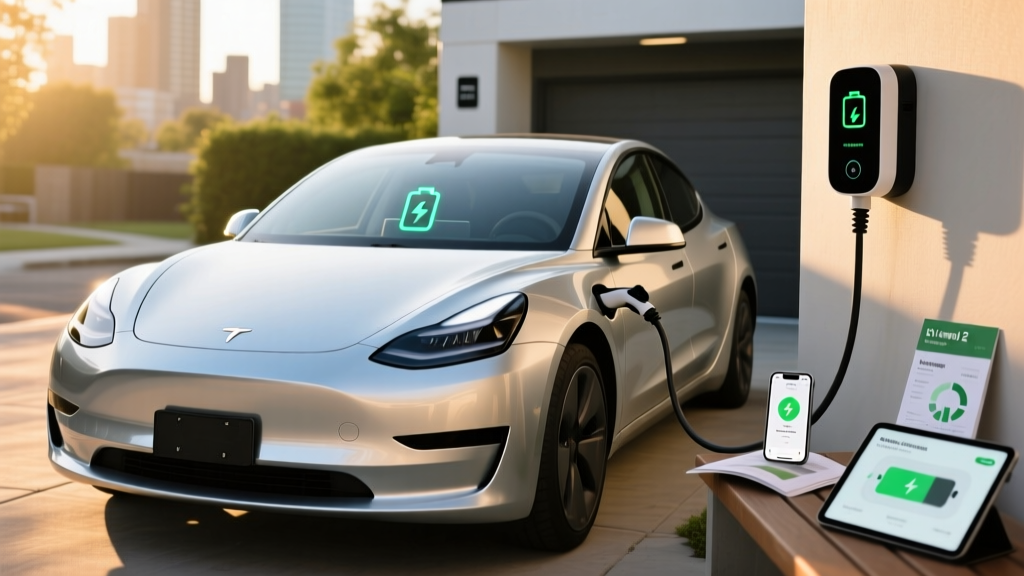
The practical recommendation: Plug in whenever you park at home. Set the charge limit to 80% (NMC) or 100% (LFP). Schedule charging for off-peak hours if your utility supports it. This is the lowest-stress, lowest-cost ownership pattern.
Cost Context: EV Charging vs Gas in 2026
One reason the nightly charging habit matters is cost. Here's how home EV charging stacks up against fueling a comparable gas car:
| Metric | 2026 EV (e.g., Ioniq 5) | 2026 Gas Car (e.g., Toyota RAV4) |
|---|---|---|
| Energy/Fuel cost | $0.13–$0.18/kWh (home avg) | $3.20–$3.80/gallon (national avg) |
| Efficiency | 3.0–3.5 mi/kWh (≈113 MPGe combined) | 30 MPG combined |
| Cost per mile | $0.04–$0.05/mile | $0.11–$0.13/mile |
| Annual fuel/energy (12,000 mi) | $480–$600 | $1,320–$1,560 |
| Annual savings (EV) | $720–$1,080/year | |
| 5-year fuel savings | $3,600–$5,400 | |
DC fast charging on road trips costs more — typically $0.30–$0.48/kWh at Electrify America or Tesla Superchargers — but most owners do 80%+ of charging at home. Even mixing in 20% public DC charging, the blended cost per mile stays well below gasoline.
When You Should Charge to 100%: The Exceptions
The 80% rule is for daily driving. There are specific situations where a full charge is appropriate or even necessary:
- Road trips: Set to 100% the night before a long drive. Occasional 100% charges cause negligible extra degradation — it's daily 100% that matters.
- LFP batteries: Charge to 100% at least weekly. LFP's flat voltage curve means the BMS can't accurately estimate SoC without periodic full charges; skipping this can cause sudden range-readout drops.
- Battery calibration: Even NMC owners should do a 100% charge every 1–2 months followed by immediate driving to help the BMS recalibrate its range estimate.
- Cold weather preconditioning: In sub-freezing climates, a full charge provides more buffer for range loss (typically 20–30% in cold weather) and gives the thermal management system more energy to work with.
Common Misconceptions — Myth vs. Fact
| Myth | Fact |
|---|---|
| "Charging every night damages the battery." | Modern BMS prevents overcharge. Nightly plugging at 80% is one of the gentlest charging patterns possible. |
| "I should let the battery drain to 0% before recharging." | Deep discharges stress lithium-ion cells. Shallow cycles (e.g., 40%→80%) are ideal for NMC. Avoid regularly dropping below 10%. |
| "Fast charging ruins the battery." | Occasional DC fast charging has minimal impact. Sustained daily DCFC at peak rates shows ~2–3% additional degradation over 100k miles vs L2 charging. |
| "My battery will need replacing in 5 years." | Federal law mandates EV battery warranties of 8 years/100,000 miles minimum. Most 2026 batteries are designed to retain 70–80% capacity at 150,000+ miles. |
| "Leaving it unplugged for a week is fine." | Generally yes, but vampire drain (especially with Sentry Mode or climate preconditioning) can drop SoC 1–3% per day. Below 10% SoC for extended periods risks cell damage. |
Actionable Decision Framework: What Should You Do Tonight?
Step 1: Identify Your Battery Chemistry
Check your owner's manual, window sticker, or manufacturer app. If your trim is labeled "Standard Range" or "RWD" (Tesla), it likely has LFP. Long Range, AWD, and Performance trims typically use NMC/NCA. When in doubt, check your vehicle's EPA filing on fueleconomy.gov — the battery chemistry is sometimes listed in the detailed specs.
Step 2: Set Your Charge Limit
- NMC/NCA: Set daily limit to 80%. Set to 90–100% only for road trips or monthly calibration.
- LFP: Set limit to 100%. Charge to 100% at least once per week (daily is fine).
Step 3: Schedule for Off-Peak Hours
If your utility offers TOU rates, schedule charging between 11 PM and 6 AM. This can save $150–$300/year depending on local rates and your driving volume.
Step 4: Plug In When You Park
Make it a habit: plug in when you get home, just like you'd plug in your phone. The car handles the rest. If you're below your limit, it charges. If you're at your limit, it maintains. Either way, your battery stays in the healthiest state.
First-Time EV Buyer Checklist: Battery Health Essentials
- Know your chemistry: NMC = 80% daily; LFP = 100% weekly minimum.
- Install Level 2 at home: A 48-amp (11.5 kW) Level 2 charger on a 60-amp circuit adds ~35–44 miles of range per hour. Installation costs $800–$2,500 depending on panel proximity and local permit requirements.
- Use scheduled charging: Every major EV app (Tesla, Hyundai Bluelink, FordPass, MyBMW) lets you set charge limits and schedules. Configure this on day one.
- Monitor State of Health (SoH): Apps like TeslaFi, Tessie, or the manufacturer's own diagnostics can track your battery's capacity over time. A healthy battery should show less than 2–3% degradation in year one.
- Don't obsess: The difference between "perfect" charging habits and "good enough" habits is typically 2–4% additional capacity retention over 8 years. Drive the car; don't let the battery baby-sit you.
- Understand your warranty: Per the IRS §30D guidelines and federal mandate, battery warranties cover at least 8 years/100,000 miles with a capacity retention threshold (typically 70% of original capacity). If your battery degrades beyond that threshold, replacement is covered.
Frequently Asked Questions
Is it okay to leave my EV plugged in for days at a time?
Yes. Modern EVs will not overcharge. Once the battery reaches your set limit, the car stops drawing current for the traction battery and may use grid power only for thermal management and auxiliary systems. This is actually better for the battery than letting it sit unplugged and slowly drain.
Should I charge to 80% or 90% for my daily commute?
For NMC batteries, 80% is the sweet spot for longevity. However, if your daily round-trip commute exceeds 60% of your EPA-rated range, bumping to 90% is reasonable — the slight increase in degradation is worth avoiding range stress. For example, if your Ioniq 5 has a 305-mile EPA range and you drive 180 miles daily, 90% gives you a more comfortable buffer, especially in cold weather when real-world range drops 20–30%.
Does fast charging (DCFC) count differently than Level 2?
DC fast charging generates more heat, which is a degradation factor. However, modern thermal management systems (liquid cooling in most 2026 EVs) mitigate this significantly. Data from fleet studies suggests that vehicles that DC fast charge 2–3 times per week show only about 2–3% more degradation over 100,000 miles compared to exclusive Level 2 charging. Use DCFC for road trips; rely on Level 2 at home for daily needs.
What if I don't have home charging?
Without home charging, you'll rely on workplace Level 2 or public DCFC. In this case, set your charge limit to 80% when using public chargers (many apps allow this), and try to avoid regularly charging to 100% at DCFC stations unless needed for a trip. The combination of higher charge rates and higher SoC targets at public stations is the most stressful pattern for NMC batteries. Consider whether an LFP-equipped EV (which tolerates 100% better) or a PHEV might be a better fit for your situation.
How do I check if my Tesla has an LFP or NMC battery?
Go to Controls → Software → Additional Vehicle Information on your Tesla's touchscreen. If it lists "LFP" or "Lithium Iron Phosphate," you have an LFP pack. Alternatively, if your Model 3 or Model Y is a Standard Range/RWD variant built from 2021 onward, it almost certainly has LFP. Long Range and Performance variants use NMC/NCA.