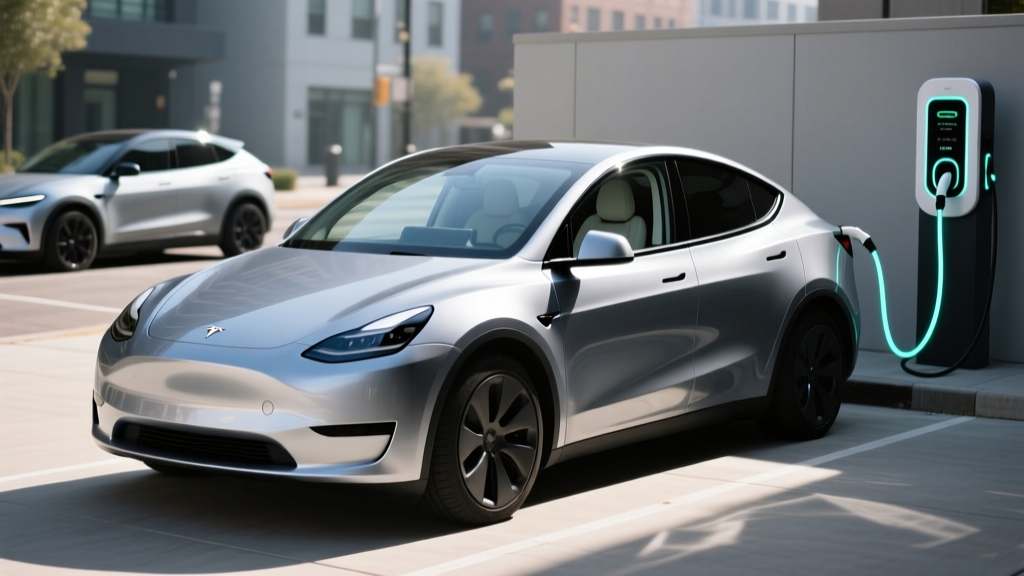
With Tesla's lineup maturing and legacy automakers closing the gap, a growing number of current owners are asking a question that would have been unthinkable five years ago: should I sell my Tesla? Whether you're eyeing a newer Hyundai Ioniq 5, a Rivian R2, or simply want to cash in on remaining resale value before further price cuts, the decision hinges on hard numbers — not brand loyalty.
This guide uses the 2026 Tesla Model Y Long Range AWD as our benchmark — the most popular Tesla on American roads and the vehicle most likely to be on the sell-or-keep fence. We'll run the real-world range, charging economics, tax-credit implications of selling versus buying new, and give you a concrete framework to decide.
2026 Model Y Long Range: The Specs That Determine Resale Value
Before you list your Tesla on Carvana or trade it in, you need to understand exactly what you're selling — and what buyers in 2026 expect from a used EV.
| Spec | Value |
|---|---|
| EPA Range | 330 miles |
| Battery Capacity | ~75 kWh usable (NMC chemistry) |
| Drivetrain | Dual-motor AWD |
| Horsepower | 384 hp (combined) |
| 0–60 mph | 4.8 seconds |
| Peak DC Fast Charge | 250 kW (Supercharger V3/V4) |
| 10–80% DCFC Time | ~27 minutes |
| Level 2 Charge Rate | 11.5 kW (~44 miles/hour) |
| Efficiency | 122 MPGe combined / 28 kWh/100mi |
| Cargo Volume | 30.2 cu ft (rear seats up), 72.1 cu ft (folded) |
| Base MSRP | $44,990 |
| Battery Warranty | 8 years / 120,000 miles (min 70% retention) |
What Your Tesla Is Actually Worth in 2026
Tesla's aggressive price cuts on new vehicles between 2023 and 2025 hammered used Tesla values. A 2022 Model Y Long Range that originally stickered at $65,990 can now be found on the used market for $28,000–$35,000 depending on mileage and condition, according to Kelley Blue Book and CarGurus listings.
Here's what determines your specific resale number:
- Mileage: Under 30,000 miles commands a premium; above 60,000 miles triggers steeper depreciation curves.
- Battery health: Pull your State of Health (SoH) data from the Tesla app or service menu. A battery showing 92%+ retention is worth $2,000–$3,000 more than one at 85%.
- Trim and options: Performance models with the Acceleration Boost and 21" wheels depreciate faster than base Long Range models due to higher initial cost and lower efficiency.
- Color and interior: White exterior with black interior remains the most common — and least premium. Midnight Cherry Red or Quicksilver add modest resale value.
- FSD transfer: Full Self-Driving (Supervised) capability can be transferred to a new Tesla purchase but does not transfer to a private buyer of your used car. This eliminates what was once a $12,000 resale advantage.
If you purchased your Model Y between 2021–2023 at peak pricing, you are likely underwater or near break-even on equity. Owners who bought in 2024 or later at the reduced MSRP are in better trade-in position.
Charging Economics: What You're Paying vs. What a Buyer Expects
One reason owners consider selling is the shift in charging costs. Tesla's Supercharger network — once a free or heavily subsidized perk — now charges market rates that narrow the gap with gas vehicles on road trips.
| Charging Method | Cost per kWh | Cost per Mile | Full Charge Cost |
|---|---|---|---|
| Home Level 2 (national avg $0.16/kWh) | $0.16 | $0.045 | ~$12.00 |
| Tesla Supercharger V3/V4 (avg $0.35/kWh) | $0.35 | $0.098 | ~$26.25 |
| Electrify America / EVgo (avg $0.43/kWh) | $0.43 | $0.120 | ~$32.25 |
| Gas equivalent (25 MPG avg, $3.40/gal) | — | $0.136 | — |
At home, the Model Y remains dramatically cheaper than any gas crossover — roughly $0.045 per mile versus $0.136 for a comparable 25 MPG gas vehicle. But on the road, Supercharger costs have climbed enough that frequent road-trippers see real savings shrink. This matters for resale: buyers increasingly ask about home charging access before committing to a used EV.
The Tax Credit Question: Selling vs. Buying New
If you sell your Tesla and buy a new EV, the IRS §30D federal tax credit becomes a major factor in your financial calculus.
| Requirement | Threshold |
|---|---|
| Vehicle MSRP Cap | $55,000 (sedans) / $80,000 (SUVs/trucks/vans) |
| Buyer AGI Cap (married filing jointly) | $300,000 |
| Buyer AGI Cap (head of household) | $225,000 |
| Buyer AGI Cap (single) | $150,000 |
| Battery Component Manufacturing | Must meet North American assembly thresholds |
| Critical Minerals Sourcing | Must meet FEOC-free supply chain requirements |
| Point-of-Sale Transfer | Available — credit applied at dealer, reducing purchase price |
For Tesla specifically: The Model Y qualifies as an SUV under IRS classification, so the $80,000 MSRP cap applies — meaning all current trims are eligible on price. However, battery-sourcing requirements under the Inflation Reduction Act have shifted year-over-year. Tesla's use of CATL-supplied LFP cells in some Standard Range models has complicated credit eligibility for those trims. The Long Range AWD with NMC cells sourced from Panasonic at the Nevada Gigafactory has maintained eligibility, but you should verify current-year status at fueleconomy.gov before relying on the credit.
If you sell your current Tesla and buy a new Model Y Long Range at $44,990, and you meet all income and sourcing requirements, the effective price drops to $37,490 after the $7,500 credit applied at point of sale. That's a compelling reason to upgrade — but only if your trade-in or sale covers enough of the gap.
Selling Your Tesla? Here's Your Decision Framework
Keep Your Tesla If:
- Your battery SoH is above 90% and you're under 80,000 miles (still well within the 8-year/120,000-mile warranty)
- You have reliable home Level 2 charging and your commute is under 80 miles round-trip
- You purchased in 2024 or later at the reduced MSRP and have positive equity
- Your Tesla has HW4 (Hardware 4) — the latest Autopilot/FSD computer — which supports current and future driver-assist features
- The Supercharger network in your region remains reliable and you value NACS connector access without adapters
Sell Your Tesla If:
- You own a 2021–2022 Model Y with HW3 and want features only available on newer platforms (better cameras, refreshed interior, ambient lighting)
- Your battery SoH has dropped below 88% and you're approaching the warranty mileage limit
- You need more cargo space, towing capacity, or ground clearance than the Model Y provides (consider Rivian R1S, Hyundai Ioniq 9, or Ford Explorer EV)
- Insurance premiums in your state have climbed above $250/month for Tesla coverage (a documented trend in CA, FL, and TX)
- You want to lock in the $7,500 federal credit on a new EV before potential legislative changes — selling now and buying new captures this benefit
How the 2026 Model Y Stacks Up Against Key Competitors
If you're considering selling your Tesla for another EV, here's how the current Model Y compares to the vehicles most likely to replace it in your driveway.
| Spec | Tesla Model Y LR | Hyundai Ioniq 5 LR AWD | Ford Mustang Mach-E ER AWD | Kia EV6 GT-Line AWD |
|---|---|---|---|---|
| EPA Range | 330 mi | 305 mi | 312 mi | 282 mi |
| Battery | 75 kWh NMC | 84 kWh NMC | 91 kWh NMC | 77.4 kWh NMC |
| Peak DC Charge | 250 kW | 240 kW | 150 kW | 240 kW |
| 10–80% Time | 27 min | 18 min | ~38 min | 18 min |
| 0–60 mph | 4.8 sec | 5.1 sec | 5.6 sec | 4.5 sec |
| Base MSRP | $44,990 | $47,400 | $44,495 | $48,900 |
| Cargo (rear up) | 30.2 cu ft | 27.2 cu ft | 29.7 cu ft | 24.4 cu ft |
| Federal Credit | $7,500* | $7,500* | $3,750* | $7,500* |
*Credit eligibility subject to buyer income, battery sourcing, and current-year IRS rules. Verify at irs.gov.
The Ioniq 5 and EV6 charge faster thanks to their 800V architecture (18 minutes 10–80% versus Tesla's 27). The Mach-E offers a more traditional dealership experience but charges noticeably slower. The Model Y still leads in range and Supercharger network access, though Tesla opened that network to NACS-equipped competitors in 2024–2025, reducing its exclusivity advantage.
Autopilot, FSD, and What Actually Transfers at Sale
A common misconception among Tesla sellers is that Full Self-Driving (Supervised) adds dollar-for-dollar to resale value. In 2026, it largely does not.
Here's what happens to software features when you sell:
- Basic Autopilot: Stays with the car. No value adjustment.
- Enhanced Autopilot ($6,000 original cost): Stays with the car. Adds modest resale value (~$1,500–$2,000).
- FSD (Supervised) — purchased outright: Stays with the car. Adds $2,000–$3,500 to private-party resale — far below the $8,000–$12,000 originally paid. Tesla occasionally offers FSD transfers to new Tesla purchases for the original owner, but this is promotional and not guaranteed.
- FSD (Supervised) — monthly subscription: Ends at sale. Nothing transfers. Buyer starts their own subscription if desired.
Where and How to Sell Your Tesla for Maximum Value
The channel through which you sell significantly impacts your return:
- Private sale (Facebook Marketplace, Craigslist, Autotrader): Highest return but most effort. Expect 10–15% more than a trade-in. Use the Tesla app's battery health screen as a selling point — screenshot it for your listing.
- Tesla Trade-In: Convenient if buying a new Tesla. Offers are typically 10–20% below private-party value but can be applied directly against your new purchase, simplifying the tax credit transaction at point of sale.
- Carvana / CarMax / Vroom: Fast and frictionless. Expect offers in the middle — better than trade-in, below private sale. Carvana and CarMax both accept EVs and provide instant online offers based on VIN and mileage.
- Tesla-specific forums and communities: Tesla Motors Club and Reddit's r/teslamotors have classifieds sections where knowledgeable buyers understand HW3 vs HW4, battery chemistry differences, and SoH data — often paying a premium for well-documented vehicles.
Frequently Asked Questions About Selling Your Tesla
What is the real-world range of a 3-year-old Model Y?
A 2023 Model Y Long Range originally rated at 330 miles EPA will typically show 310–320 miles on a full charge after 3 years of normal use, reflecting roughly 3–6% battery degradation. In real-world highway driving at 70 mph, expect 260–280 miles in moderate temperatures. Cold weather (below 30°F) reduces this to 210–240 miles.
How fast does the Model Y charge at home and on the road?
On a home Level 2 charger (11.5 kW / 48A), the Model Y adds approximately 44 miles of range per hour — a full overnight session replenishes the battery completely. On a Tesla Supercharger V3/V4, it peaks at 250 kW and charges from 10–80% in approximately 27 minutes. On non-Tesla DC fast chargers with a NACS-to-CCS adapter (or native CCS on older models), expect 150–170 kW peak rates and 35–40 minute 10–80% times.
Does my Tesla still qualify for the federal tax credit if I sell and buy new?
The credit applies to the buyer of the new vehicle, not the seller of the old one. If you sell your Tesla and purchase a new qualifying EV, you may claim the §30D credit (up to $7,500) if you meet the income caps ($150K single / $300K married filing jointly), the vehicle meets MSRP caps ($80K for SUVs), and the battery sourcing requirements are satisfied. The credit can now be transferred at point of sale, reducing your purchase price directly. Verify current eligibility at irs.gov.
Is it worth selling my Tesla for a Hyundai Ioniq 5 or Kia EV6?
If faster DC charging (18 min vs 27 min 10–80%) and a more conventional interior with physical controls matter to you, yes. The Ioniq 5 and EV6 use 800V architecture that outpaces Tesla's 400V system at compatible chargers. However, you'll sacrifice 25–50 miles of EPA range, lose direct Supercharger access (though NACS adapters and native NACS ports on 2025+ models help), and pay a comparable or slightly higher MSRP. The trade is charging speed and build quality for range and network simplicity.
Will Tesla buy back my car?
Tesla offers a trade-in program through their website and app. You enter your VIN, mileage, and condition details, and receive an offer — typically valid for 30 days or 1,000 additional miles. Tesla trade-in offers are competitive with CarMax but generally below private-party value. The advantage is seamless application toward a new Tesla order, and the trade-in value reduces the taxable amount of your new purchase in most states.
What are the biggest pros and cons of keeping vs. selling?
Keep Your Tesla — Pros
- Supercharger network still the most reliable DCFC ecosystem
- OTA updates continue adding features
- Home charging economics remain unbeatable ($0.045/mi)
- No transaction costs or sales tax on a new purchase
- Battery warranty coverage up to 120,000 miles
Sell Your Tesla — Pros
- Lock in the $7,500 federal credit on a new EV purchase
- Upgrade to HW4 cameras and refreshed interior (2024+ models)
- Escape rising Tesla insurance premiums in many states
- Switch to a platform with faster 800V charging (Ioniq 5/EV6)
- Avoid further depreciation if Tesla cuts new-vehicle prices again
The decision to sell your Tesla in 2026 is ultimately a math problem, not an emotional one. Pull your battery health data, get three offers (Tesla trade-in, CarMax, and a private-sale estimate), calculate the gap to a new EV after the federal credit, and decide whether the monthly payment difference justifies the upgrade. For most owners with a 2023 or newer Model Y in good health, the numbers favor keeping. For those with older HW3 vehicles approaching 70,000 miles, the trade-up window may be closing as incentives and credit rules evolve.