Quick Answer: Ford Hands-Free Driving in 2028 EVs
Ford's hands-free driving system is called BlueCruise, currently available on the Mustang Mach-E and F-150 Lightning. As of 2026, BlueCruise is a Level 2 driver-assistance system — not autonomous driving — that permits hands-off operation on over 130,000 miles of pre-mapped divided highways in the U.S. and Canada. Ford's upcoming next-generation EVs (targeted for 2027-2028 launch on a new universal platform) are expected to ship with enhanced BlueCruise hardware, but no Level 3 or Level 4 consumer system has been announced. If you're evaluating a Ford EV today specifically for hands-free capability, the 2026 Mach-E (starting ~$42,495) and Lightning (starting ~$54,995) are the models to consider, with BlueCruise either included for a trial period or available as a $2,100 package plus a subscription (~$75/month or $800/year after the trial).
What BlueCruise Actually Does (and Doesn't Do)
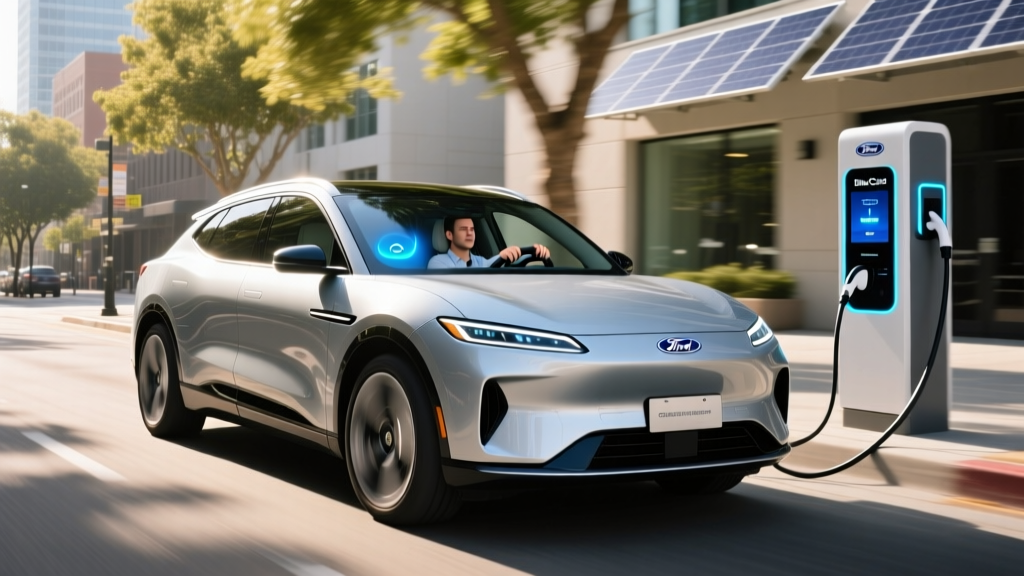
Ford's BlueCruise uses a combination of cameras, radar, and a driver-facing infrared camera to enable hands-off steering on qualified highway sections. The system handles lane centering, adaptive cruise control, and lane changes (on newer versions, BlueCruise 1.3 and above). The driver-facing camera monitors your eyes — you must keep them on the road, even though your hands can leave the wheel.
SAE Level 2: Not Self-Driving
BlueCruise operates at SAE Level 2 automation. This means the system can control steering and acceleration simultaneously, but the human driver remains fully responsible for the vehicle at all times. You are not a passenger — you are a supervisor. This is fundamentally different from Level 4 robotaxi services like Waymo, which operate without any driver in designated geofenced areas. Ford has not announced a Level 3 (eyes-off, conditional automation) or Level 4 consumer vehicle.
In real-world use on interstate highways, BlueCruise performs reliably in clear conditions, maintaining smooth lane position and speed management. However, it disengages or refuses to activate in several common scenarios:
- Construction zones with shifted or missing lane markings
- Heavy rain, fog, or snow that obscure lane lines or camera visibility
- Non-divided roads — BlueCruise only works on pre-mapped divided highways
- Sharp curves exceeding the system's lateral acceleration threshold
- Driver inattention — if the infrared camera detects your eyes off-road for more than a few seconds, it escalates alerts and eventually slows the vehicle
What BlueCruise Will NOT Do
- Navigate city streets, intersections, or traffic lights
- Make turns or handle roundabouts
- Operate in parking lots or driveways
- Function as a substitute for an attentive driver — you are liable for all driving decisions
- Work on unmapped roads, even if they are divided highways
Ford EV Lineup: BlueCruise Availability and Pricing (2026)
As of the 2026 model year, BlueCruise is available on two Ford battery-electric vehicles. Here's how the numbers stack up:
| Spec | 2026 Mustang Mach-E | 2026 F-150 Lightning |
|---|---|---|
| Base MSRP | $42,495 (Select) | $54,995 (Pro) |
| EPA Range | 250–320 mi (battery/trim dependent) | 240–320 mi |
| Battery (usable) | 75.7 kWh (Standard) / 98.8 kWh (Extended) | 101 kWh (Standard) / 131 kWh (Extended) |
| Chemistry | NMC (nickel manganese cobalt) | NMC |
| Peak DC Fast Charge | 150 kW | 150 kW (Standard) / 170 kW (Extended) |
| 10–80% DC Charge Time | ~38 min | ~41 min (Extended Range) |
| Level 2 Charge Rate | 10.5 kW (~32 mi/hr) | 11.3 kW (~30 mi/hr) |
| 0–60 mph | 5.1 sec (GT: 3.5 sec) | 3.8 sec (Extended Range) |
| Horsepower | 290–480 hp | 580 hp |
| BlueCruise Availability | Available on Premium, GT, California Route 1 | Available on Lariat and above |
| BlueCruise Cost | $2,100 package (incl. 90-day trial), then $75/mo or $800/yr | $2,100 package (incl. 90-day trial), then $75/mo or $800/yr |
| Battery/Powertrain Warranty | 8 years / 100,000 miles | 8 years / 100,000 miles |
| Federal Tax Credit (§30D) | Eligibility varies by trim, sourcing, and buyer income — verify at IRS.gov | Same sourcing/income/MSRP-cap rules apply |
Real-world range note: EPA estimates are achieved under ideal test cycles. In highway driving at 70+ mph, expect roughly 85-90% of EPA range in mild weather. In cold conditions (below 32°F), cabin heating and battery thermal losses can reduce range by 20-30%, meaning a Mach-E Extended Range rated at 320 miles EPA might deliver 220-250 miles on a winter highway trip. This matters for road-trip planning, not daily commuting.
What Ford Has Announced for 2027–2028 EVs
Ford has publicly stated it will launch a next-generation EV platform — often referred to internally as a "universal EV platform" — with production targeted for 2027. Vehicles on this platform (expected to include a midsize electric pickup and crossover) are projected to feature:
- Lower-cost battery architectures (including potential LFP options for cost reduction)
- Updated electrical/electronic architecture enabling over-the-air feature expansion
- Next-generation BlueCruise hardware with additional sensor capability
However, Ford has not announced Level 3 or Level 4 autonomy for any consumer vehicle. Any "hands-free driving" in 2028 Ford EVs will almost certainly remain Level 2 — hands off the wheel, eyes on the road, driver fully liable. If you see headlines about "Ford self-driving in 2028," treat them as speculative or referring to Ford's commercial/fleet partnerships (e.g., potential robotaxi pilots), not consumer vehicles you can buy.
EV vs Gas: The Real Ownership Cost Comparison
Hands-free driving is a feature, but the bigger ownership question is whether a Ford EV saves you money compared to a gas equivalent. Here's a 5-year cost comparison between the 2026 Mustang Mach-E (Extended Range Premium) and a comparably equipped 2026 Ford Edge (gas midsize crossover):
| Cost Category (5 Years) | 2026 Mach-E Ext. Range Premium | 2026 Ford Edge ST-Line (Gas) |
|---|---|---|
| Purchase Price (MSRP) | $51,875 | $44,355 |
| Estimated §30D Tax Credit | Up to $7,500 (if eligible — verify sourcing/income) | $0 |
| Effective Purchase Price | ~$44,375 (if full credit applies) | $44,355 |
| Fuel/Energy (60,000 mi) | ~$3,600 (home charging at $0.14/kWh avg) | ~$7,200 (25 MPG combined at $3.00/gal) |
| Maintenance (5 yr) | ~$1,200 (no oil changes, less brake wear) | ~$3,500 (oil, filters, brakes, fluids) |
| Insurance (avg) | ~$11,400 ($2,280/yr — EVs typically 15-20% higher) | ~$9,600 ($1,920/yr) |
| Depreciation (est.) | ~$22,000 | ~$18,500 |
| 5-Year Total Cost | ~$82,575 | ~$83,155 |
Key takeaways: The Mach-E's higher insurance premiums and steeper depreciation largely offset fuel and maintenance savings over five years. The federal tax credit is the swing factor — if you qualify for the full $7,500 under current IRS §30D rules, the EV comes out slightly ahead. If you don't qualify (due to income caps, battery-sourcing requirements, or MSRP limits), the gas Edge is cheaper to own over 5 years. Your actual electricity rate, annual mileage, and local gas prices will shift these numbers significantly.
Home Charging: The Make-or-Break Factor
Hands-free highway driving gets the attention, but 80-90% of EV charging happens at home. If you cannot install a Level 2 home charger, EV ownership becomes substantially less convenient.
| Item | Estimated Cost Range |
|---|---|
| Level 2 Charger (240V, 40-48A) | $400–$700 (Ford Mobile Power Cord included; dedicated wall unit extra) |
| Electrician labor (240V outlet or hardwire) | $500–$2,000 |
| Electrical panel upgrade (if needed, 100A→200A) | $1,500–$3,500 |
| Permit and inspection | $50–$300 |
| Total (no panel upgrade) | $950–$3,000 |
| Total (with panel upgrade) | $2,450–$6,500 |
The Mach-E and Lightning both support ~10.5–11.3 kW Level 2 charging, which adds roughly 30-32 miles of range per hour. A full overnight charge (8-10 hours) replenishes the entire battery — more than adequate for daily driving. Per fueleconomy.gov, the Mach-E Extended Range achieves approximately 101 MPGe combined, translating to roughly 3.0–3.5 miles per kWh depending on conditions.
If you lack home charging access (apartment, street parking, no garage), you'll rely on public Level 2 and DC fast chargers. At current Electrify America or EVgo pricing ($0.40–$0.55/kWh), your fuel cost roughly doubles compared to home charging, and you'll spend 30-45 minutes per session at a DC fast charger 1-2 times per week. This is viable but meaningfully less convenient.
Common Misconceptions About Ford Hands-Free Driving
| Myth | Fact |
|---|---|
| "BlueCruise is self-driving" | It's SAE Level 2. You must monitor the road and are legally responsible for all driving actions. |
| "I can use BlueCruise on any road" | It only activates on pre-mapped divided highways (~130,000 miles in North America). City streets, rural roads, and construction zones are excluded. |
| "Ford's 2028 EVs will be fully autonomous" | No Ford consumer vehicle has been announced with Level 3+ capability. Expect enhanced Level 2 at most. |
| "BlueCruise works in all weather" | Heavy rain, snow, fog, and glare can cause the system to disengage. You must be ready to take over instantly. |
| "EVs cost more to own no matter what" | With the §30D credit, home charging, and reduced maintenance, 5-year total cost can be competitive with gas — but insurance and depreciation narrow the gap. |
| "The battery will need replacing in 5 years" | Ford warranties the battery for 8 years/100,000 miles against degradation below 70% capacity. Real-world data from older Mach-E and Lightning fleets shows ~5-8% degradation at 60,000 miles — well within warranty thresholds. |
Decision Framework: Should You Buy a Ford EV for Hands-Free Driving?
Choose the Ford Mach-E or Lightning with BlueCruise if:
- You drive 10+ miles of divided highway daily (interstate commute) where BlueCruise adds genuine comfort
- You have access to home Level 2 charging (garage or driveway with 240V capability)
- You qualify for some or all of the §30D federal tax credit (check income caps: $150K single / $300K joint, and MSRP caps: $55K cars / $80K trucks/SUVs at IRS.gov)
- You value reduced maintenance (no oil changes, regenerative braking extends pad life)
- You accept that BlueCruise is a premium driver-assist, not autonomy — you're still driving
Look elsewhere (or wait) if:
- You expected "self-driving" — no consumer Ford offers this, and none will by 2028
- You lack home charging access and your area has sparse public DC fast-charging infrastructure
- Your daily driving is primarily city/suburban — BlueCruise doesn't activate outside divided highways
- You're counting on a fully autonomous Ford EV in 2028 — that product does not exist and hasn't been announced
- You need the lowest possible 5-year cost and don't qualify for the federal tax credit — a hybrid like the Ford Maverick Hybrid may be more economical
Frequently Asked Questions
Is BlueCruise included in the price of a Ford EV?
BlueCruise typically comes with a 90-day free trial when you purchase the $2,100 BlueCruise package on eligible trims. After the trial, it requires a subscription: $75/month or $800/year. Some promotional offers include extended trials, but ongoing use is not free. Factor this into your ownership budget — it's roughly $4,000 over 5 years on top of the vehicle purchase.
How does BlueCruise compare to Tesla Autopilot or GM Super Cruise?
BlueCruise and GM's Super Cruise are closely matched — both are hands-off, eyes-on Level 2 systems that operate on pre-mapped highways. Super Cruise covers more mapped miles (~400,000) and has slightly smoother lane-change behavior. Tesla Autopilot/FSD (Supervised) works on more road types but still requires hands-on-wheel engagement in most configurations. None of these systems are self-driving. All require active driver supervision and place legal liability on you.
Will a 2028 Ford EV have better hands-free driving than today's BlueCruise?
Likely yes in incremental ways — better sensor hardware, expanded highway coverage, possibly automated lane changes in more scenarios. But Ford has not committed to Level 3 (eyes-off) autonomy for any consumer product. Expect a more capable Level 2 system, not a fundamentally different autonomy level. If Level 3+ matters to you, the only currently available consumer option in the U.S. is Mercedes-Benz Drive Pilot (Level 3) in the EQS sedan, limited to specific highways in Nevada and California at speeds under 40 mph.
What happens if I cancel my BlueCruise subscription?
The vehicle reverts to standard adaptive cruise control with lane centering — you lose the hands-off capability and the driver-monitoring camera integration. All standard safety features (automatic emergency braking, blind-spot monitoring, lane-keeping assist) continue to function. The car remains fully drivable; you simply lose the premium hands-free highway feature.
Does using BlueCruise affect my insurance rate?
Currently, most insurers do not offer discounts specifically for Level 2 driver-assist systems. EV insurance premiums tend to run 15-20% higher than comparable gas vehicles due to higher repair costs and vehicle values. BlueCruise use does not currently increase or decrease your premium, but some insurers are beginning to consider ADAS data in future pricing models.