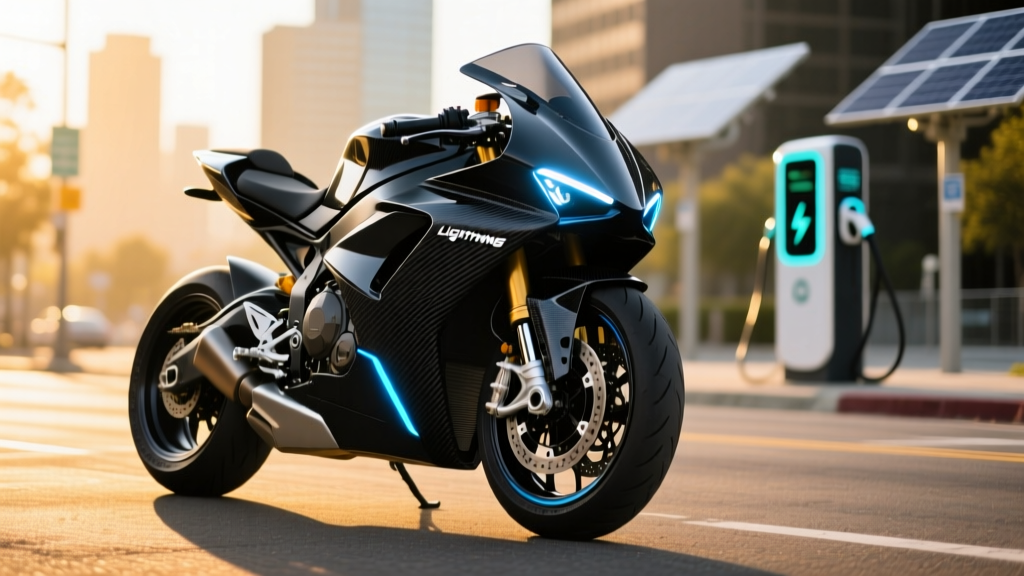
The Lightning LS-218 earned its name by hitting 218 mph at the Bonneville Salt Flats, cementing its status as one of the fastest production electric motorcycles ever built. But beyond the headline-grabbing top speed, the LS-218 is a low-volume, hand-built machine from a California startup that occupies a very specific niche: collectors and enthusiasts who want electric superbike performance without the Ducati price tag. This review breaks down what owning one actually looks like in 2026.
What the Lightning LS-218 Actually Is
Lightning Motorcycles, based in San Carlos, California, began producing the LS-218 in limited numbers after its 2014 debut. Unlike mass-market EVs from Tesla or Rivian, the LS-218 is essentially a boutique, semi-custom superbike. Production volumes are extremely low — Lightning builds to order, and delivery timelines can stretch months. The company has explored partnerships and concept variants over the years, but the core LS-218 platform remains a hand-assembled, high-performance electric motorcycle aimed squarely at experienced riders who prioritize acceleration and exclusivity over practicality.
This is not a commuter motorcycle. It has no storage, minimal weather protection, and a riding position optimized for speed, not comfort. Think of it as the electric equivalent of a limited-run MV Agusta or Confederate/Harley-Davidson LiveWire competitor, but with far more raw performance on paper.
Performance: 200 HP and a 218 MPH Top Speed
The LS-218's headline numbers are staggering, even by 2026 superbike standards:
- 0–60 mph: Approximately 2.2 seconds (manufacturer claim, dependent on battery pack and gearing)
- Top speed: 218 mph (Bonneville-proven; street-limited by gearing configuration)
- Peak power: 200 HP (150 kW) from a liquid-cooled IPM synchronous motor
- Peak torque: 168 lb-ft at the motor shaft, available from 0 RPM
- Drivetrain: Single-speed chain drive, rear-wheel
- Curb weight: Approximately 580 lbs (varies by battery pack choice)
Instant electric torque delivery means the LS-218 pulls harder off the line than virtually any internal-combustion superbike, including the Ducati Panigale V4 and BMW S1000RR. The single-speed transmission eliminates shifting entirely — you twist and go. However, sustaining 218 mph requires specific gearing that compromises low-speed tractability. Most owners opt for street-friendly gearing that caps top speed around 150–180 mph but improves acceleration and city rideability.
Range, Battery, and Real-World Expectations
EPA-equivalent estimate: ~80–100 miles (city cycle, 12 kWh pack)
Real-world highway (70+ mph): Expect 45–60 miles
Cold-weather (below 40°F): Reduce estimates by 15–25%
Lightning offers the LS-218 with multiple battery pack options, historically ranging from a 12 kWh pack to a 20 kWh pack. The chemistry is lithium-ion (NMC-type pouch cells, consistent with the high-discharge requirements of a superbike application — LFP cells, while more durable, are too heavy and energy-density-poor for this use case).
The EPA does not test motorcycles to the same standards as cars, so range figures for the LS-218 are best understood as manufacturer estimates validated by owner reports. The 12 kWh pack delivers roughly 80–100 miles in mixed city riding at moderate speeds. Highway riding at 70+ mph — where aerodynamic drag dominates — cuts that to 45–60 miles. The larger 20 kWh pack extends range proportionally but adds weight, slightly reducing performance.
For context, the Harley-Davidson LiveWire One (15.5 kWh usable) achieves an EPA-estimated 146 miles city / 95 miles highway. The LS-218's smaller battery and higher-performance tuning mean less range, but the trade-off is a power-to-weight ratio the LiveWire cannot match.
Charging Speed: DC Fast and Level 2
| Charging Level | Power (kW) | Time / Rate |
|---|---|---|
| Level 1 (120V household) | ~1.2 kW | ~10–16 hours (0–100%, 12 kWh pack) |
| Level 2 (240V, J1772) | ~3.3–6.6 kW | ~2–4 hours (0–100%, 12 kWh pack) |
| DC Fast Charge (CHAdeMO) | Up to ~20 kW (peak) | ~30 min (10–80%, 12 kWh pack) |
The LS-218 supports CHAdeMO DC fast charging, which is increasingly uncommon in 2026 as the industry consolidates around NACS and CCS. This means finding a compatible public fast charger requires planning — many newer Electrify America and Tesla Supercharger stations do not offer CHAdeMO connectors. Owners should verify station compatibility via apps like PlugShare before relying on public DC charging.
At roughly 20 kW peak DC charge rate, the LS-218's small battery fills relatively quickly in absolute terms, but the charge rate is modest compared to modern four-wheel EVs pulling 150–350 kW. The small battery simply cannot accept high charge rates without excessive heat and cell degradation. Expect the charge curve to taper significantly above 80% State of Charge (SoC), which is standard for NMC chemistry.
Home Level 2 charging at 6.6 kW will fully replenish the 12 kWh pack in approximately 2 hours — adequate for riders who charge overnight between weekend rides.
Pricing, Tax Credits, and Total Cost
The LS-218 has historically been priced in three tiers based on battery pack size and component specification:
| Configuration | Battery | Est. MSRP |
|---|---|---|
| Base (12 kWh) | 12 kWh NMC | ~$38,998 |
| Mid (16 kWh) | 16 kWh NMC | ~$42,998 |
| Top (20 kWh) | 20 kWh NMC | ~$46,998 |
Because Lightning builds to order and production is extremely limited, actual transaction prices may vary. Contacting Lightning Motorcycles directly is the only way to get a firm quote and delivery timeline.
Federal Tax Credit Eligibility (§30D)
The IRS §30D Clean Vehicle Credit applies to qualifying electric motorcycles, but eligibility for the LS-218 is uncertain and depends on several factors that change frequently:
- MSRP cap: Electric motorcycles must have an MSRP under $8,000 to qualify — meaning the LS-218 at $38,998+ does not qualify for the federal §30D credit.
- Battery sourcing: Even if the price cap were met, critical mineral and battery component sourcing requirements must be satisfied.
- Buyer income limits: AGI caps apply ($150K single / $300K joint filers for new vehicles).
Bottom line: at its current pricing, the Lightning LS-218 does not qualify for the federal EV tax credit. Buyers should not factor a $7,500 credit into their purchase budget. Some state-level incentives for electric motorcycles may apply — check your state's energy office or DMV for current programs.
Who Should (and Shouldn't) Buy the LS-218
- Experienced sportbike riders seeking electric performance bragging rights
- Collectors who want a rare, conversation-starting machine
- Riders with home charging and short, spirited ride routes
- Track-day enthusiasts (with appropriate safety gear and venue)
- Daily commuters who need 100+ miles of range
- Riders who rely on public DC fast charging for longer trips
- Buyers expecting dealer-network service and support
- First-time motorcyclists (the power delivery demands respect)
The LS-218 is a garage queen for most owners — a weekend toy that delivers mind-bending acceleration on canyon roads and at track events. It is not a practical daily rider. The limited range, long charge times on DC, CHAdeMO connector dependency, and absence of a dealer service network mean this motorcycle requires deliberate ownership planning.
Pros and Cons
- 218 mph top speed — fastest production electric motorcycle
- 2.2-second 0–60 mph beats nearly any ICE superbike
- Instant torque, no shifting, no clutch — pure acceleration
- Exclusivity — extremely low production numbers
- Liquid-cooled motor sustains performance better than air-cooled rivals
- Near-silent operation appeals to noise-restricted riding areas
- 45–60 mile real-world highway range limits trip planning
- CHAdeMO-only DC charging — increasingly hard to find
- No federal tax credit eligibility (MSRP far exceeds $8K cap)
- Hand-built, low-volume — service and parts require factory contact
- 580-lb curb weight is heavy for a sportbike
- No ABS or advanced rider aids (traction control, wheelie control) standard
- No cargo, no passenger accommodations, minimal wind protection
LS-218 vs. the Competition
| Spec | Lightning LS-218 | Harley-Davidson LiveWire One | Zero SR/S |
|---|---|---|---|
| Peak Power | 200 HP | 105 HP | 110 HP |
| 0–60 mph | ~2.2 sec | 3.0 sec | 3.2 sec |
| Battery (usable) | 12–20 kWh | 15.5 kWh | 15.8 kWh |
| EPA Est. Range (city) | ~80–100 mi | 146 mi | 154 mi (w/ Power Tank) |
| DC Fast Charge | CHAdeMO, ~20 kW | CCS, ~24 kW | CCS, ~18 kW |
| MSRP | ~$38,998+ | ~$21,999 | ~$23,995 |
| ABS / Rider Aids | Limited / None | Cornering ABS, TC | ABS, TC, modes |
The LS-218 wins on raw performance by a wide margin but loses on practicality, safety tech, charging infrastructure compatibility, and price. The LiveWire One and Zero SR/S are far more livable daily riders with better range, modern rider aids, and CCS charging compatibility. The LS-218 exists in a different category — it's a performance statement, not a practical transportation choice.
Warranty and Long-Term Ownership
Lightning Motorcycles has historically offered a limited warranty on the LS-218, though exact terms vary by model year and should be confirmed directly with the manufacturer before purchase. Based on available information:
- Powertrain/motor: Limited warranty, typically 1–2 years
- Battery pack: Limited warranty, typically 2–3 years or a specified mileage threshold
- Battery degradation: NMC cells in high-discharge superbike applications may degrade faster than in conservative four-wheel EVs; expect 10–15% capacity loss over 5 years of moderate use
Battery replacement cost is not publicly listed but can be expected to run $5,000–$10,000+ based on pack size and cell costs. Given the low production volume, replacement parts and service require direct coordination with Lightning — there is no dealer network. This is a critical ownership consideration that separates the LS-218 from mass-produced electric motorcycles with established service channels.
Frequently Asked Questions
What is the real-world range of the Lightning LS-218?
With the 12 kWh battery pack, expect approximately 80–100 miles in city riding at moderate speeds. Highway riding at 70+ mph reduces range to roughly 45–60 miles due to aerodynamic drag. Cold weather (below 40°F) further reduces range by 15–25%. The optional 20 kWh pack extends range proportionally but adds weight.
How fast does the LS-218 charge?
On a DC fast charger (CHAdeMO), the 12 kWh pack charges from 10–80% in approximately 30 minutes at a peak rate of ~20 kW. On a Level 2 home charger (240V, 6.6 kW), a full charge takes about 2 hours. Level 1 (120V household) charging takes 10–16 hours. Note that CHAdeMO public chargers are increasingly rare — plan accordingly.
Does the Lightning LS-218 qualify for the federal EV tax credit?
No. The IRS §30D credit for electric motorcycles requires an MSRP under $8,000. At $38,998+, the LS-218 exceeds this cap and does not qualify. State-level incentives may be available — check your local energy office.
Is the LS-218 worth buying vs. the LiveWire or Zero SR/S?
If your priority is maximum performance and exclusivity, the LS-218 has no equal. If you need daily usability, 100+ miles of range, modern rider aids (ABS, traction control), CCS charging compatibility, and dealer service, the Harley-Davidson LiveWire One or Zero SR/S are far more practical choices at roughly half the price.
What are the biggest drawbacks of owning an LS-218?
Limited highway range (45–60 miles), CHAdeMO-only DC charging (hard to find in 2026), no federal tax credit, no dealer service network, minimal rider aids, and high purchase price. This is a collector/enthusiast motorcycle, not a practical daily rider.
Can I take the LS-218 on a road trip?
Technically yes, but practically it's very difficult. You'll need to plan stops every 45–60 miles at locations with CHAdeMO chargers — which are increasingly scarce. Each charging stop takes ~30 minutes for 10–80%. Most owners use the LS-218 for local rides and track days, not touring.