Quick Answer: What Is the Rosenbauer Electric Fire Truck?
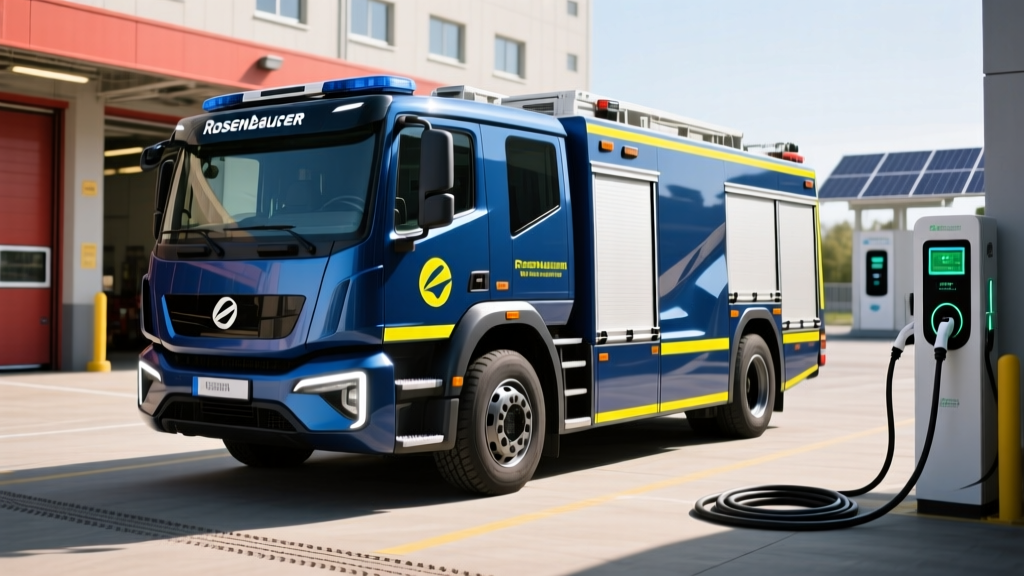
The Rosenbauer RT (Revolutionary Technology) is a battery-electric fire apparatus built on a custom chassis with a fully electric drivetrain and a separate diesel range extender for extended emergency operations. The flagship RT 3000 carries a 132 kWh lithium-ion (NMC) traction battery paired with a ~270 kW electric motor producing roughly 360 hp. Pure-electric range is estimated at up to 186 miles (300 km) under ideal conditions, though real-world urban response driving typically yields 90–130 miles. The diesel range extender provides unlimited operational time at the scene for pump-and-roll and high-load scenarios. Base pricing for a fully configured Rosenbauer RT pumper starts around $1.2–$1.5 million USD, roughly 2–3× the cost of an equivalent diesel custom pumper.
Why Municipalities Are Evaluating Electric Fire Apparatus
Fire departments face mounting pressure to cut diesel idling emissions at stations, reduce noise in residential neighborhoods during early-morning calls, and meet municipal zero-emission fleet mandates. The Rosenbauer RT was designed from the ground up as an electric-first platform rather than a diesel truck with a battery bolted on. This matters because fire apparatus duty cycles are unlike any passenger EV: extreme stop-and-go, heavy accessory loads (pumps, hydraulics, lighting), long station-idle periods, and unpredictable mission lengths.
Rosenbauer, an Austrian firefighting-equipment manufacturer with over 150 years of history and U.S. operations based in Minnesota, began delivering the RT series to European departments in the early 2020s and has since expanded availability to North American markets through its Rosenbauer Group dealer network. Several U.S. pilot programs and international deployments in cities including Berlin, Amsterdam, and Dubai have provided real-world operational data that informs this guide.
Rosenbauer RT Key Specifications
| Specification | Rosenbauer RT (Pumper Configuration) |
|---|---|
| Traction Battery | 132 kWh NMC lithium-ion |
| Electric Motor Output | ~270 kW (360 hp) |
| Pure-Electric Range (ideal) | Up to 186 mi (300 km) |
| Real-World Response Range | ~90–130 mi (urban duty cycle) |
| DC Fast Charge (peak) | Up to 150 kW CCS2 |
| 10–80% Charge Time | ~50–65 minutes (at 150 kW) |
| Level 2 Depot Charging | ~22–44 kW AC |
| Range Extender (diesel) | Inline diesel generator, ~150–200 kW output |
| 0–50 mph (loaded) | ~25 seconds (estimated) |
| GVWR | ~36,000–42,000 lbs depending on config |
| Estimated Base Price | $1.2–$1.5 million USD |
| Battery Warranty | 8–10 years / performance guarantee per contract |
Electric vs Diesel Fire Apparatus: The Data
Comparing a battery-electric Rosenbauer RT to a conventional diesel custom pumper (such as a Pierce Enforcer or E-One Cyclone) requires looking beyond sticker price. Diesel apparatus typically cost $550,000–$800,000 new, depending on pump capacity and aerial configuration, while the RT commands a significant premium. But operational costs tell a different story over a 15–20 year apparatus lifespan.
| Metric | Rosenbauer RT (Electric + Range Extender) | Conventional Diesel Pumper |
|---|---|---|
| Acquisition Cost | $1.2–$1.5M | $550K–$800K |
| Fuel / Energy Cost per Year | $3,000–$6,000 (electric + diesel extender) | $12,000–$22,000 (diesel only) |
| Maintenance Cost per Year | $4,000–$8,000 (fewer moving parts) | $10,000–$18,000 (engine, DPF, DEF, trans) |
| Station Idling Emissions | Zero (electric standby) | Continuous diesel particulate + NOx |
| Noise at Station / Night Calls | Near-silent electric departure | 85+ dB diesel start-up |
| Estimated 15-Year Fuel + Maint. | $105K–$210K | $330K–$600K |
| Apparatus Lifespan | 15–20 years (chassis); battery TBD | 15–25 years |
The fuel and maintenance savings are substantial — potentially $200,000–$400,000 over 15 years — but they do not fully offset the acquisition premium on a single-unit basis. The financial case strengthens when departments factor in EPA Clean School Bus and EPA Clean Heavy-Duty Vehicle grant funding, state air-quality incentives, and the health-cost reduction of eliminating diesel exhaust in fire stations (a known carcinogen exposure risk per NIOSH research).
Real-World Ownership: Charging, Range, and Climate
Deploying a Rosenbauer RT is fundamentally a fleet-infrastructure project, not just a vehicle purchase. Here is what first-time electric apparatus buyers need to understand:
Depot Charging Requirements
The RT is designed for overnight depot charging at the fire station. At a 22 kW AC Level 2 connection, a full 0–100% charge takes roughly 6 hours — sufficient for a typical overnight turnaround. At 44 kW AC (dual charger or higher-power depot unit), that drops to approximately 3–3.5 hours. Stations must install dedicated commercial-grade charging equipment, typically requiring a 480V three-phase electrical service. Electrical infrastructure upgrades for a single bay can range from $25,000–$80,000 depending on existing panel capacity, trenching distance, and utility transformer requirements.
DC Fast Charging for Mutual Aid and Extended Calls
For mutual-aid responses or extended incidents away from the home station, the RT supports up to 150 kW DC fast charging via CCS2 (the European/North American standard for heavy-duty). A 10–80% session takes approximately 50–65 minutes. Note that heavy-duty charging infrastructure is still sparse — departments cannot rely on public networks for emergency recharging. Some progressive departments are installing DC fast chargers at mutual-aid partner stations or regional training centers.
Cold-Weather Range Loss
This is a critical consideration for departments in northern climates. NMC lithium-ion batteries lose 15–30% of usable capacity at temperatures below 20°F (–7°C). The RT includes an active thermal management system with battery preconditioning, which mitigates but does not eliminate cold-weather loss. Departments in Minnesota, Michigan, or New England should plan for an effective winter electric range of 65–110 miles and rely on the diesel range extender for extended winter operations. The Rosenbauer RT's range extender exists precisely for this reason — it eliminates the range-anxiety problem that would otherwise make a pure-electric fire truck operationally risky.
Mission Profile Matters
Urban departments with high call volume but short response distances (3–8 miles per call) are the best candidates for electric operation. The RT can easily complete a full shift of typical urban calls on battery alone. Rural departments with long response distances (15–30+ miles one way) and extended on-scene pump operations will use the range extender frequently, reducing but not eliminating the electric benefits.
Cost Breakdown: Total Cost of Ownership
| Cost Category (15-Year Lifecycle) | Rosenbauer RT Electric | Diesel Pumper |
|---|---|---|
| Vehicle Acquisition | $1,200,000–$1,500,000 | $550,000–$800,000 |
| Depot Charging Infrastructure | $30,000–$80,000 | N/A |
| Fuel / Electricity (15 years) | $45,000–$90,000 | $180,000–$330,000 |
| Maintenance (15 years) | $60,000–$120,000 | $150,000–$270,000 |
| Battery Replacement (est. year 12–15) | $80,000–$150,000 | N/A (engine rebuild: $40K–$80K) |
| DPF / DEF / Emissions Systems | $0 | $25,000–$50,000 |
| Estimated Federal / State Grants | –$150,000 to –$500,000 | $0 |
| Net 15-Year Cost (mid-range) | $1,115,000–$1,490,000 | $905,000–$1,450,000 |
When grants are secured and operational savings compound, the total lifecycle cost of the Rosenbauer RT approaches parity with diesel — and can undercut it in departments with high annual mileage and generous state incentive programs. The EPA's Clean Heavy-Duty Vehicle Program and state-level programs (such as California's HVIP or New York's Truck Voucher Incentive) can cover $150,000–$500,000 of the acquisition premium. Always verify current incentive availability with your state energy office and the IRS, as program funding fluctuates.
Note: The federal §30D clean vehicle credit does not apply to fire apparatus — it covers light-duty vehicles under 14,000 lbs GVWR. However, the Commercial Clean Vehicle Credit (§45W) may apply for municipally owned fleets through direct-pay provisions under the Inflation Reduction Act, potentially offering up to $40,000 per vehicle for vehicles over 14,000 lbs. Consult a municipal tax advisor for eligibility.
Common Misconceptions About Electric Fire Trucks
| Myth | Fact |
|---|---|
| "An electric fire truck will run out of battery during a major incident." | The Rosenbauer RT includes a diesel range extender specifically for extended operations. The truck can run pumps, hydraulics, and lighting indefinitely using the onboard generator. |
| "Electric trucks can't pump water." | The RT's electric drivetrain can power the fire pump via a power take-off system. The range extender supplements during high-flow pumping operations. |
| "Charging takes too long for emergency response." | Depot charging is designed for overnight turnaround. During a shift, the truck departs fully charged. DC fast charging is available for mid-shift top-ups if needed. |
| "Electric fire trucks are unproven and experimental." | Multiple European and Middle Eastern departments have operated Rosenbauer RT units in frontline service since 2021–2022. U.S. pilot programs have generated multi-year operational data. |
| "Batteries will need replacing every 5 years." | NMC heavy-duty batteries are warrantied for 8–10 years with guaranteed capacity retention thresholds (typically 70–80% SoH). Real-world degradation in depot-charged, thermally-managed systems is slower than in passenger EVs. |
| "All departments should switch to electric now." | Electric apparatus are best suited for urban/suburban departments with predictable call patterns, short response distances, and access to depot charging. Rural and wildland departments may not yet be strong candidates. |
Decision Framework: Is the Rosenbauer RT Right for Your Department?
Choose the Rosenbauer RT (electric) if:
- Your department is urban or suburban with average response distances under 10 miles
- Your station has or can install 480V three-phase electrical service for depot charging
- Your municipality has zero-emission fleet mandates or sustainability goals
- You can secure EPA, state, or regional grant funding to offset the acquisition premium
- Firefighter health (diesel exhaust exposure at station) is a priority
- Your annual apparatus mileage is under 8,000–10,000 miles
Stick with a diesel pumper if:
- You operate in a rural area with long response distances and no mutual-aid charging
- Your station electrical service cannot support Level 2+ charging without a $100K+ utility upgrade
- You regularly deploy apparatus for multi-hour wildland or highway incidents far from base
- Your budget cannot absorb the acquisition premium even after grant funding
- You need immediate replacement and cannot accommodate a 12–18 month build lead time
What First-Time Electric Apparatus Buyers Should Know
Purchasing a Rosenbauer RT is not like ordering a diesel pumper from a dealer lot. Key differences include:
- Lead times: Custom electric apparatus may require 18–24 months from order to delivery, versus 12–18 months for conventional diesels.
- Infrastructure planning: Begin electrical infrastructure assessment at least 12 months before expected delivery. Engage your utility early — transformer upgrades can take 6–12 months.
- Training: Firefighters and fleet mechanics need specific training on high-voltage systems, battery safety, and electric drivetrain maintenance. Rosenbauer provides factory training programs.
- Grant applications: Most departments that have successfully deployed electric apparatus did so with significant grant funding. Begin the application process 12–18 months before your planned purchase year.
- Data monitoring: The RT provides telematics for battery state of health (SoH), energy consumption per call, and charging patterns. Use this data to optimize operations and build the case for future electric apparatus purchases.
- Mutual-aid planning: Coordinate with neighboring departments on charging compatibility and emergency recharging protocols.
Frequently Asked Questions
What is the real-world electric range of the Rosenbauer fire truck?
While Rosenbauer rates the RT at up to 186 miles (300 km) under ideal conditions, real-world urban response driving — with frequent acceleration, accessory loads, and climate control — typically yields 90–130 miles on a full charge. Cold weather (below 20°F) reduces this further to approximately 65–110 miles. The diesel range extender provides unlimited additional operational time.
How long does it take to charge the Rosenbauer RT?
At a 22 kW depot charger, a full charge takes roughly 6 hours. At 44 kW, approximately 3–3.5 hours. DC fast charging at 150 kW achieves a 10–80% charge in approximately 50–65 minutes. For most fire departments, overnight depot charging is the primary method, and the truck departs each shift fully charged.
Does the Rosenbauer RT qualify for federal tax credits?
The §30D consumer credit does not apply — it covers light-duty vehicles only. However, the §45W Commercial Clean Vehicle Credit may offer up to $40,000 for qualifying heavy-duty commercial vehicles, and the IRA's direct-pay provisions allow tax-exempt entities (including municipalities) to receive the credit as a direct payment. Verify current rules with the IRS Commercial Clean Vehicle Credit page and a municipal tax professional.
Can the Rosenbauer electric fire truck pump water on battery power alone?
Yes. The RT's electric drivetrain can power the onboard fire pump through an electric power take-off (ePTO) system. For extended high-flow pumping operations (such as a working structure fire lasting multiple hours), the diesel range extender activates to supplement battery power and ensure uninterrupted pump operation.
What happens if the battery degrades over time?
Rosenbauer warranties the traction battery for 8–10 years with a guaranteed state-of-health (SoH) threshold — typically 70–80% of original capacity. Because the RT is depot-charged (controlled charging rates, thermal management, and avoiding extreme SoC levels), degradation is slower than in consumer EVs. A replacement battery pack is estimated at $80,000–$150,000 depending on future cell pricing, which is expected to decline through the 2030s.
How does the Rosenbauer RT compare to other electric fire trucks?
The primary competitor is the Pierce Volterra platform (a parallel-electric hybrid pumper) and the E-One eMAX Electric. The Pierce Volterra uses a smaller battery with a diesel-electric series hybrid approach, offering shorter electric-only range but lower acquisition cost. The Rosenbauer RT is the most battery-dominant design in its class, with the largest pure-electric range, making it the strongest choice for departments prioritizing zero-emission station and response operations.