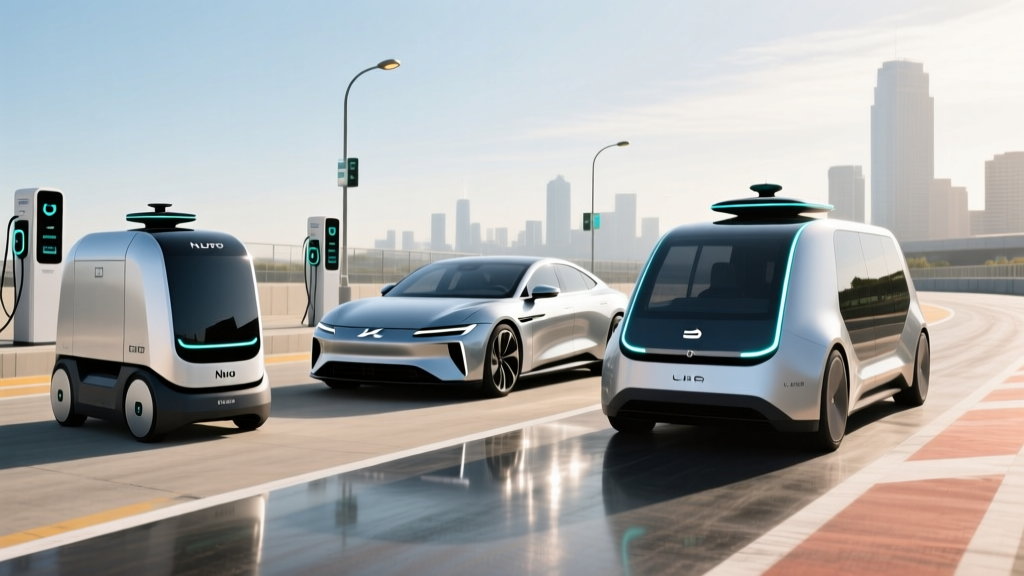
The phrase nuro lucid uber has been surfacing in EV and autonomous-vehicle circles as three very different companies converge on a shared premise: electrified, software-defined mobility is the next decade's dominant architecture. Nuro builds autonomous delivery pods with no steering wheel. Lucid Motors engineers some of the most efficient luxury electric sedans on the road. Uber is aggressively positioning itself as the aggregation layer for robotaxi and autonomous delivery networks. Understanding how these three fit together—and what their technology means for actual EV shoppers—requires separating hype from hardware.
This profile examines each company's current 2026 vehicle platform, the autonomous stack tying them together, and the practical ownership implications if you're considering a Lucid today or watching the robotaxi space for your next mobility decision.
Lucid Air in 2026: The Consumer EV You Can Actually Buy
Of the three entities in the nuro lucid uber conversation, Lucid Motors is the only one selling a vehicle you can drive home today. The 2026 Lucid Air lineup continues to set benchmarks in efficiency and range, leveraging a 900-volt architecture that remains rare outside of Porsche and Hyundai's E-GMP platforms.
| Attribute | Value |
|---|---|
| EPA Range | 419 miles (Pure RWD) |
| Battery Capacity | 88 kWh usable (NMC lithium-ion) |
| Drivetrain | Rear-wheel drive, single motor |
| Horsepower | 436 hp |
| 0–60 mph | 5.0 seconds |
| Max DC Fast Charge | 200 kW peak |
| 10–80% DC Charge Time | ~25 minutes |
| Level 2 Home Charge Rate | 19.2 kW (up to 46 mi/hr) |
| Efficiency | 146 MPGe combined / 23 kWh/100 mi |
| Cargo Volume | 32 cu ft (rear trunk + frunk combined) |
| Rear Legroom | 37.6 inches |
| Base MSRP | $69,900 (Pure trim) |
| Battery Warranty | 8 years / 100,000 miles |
Charging the Lucid Air: Speed, Infrastructure, and the NACS Transition
Lucid's 900V battery architecture enables impressive charge rates, but the charging curve tells the full story. The Air Pure peaks at approximately 200 kW at a low state of charge, sustaining that rate through roughly 50% SoC before tapering to 120–140 kW through 80%. Above 80%, charge speed drops significantly—a universal lithium-ion behavior designed to protect cell longevity.
| Charge Level | Power | Miles Added per Hour | Notes |
|---|---|---|---|
| Level 1 (120V) | 1.4 kW | ~4 mi/hr | Emergency/trickle only |
| Level 2 (240V, 48A) | 11.5 kW | ~30 mi/hr | Standard home charger |
| Level 2 (240V, 80A) | 19.2 kW | ~46 mi/hr | Requires upgraded home circuit |
| DC Fast Charge | 200 kW peak | ~300 mi in 25 min (10-80%) | CCS1 or NACS with adapter |
For 2026, Lucid has adopted the North American Charging Standard (NACS) port on new vehicles, granting native access to Tesla's Supercharger network. Existing CCS-equipped Lucid owners can use a NACS adapter. For home charging, the 19.2 kW onboard charger is among the fastest in the industry, but it requires a 100-amp dedicated circuit—something many homes need a panel upgrade to support. Budget $1,500–$3,500 for a full Level 2 installation depending on your electrical panel's existing capacity.
Nuro R3: The Autonomous Delivery Pod You'll Never Drive
Nuro occupies a fundamentally different lane. The company's third-generation autonomous delivery vehicle, the R3, is a compact, low-speed electric pod designed exclusively for last-mile goods delivery—groceries, prescriptions, restaurant orders. There is no steering wheel, no pedals, and no passenger seat. It is an SAE Level 4 vehicle, meaning it operates without a human driver, but only within geofenced operational zones under specific conditions.
The Nuro R3 is not a vehicle consumers can purchase. It operates as a B2B platform, deployed in partnership with retailers and logistics companies. Its specs are optimized for urban delivery, not range or performance:
- Battery: ~35 kWh LFP (lithium iron phosphate) — chosen for cycle life and thermal stability over energy density
- Range: Approximately 100 miles per charge (sufficient for a full day of local delivery routes)
- Top Speed: 45 mph (electronically limited)
- Charging: Level 2 AC charging, full charge in approximately 4 hours
- Cargo Capacity: Modular compartments, up to 12 standard grocery bags
- Sensors: LiDAR, radar, cameras, ultrasonic — full 360° perception suite
Nuro received an NHTSA exemption allowing production of vehicles without traditional occupant controls, a regulatory milestone that distinguishes it from most AV startups. As of 2026, Nuro operates commercially in select markets including Houston and the San Francisco Bay Area, with NHTSA overseeing safety compliance for these exempted vehicles.
Uber's Autonomous Strategy: Aggregator, Not Automaker
Uber does not manufacture vehicles. Its role in the nuro lucid uber ecosystem is as a platform and distribution layer. In 2026, Uber's autonomous vehicle strategy has three pillars:
- Robotaxi partnerships: Uber has integrated Waymo's Level 4 robotaxi service into its app in Phoenix, San Francisco, and Los Angeles. Riders can hail a Waymo vehicle directly through Uber, with pricing comparable to UberX in most markets.
- Autonomous delivery integration: Uber Eats has piloted Nuro R3 deliveries in select markets, using the pod for last-mile food and grocery drops while a human courier handles the final handoff in complex delivery scenarios.
- Lucid fleet potential: While no formal Uber-Lucid fleet deal has been announced as of early 2026, Lucid's Air platform—with its 400+ mile range and luxury positioning—makes it a natural candidate for premium ride-hail and autonomous-ready fleet applications.
For EV buyers, the Uber connection matters primarily as a signal of where autonomous mobility is heading. The vehicles you buy today are unlikely to be retrofitted into robotaxis, but the sensor suites and software architectures being developed by Nuro and Waymo are informing the ADAS (Advanced Driver Assistance Systems) features appearing in consumer vehicles.
Lucid Air: Federal Tax Credit and Ownership Economics
The 2026 Lucid Air's eligibility for the federal §30D EV tax credit is nuanced. Under current IRS rules, the full $7,500 credit requires meeting battery component and critical mineral sourcing thresholds, buyer income caps, and MSRP limits.
| Trim | MSRP | MSRP Cap Eligible? | Max Potential Credit | Effective Price (with max credit) |
|---|---|---|---|---|
| Pure RWD | $69,900 | Yes (under $55,000 sedan cap? No — sedan cap is $55,000) | $0 (exceeds sedan MSRP cap) | $69,900 |
| Pure AWD | $77,900 | No | $0 | $77,900 |
| Touring | $87,400 | No | $0 | $87,400 |
| Grand Touring | $125,600 | No | $0 | $125,600 |
Critical caveat: The §30D credit caps sedan eligibility at $55,000 MSRP. The Lucid Air, as a luxury sedan starting at $69,900, does not qualify for the federal new-vehicle EV tax credit regardless of buyer income or battery sourcing. Buyers should not factor a $7,500 credit into their purchase decision for any Air trim. Some states offer separate incentives that may apply—check your state energy office or fueleconomy.gov for current local programs.
- Vehicle MSRP must not exceed $55,000 (sedans) or $80,000 (SUVs/trucks/vans)
- Buyer adjusted gross income must not exceed $150,000 (single) / $300,000 (joint)
- Battery components must meet North American manufacturing thresholds
- Critical minerals must meet US or FTA-partner sourcing thresholds
- Credit can be transferred to dealer at point of sale for immediate price reduction
- Tax professional consultation recommended — eligibility is taxpayer-specific
Lucid Air: Pros, Cons, and the Competitive Picture
- Class-leading 419-mile EPA range (Pure RWD)
- Outstanding efficiency: 146 MPGe / 23 kWh/100 mi
- 19.2 kW onboard Level 2 charger — fastest in its class
- Spacious interior with 37.6" rear legroom and 32 cu ft cargo
- 900V architecture enables strong DC fast-charge performance
- NACS native access to Tesla Supercharger network (2026 models)
- DreamDrive Pro ADAS included — adaptive cruise, lane centering, auto parking
- No federal tax credit eligibility — sedan MSRP cap is $55,000
- Limited service center network compared to Tesla or legacy OEMs
- Infotainment screen can be slow to respond under heavy load
- DC fast-charge peak of 200 kW trails Hyundai Ioniq 5's 240+ kW
- Brand awareness and resale value still establishing vs. German luxury rivals
- No Level 3+ autonomous driving — DreamDrive Pro is SAE Level 2 only
Who Should Buy a Lucid Air — and Who Should Watch the Robotaxi Space?
The 2026 Lucid Air is best suited for buyers who prioritize range and efficiency above all else in a luxury sedan. If your commute is long, your road trips are frequent, and you value interior space over badge prestige, the Air Pure at $69,900 delivers more miles per dollar and miles per kWh than nearly any competitor. It's a strong choice for:
- Long-distance commuters who need 400+ miles of real-world range without charging anxiety
- Tech-forward luxury buyers who want cutting-edge EV efficiency without the Tesla ubiquity
- Home-charging households with the electrical capacity for 19.2 kW Level 2 (overnight full charges)
It is not the right choice if you need federal tax credit assistance to justify the purchase, if you rely on a dense dealer service network, or if you're expecting Level 3 or Level 4 autonomous driving. Lucid's DreamDrive Pro is a competent Level 2 system—it maintains speed, centers lanes, and handles stop-and-go traffic—but you must remain engaged with hands on or near the wheel at all times.
For buyers watching the autonomous space: Nuro's R3 and Waymo's robotaxi service (accessible via Uber) represent the real Level 4 experience, but these are services you use, not vehicles you own. The consumer-autonomous convergence is still years away. Buy a Lucid for what it is today—an exceptionally efficient luxury EV—not for what the broader nuro lucid uber ecosystem might become.
Frequently Asked Questions
What is the real-world range of the 2026 Lucid Air?
The EPA rates the Air Pure RWD at 419 miles. In real-world mixed driving, expect 350–380 miles. At sustained highway speeds of 75 mph, plan for 340–370 miles. In freezing temperatures, range can drop to 280–310 miles. Lucid's heat pump system is effective but cannot fully eliminate cold-weather battery losses.
How fast does the Lucid Air charge at home and on DC fast chargers?
On a DC fast charger, the Air peaks at 200 kW and charges from 10–80% in approximately 25 minutes. At home on a 240V/80A Level 2 circuit, it charges at 19.2 kW, adding roughly 46 miles of range per hour—a full charge from empty in under 5 hours. Most owners on a standard 48A Level 2 circuit will see 11.5 kW and ~30 mi/hr.
Does the Lucid Air qualify for the federal EV tax credit?
No. The §30D credit caps sedan MSRP at $55,000, and the least expensive Lucid Air starts at $69,900. No trim qualifies regardless of buyer income or battery sourcing. State-level incentives may still apply—consult your state energy office.
Is the Lucid Air worth buying vs. Tesla Model S or Mercedes EQS?
The Air Pure offers more EPA range (419 vs. Model S's ~402 miles) and significantly better efficiency. The Model S benefits from a more mature Supercharger network (though Lucid now has NACS access), faster 0–60 performance, and stronger resale data. The Mercedes EQS trails in range and efficiency but leads in interior luxury materials and dealer service infrastructure. The Air wins on efficiency and range; choose Tesla for charging confidence and Mercedes for traditional luxury service.
Can I buy a Nuro R3 delivery pod?
No. The Nuro R3 is a commercial autonomous delivery vehicle available only to business partners. It is not street-legal for consumer ownership and has no steering wheel, pedals, or passenger accommodations.
Is Uber's robotaxi service the same as Lucid's driver-assist?
No. Uber's integrated Waymo robotaxi service is SAE Level 4—fully driverless in geofenced zones. Lucid's DreamDrive Pro is SAE Level 2, requiring active driver supervision at all times. These are fundamentally different automation levels with different legal and safety frameworks.
What is the Lucid Air's battery warranty?
Lucid covers the Air's battery and powertrain for 8 years or 100,000 miles, whichever comes first. This is standard for the luxury EV segment and matches Tesla's coverage. The warranty guarantees the battery will retain a minimum percentage of its original capacity (typically 70–75%) over the warranty period.