The Rivian R2T: A Smaller, More Affordable Electric Pickup
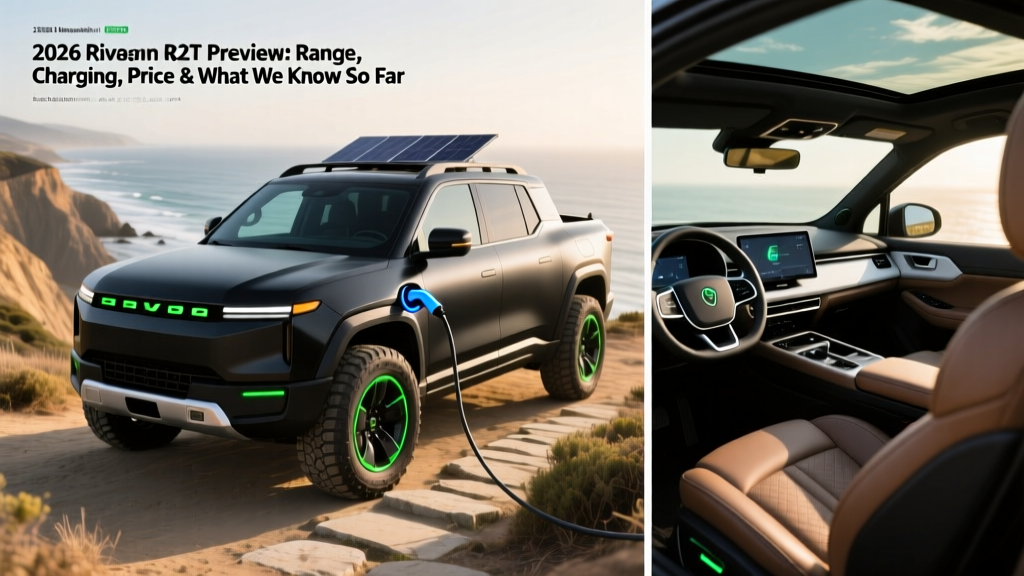
Rivian's R1T proved that an electric truck could handle real work while delivering sports-car acceleration. But at $70,000-plus, it remains out of reach for many buyers. The Rivian R2T is the brand's answer: a midsize electric pickup built on the new, more cost-efficient R2 platform, targeting a starting price near $45,000 and aiming to compete directly with the Ford Maverick hybrid, Toyota Tacoma, and eventually the Chevrolet Silverado EV's lower trims.
As of early 2026, the R2T is announced but not yet on sale. Production of the R2 SUV begins in the first half of 2026 at Rivian's Normal, Illinois plant, with the R2T truck variant expected to follow shortly after. The specifications below are based on Rivian's published preliminary data, executive briefings, and platform disclosures. Final EPA certification figures may differ at launch.
| Attribute | Estimated / Announced Figure |
|---|---|
| EPA Range (target, Standard Battery) | ~300 miles |
| EPA Range (target, Max Battery) | ~330+ miles |
| Battery Capacity (Standard, usable) | ~75 kWh (LFP expected) |
| Battery Capacity (Max, usable) | ~95 kWh (NMC expected) |
| DC Fast Charge (peak) | ~200 kW |
| 10–80% DC Charge Time (est.) | ~28 minutes |
| Level 2 Home Charging | 11.5 kW (~33 mi/hr) |
| Drivetrain (base) | Rear-Wheel Drive (single motor) |
| Drivetrain (AWD/Dual-Motor) | Dual-Motor AWD available |
| 0–60 mph (Dual-Motor AWD, est.) | ~5.0 seconds |
| Horsepower (Dual-Motor, est.) | ~400 hp combined |
| Towing Capacity (target) | ~5,000 lbs |
| Base MSRP (target) | $45,000 |
| Battery Warranty (expected) | 8 yr / 100,000 mi |
Sources: Rivian product announcements; automotive industry reporting. Final EPA figures pending certification.
Range and Efficiency: What to Expect Beyond the Sticker
Rivian has targeted approximately 300 miles of EPA-estimated range for the standard-battery R2T, with a larger Max Battery pack pushing that figure to around 330 miles or more. These are preliminary targets, not yet certified by the EPA.
EPA estimates are measured under controlled lab conditions. Here's what to anticipate in actual driving:
- Highway cruising (70–75 mph): Expect roughly 10–15% less than the EPA sticker — so around 255–270 miles from the standard pack on a long road trip.
- Cold weather (below 32°F): Lithium-based batteries lose efficiency in the cold. Plan for 20–30% range reduction in sustained sub-freezing conditions, bringing effective range to roughly 210–240 miles unless preconditioning is used.
- City/stop-and-go driving: Regenerative braking recovers energy, often yielding range at or slightly above the EPA estimate.
- Towing: Pulling a trailer at highway speeds can cut range by 40–50%. A 5,000-lb tow load may reduce effective range to 150–180 miles.
Rivian's thermal management system and heat pump (expected on R2T) help mitigate cold-weather losses, but physics always wins — plan charging stops accordingly.
Efficiency is projected to land in the range of 95–105 MPGe combined (roughly 32–35 kWh per 100 miles) for the dual-motor AWD variant. The single-motor RWD configuration should be slightly more efficient. For context, the larger R1T Dual-Motor achieves about 73 MPGe combined on the EPA cycle, according to fueleconomy.gov. The R2T's smaller footprint and lighter weight should meaningfully improve that number.
Battery Chemistry: LFP vs. NMC Trade-Offs
Rivian's R2 platform is expected to offer two battery options, mirroring the strategy used on the updated R1S and R1T:
| Factor | Standard Battery (LFP) | Max Battery (NMC) |
|---|---|---|
| Chemistry | Lithium Iron Phosphate | Nickel Manganese Cobalt |
| Usable Capacity (est.) | ~75 kWh | ~95 kWh |
| Range (target) | ~300 miles | ~330+ miles |
| Energy Density | Lower (heavier per kWh) | Higher (lighter per kWh) |
| Cycle Life | 3,000+ cycles (excellent) | 1,000–2,000 cycles (good) |
| Charging to 100% Daily | Recommended — no degradation penalty | Not ideal — accelerates wear above 80% |
| Cold-Weather Performance | Slightly weaker in extreme cold | Better low-temp performance |
| Cost | Lower — enables the $45K price point | Higher — premium upgrade |
The LFP standard battery is a smart fit for daily commuters and fleet buyers who charge at home every night and rarely need maximum range. Its long cycle life means less degradation over time. The NMC Max Battery suits road-trippers and those in cold climates who need every available mile.
Charging Speed: DC Fast Charging and Home Setup
Charging speed is a top concern for truck buyers who plan to tow or road-trip. Here's what we know about the R2T's charging profile:
| Charging Level | Power / Rate | Miles Added per Hour | Notes |
|---|---|---|---|
| Level 1 (120V household) | ~1.4 kW | ~4 mi/hr | Emergency/trickle only |
| Level 2 (240V home, 48A) | 11.5 kW | ~33 mi/hr | Full charge overnight (~9–10 hours) |
| DC Fast Charge (peak) | ~200 kW | ~700+ mi/hr (at peak) | 10–80% in ~28 min (est.) |
Understanding the charge curve: The ~200 kW peak rate is not sustained across the entire session. Like all EVs, the R2T will charge fastest between roughly 10% and 50% State of Charge (SoC), then taper progressively. Expect the 50–80% portion to take nearly as long as 10–50%. Charging above 80% slows dramatically to protect the battery — plan road-trip stops around the 10–80% window for the fastest turnaround.
Home charging reality: A Level 2 home charger at 11.5 kW adds about 33 miles of range per hour of charging. For a daily commute of 40–60 miles, plugging in overnight easily replenishes what you use. Installation of a 240V/60A circuit typically costs $500–$2,000 depending on panel capacity and run length — budget for a licensed electrician to assess your home's electrical panel before purchase.
The R2T is expected to ship with a NACS (North American Charging Standard) port, giving it native access to Tesla's Supercharger network — now the largest DC fast-charging network in North America with over 25,000 stalls. This is a significant practical advantage over vehicles still equipped with CCS1 connectors.
Performance, Drivetrain, and Capability
The R2T will launch with a single-motor rear-wheel-drive base configuration — a first for Rivian — to hit that critical $45,000 price point. A dual-motor AWD variant will be available for buyers who need all-weather traction and stronger acceleration.
- Single-Motor RWD (base): Estimated ~250 hp, 0–60 mph in approximately 6.5 seconds. Adequate for commuting and light hauling.
- Dual-Motor AWD: Estimated ~400 hp combined, 0–60 mph in approximately 5.0 seconds. Competitive with midsize gas trucks in the V6 turbo segment.
Towing capacity is targeted at 5,000 pounds — sufficient for a small boat, utility trailer, or light camper, but below the R1T's 11,000-lb rating. Payload capacity is expected around 1,500 lbs. The R2T's shorter bed (estimated ~4.5 feet) limits what you can haul compared to full-size trucks, but the trade-off is a more maneuverable, urban-friendly footprint.
The R2T is expected to retain Rivian's signature gear tunnel storage (a pass-through compartment behind the cab) and may offer a compact front trunk (frunk), though dimensions are not yet confirmed.
Pricing, Trims, and Federal Tax Credit Eligibility
| Configuration | Est. Base MSRP | Max §30D Credit | Effective Price (if eligible) |
|---|---|---|---|
| RWD Standard Battery | $45,000 | Up to $7,500 | ~$37,500 |
| AWD Dual-Motor Standard | $52,000 | Up to $7,500 | ~$44,500 |
| AWD Dual-Motor Max Battery | $58,000 | Up to $7,500 | ~$50,500 |
Does the Rivian R2T qualify for the federal EV tax credit? Potentially — but eligibility under IRS §30D depends on several conditions that buyers must verify:
- MSRP cap: Trucks, vans, and SUVs must have an MSRP at or below $80,000. All announced R2T trims fall well under this limit. ✓
- Buyer income cap: Adjusted gross income must not exceed $150,000 (single), $225,000 (head of household), or $300,000 (joint).
- Battery sourcing: A percentage of critical minerals and battery components must be sourced from the U.S. or free-trade-agreement countries. These thresholds increase annually — 2026 requirements are stricter than 2025. Rivian's North American assembly is favorable, but specific mineral-sourcing compliance for the R2T has not been confirmed.
- Point-of-sale transfer: Eligible buyers can transfer the credit to the dealer at purchase, reducing the purchase price upfront rather than waiting for a tax refund.
- VIN registration: The vehicle must be registered for personal use in the U.S.
Tax credit rules are subject to change. Consult a tax professional and verify eligibility at irs.gov before purchasing.
Interior, Cargo, and Technology
The R2T is a midsize truck, so interior space prioritizes efficiency over luxury sprawling. Expect:
- Seating: 5 passengers (single row of rear seating, unlike the R1T's optional configurations)
- Bed length: Approximately 4.5 feet (shorter than Tacoma's 5- or 6-foot options)
- Gear tunnel: Expected — Rivian's signature lockable, weather-sealed pass-through storage
- Frunk: Likely, but smaller than the R1T's ~11 cu ft unit
- Infotainment: 15.6-inch center touchscreen running Rivian's proprietary OS, with over-the-air (OTA) updates
- Driver assistance: Rivian's Driver+ system (SAE Level 2) — hands-on-wheel supervised highway assist with adaptive cruise and lane centering. This is not self-driving. The driver must remain attentive at all times.
Rivian Driver+ is a Level 2 driver-assistance system. It can manage steering, acceleration, and braking on compatible highways, but the driver must keep hands on the wheel and eyes on the road. It does not handle construction zones, unmapped roads, or complex urban scenarios autonomously. Only Level 4 services (like Waymo in designated geofenced areas) operate without a human driver.
Warranty Coverage
Rivian's current warranty structure for the R1 platform provides a strong baseline for what to expect on the R2T:
- Battery & drivetrain: 8 years / 100,000 miles (expected) — covering defects and capacity loss below a specified threshold (typically 70% retention)
- Vehicle limited warranty: 5 years / 60,000 miles (expected)
- Roadside assistance: Included for the duration of the basic warranty
For an LFP-equipped R2T, long-term battery degradation should be minimal — LFP chemistry routinely retains 90%+ capacity after 1,000+ charge cycles, which translates to well over 200,000 miles of typical use.
Pros, Cons, and Who Should Buy the Rivian R2T
- Target $45,000 starting price — most affordable electric truck at launch
- NACS charging port — native Tesla Supercharger access
- LFP battery option — excellent longevity, daily 100% charging friendly
- Gear tunnel storage — unique utility no gas truck offers
- OTA software updates — features improve over time
- Compact footprint — easy to park and maneuver in cities
- Short bed (~4.5 ft) limits hauling larger items
- 5,000-lb tow rating — not for heavy trailers or large campers
- Not yet on sale — final specs and pricing unconfirmed
- No crew-cab rear legroom comparable to full-size trucks
- Rivian's service center network is still expanding
- Cold-weather range loss on LFP pack may be noticeable
- Choose the R2T if: You want an electric truck for daily commuting, light hauling, and weekend adventures — and you value a lower price, NACS charging, and a compact footprint over maximum towing and bed length.
- Look elsewhere if: You regularly tow over 5,000 lbs, need a full-size bed, or require a proven service network in rural areas. The Ford F-150 Lightning, Rivian R1T, or Chevrolet Silverado EV may better serve heavy-duty truck needs.
Frequently Asked Questions
What is the real-world range of the Rivian R2T?
Rivian targets approximately 300 miles EPA for the standard battery and 330+ miles for the Max Battery. In real-world highway driving at 70–75 mph, expect about 255–270 miles from the standard pack. In sub-freezing temperatures, plan for 210–240 miles. Towing can cut range to 150–180 miles. These are estimates pending final EPA certification.
How fast does the Rivian R2T charge?
DC fast charging is expected to peak at approximately 200 kW, delivering a 10–80% charge in roughly 28 minutes. At home on a Level 2 (240V) charger at 11.5 kW, the R2T adds about 33 miles of range per hour, fully replenishing overnight. The NACS port provides native access to Tesla Superchargers.
How much does the Rivian R2T cost after tax credits?
The base RWD model is targeted at $45,000 MSRP. If you qualify for the full $7,500 federal §30D tax credit (subject to income, MSRP, and battery-sourcing rules), the effective price drops to approximately $37,500. Higher trims with AWD and Max Battery are estimated at $52,000–$58,000 before credits.
Does the Rivian R2T qualify for the federal EV tax credit?
It is expected to qualify, but eligibility depends on 2026 IRS §30D rules: buyer income must fall below caps ($150K single / $300K joint), the MSRP must be under $80,000 (all R2T trims qualify), and battery critical-mineral sourcing must meet 2026 thresholds. Confirm eligibility with a tax professional before purchasing. Rules may change.
Is the Rivian R2T worth buying vs. competitors?
The R2T occupies a unique niche: a compact, affordable electric truck with NACS charging and clever storage. Compared to the Ford Maverick hybrid (not electric, but similarly priced and practical), the R2T offers zero tailpipe emissions and far lower fuel costs. Against the Ford F-150 Lightning, the R2T is smaller and less capable for towing, but significantly cheaper. If you need a daily-driver truck with light-duty utility and want to go electric without spending $70K+, the R2T is one of the most compelling upcoming options.
When will the Rivian R2T be available?
Rivian has confirmed that R2 platform production begins in the first half of 2026. The R2 SUV leads production, with the R2T truck variant expected to follow. Reservations are open on Rivian's website with a refundable deposit. Final pricing and EPA figures will be confirmed closer to delivery.