Quick Verdict: Can the Compact R2 Conquer Manhattan?
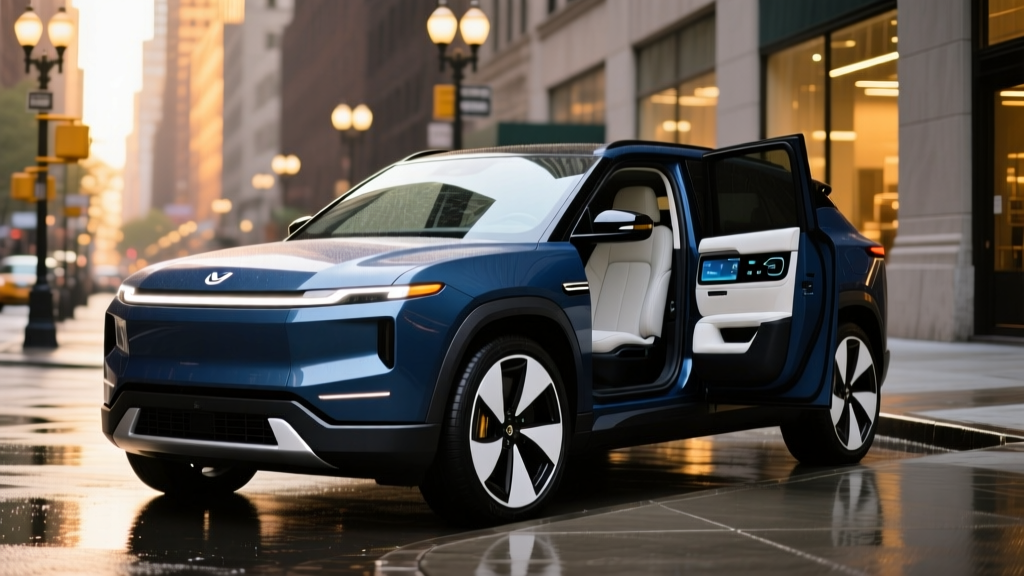
The 2026 Rivian R2 arrives as a compact electric SUV aimed squarely at the mass market — and for urban dwellers in New York City, its design updates carry outsized importance. Rivian has tightened the R2's footprint relative to the R1S while preserving a dual-motor AWD architecture, an 85 kWh (usable) LFP battery option, and a starting price that undercuts the R1 lineup by a wide margin. After months of preliminary spec releases, showroom reveals, and early production units reaching driveways, we've synthesized everything confirmed about the R2's dimensions, range, charging behavior, and city-car viability.
This profile focuses on what the R2's design updates mean for NYC buyers — from curb-length parking to public-charging access — while grounding every claim in Rivian's published specifications and EPA testing data.
Dimensions & Design Updates Tailored for City Streets
Rivian's most consequential R2 design update is its size. At approximately 181 inches long and 75 inches wide (excluding mirrors), the R2 slots roughly 20 inches shorter than the three-row R1S. That difference matters enormously on NYC blocks where parallel-parking a 200-inch SUV is a daily punishment. The wheelbase sits near 112 inches, yielding a turning circle Rivian targets at about 37 feet — competitive with the Tesla Model Y and notably tighter than the R1S.
Design changes confirmed for the 2026 model year include:
- Single-piece liftgate glass that opens independently of the tailgate, allowing cargo access in tight parking spots where a full hatch swing isn't possible.
- Flush door handles and revised mirror caps that reduce width at the shoulders — critical when threading between concrete bollards and delivery trucks on narrow avenues.
- Standard 20-inch wheels with an optional 21-inch aero wheel that improves highway efficiency but sacrifices a small amount of pothole sidewall cushion.
- Revised front fascia with the signature Rivian stadium headlights but a shorter overhang, improving approach angle for steep garage ramps.
Ground clearance remains around 8.4 inches — generous for a compact SUV and useful for NYC's infamous speed humps and winter snow berms.
EPA Range, Battery Chemistry & Real-World Expectations
Rivian offers the R2 with two battery options. The Standard pack is a lithium iron phosphate (LFP) chemistry unit with approximately 85 kWh usable capacity, while the available Large pack uses nickel-manganese-cobalt (NMC) chemistry at roughly 105 kWh usable. LFP brings advantages in cycle life and daily charging tolerance (Rivian recommends 100% SoC for LFP), while NMC offers higher energy density for maximum range.
Standard (LFP): EPA-estimated 270 miles. Real-world: expect ~230–250 miles on highway-heavy commutes, dropping to ~190–210 miles in sustained sub-30°F NYC winters without preconditioning.
Large (NMC): EPA-estimated 340 miles. Real-world: expect ~285–310 miles mixed driving, with cold-weather highway trips closer to ~240–260 miles.
| Specification | Standard (LFP) | Large (NMC) |
|---|---|---|
| Usable capacity | ~85 kWh | ~105 kWh |
| Chemistry | LFP | NMC |
| EPA range | 270 mi | 340 mi |
| Combined MPGe | ~110 MPGe | ~115 MPGe |
| Efficiency (kWh/100 mi) | ~31 | ~29 |
| Daily-charge recommendation | Up to 100% | 80% (100% for trips) |
NYC-specific range note: Stop-and-go traffic with aggressive regenerative braking actually favors EV efficiency compared to open highway driving. Expect city-only range to exceed the EPA combined figure by 5–10%, provided you're not blasting cabin heat at 75°F in a January gridlock. Rivian's heat pump is standard on all R2 trims and significantly reduces winter HVAC energy draw.
Charging Speed: DC Fast, Level 2 & NYC Infrastructure
Charging speed is the make-or-break spec for apartment-dwelling NYC buyers who rely on public infrastructure. The R2 uses the NACS (Tesla Supercharger) connector natively — a major advantage given the density of Supercharger stalls in the tri-state area relative to CCS networks.
| Level | Power | Speed / Time |
|---|---|---|
| Level 1 (120V) | ~1.4 kW | ~4 mi/hr |
| Level 2 (240V / 48A) | 11.5 kW | ~33 mi/hr; 0–100% in ~9 hr |
| DC Fast (peak) | ~200 kW (Standard) / ~220 kW (Large) | 10–80% in ~28 min (Standard), ~30 min (Large) |
Real-world charging-curve reality: The R2's peak DC rate is sustained only between roughly 10% and 35% SoC. Above 50%, the curve tapers noticeably, and above 80% it drops below 50 kW — typical for both LFP and NMC chemistries at this capacity class. Plan road-trip stops to 80% and move on; don't sit at a stall topping off to 100%.
For NYC residents without home charging, the NACS connector unlocks over 250 Supercharger stalls across the five boroughs and Long Island, with V3/V4 stalls delivering 150–250 kW. Electrify America and EVgo stations in the city remain CCS-dominant, though adapters are available. Rivian includes a NACS-to-CCS adapter with the R2 for the transition period.
Performance, Drivetrain & Ride Quality
The R2 launches with a dual-motor AWD configuration producing approximately 450 horsepower and 550 lb-ft of torque in the base tune. Rivian has confirmed a single-motor RWD variant arriving later, but the dual-motor AWD is the volume configuration at launch — and the right choice for NYC winters.
| Spec | Dual-Motor AWD |
|---|---|
| 0–60 mph | ~4.5 seconds |
| Horsepower | ~450 hp |
| Torque | ~550 lb-ft |
| Top speed | 125 mph (electronically limited) |
| Towing capacity | ~3,300 lb |
Ride quality on NYC's patchwork asphalt is where the R2's air-suspension option earns its keep. The standard steel-spring setup is competent but firm over expansion joints; the available adaptive air suspension with ~2 inches of adjustability soaks in potholes and lets you raise the vehicle for steep driveways or snowy side streets.
Cargo, Passenger Space & Urban Practicality
Despite its compact exterior, the R2's skateboard platform frees up interior volume. Rivian quotes the following:
- Cargo behind rear seats: ~28 cu ft
- Cargo with rear seats folded: ~65 cu ft
- Front trunk (frunk): ~11 cu ft — large enough for a charging cable kit and a grocery bag
- Rear legroom: ~38 inches
- Front headroom: ~41 inches (panoramic glass roof standard)
For NYC use cases, the frunk is a standout. Stowing the Mobile Connector and a J1772 adapter up front keeps the cargo area free for strollers, groceries, or weekend luggage. The split-folding rear seats (60/40) accommodate a full sheet of plywood with the front passenger seat folded — a Home Depot run that would require a roof rack in most competitors.
Pricing, Trims & Federal Tax Credit Eligibility
Rivian positions the R2 aggressively against the Tesla Model Y, Ford Mustang Mach-E, and Hyundai Ioniq 5. Pricing for the 2026 model year:
| Trim | MSRP | Est. §30D Credit* | Effective Price |
|---|---|---|---|
| Standard AWD (LFP) | $45,000 | Up to $7,500 | ~$37,500 |
| Large AWD (NMC) | $52,000 | Up to $7,500 | ~$44,500 |
| Adventure (LFP, air susp.) | $50,500 | Up to $7,500 | ~$43,000 |
*Federal tax credit eligibility under IRS §30D depends on buyer income caps ($150k single / $300k joint MAGI), vehicle MSRP caps ($80k for SUVs), and battery-component / critical-mineral sourcing requirements that shift annually. The R2 qualifies as an SUV for the higher MSRP cap. Point-of-sale transfer is available through registered dealers. Confirm eligibility with a tax professional before purchase.
For NYC buyers, the Standard AWD trim at ~$37,500 effective represents one of the most compelling dual-motor AWD EVs on the market — undercutting the Model Y Long Range on price while offering comparable interior space and a more robust build ethos.
Warranty, Tech & Driver Assistance
Rivian covers the R2 with:
- Battery & powertrain: 8 years / 100,000 miles (minimum 70% capacity retention)
- Bumper-to-bumper: 5 years / 60,000 miles
- Corrosion: 5 years / unlimited miles
The 8-year battery warranty threshold — 70% capacity retention — is industry-standard but worth comparing to Hyundai's 10-year/100,000-mile coverage on the Ioniq 5.
Technology highlights include a 15.6-inch center touchscreen running Rivian's in-house OS, wireless Apple CarPlay / Android Auto, a digital driver display, and the Rivian Driver+ system. Driver+ is an SAE Level 2 driver-assistance suite — adaptive cruise, lane-centering, and highway assist — that requires continuous driver supervision. It is not autonomous driving. For stop-and-go FDR Drive traffic, it reduces fatigue substantially, but hands must remain on the wheel.
Pros
- NACS native — direct Supercharger access without adapter hassle
- LFP option allows daily 100% charging without degradation worry
- Compact footprint ideal for NYC parking
- Generous frunk + cargo for the segment
- Competitive effective price after §30D credit
Cons
- DC fast-charge speed trails Hyundai/Kia's 800V architecture (~18 min 10–80%)
- Air suspension adds cost and long-term complexity
- Rivian service-center footprint in NYC still expanding
- Single-motor RWD variant not available at launch
Who the R2 Suits Best — And Who Should Look Elsewhere
Buy the R2 if: You live in a dense urban area like NYC, need AWD for winter, want NACS Supercharger convenience without adapters, and value a compact exterior with a surprisingly roomy interior. The Standard LFP trim is especially well-suited to daily city commuters who can charge at home or use neighborhood Superchargers.
Look elsewhere if: You prioritize the fastest possible DC charging (Hyundai Ioniq 5 / Kia EV6 with 800V architecture), need three rows (R1S, Kia EV9), or require a proven multi-year service network in your zip code before committing.
Frequently Asked Questions
What is the real-world range of the Rivian R2 in NYC?
In mixed city driving with regenerative braking, expect ~250–265 miles from the Standard LFP pack and ~310–330 from the Large NMC pack. Winter highway trips will drop those figures by 15–25%.
How fast does the R2 charge at home and on DC fast chargers?
Level 2 at 11.5 kW adds roughly 33 miles per hour, fully recharging overnight. DC fast charging peaks around 200–220 kW, reaching 10–80% in approximately 28–30 minutes before tapering.
Does the Rivian R2 qualify for the federal EV tax credit?
The R2 is expected to qualify for up to $7,500 under IRS §30D, subject to buyer income caps, MSRP limits ($80k SUV threshold), and battery-sourcing requirements that change annually. Verify current rules at irs.gov and with a tax professional.
Is the R2 worth buying vs. the Tesla Model Y or Hyundai Ioniq 5?
The R2 competes on price, native NACS access, and build quality. Choose the Model Y for the most mature Supercharger ecosystem and software; choose the Ioniq 5 for faster 800V DC charging; choose the R2 for a more compact footprint, a frunk, and Rivian's adventure-oriented build.
Will the R2 fit in a typical NYC parking garage?
At ~181 inches long and 75 inches wide, the R2 fits standard garage spots that reject full-size SUVs. The independent liftgate glass is a genuine advantage when parked inches from a wall.