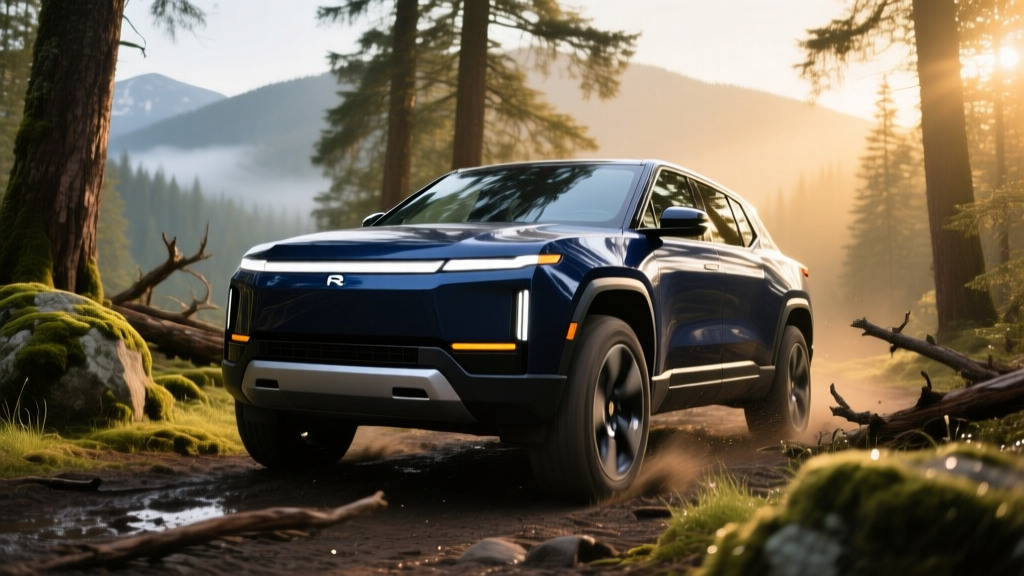
Rivian R2 at a Glance: The Compact Electric SUV Aimed at the Masses
Rivian's R2 is the automaker's bid to move beyond the premium R1S and R1T niche and into the high-volume compact electric SUV segment. Built on a new, smaller platform at Rivian's Normal, Illinois facility (with production ramping through 2026), the R2 targets buyers who want adventure-oriented utility without the $75,000+ starting price of its larger siblings. But with the compact EV SUV space now crowded — Tesla Model Y, Hyundai Ioniq 5, Ford Mustang Mach-E, and the upcoming Volkswagen ID.4 refresh — understanding the true cost of the Rivian R2 goes well beyond the sticker price.
This review dissects every layer of R2 ownership: base and as-tested pricing, federal tax credit mechanics under IRS §30D, real-world range versus EPA estimates, charging speed and infrastructure costs, and five-year total cost of ownership. If you're researching the cost of Rivian R2 before putting down a reservation deposit, this is the data you need.
Spec Table: Rivian R2 Key Numbers (2026 Model Year)
| Specification | R2 Standard (Dual-Motor AWD) | R2 Performance (Tri-Motor AWD) |
|---|---|---|
| Base MSRP | $45,000 | $52,000 |
| EPA Est. Range | 330 miles | 300 miles |
| Battery Capacity (usable) | ~85 kWh (NMC) | ~95 kWh (NMC) |
| Max DC Fast Charge | ~200 kW peak | ~220 kW peak |
| 10–80% DC Charge Time | ~28 minutes | ~26 minutes |
| Level 2 Home Charging | 11.5 kW (~37 mi/hr) | 11.5 kW (~37 mi/hr) |
| 0–60 mph | ~5.0 seconds | ~3.5 seconds |
| Horsepower | ~400 hp | ~600 hp |
| Drivetrain | Dual-Motor AWD | Tri-Motor AWD |
| Efficiency | ~115 MPGe / 29 kWh/100mi | ~105 MPGe / 32 kWh/100mi |
| Cargo Volume (rear seats up) | ~32 cu ft | ~32 cu ft |
| Cargo Volume (rear seats folded) | ~68 cu ft | ~68 cu ft |
| Battery/Powertrain Warranty | 8 yr / 100,000 mi | 8 yr / 100,000 mi |
| NACS Port | Yes (native) | Yes (native) |
Note: Rivian has published preliminary specifications for the R2 platform. Final EPA certification figures may vary slightly at launch. We will update this table as official numbers are confirmed. Source: Rivian R2 official page.
What Is the Real-World Range of the Rivian R2?
Real-World Expectation: 270–295 miles highway (70–80 mph); 240–265 miles in sub-30°F cold weather; 310+ miles mixed city/suburban driving with regen braking.
The R2's 330-mile EPA rating positions it competitively against the Tesla Model Y Long Range (320 miles EPA) and ahead of most Hyundai Ioniq 5 configurations. But EPA range is a laboratory composite — real-world results depend heavily on driving style, terrain, and temperature.
On highway road trips at sustained 75–80 mph, expect to use roughly 310–340 Wh/mi in the Standard Dual-Motor trim, which translates to approximately 270–295 usable miles before you'd want to stop at 10–15% state of charge. In cold weather (below 30°F), cabin heating and battery thermal management can reduce effective range by 20–30%, bringing the realistic highway figure to roughly 240–265 miles. The R2's heat pump (standard equipment) helps mitigate this loss compared to resistive heating systems, but physics still applies.
City and suburban drivers who take advantage of regenerative braking will see the best results — easily matching or slightly exceeding the EPA number in stop-and-go traffic where regen recaptures energy that would otherwise be lost to friction brakes.
Charging Speed: DC Fast Charging and Home Level 2
Charging speed is where many EV buyers get burned by marketing claims of "up to X kW" without understanding sustained charge rates and the charge curve. Here's what the R2 actually delivers:
| Charging Level | Power / Rate | What You Get |
|---|---|---|
| Level 1 (120V household) | ~1.4 kW | ~4–5 miles per hour |
| Level 2 (240V, 48A home charger) | 11.5 kW | ~37 miles per hour; full charge in ~8–9 hours |
| DC Fast Charge (peak) | ~200 kW (Standard) / ~220 kW (Performance) | Peak rate at low SoC; tapers above 60% |
| DC Fast Charge 10–80% | ~28 min (Standard) / ~26 min (Performance) | ~230 miles added in 28 minutes |
| DC Fast Charge 80–100% | Significantly reduced (taper curve) | Expect 30+ additional minutes for final 20% |
The R2 ships with a native NACS (North American Charging Standard) port, meaning direct access to Tesla's Supercharger network — currently the most reliable and extensive DC fast-charging infrastructure in the U.S. At a V4 Supercharger or compatible 250+ kW station, the R2's ~200 kW peak rate means you'll see strong charge speeds in the 10–50% SoC window, with a gradual taper as the battery management system protects cell health above 60%.
Practical road-trip planning: Plan stops around the 10–80% window. Charging from 80–100% on DC is painfully slow on any EV due to lithium-ion charge-curve physics. For daily driving, charge to 80% at home on Level 2 and only use DC fast charging for trips.
Home charging cost: Installing a 240V/48A Level 2 home charger (hardwired, such as a ChargePoint Home Flex or Tesla Wall Connector) typically costs $800–$2,500 total, including equipment and electrician labor. If your electrical panel needs an upgrade to 200A service, add $1,500–$3,500. Always get a quote from a licensed electrician — panel capacity and conduit runs vary by home. See our DOE charging guide reference for technical background.
Rivian R2 Pricing: MSRP, Trims, and the Federal Tax Credit
The headline number for the R2 is $45,000 for the Standard Dual-Motor — a deliberate price point aimed at undercutting the Tesla Model Y Long Range and landing within the federal EV tax credit's MSRP cap. Here's the full pricing picture:
| Trim | Base MSRP | Est. As-Tested (w/ common packages) | Federal §30D Credit Eligible? | Effective Price After Credit |
|---|---|---|---|---|
| R2 Standard (Dual-Motor AWD) | $45,000 | $48,000–$51,000 | Yes (if under $80,000 MSRP cap & buyer income limits met) | ~$37,500–$43,500 |
| R2 Performance (Tri-Motor AWD) | $52,000 | $56,000–$62,000 | Yes (if under $80,000 MSRP cap & buyer income limits met) | ~$44,500–$54,500 |
Does the Rivian R2 Qualify for the Federal EV Tax Credit?
The R2 is designed to qualify for the full $7,500 federal tax credit under IRS §30D rules, but eligibility depends on several buyer- and vehicle-specific factors:
- MSRP Cap: The R2 must have an MSRP at or below $80,000 for SUVs. Both current trims clear this threshold comfortably.
- Buyer Income Limits: Modified adjusted gross income (MAGI) must not exceed $150,000 (single), $225,000 (head of household), or $300,000 (joint filers).
- Battery Sourcing Requirements: The critical minerals and battery component requirements phase in progressively. Rivian has been actively diversifying its supply chain away from China-sourced materials, but specific eligibility for the full $7,500 (vs. $3,750 if only one of the two sourcing requirements is met) depends on the production batch and model year. Confirm with your dealer at time of purchase.
- Point-of-Sale Transfer: As of 2024, buyers can transfer the credit to the dealer at purchase, effectively reducing the purchase price by $7,500 at the point of sale rather than waiting to claim it on your tax return. This option is expected to continue for 2026 model-year purchases.
- Final Assembly: The R2 is assembled in Normal, Illinois, satisfying the North American final assembly requirement.
Critical caveat: Battery sourcing rules tighten each year. A vehicle that qualifies for the full $7,500 in early 2026 may see partial eligibility ($3,750) if sourcing requirements change mid-year. Always verify current eligibility on fueleconomy.gov before finalizing your purchase. Consult a tax professional for your specific situation.
Performance, Interior, and Standout Technology
The R2 isn't just a smaller R1S — it's a ground-up redesign on Rivian's second-generation platform. Here's what matters for daily ownership:
Performance
The Standard Dual-Motor delivers ~400 hp and a 5.0-second 0–60 mph time — brisk for a family SUV and more than adequate for highway merging and passing. The Performance Tri-Motor's ~600 hp and 3.5-second sprint puts it in sports-car territory, though at the cost of some range and a higher price. Both configurations feature Rivian's torque-vectoring AWD system with independent motors per axle, providing genuine off-road capability (ground clearance, approach/departure angles) that most competitors in this segment can't match.
Interior and Cargo
With ~32 cu ft behind the rear seats and ~68 cu ft with seats folded, the R2 offers practical cargo space competitive with the Model Y. Rivian's signature gear tunnel (a pass-through storage compartment between the cabin and cargo area, inherited from the R1T/R1S design language) adds flexible storage for long, narrow items like skis or camping gear. Rear-seat legroom is designed to accommodate adults comfortably on longer trips, though final dimensions await production-vehicle confirmation.
Technology and Driver Assistance
The R2 features Rivian's latest infotainment stack on a large central touchscreen, over-the-air (OTA) update capability, and the Rivian Driver+ assistance system. Driver+ is a SAE Level 2 driver-assistance system — it provides adaptive cruise control, lane-centering, and highway steering support, but requires active driver supervision at all times. This is not autonomous driving. Keep your hands on the wheel and eyes on the road.
Unique features include Rivian's Camp Mode (maintains climate control and powers accessories while parked), integrated air compressor, and a front trunk (frunk) for additional sealed, weatherproof storage. The native NACS port and Tesla Supercharger access are significant infrastructure advantages over CCS-only competitors.
Who Should Buy the Rivian R2 — And Who Shouldn't?
- You want a compact electric SUV with genuine off-road and adventure capability (ground clearance, AWD torque vectoring, wading depth)
- Tesla Supercharger network access is a priority for road trips
- You need more cargo flexibility than a crossover hatchback offers (gear tunnel, frunk)
- You qualify for the §30D tax credit, bringing the effective price into the low $40Ks
- You value OTA updates and a software-defined vehicle architecture
- Maximum range-per-dollar is your only priority (Ioniq 5 and Model Y offer competitive range at similar or lower prices)
- You need immediate availability — R2 production ramp may mean wait times in 2026
- You want a third-row seat (look at the R1S, Kia EV9, or Tesla Model X)
- You don't have access to home Level 2 charging and rely entirely on public infrastructure in a charging-desert area
Rivian R2 vs. Key Competitors: Is It Worth the Cost?
The R2's most direct competitors are the Tesla Model Y Long Range, Hyundai Ioniq 5, and Ford Mustang Mach-E. Here's how the R2 stacks up on the metrics that matter:
| Metric | Rivian R2 Standard | Tesla Model Y LR | Hyundai Ioniq 5 LR AWD |
|---|---|---|---|
| Base MSRP | $45,000 | ~$48,000 | ~$50,000 |
| EPA Range | 330 mi | ~320 mi | ~290 mi |
| DC Fast Charge Peak | ~200 kW | ~250 kW | ~240 kW |
| 10–80% DC Time | ~28 min | ~22 min | ~18 min |
| Charging Port | NACS (native) | NACS (native) | CCS (NACS adapter avail.) |
| Off-Road Capability | High (torque vectoring, clearance) | Low | Low |
| §30D Credit Eligible | Yes (verify sourcing) | Yes (verify sourcing) | Yes (verify sourcing) |
The R2's key differentiator is adventure capability — no competitor in this price bracket offers comparable off-road geometry, wading depth, or the gear-tunnel storage concept. However, the Tesla Model Y charges faster on DC (250 kW peak vs. ~200 kW) and benefits from a more mature service-center network. The Ioniq 5's 800V architecture delivers the fastest 10–80% charge times in the segment (~18 minutes) but lacks native NACS, requiring an adapter for Supercharger access.
On total cost of ownership, the R2 is competitive if you qualify for the full $7,500 credit. Electricity costs for home charging average $0.13–$0.17/kWh nationally, making the R2's ~29 kWh/100mi efficiency translate to roughly $3.77–$4.93 per 100 miles — compared to $12–$15 per 100 miles for a comparable gas SUV at 25 MPG and $3.25/gallon fuel.
Pros and Cons
- 330-mile EPA range competitive with or exceeding segment leaders
- Native NACS port = direct Tesla Supercharger access
- Genuine off-road capability unique in the compact EV SUV class
- $45,000 starting MSRP qualifies for §30D tax credit MSRP cap
- Gear tunnel + frunk provide flexible, adventure-friendly storage
- OTA software updates and feature improvements over time
- 8-year/100,000-mile battery and powertrain warranty
- ~200 kW peak DC charge rate trails Ioniq 5 (~240 kW) and Model Y (~250 kW)
- Production ramp may mean delivery wait times in 2026
- Rivian's service center network is still growing — coverage varies by region
- Battery sourcing requirements could reduce credit to $3,750 for some production batches
- No third-row option; families needing 6+ seats must look at R1S or competitors
- Real-world cold-weather range loss of 20–30% is significant for northern-climate drivers
Frequently Asked Questions
What is the total cost of ownership for the Rivian R2 over 5 years?
Factoring in the $45,000 base price, $7,500 federal credit (if eligible), ~$0.15/kWh home charging, estimated insurance ($1,800–$2,400/year for a compact EV SUV), and minimal maintenance (no oil changes, reduced brake wear from regen), a 5-year/75,000-mile ownership estimate lands in the $55,000–$65,000 range all-in. This is competitive with a gas-powered compact SUV once fuel savings are factored in, though EV insurance premiums tend to run 15–25% higher than comparable ICE vehicles.
Can I charge the Rivian R2 at Tesla Superchargers?
Yes. The R2 has a native NACS port, meaning it plugs directly into Tesla Superchargers without an adapter. This is a significant advantage for road-trip charging reliability, as the Supercharger network consistently outperforms other DC networks in uptime and ease of use.
How long will the R2 battery last?
Rivian warranties the battery pack for 8 years or 100,000 miles against capacity loss below a specified threshold (typically 70% state of health). Based on industry data from NMC packs in similar applications, expect roughly 10–15% degradation over 150,000 miles of normal use. Avoid habitual DC fast charging to 100% and frequent deep discharges to 0% to maximize longevity.
Is the Rivian R2 a good family vehicle?
For families of 4 or fewer, the R2 offers strong utility: ample cargo space, AWD for inclement weather, competitive range for family road trips, and adventure features like the integrated air compressor and Camp Mode. Families needing a third row should consider the larger R1S or Kia EV9.
Does the Rivian R2 qualify for state EV incentives?
State and local incentives vary widely by jurisdiction and change frequently. Some states offer additional rebates of $1,000–$5,000 on top of the federal credit. Check your state's energy office or AFDC state incentive database for current programs in your area.