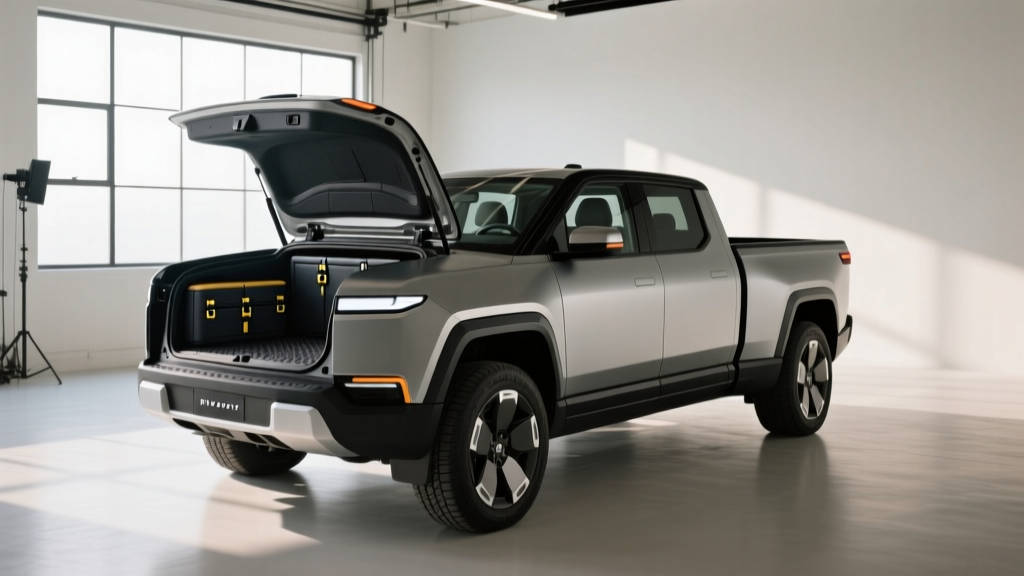
The Rivian R1T is the only midsize electric pickup built around a single defining idea: maximize usable space in a vehicle shorter than a Toyota Tacoma. While most EV truck reviews focus on horsepower and 0-60 times, the question buyers actually ask on forums and at trailheads is about Rivian truck storage — how much gear fits, where it hides, and whether the famous gear tunnel lives up to the hype.
After loading the R1T Dual-Motor with camping equipment, lumber, and a week's worth of groceries, here is every storage dimension, efficiency figure, and ownership cost you need before writing a check.
Quick Specs at a Glance
| Spec | 2026 R1T Dual-Motor (Standard) | 2026 R1T Tri-Motor |
|---|---|---|
| EPA Range | 352 miles (Max Pack) | 328 miles (Max Pack) |
| Battery (usable) | 149 kWh (Max Pack, NMC) | 149 kWh (Max Pack, NMC) |
| Peak DC Fast Charge | ~220 kW | ~220 kW |
| 10–80% DC Time | ~40 min | ~40 min |
| Level 2 Home Charge | 11.5 kW (~25 mi/hr) | 11.5 kW (~25 mi/hr) |
| 0–60 mph | 4.5 sec | 2.9 sec |
| Horsepower | 533 hp | 850 hp |
| Drivetrain | AWD (dual-motor) | AWD (tri-motor) |
| MPGe (combined) | 70 MPGe | 65 MPGe |
| Efficiency | 48 kWh/100 mi | 52 kWh/100 mi |
| Max Tow Rating | 11,000 lb | 11,000 lb |
| Base MSRP | $69,900 | $99,900 |
| Battery/Powertrain Warranty | 8 yr / 175,000 mi | 8 yr / 175,000 mi |
The Full Rivian Truck Storage Breakdown
The R1T's skateboard platform — battery pack slung low between the axles — eliminates the engine bay and transmission tunnel, freeing up volume that no body-on-frame truck can match. Here is every compartment measured.
Bed
The composite bed measures 4 ft 6 in (54 in) long with the tailgate closed and 6 ft 8 in (80 in) with the tailgate down. Width between wheel wells is 50.5 in. That is shorter than a standard F-150 bed, but Rivian compensates with the gear tunnel and a powered tonneau cover rated for 500 lb of distributed load on top.
Gear Tunnel
The signature Rivian truck storage feature. This pass-through compartment behind the rear seats spans the full width of the truck and holds 11.6 cubic feet. The openings on either side of the bed measure roughly 18 in tall by 20 in wide — enough for golf bags, snowboards, folding camp chairs, or a week of duffel bags. Rivian sells an optional Gear Tunnel Shuttle ($1,500), a motorized tray that slides the entire load out for easier access. Without the shuttle, you are reaching deep into a dark tube, which is the tunnel's single ergonomic weakness.
Front Trunk (Frunk)
The frunk provides 11.1 cubic feet of lockable, weather-sealed space with a drain plug at the bottom — functionally a built-in cooler or wet-gear bin. It fits two carry-on suitcases or a full set of charging cables and emergency supplies. The powered latching lid opens via the key fob, app, or a button on the front badge.
Cabin Storage
Behind the rear seats, a fold-down center pass-through allows items up to ~6 ft long (kayak paddles, lumber) to extend from the bed into the cabin. Rear under-seat storage is shallow but useful for a first-aid kit or tire inflator. The center console is deep, and the floating shelf under the dash holds a laptop or tablet.
Total Cargo Volume
Combined: bed (closed tailgate) + gear tunnel + frunk = approximately 33 cubic feet of enclosed or semi-enclosed storage before the bed is even loaded above the rails. That figure is unique in the midsize truck segment.
Range, Efficiency, and Real-World Expectations
Real-World Highway (70 mph, 65°F): ~280–300 miles
Cold-Weather Highway (20°F, heater on): ~220–250 miles
Towing (5,000 lb trailer, flat terrain): ~160–180 miles
Source: fueleconomy.gov and owner-reported data
The R1T is a 7,100-pound brick pushing through the air, so highway efficiency drops sharply above 70 mph. The Max Pack's 149 kWh NMC battery is the largest in any consumer pickup, and it is the reason the R1T can still crack 280 real-world highway miles. The Standard Pack (106 kWh, ~270 mi EPA) saves weight and cost but cuts real-world highway range to roughly 215 miles — fine for commuting, tight for road trips.
Rivian's heat pump is standard and does meaningful work in cold climates, limiting range loss to roughly 25–30% at 20°F — better than resistive-heater competitors but still a planning factor for winter ski trips.
Charging Speed: DC Fast and Home Level 2
| Level | Power | Miles Added per Hour | Notes |
|---|---|---|---|
| Level 1 (120V) | 1.4 kW | ~3 mi/hr | Emergency/trickle only |
| Level 2 (240V, 48A) | 11.5 kW | ~25 mi/hr | Full overnight charge in ~13 hr (Max Pack) |
| DC Fast (peak) | ~220 kW | ~550 mi/hr (at peak) | 10–80% in ~40 min; tapers hard above 85% |
| DC Fast (sustained avg) | ~150 kW | — | Average across the 10–80% curve |
| Tesla Supercharger (NACS adapter) | ~170 kW | — | Adapter included with newer models; V3 stalls cap at 250 kW but R1T peaks lower |
Rivian uses the CCS1 connector natively and provides a NACS adapter for access to Tesla's Supercharger network (15,000+ stalls in the U.S. as of 2026). The charge curve is honest: the truck pulls close to 220 kW from 10% to roughly 35% SoC, then steps down progressively. Expect 10–80% in about 40 minutes at a 350 kW Electrify America or EVgo stall. Above 80%, the rate collapses to under 50 kW — plan your stops to 80% and go.
At home, an 11.5 kW Level 2 wall connector (Rivian Wall Charger or ChargePoint Home Flex) on a 60A circuit adds roughly 25 miles per hour, fully replenishing the Max Pack overnight. Installation on a 200A panel typically runs $800–$1,800 including parts, labor, and permit; a panel upgrade to 400A can add $2,000–$4,000.
Pricing, Trims, and Federal Tax Credit
The 2026 R1T lineup has simplified into three configurations per motor tier:
- Dual-Motor Standard Pack: $69,900
- Dual-Motor Max Pack: $79,900
- Tri-Motor Max Pack: $99,900
Destination adds $1,800. The Adventure package (off-road tires, reinforced underbody, camp kitchen option) adds roughly $4,500.
IRS §30D Federal Tax Credit Eligibility
- MSRP cap: Pickup trucks must be under $80,000. Dual-Motor trims qualify; Tri-Motor ($99,900) does NOT.
- Buyer income cap: $300,000 joint / $225,000 head of household / $150,000 single (MAGI).
- Battery sourcing: Critical-mineral and battery-component thresholds tighten annually under the Inflation Reduction Act. Confirm current-year sourcing compliance on IRS.gov's qualifying vehicle list before purchase.
- Point-of-sale transfer: You can transfer the credit to the dealer at purchase to reduce the out-of-pocket price, rather than waiting to claim it on your tax return.
Source: IRS §30D New Clean Vehicle Credit. Rules subject to change; consult a tax professional.
Bottom line: a Dual-Motor Max Pack buyer who meets income limits and confirms battery sourcing can reduce the effective price from ~$81,700 (with destination) to roughly $74,200. The Tri-Motor is ineligible due to the MSRP cap.
On-Road Performance and Ride Quality
The Dual-Motor's 533 hp and 4.5-second 0–60 time are plenty for merging and passing; the Tri-Motor's 850 hp and 2.9-second sprint are supercar numbers in a truck that weighs over three tons. Both feel planted thanks to the low center of gravity and Rivian's fully independent suspension with hydraulic roll control (no sway bars).
Ride quality on pavement is firm but well-damped. The air suspension (standard on Max Pack, optional elsewhere) offers 6.5 to 14.9 inches of ground clearance and kneels 2 inches for easier bed loading. Off-road, the R1T's quad-motor tank-turn capability was dropped with the original quad-motor configuration; the Tri-Motor still offers impressive trail articulation and an approach angle of 35.5 degrees in Off-Road mode.
Tech, Driver Assists, and Drawbacks
The 15.6-inch center touchscreen runs Rivian's in-house software, which has matured significantly since the 2022 launch. Wireless Apple CarPlay and Android Auto are now standard. The 12.3-inch driver cluster is clear but not configurable beyond basic layouts.
Driver+ (Level 2 assist): Combines adaptive cruise control and lane centering on divided highways. It is competent but requires hands on the wheel — there is no eyes-off capability. This is SAE Level 2 automation; the driver is always responsible.
Notable drawbacks:
- No Apple CarPlay/Android Auto at launch was fixed, but third-party app ecosystem remains limited vs. Android Automotive competitors.
- The gear tunnel without the optional Shuttle is hard to access for shorter users.
- Towing range drops dramatically — 160–180 miles with a 5,000 lb trailer is a planning challenge on long hauls.
- Service center density is still limited outside major metros; mobile service handles minor issues but bodywork can mean weeks of downtime.
Pros and Cons
Pros
- Class-leading enclosed storage (gear tunnel + frunk + bed = ~33 cu ft)
- 352-mile Max Pack range is the most of any electric truck
- NACS adapter unlocks Tesla Supercharger network
- Refined on-road manners for a body-on-frame-class pickup
- 8-year/175,000-mile battery warranty exceeds industry norm
Cons
- Tri-Motor exceeds $80K MSRP cap — no federal tax credit
- Towing range under 180 miles with a mid-weight trailer
- Gear tunnel ergonomics poor without $1,500 Shuttle option
- Service network still sparse in rural and Mountain West states
- 40-minute 10–80% DC charge is slower than Hyundai/Kia E-GMP trucks
Who the R1T Suits Best
Buy it if: You want a daily-drivable truck that moonlights as a weekend adventure rig, prioritize enclosed lockable storage over a full-size bed, and can charge at home. The Dual-Motor Max Pack at ~$74K after the federal credit is the value sweet spot.
Look elsewhere if: You regularly tow more than 4,000 lb over long distances (consider the Ford F-150 Lightning Extended Range or a diesel), need a full 6-foot bed without a tailgate-down workaround, or live far from a Rivian service center.
Frequently Asked Questions
What is the real-world range of the Rivian R1T?
The EPA rates the Dual-Motor Max Pack at 352 miles. In real-world highway driving at 70 mph and moderate temperatures, expect 280–300 miles. Cold weather (20°F) drops that to 220–250 miles. The Standard Pack's real-world highway range is closer to 215 miles.
How fast does the R1T charge at home and on the road?
At home on a 240V Level 2 charger (11.5 kW), the R1T adds about 25 miles per hour — a full Max Pack charge takes roughly 13 hours. On a DC fast charger, it peaks at ~220 kW and averages ~150 kW across the 10–80% curve, reaching 80% in about 40 minutes.
Does the Rivian R1T qualify for the $7,500 federal EV tax credit?
The Dual-Motor trims (MSRP under $80,000) qualify if the buyer meets IRS income caps ($300K joint / $150K single) and the vehicle's battery meets current-year critical-mineral and component sourcing rules. The Tri-Motor at $99,900 exceeds the MSRP cap and does not qualify. Always verify on the IRS qualifying vehicle list.
How does R1T storage compare to the Ford F-150 Lightning?
The Lightning has a larger bed (5.5 ft closed) and a bigger frunk (14.1 cu ft), but no gear tunnel. Total enclosed/semi-enclosed volume favors the Lightning for pure bed capacity, while the R1T wins for secure, weather-sealed, compartmentalized storage — especially the gear tunnel for long, narrow items.
Is the Rivian R1T worth buying in 2026?
If your priority is a refined, adventure-capable electric truck with the most thoughtful storage design in the segment and you can charge at home, yes — the Dual-Motor Max Pack is the best overall value. If you tow heavy or need a full-size bed, the F-150 Lightning or Chevrolet Silverado EV may suit you better.