Rivian in Orlando: What Central Florida Buyers Need to Know in 2026
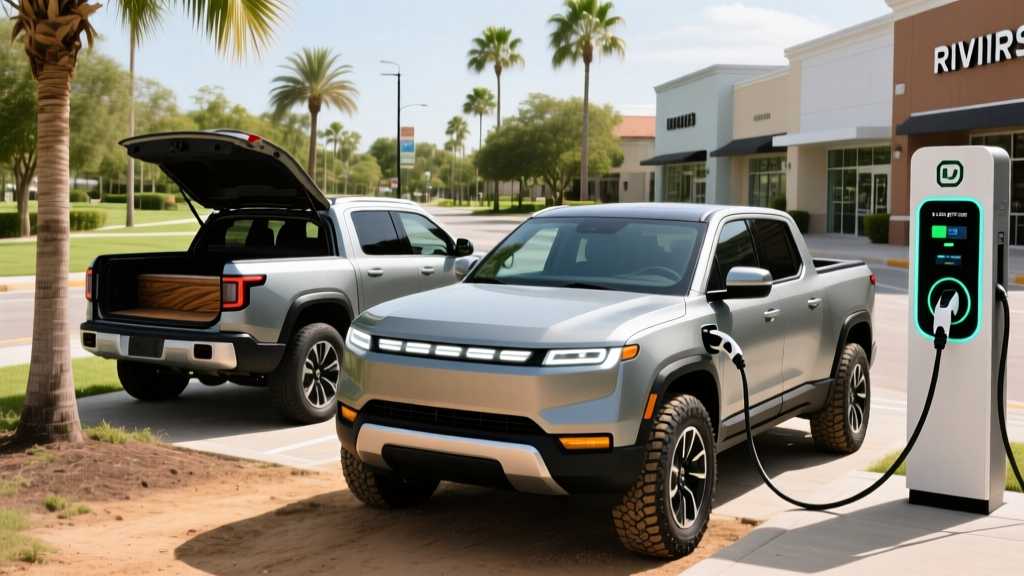
Orlando's EV infrastructure has matured considerably, and the Rivian R1T (pickup) and R1S (three-row SUV) have become increasingly common sights from Winter Park to Lake Nona. But buying a Rivian in Central Florida comes with a unique set of considerations: relentless summer heat, a growing but still uneven DC fast-charging network, and long highway stretches toward Tampa, Jacksonville, or the Gulf Coast that put range claims to the test.
This guide covers the 2026 Rivian R1T and R1S lineup — the updated dual-motor and tri-motor configurations, the Standard and Max battery packs, real-world efficiency in Florida conditions, charging logistics along I-4 and the Turnpike, and exactly what you'll pay after federal incentives.
2026 Rivian R1T and R1S: Spec Table at a Glance
Rivian simplified its powertrain lineup for 2025 and carried refinements into 2026. Here's what's currently in production across the key configurations most Orlando buyers cross-shop.
| Spec | R1T Dual-Motor (Standard) | R1T Dual-Motor (Max) | R1S Tri-Motor (Max) |
|---|---|---|---|
| EPA Range | ~270 mi | ~352 mi | ~321 mi |
| Battery (usable) | ~92 kWh (LFP) | ~129 kWh (NMC) | ~129 kWh (NMC) |
| Horsepower | 533 hp | 533 hp | 850 hp |
| 0–60 mph | ~4.5 sec | ~4.5 sec | ~2.9 sec |
| Drivetrain | AWD (dual-motor) | AWD (dual-motor) | AWD (tri-motor) |
| Max DC Fast Charge | ~200 kW | ~220 kW | ~220 kW |
| 10–80% DC Time | ~28 min | ~32 min | ~32 min |
| Level 2 Home Rate | 11.5 kW (~25 mi/hr) | 11.5 kW (~25 mi/hr) | 11.5 kW (~25 mi/hr) |
| Towing Capacity | 11,000 lbs | 11,000 lbs | 7,700 lbs (R1S) |
| Base MSRP | ~$69,900 | ~$75,900 | ~$99,900 |
Source: Rivian R1T specs, Rivian R1S specs, and EPA data at fueleconomy.gov. Specs subject to change by model year; verify at time of order.
Real-World Range: Orlando Heat, Highway, and the I-4 Factor
The R1T Dual-Motor Max carries an EPA-estimated 352 miles of range. In Orlando-area driving — a mix of stop-and-go on I-4, surface streets, and sustained 70–75 mph highway runs toward Tampa or Daytona — expect 290–320 real-world miles in moderate temperatures. Pushing 80 mph on the Florida Turnpike in July with A/C blasting can drop that to ~265–280 miles.
Cold-weather range loss is minimal in Orlando (rarely below 40°F), giving Florida owners a real advantage over northern counterparts who see 20–30% range drops in winter.
Florida's heat creates a different challenge: cabin cooling and battery thermal management draw continuous power. During July and August, when Orlando temperatures routinely exceed 95°F, the climate system can consume 2–4 kW continuously. Over a 300-mile highway trip, that parasitic load shaves roughly 10–15 miles off range compared to a 70°F spring day.
Efficiency for the Dual-Motor R1T typically lands between 44–48 kWh/100 miles (roughly 70–76 MPGe combined) in mixed driving. The heavier Tri-Motor R1S runs closer to 50–54 kWh/100 miles. For context, that's about 2.0–2.4 miles per kWh — respectable for vehicles weighing over 6,800 pounds, but you'll feel it on long highway stretches where every kWh counts.
If your typical Orlando commute stays within a 60-mile daily round trip (think Altamonte Springs to Lake Nona, or Dr. Phillips to UCF), even the Standard pack covers a full work week without plugging in. Road-trippers heading to the Panhandle or South Florida should plan charging stops — more on that below.
Charging Speed: DC Fast Charging and Home Level 2 Setup
| Charging Level | Power / Rate | Miles Added Per Hour | Best For |
|---|---|---|---|
| Level 1 (120V outlet) | ~1.4 kW | ~3 mi/hr | Emergency top-up only |
| Level 2 (240V, 48A home) | 11.5 kW | ~25 mi/hr | Daily overnight charging |
| DC Fast (200–220 kW peak) | Up to 220 kW | ~500+ mi/hr (peak) | Road trips, quick stops |
Rivian's onboard charger accepts up to 11.5 kW on Level 2, meaning a full overnight charge from 20% to 100% on the Standard pack takes roughly 7 hours; the Max pack takes about 10–11 hours. For Orlando homeowners, a 48-amp Level 2 wall connector on a 60-amp dedicated circuit is the sweet spot. Expect installation costs of $800–$2,500 depending on panel proximity and whether your home's electrical panel needs an upgrade (many Orlando homes built in the 1990s–2000s have 150-amp or 200-amp panels with capacity for a Level 2 circuit).
On DC fast charging, the R1T/R1S peak at 200–220 kW depending on pack size. The charge curve matters here: Rivian holds strong power through roughly 50–60% state of charge, then tapers progressively. A 10–80% session takes approximately 28–32 minutes at a capable 350 kW station. At older 150 kW chargers — still common at some Electrify America and EVgo locations along I-4 — expect 10–80% in roughly 40–45 minutes.
Orlando's Rivian Adventure Network has expanded, with chargers strategically placed near popular outdoor destinations. The broader public network includes Electrify America stations at major shopping centers, Tesla Superchargers (now open to non-Tesla EVs via the NACS adapter Rivian provides), and ChargePoint locations. For the Orlando-to-Tampa corridor (~85 miles), one DC stop is sufficient in any Rivian configuration. Orlando to Miami (~235 miles) is achievable in the Max pack without stopping in ideal conditions, but most drivers will want a 15-minute top-up near Sebring or Okeechobee for comfort.
Connector note: 2026 Rivian vehicles ship with the NACS (Tesla-style) charge port natively, giving direct access to Tesla Supercharger stalls without an adapter. CCS adapters are available for legacy Electrify America and EVgo stations that haven't yet added NACS cables.
Performance, Ride Quality, and Daily Driving
The Dual-Motor R1T delivers 533 horsepower and a 4.5-second 0–60 mph time — genuinely quick for a 7,000-pound pickup. The Tri-Motor R1S pushes 850 hp and hits 60 in under 3 seconds, which is supercar territory in a three-row SUV. In Orlando traffic merging onto the East-West Expressway (SR 408) or jumping into a gap on I-4, the instant torque is immediately useful.
Rivian's air suspension provides adjustable ride height — useful for clearing flooded streets during Florida's afternoon thunderstorms (up to 14.9 inches of ground clearance in Off-Road mode) and lowering for highway efficiency in Sport mode. The regenerative braking system offers strong one-pedal driving, which reduces brake wear considerably — a welcome benefit given Orlando's stop-and-go congestion.
The R1T's 4.5-foot bed includes the signature Gear Tunnel — a pass-through storage compartment spanning the vehicle width behind the rear seats. It's ideal for golf clubs, camping gear, or groceries that you'd rather keep out of the cabin. The R1S offers seating for up to seven, with ~104 cu ft of total cargo volume behind the first row (seats folded) and usable third-row space for adults on shorter trips.
Pricing, Trim Levels, and Federal Tax Credit Eligibility
| Configuration | Base MSRP | Est. As-Tested | §30D Credit Eligible? | Effective Price (est.) |
|---|---|---|---|---|
| R1T Dual-Motor Standard | ~$69,900 | $74,000–$78,000 | Possible (see below) | ~$62,400–$70,500 |
| R1T Dual-Motor Max | ~$75,900 | $80,000–$86,000 | Likely (MSRP cap applies) | ~$68,400–$78,500 |
| R1S Dual-Motor Standard | ~$74,900 | $79,000–$84,000 | Possible | ~$67,400–$76,500 |
| R1S Tri-Motor Max | ~$99,900 | $105,000+ | Exceeds MSRP cap | Full MSRP |
- MSRP cap: Vans/SUVs/pickups must be ≤$80,000 MSRP. The R1S Tri-Motor exceeds this cap and does not qualify.
- Buyer income cap: AGI ≤$150,000 (single), ≤$225,000 (head of household), ≤$300,000 (joint filers).
- Battery sourcing: Increasing percentages of critical minerals and battery components must be sourced from the U.S. or FTA partners. Rivian has worked to qualify, but rules tighten annually.
- Point-of-sale transfer: Eligible buyers can apply the credit as an immediate price reduction at delivery rather than waiting for tax filing.
- Verify current rules: Check IRS §30D guidance before ordering — sourcing requirements change yearly.
The Dual-Motor Standard and Max configurations of the R1T fall under the $80,000 pickup MSRP cap, making them potentially eligible for the full $7,500 credit — provided your income qualifies and the battery sourcing requirements are met at time of delivery. The R1S (classified as an SUV) also has an $80,000 cap, meaning the Dual-Motor Standard qualifies but higher trims with options may push over. The Tri-Motor R1S at ~$99,900 does not qualify regardless of income.
Florida state incentives: Florida does not currently offer a state-level EV purchase rebate. However, some Orlando-area utilities (OUC, Duke Energy Florida) have offered off-peak charging rebates or reduced EV time-of-use rates. Check with your local utility for current programs.
Interior, Tech, and Driver Assistance
Rivian's 15.6-inch center touchscreen runs proprietary software that has received multiple over-the-air updates since launch. The 2026 interface is more responsive than early versions, with improved navigation and charge-route planning that automatically factors in elevation, temperature, and driving style. Apple CarPlay and Android Auto are not supported — a deliberate choice by Rivian that remains a dealbreaker for some buyers who rely on phone-mirrored navigation and music apps.
The Rivian Driver+ suite provides adaptive cruise control, lane-centering, and automatic emergency braking. This is a Level 2 driver-assistance system per SAE classification — meaning you must keep your hands on the wheel and eyes on the road at all times. It works well on long Florida Turnpike stretches but does not replace an attentive driver. Unlike Ford's BlueCruise or GM's Super Cruise, Rivian does not currently offer hands-free driving on pre-mapped highways.
Standout features include:
- Camp Kitchen (R1T option): A slide-out electric kitchen integrated into the Gear Tunnel — unique in the EV pickup segment.
- Powered tonneau cover with integrated bed lighting.
- Vehicle-to-load (V2L) capability: Power tools, tailgate setups, or even home appliances during outages via bed and cabin outlets.
- Dog-friendly features: Pet mode maintains cabin climate, and the rear cargo area is designed for easy pet access.
Notable drawbacks:
- No Apple CarPlay or Android Auto.
- Third-row space in the R1S is tight for adults on long trips.
- Service center availability in Orlando has improved but still lags behind legacy automaker dealer networks — plan for potential wait times for body/paint work.
- Insurance premiums run higher than comparable ICE trucks; expect $200–$350/month depending on coverage and driving history.
- Class-leading real-world range (Max pack) for an electric pickup/SUV
- Genuine off-road capability with air suspension and quad-motor option
- NACS port = direct Tesla Supercharger access
- Unique Gear Tunnel and Camp Kitchen utility
- Strong OTA update cadence improving the vehicle over time
- Minimal cold-weather range loss in Florida climate
- No Apple CarPlay / Android Auto
- Tri-Motor R1S exceeds $80K MSRP cap — no federal credit
- Limited service center footprint vs. Ford/Chevy
- High insurance costs relative to ICE trucks
- Driver+ is capable but not hands-free on highways
- Heavy vehicle = higher tire wear and kWh/100mi vs. lighter EVs
Who Should Buy a Rivian in Orlando?
Choose the R1T Dual-Motor Standard if: You want an electric daily-driver pickup for Orlando commuting, occasional weekend trips to the springs or coast, and your daily driving stays under 80 miles. The Standard pack covers your week, and the ~$62K effective price (with credit) makes it competitive with a loaded Ford F-150 Lightning.
Choose the R1T/R1S Dual-Motor Max if: You regularly drive Orlando–Tampa–Jacksonville corridors, tow a boat to the Gulf, or take road trips to North Georgia or the Keys. The 320+ real-world miles provide genuine flexibility, and the NACS Supercharger access fills gaps in Rivian's Adventure Network.
Choose the R1S Tri-Motor if: Performance is a priority, budget is flexible, and you don't need the federal credit. The 850-hp tri-motor is absurdly fast, but at $100K+ it competes with luxury SUVs from BMW, Mercedes, and Porsche — not other electric trucks.
Look elsewhere if: You need Apple CarPlay, prefer hands-free highway driving (consider Ford BlueCruise or GM Super Cruise), want a lower purchase price (check the Ford F-150 Lightning or Chevrolet Silverado EV), or need extensive dealer service access in rural Central Florida.
Warranty and Long-Term Ownership
Rivian provides an 8-year/175,000-mile battery and drive unit warranty, which is among the most generous in the EV truck segment. The bumper-to-bumper coverage runs 5 years/60,000 miles. The battery warranty guarantees retention above a specified capacity threshold (typically 70% state of health) over the coverage period.
For Orlando owners, the LFP chemistry in the Standard pack offers a longevity advantage: LFP cells degrade more slowly than NMC, especially when routinely charged to 100%. Rivian recommends regular 100% charges for the LFP Standard pack, while the NMC Max pack benefits from daily charging to 80–90% with periodic 100% calibration charges. Florida's warm climate accelerates calendar degradation slightly compared to cooler regions, but Rivian's active liquid thermal management mitigates this significantly — parked in a garage or shaded carport, battery health should remain strong well past the warranty period.
Maintenance costs are low: no oil changes, no transmission fluid, minimal brake wear thanks to regenerative braking. Budget for cabin air filter replacement (~$100–$150 annually in Florida's pollen-heavy environment), wiper fluid, and tire rotation. Expect to replace tires every 30,000–40,000 miles given the vehicle's weight and torque — all-season or touring tires in the 275/65R20 or 275/55R21 range run $250–$400 per corner.
Frequently Asked Questions
What is the real-world range of the Rivian R1T in Orlando?
The Dual-Motor Max delivers an EPA-estimated 352 miles. In Orlando's mixed driving — highway, surface streets, and summer A/C use — expect 290–320 real-world miles. Sustained 80 mph highway driving in peak heat can reduce this to approximately 265–280 miles. The Standard pack yields roughly 220–250 real-world miles in similar conditions.
How fast does a Rivian charge at home and on the road?
On a 48-amp Level 2 home charger (240V), the Rivian adds about 25 miles of range per hour, fully replenishing the Standard pack overnight in ~7 hours and the Max pack in ~10–11 hours. On DC fast chargers, peak rates reach 200–220 kW, with a 10–80% session taking approximately 28–32 minutes at a capable 350 kW station.
Does the Rivian R1T qualify for the $7,500 federal EV tax credit?
The R1T Dual-Motor configurations fall under the $80,000 MSRP cap for pickups and may qualify for the full $7,500 credit, subject to buyer income limits (≤$150K single / ≤$300K joint) and battery sourcing requirements that tighten annually. Always verify current eligibility on the IRS clean vehicle credits page before ordering. The credit can be applied at point of sale as an immediate price reduction.
Is the Rivian R1T worth buying vs. the Ford F-150 Lightning?
The R1T offers more range (Max pack), genuine off-road capability, and a more distinctive design. The F-150 Lightning is typically less expensive, has broader dealer service coverage, and supports Apple CarPlay. If you value range, adventure features, and build quality, the R1T wins. If you prioritize price, service convenience, and phone integration, the Lightning may be the better fit.
What are the biggest drawbacks of owning a Rivian in Orlando?
Service center wait times can be longer than legacy automaker dealers. Insurance premiums run $200–$350/month. The lack of Apple CarPlay frustrates some owners. And while Orlando's charging network is adequate, rural Central Florida and some Panhandle routes still have sparse DC fast-charger coverage.
Can I tow with a Rivian in Florida without destroying my range?
The R1T is rated for 11,000 lbs of towing. However, towing a 5,000–7,000 lb trailer will cut real-world range roughly in half — expect 140–170 miles on the Max pack while towing. Plan charging stops accordingly, and note that not all DC fast chargers have pull-through stalls designed for truck-and-trailer configurations.