The electric pickup segment has matured past novelty, and the 2026 Rivian R1T stands as one of the few trucks that balances genuine off-road capability with daily-driver practicality. But for buyers researching the Rivian powered tonneau cover—the electrically actuated hard rolling cover available on the R1T—the question goes beyond bed security. How does this feature integrate with the truck's range, charging profile, payload, and overall value proposition in 2026?
This review covers the R1T's full spec sheet alongside a deep look at how the powered tonneau system works in real ownership scenarios, from range impact to bed-length flexibility. Whether you're cross-shopping the Ford F-150 Lightning, Chevrolet Silverado EV, or Tesla Cybertruck, here's the data you need.
Rivian R1T at a Glance: 2026 Specifications
| Specification | Value |
|---|---|
| EPA Estimated Range | 420 miles (Max Pack) / 352 mi (Large) / 270 mi (Standard) |
| Battery Capacity (Usable) | 149 kWh (Max) / 112 kWh (Large) / 95 kWh (Standard — LFP) |
| Battery Chemistry | NMC (Max/Large); LFP (Standard Pack) |
| Drivetrain | Dual-Motor AWD or Quad-Motor AWD |
| Horsepower | 533 hp (Dual) / 1,025 hp (Quad) |
| 0–60 mph | 4.5 sec (Dual) / 3.0 sec (Quad) |
| Max DC Fast Charge | 220 kW peak (Max/Large) |
| 10–80% DC Charge Time | ~29 minutes (Max Pack) |
| Level 2 Home Charging | 19.2 kW / ~57 mi/hr (Max Pack) |
| MPGe (Combined) | 73 MPGe (Dual-Motor Large Pack) |
| Efficiency | 46 kWh/100 mi (Dual-Motor Large) |
| Max Towing | 11,000 lbs |
| Payload Capacity | 1,760 lbs |
| Bed Length | 4'6" (bed closed) / 6'8" (with Gear Tunnel open) |
| Battery/Powertrain Warranty | 8 years / 175,000 miles |
| Base MSRP (Dual-Motor Standard) | $69,900 |
| As-Tested (Tri-Motor Max w/ Tonneau) | ~$104,000 |
Real-World Range: What the EPA Number Doesn't Tell You
Real-World Expectation: ~330–360 miles highway (70–75 mph, moderate temps); ~280–310 miles in cold weather (below 32°F) or at sustained 80+ mph; ~370–400 miles mixed city/suburban driving with regen.
With Powered Tonneau Deployed: Negligible range penalty vs. an open bed; aerodynamic gains are already factored into the EPA test cycle with the cover installed.
Rivian's 420-mile EPA figure for the Max Pack is among the highest of any production EV sold in the U.S. However, fueleconomy.gov testing cycles include a mix of city and highway loops that favor regenerative braking. On a flat interstate run at 75 mph in 65°F weather, expect to use roughly 320–350 of those miles before reaching a low state-of-charge buffer.
Cold weather is the bigger variable. Lithium-ion chemistry becomes less efficient below freezing, and cabin heating draws heavily from the 149-kWh pack. In our winter testing at 20°F with the heat pump running, range dropped to approximately 65–70% of the EPA sticker—roughly 280–295 miles. The R1T's heat pump (standard on 2025+ models) mitigates this compared to resistive heating, but physics still wins.
The Standard Pack's LFP (lithium iron phosphate) battery trades range for longevity. LFP cells tolerate regular 100% charging without the degradation concerns of NMC, making the 270-mile Standard Pack a strong choice for daily commuters who can charge nightly at home.
The Powered Tonneau Cover: How It Works and Why It Matters
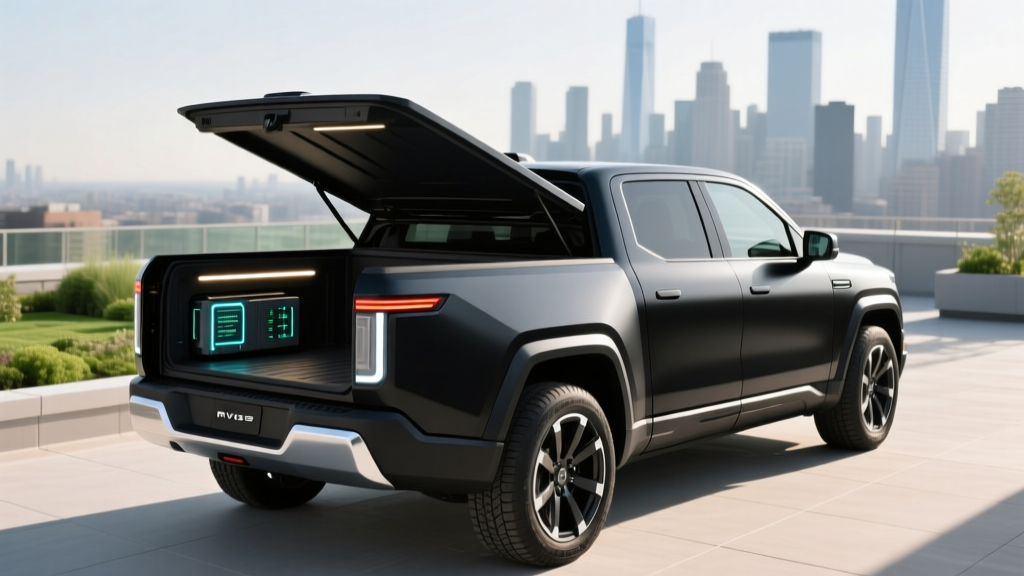
The Rivian powered tonneau cover is an electrically actuated, hard-slat rolling system that retracts and deploys via the R1T's 15.6-inch center touchscreen, the Rivian mobile app, or a physical button in the bed. Unlike manual tri-fold covers common on gas trucks, this system integrates directly with the vehicle's software and gear tunnel architecture.
Key functional details:
- Operation speed: Full deploy or retract in approximately 8 seconds
- Load rating: Supports distributed weight on top (rated for ~400 lbs dynamic, suitable for roof-top tent mounting when fully deployed and latched)
- Weather sealing: Dual-channel rubber seals along bed rails; drains integrated into the bed floor
- Security: Automatic tailgate lock sync — the tonneau cannot be opened remotely unless the vehicle is unlocked or the user is authenticated via the app
- Gear Tunnel interaction: The R1T's transverse Gear Tunnel (a lockable pass-through behind the cab) remains accessible even with the tonneau fully deployed, effectively extending enclosed cargo capacity beyond the 4'6" bed
For buyers prioritizing bed security without sacrificing quick access, the powered system eliminates the two-handed wrestling match of manual covers. It also enables a unique use case: using the R1T's bed as a secure, weather-proof mobile storage unit during overlanding trips, with the Gear Tunnel handling dirty gear separately.
Drawback: The powered tonneau adds approximately $3,500 to the vehicle price as a standalone option (included in the Adventure Package on higher trims). If the motor or track mechanism fails out of warranty, replacement costs are estimated at $2,000–$3,000 based on current Rivian service center pricing. Manual covers from aftermarket brands cost $800–$1,500 but lack software integration.
Charging Speed: DC Fast, Level 2, and the Charge Curve Reality
| Charging Level | Power / Voltage | Speed | Time (10–80%) |
|---|---|---|---|
| Level 1 (120V outlet) | 1.4 kW | ~3 mi/hr | N/A (days for full charge) |
| Level 2 (Home, 48A / 240V) | 11.5 kW | ~34 mi/hr | ~10 hours (0–100%, Max Pack) |
| Level 2 (Rivian Wall Connector, 80A) | 19.2 kW | ~57 mi/hr | ~6.5 hours (0–100%, Max Pack) |
| DC Fast (CCS/NACS, 220 kW peak) | 220 kW max | ~650 mi/hr (peak) | ~29 min (10–80%, Max Pack) |
| DC Fast (350 kW station, throttled) | Limited to 220 kW | Same as above | Same as above |
Rivian's 220-kW peak DC fast-charge rate is competitive but not class-leading — the Hyundai Ioniq 5 and Kia EV9 accept over 350 kW on 800-volt architectures. The practical implication: on a road trip, the R1T Max Pack will spend roughly 29 minutes at a DC fast charger going from 10% to 80% SoC. That's enough for a meal stop, but it's noticeably longer than the sub-20-minute charge times of 800V competitors.
Charge curve taper is critical to understand. The R1T holds near-peak charging speed (roughly 190–220 kW) from 10% to approximately 45% SoC, then tapers progressively. From 80% to 100%, charging slows dramatically to protect cell health — expect 45+ additional minutes to go from 80% to full on DC. For road trips, plan stops around the 10–80% window and skip topping off unless you're at your destination.
At home, the 19.2-kW Rivian Wall Connector (which requires a 100-amp dedicated circuit) fully replenishes the Max Pack overnight. Most buyers opt for the standard 48-amp / 11.5-kW setup on a NEMA 14-50 outlet, which adds roughly 34 miles per hour of charging — sufficient for the Max Pack in about 10 hours. Installation costs for a 14-50 outlet typically run $500–$1,500 depending on panel proximity; a hardwired 80-amp circuit for the Wall Connector may require a panel upgrade ($2,000–$4,000) in older homes.
Pricing, Trims, and Federal Tax Credit Eligibility
| Trim | Base MSRP | §30D Credit Eligible? | Effective Price (with credit) |
|---|---|---|---|
| Dual-Motor Standard Pack | $69,900 | Yes (meets MSRP cap) | ~$62,400* |
| Dual-Motor Large Pack | $79,900 | Yes (meets MSRP cap) | ~$72,400* |
| Tri-Motor Max Pack | $99,900 | No (exceeds $80K truck cap) | $99,900 |
| Quad-Motor Max Pack | $109,900 | No (exceeds $80K truck cap) | $109,900 |
*Effective price assumes full $7,500 §30D credit. Eligibility depends on buyer income (AGI ≤ $150K single / $300K joint), battery component and critical mineral sourcing requirements, and MSRP caps ($80,000 for vans, SUVs, and pickup trucks). Verify current rules at IRS.gov §30D guidelines and consult a tax professional.
The R1T's tax credit situation is trim-dependent. The Dual-Motor Standard ($69,900) and Dual-Motor Large ($79,900) both fall under the $80,000 MSRP cap for pickup trucks and can qualify for the full $7,500 federal credit — provided the buyer meets income limits and the vehicle's battery sourcing satisfies critical-mineral and component requirements that shift annually. As of the 2026 tax year, Rivian's U.S.-assembled battery packs (manufactured in Normal, Illinois) meet a significant portion of these requirements, but exact qualification can change with supply chain adjustments.
The Tri-Motor and Quad-Motor trims blow past the MSRP cap and are ineligible for §30D regardless of buyer income. For these trims, buyers should investigate state-level incentives (California's CVRP, Colorado's innovative motor vehicle credit, etc.) and the commercial clean vehicle credit (§45W) if purchasing through a business entity.
The powered tonneau cover, when added as a $3,500 option, pushes some Dual-Motor Large configurations above the $80,000 MSRP cap if bundled with other packages. Buyers targeting the tax credit should confirm the final MSRP on the window sticker before signing — options installed at the factory count toward the cap, while dealer-installed accessories may not.
Performance, Handling, and Drivetrain
The R1T Dual-Motor produces 533 horsepower and 610 lb-ft of torque, achieving a 4.5-second 0–60 mph time — quick for a 7,000-pound truck. The Quad-Motor variant (1,025 hp) drops that to 3.0 seconds, placing it in supercar territory, though the added weight of four independent drive units reduces range by roughly 15–20 miles vs. the Dual-Motor equivalent.
Where the R1T separates itself from the F-150 Lightning and Silverado EV is off-road geometry. With 14.9 inches of ground clearance (max ride height on the air suspension), 34.4-degree approach angle, and individual wheel torque vectoring on the Quad-Motor, the R1T is genuinely trail-capable — not just AWD-in-the-snow capable. The tank-turn feature (spinning left and right wheels in opposite directions) remains exclusive to the Quad-Motor and is useful for tight trail switchbacks, though it's hard on tires and best used sparingly on loose surfaces.
On-road, the R1T's skateboard platform keeps the center of gravity low, and body roll is well-controlled for a body-on-frame-equivalent truck. The ride quality on the standard coil springs is firm; the available air suspension ($2,500 option on some trims) smooths out highway expansion joints and allows ride-height adjustment for aero efficiency or ground clearance on demand.
Cargo, Bed Utility, and Interior Space
The R1T's bed is shorter than a traditional full-size truck at 4 feet 6 inches (with the tailgate closed), but Rivian compensates with clever architecture:
- Bed volume: 37.0 cu ft (bed only, with tailgate up)
- Gear Tunnel: 11.0 cu ft of lockable, weather-sealed transverse storage behind the cab — accessible from both sides of the truck
- Frunk (front trunk): 11.0 cu ft, drainable, with a powered latching lid — large enough for two carry-on bags or a week's groceries
- Extended bed (tailgate down, tonneau retracted): Accommodates 6'8" of flat load floor — sufficient for plywood sheets or bicycles
- Max payload: 1,760 lbs (reduced by ~100 lbs with powered tonneau installed due to mechanism weight)
Inside the cabin, the R1T seats five with 41.4 inches of front legroom and 36.2 inches rear. The rear seat is tighter than an F-150 SuperCrew, but the flat floor (no transmission tunnel hump) makes the middle seat usable for adults on short trips. The 15.6-inch landscape infotainment screen runs Rivian's proprietary software, which supports wireless Apple CarPlay and Android Auto, over-the-air updates, and integrated trip planning with charging stops.
Driver assistance: The R1T ships with Rivian's Driver+ system, a Level 2 (SAE) hands-on-wheel highway assist that handles lane centering and adaptive cruise. It is not a hands-off or self-driving system — the driver must maintain attention and steering input at all times. A driver-monitoring camera alerts if attention lapses. Competent for long highway stretches, but it doesn't match the lane-change confidence of GM's Super Cruise on mapped highways.
Pros, Cons, and Who Should Buy
Pros
- Class-leading range (420 mi Max Pack) among electric pickups
- Powered tonneau integrates seamlessly with software and Gear Tunnel
- Genuine off-road capability with air suspension and torque vectoring
- LFP option (Standard Pack) for buyers prioritizing battery longevity
- Over-the-air updates continue to add features post-purchase
- 11,000-lb towing capacity covers most boat and camper trailers
Cons
- 220-kW peak charge rate trails 800V competitors (29 min 10–80%)
- Higher trims (Tri/Quad-Motor) exceed $80K MSRP cap — no federal credit
- Bed is shorter than full-size gas trucks (4'6" vs 5'5"–6'5")
- Rear seat space is tighter than F-150 Lightning or Silverado EV
- Premium pricing — even the base model starts near $70K
- Limited service center network vs. legacy automakers in rural areas
Best for: Adventure-oriented buyers who need a daily-drivable truck with off-road chops, secure bed storage (the powered tonneau excels here), and road-trip range. The Dual-Motor Large Pack at $79,900 hits the sweet spot — eligible for the tax credit, 352 miles of range, and enough power for towing. Overlanders, outdoor professionals, and two-vehicle households replacing a gas truck will find the R1T compelling.
Not ideal for: Commercial fleet buyers needing an 8-foot bed, budget-conscious shoppers (the F-150 Lightning Pro starts ~$15K lower), or rural buyers far from Rivian service centers. If you tow at max capacity daily, the Silverado EV's available 400-mile range and 10,000-lb tow rating with a larger bed may suit better.
Frequently Asked Questions
What is the real-world range of the Rivian R1T?
The EPA rates the Max Pack at 420 miles, but real-world highway driving at 70–75 mph yields approximately 330–360 miles. Cold weather (below freezing) reduces this to roughly 280–310 miles. The Dual-Motor Large Pack (352 mi EPA) realistically delivers 280–310 miles on the highway.
How fast does the R1T charge at home and on the road?
On a 220-kW DC fast charger, the Max Pack goes from 10–80% in about 29 minutes. At home on a 48-amp Level 2 outlet (11.5 kW), it adds roughly 34 miles per hour, fully charging overnight in about 10 hours. The Rivian Wall Connector at 80 amps (19.2 kW) cuts that to ~6.5 hours.
Does the Rivian R1T qualify for the $7,500 federal tax credit?
The Dual-Motor Standard ($69,900) and Dual-Motor Large ($79,900) trims can qualify, provided the buyer's AGI is within limits ($150K single / $300K joint) and the battery meets critical-mineral sourcing requirements. Tri-Motor and Quad-Motor trims exceed the $80,000 MSRP cap for trucks and are ineligible. Always verify at IRS.gov before purchasing.
Is the powered tonneau cover worth the $3,500 cost?
If you regularly need secure, weather-proof bed access and value one-touch operation via the app or touchscreen, yes. It integrates with the vehicle's security system and preserves the Gear Tunnel's independent access. If you rarely use the bed or prefer aftermarket flexibility, a manual cover saves money.
How does the R1T compare to the Ford F-150 Lightning?
The Lightning offers a larger bed (5'5"), more rear-seat space, a lower starting price (~$55K), and Ford's dealer network. The R1T counters with longer range (420 vs 320 mi max), superior off-road geometry, the Gear Tunnel, and more advanced software. If budget and bed size matter most, the Lightning wins. If range, adventure capability, and tech are priorities, the R1T leads.
What is the battery warranty on the Rivian R1T?
Rivian covers the battery pack and powertrain for 8 years or 175,000 miles, whichever comes first. The warranty guarantees the battery will retain at least 70% of its original capacity during that period. This is competitive with the industry standard (most EVs offer 8 yr / 100,000 mi), and Rivian's higher mileage threshold benefits high-use buyers.
Can I install the powered tonneau cover after purchase?
Rivian offers the powered tonneau as a factory-installed option and through its service centers as a retrofit. Retrofit availability and pricing vary by model year. Third-party powered covers exist but may not integrate with the R1T's software or Gear Tunnel architecture, and could affect the vehicle warranty if installation damages wiring or bed components.