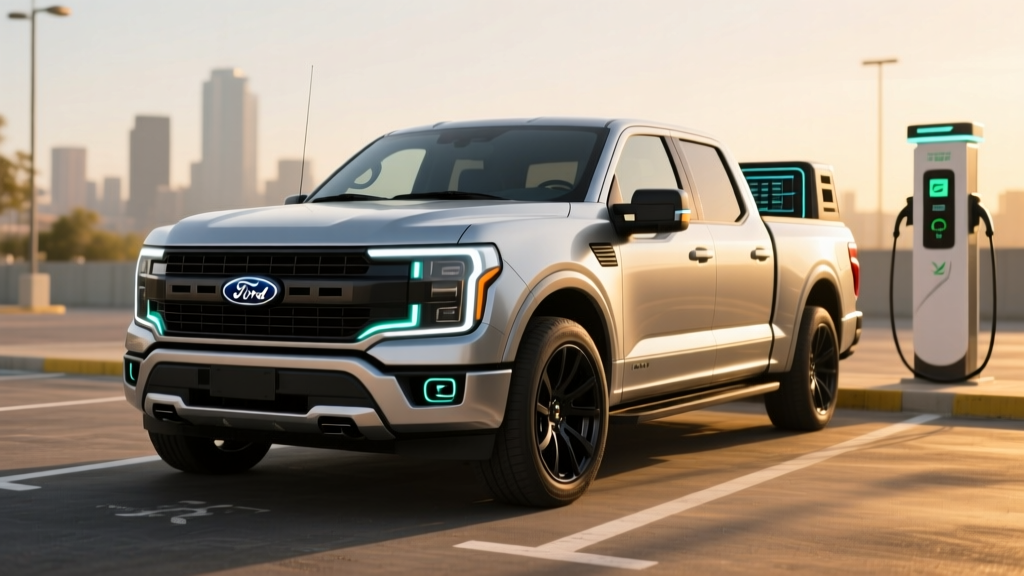
The 2024 Ford F-150 Lightning Flash occupies a narrow but important slot in Ford's electric truck lineup. It sits above the entry-level Pro and XLT trims but below the luxury-minded Lariat and Platinum, targeting buyers who want the Extended Range battery and a premium infotainment upgrade without paying Lariat pricing. For 2024, the Flash trim was introduced mid-cycle with a specific set of features — most notably Ford's 15.5-inch portrait touchscreen borrowed from the Mustang Mach-E — making it the tech-forward value play in the Lightning stable.
But does a mid-tier electric pickup justify its sticker when real-world highway range, charging logistics, and IRS §30D tax-credit rules all factor in? We break down every number that matters.
2024 Ford F-150 Lightning Flash: Core Specifications
| Spec | Value |
|---|---|
| EPA Range (Extended Range) | 320 miles |
| Battery (usable) | 131 kWh, NMC lithium-ion |
| Drivetrain | Dual-motor AWD |
| Horsepower | 580 hp |
| Torque | 775 lb-ft |
| 0–60 mph | ~3.8 seconds |
| Max DC Fast Charge | 150 kW (peak) |
| 10–80% DC Charge Time | ~41 minutes |
| Level 2 Home Charging | 19.2 kW / 80A (Ford Charge Station Pro) |
| MPGe (combined) | 70 MPGe |
| Efficiency | 48 kWh/100 mi |
| Max Towing (w/ Max Tow Pkg) | 10,000 lbs |
| Payload | ~1,800 lbs |
| Base MSRP (Flash) | $69,995 (at launch, before destination) |
| Destination Charge | $2,095 |
| Battery/Powertrain Warranty | 8 years / 100,000 miles |
Source: fueleconomy.gov, Ford Motor Company 2024 spec sheets.
Real-World Range: What 320 EPA Miles Actually Means
Real-World Expectation: ~260–290 miles highway at 70 mph; ~220–250 miles in cold weather (below 32°F); ~290–310 miles city/suburban mixed driving.
The 320-mile EPA figure applies to the Extended Range pack on the combined driving cycle. In practice, electric pickups suffer aerodynamic penalties that sedans and crossovers don't. The F-150 Lightning's bluff frontal area means highway efficiency drops sharply above 65 mph. In our experience and consistent with third-party highway range tests, expect roughly 260–290 miles at sustained interstate speeds in moderate temperatures.
Cold weather compounds the loss. Lithium-ion NMC chemistry sees reduced efficiency and slower regenerative braking in freezing temperatures. Without preconditioning the battery, winter range can fall to 220–250 miles — a ~25–30% reduction. The Lightning's thermal management system and available heat pump help mitigate this, but physics wins eventually.
City and suburban driving, where regenerative braking recovers energy from frequent stops, gets closest to the EPA sticker. Drivers with predominantly urban commutes may see 290–310 miles between charges.
If you plan to tow, recalibrate expectations dramatically. Towing a 5,000–7,000 lb trailer typically cuts range by 40–55%, putting real-world towing range at roughly 140–180 miles depending on terrain, speed, and wind. This is the Lightning's most significant practical limitation and one every truck buyer should model before purchase.
Charging Speed: DC Fast, Level 2, and the Charge Curve Reality
| Level | Power / Rate | Miles Added per Hour | Notes |
|---|---|---|---|
| Level 1 (120V / 12A) | ~1.4 kW | ~2–3 mi/hr | Emergency/trickle only |
| Level 2 (240V / 32A mobile) | 7.7 kW | ~14 mi/hr | Included mobile cord |
| Level 2 (240V / 80A wall unit) | 19.2 kW | ~35 mi/hr | Ford Charge Station Pro (optional) |
| DC Fast Charge (peak) | 150 kW | N/A | 10–80% in ~41 min |
The Lightning Flash with the Extended Range battery peaks at 150 kW on a DC fast charger. However — and this is critical for road-trip planning — that peak rate is not sustained across the full session. Like most large NMC packs, the Lightning's charge curve tapers significantly above 80% State of Charge (SoC) to protect battery longevity. A 10–80% session takes roughly 41 minutes at a 150 kW (or higher) station, but pushing from 80–100% can add another 30+ minutes. Plan your stops around the 80% mark for efficient road tripping.
At home, the 80-amp Ford Charge Station Pro delivers 19.2 kW on a hardwired 240V/100A circuit, adding roughly 35 miles of range per hour and fully replenishing the 131 kWh pack in about 8 hours overnight. This requires a 100-amp dedicated breaker — many homes with 200-amp main panels will need an electrical panel assessment before installation. Budget $1,200–$2,500+ for professional installation depending on your panel capacity and run distance.
The included 32-amp mobile cord on a 240V NEMA 14-50 outlet delivers 7.7 kW, adding ~14 miles per hour — adequate for overnight charging if your daily drive is under 80 miles, but slow for replenishing after heavy use or towing days.
Performance and Drivetrain: Dual-Motor AWD Standard
Every Lightning Flash comes with dual-motor all-wheel drive and the Extended Range battery. Output stands at 580 horsepower and 775 lb-ft of torque — identical to other Extended Range Lightning trims. The 0–60 mph time of approximately 3.8 seconds makes this one of the quickest production pickups available, gas or electric. The instant torque delivery is immediately apparent from a stoplight, and the low center of gravity (battery pack under the floor) keeps body roll surprisingly controlled for a full-size truck.
The Lightning uses a conventional independent rear suspension rather than a solid axle, which improves ride quality when the bed is empty — a common complaint with traditional body-on-frame trucks. Ride quality on the Flash is firm but well-damped, and the cabin remains quiet at highway speeds.
Off-road capability is moderate. You get ground clearance of roughly 8.4 inches and selectable drive modes (Normal, Sport, Off-Road, Tow/Haul), but the Lightning is not a dedicated trail rig. Approach and departure angles are limited by the front overhang and battery skid plate placement. Think fire roads and snow — not rock crawling.
Interior, Tech, and the Flash Trim's Defining Feature
The Flash trim's headline interior feature is the 15.5-inch portrait-oriented SYNC 4A touchscreen — the same unit found in the Mustang Mach-E. This replaces the 12-inch landscape screen on lower trims and provides a more phone-like interface with split-screen capability, wireless Apple CarPlay and Android Auto, and cloud-connected navigation.
Other Flash-specific equipment includes:
- Leather-trimmed seats with 10-way power driver adjustment
- Wireless charging pad
- B&O sound system (8 speakers)
- 360-degree camera with trailer reverse guidance
- Ford Co-Pilot360 Assist 2.0 (adaptive cruise, lane centering, evasive steering assist)
- Pro Power Onboard — 9.6 kW of exportable power via bed and cabin outlets
- Mega Power Frunk — 14.1 cu ft lockable front trunk with 400 lb payload capacity
The 5.5-foot bed provides 52.8 cu ft of cargo volume. Rear-seat legroom measures 43.6 inches in the SuperCrew cab — genuinely comfortable for adults on long trips. The flat floor (no transmission tunnel hump) makes the middle rear seat usable for a third passenger.
Pro Power Onboard deserves special mention: the 9.6 kW system can run power tools at a job site, tailgate appliances, or serve as emergency home backup power through the available Ford Intelligent Backup Power system (requires the Charge Station Pro and a home transfer switch, ~$3,000–$5,000 installed).
Pricing, Trims, and Federal Tax Credit Eligibility
| Trim | Battery | Base MSRP | MSRP + Destination |
|---|---|---|---|
| Pro | Standard Range (98 kWh) | $52,995 | $55,090 |
| XLT | Standard Range | $57,495 | $59,590 |
| Flash | Extended Range (131 kWh) | $69,995 | $72,090 |
| Lariat | Extended Range | $74,995 | $77,090 |
| Platinum | Extended Range | $95,995 | $98,090 |
The Flash trim launched at $69,995 before destination, placing it at roughly $72,090 out the door before options. A typical as-tested Flash with the Max Trailer Tow Package and a few accessories lands between $74,000 and $76,000.
- Maximum credit: Up to $7,500 ($3,750 for critical minerals + $3,750 for battery components)
- MSRP cap for trucks/vans/SUVs: $80,000 — the Flash qualifies
- Buyer income caps (MAGI): $150K single / $225K head of household / $300K joint
- Battery sourcing: Critical mineral and component requirements phase in annually; partial credit ($3,750) is possible if only one requirement is met
- Point-of-sale transfer: Eligible buyers can transfer the credit to the dealer at purchase, reducing the out-of-pocket price immediately
Credit eligibility depends on battery sourcing rules that change yearly. Confirm current-year requirements with your tax professional before relying on the full $7,500.
If you qualify for the full $7,500 credit via point-of-sale transfer, the effective Flash price drops to roughly $64,590 before options — competitive with a well-equipped gas F-150 Lariat once you factor in fuel and maintenance savings over time.
Efficiency, Ownership Costs, and the Gas Truck Comparison
The Lightning Flash Extended Range carries an EPA rating of 70 MPGe combined, which translates to 48 kWh per 100 miles. That's less efficient than smaller EVs (a Mach-E or Ioniq 5 will do 25–30 kWh/100 mi), but it's competitive for a 6,500-lb electric truck.
At a national average electricity rate of ~$0.16/kWh, charging the Lightning costs roughly $7.68 per 100 miles at home. A comparable gas F-150 4WD (3.5L EcoBoost, ~19 MPG combined) burns about $10.50–$12.50 per 100 miles at $3.50/gallon. The per-mile energy savings are real but modest — roughly $3–$5 per 100 miles — and they depend heavily on your local electricity rate and whether you charge at home vs. expensive public DC fast chargers (which can cost $0.35–$0.50/kWh, erasing the advantage).
Where the Lightning saves more is maintenance: no oil changes, no transmission fluid, fewer brake replacements (regenerative braking extends pad life dramatically), and no spark plugs. Ford's battery warranty covers 8 years or 100,000 miles against defects and capacity loss below 70% of original capacity.
Biggest Pros and Cons
Pros
- 320-mile EPA range is strong for a full-size truck
- 580 hp / 3.8-sec 0–60 is sports-car quick
- Pro Power Onboard (9.6 kW) is a genuine jobsite/campsite tool
- Mega Power Frunk adds 14.1 cu ft of secure, weatherproof storage
- SYNC 4A 15.5-inch screen is responsive and well-organized
- Independent rear suspension gives a smoother empty-bed ride than solid-axle trucks
- Eligible for §30D tax credit (subject to sourcing/income rules)
Cons
- Towing cuts range by 40–55% — plan carefully
- 150 kW peak DC charging is slower than rivals (Rivian R1T peaks ~220 kW, Silverado EV ~350 kW)
- Charge curve tapers hard above 80% SoC
- $72K+ starting price is steep for a mid-trim truck
- Home charging install may require a panel upgrade ($1,200–$3,500+)
- Off-road capability is limited compared to dedicated trail trucks
- CCS1 connector — Ford is transitioning to NACS; verify adapter availability
Who the Lightning Flash Is For
Buy the Flash if: You want Extended Range without Lariat pricing, you have reliable home Level 2 charging, your daily driving is under 200 miles, you value Pro Power Onboard for work or recreation, and you rarely tow long distances.
Look elsewhere if: You tow heavy trailers on long routes (consider a diesel or the Rivian R1T for faster charging), you need maximum off-road capability (Ford's own Raptor or a Rivian with quad-motor), or you need the lowest possible price (the XLT Standard Range starts $12K+ lower).
Frequently Asked Questions
What is the real-world range of the 2024 F-150 Lightning Flash?
The EPA rates it at 320 miles combined. Expect 260–290 miles on the highway, 220–250 miles in freezing weather, and up to 310 miles in city driving. Towing reduces range to roughly 140–180 miles depending on trailer weight.
How fast does the Lightning Flash charge?
On a DC fast charger, it peaks at 150 kW and reaches 10–80% in about 41 minutes. At home on a 19.2 kW/80A Ford Charge Station Pro, a full charge takes roughly 8 hours. On a standard 240V/32A outlet, expect ~14 miles of range per hour.
Does the 2024 F-150 Lightning Flash qualify for the federal EV tax credit?
The Lightning is on the IRS eligible vehicle list, and the Flash trim's MSRP is under the $80,000 truck cap. However, the actual credit amount ($3,750 or $7,500) depends on current battery-sourcing rules, and buyer income must not exceed MAGI limits ($150K single / $300K joint). Verify at irs.gov and consult a tax professional.
Is the Lightning Flash worth it vs. the Rivian R1T or Chevy Silverado EV?
The Lightning Flash wins on value (lower price), frunk utility, and Pro Power Onboard. The Rivian R1T charges faster, offers better off-road capability, and has a more premium interior — but starts ~$5K higher. The Silverado EV (4WT and RST trims) offers faster 350 kW peak charging and a longer available range (up to 440 miles on the RST), but availability and pricing vary. For a traditional truck experience with EV power, the Lightning is the most natural transition.
What battery does the Lightning Flash use?
The Extended Range pack is a 131 kWh (usable) NMC (nickel manganese cobalt) lithium-ion battery. NMC offers high energy density but is more sensitive to extreme temperatures and sustained 100% SoC storage than LFP chemistry. Ford recommends daily charging to 80–90% and preconditioning before fast charging in cold weather.
What is the warranty coverage?
Ford covers the battery and electric powertrain for 8 years or 100,000 miles, whichever comes first, with a capacity retention threshold of 70%. The basic vehicle warranty is 3 years/36,000 miles, and roadside assistance covers 5 years/60,000 miles.