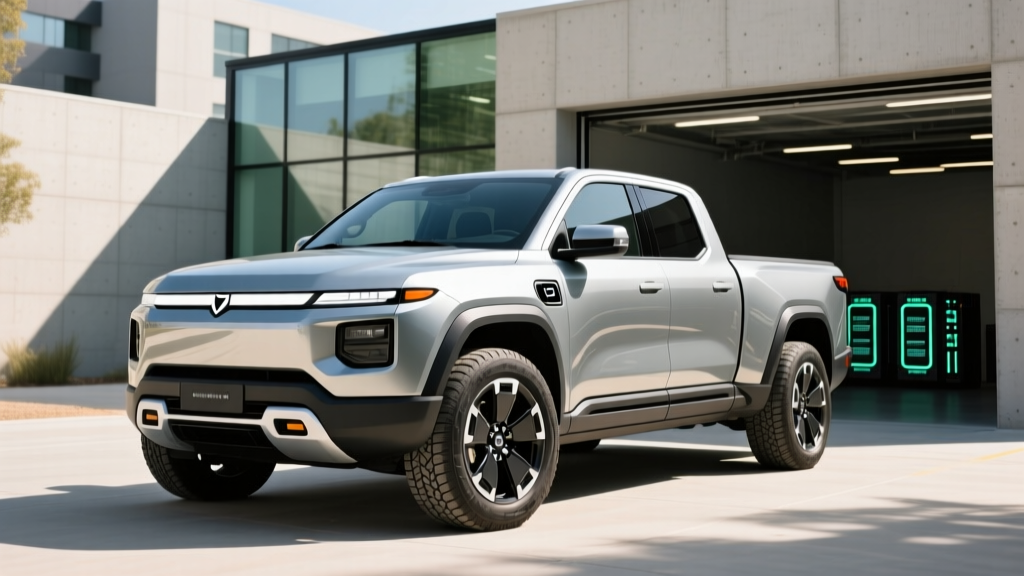
Rivian's R1T pickup remains one of the most capable electric trucks on the market, but the horsepower story is more layered than a single number. Depending on which motor configuration you choose, Rivian R1T horsepower ranges from a stout 533 hp in the Dual-Motor up to a supercar-rivaling 1,025 hp in the Quad-Motor Tri. This review breaks down every drivetrain variant, pairs it with real-world range and charging data, and tells you whether the R1T still earns its premium price in 2026.
Quick Verdict: Which R1T Drivetrain Is Right for You?
Choose the Dual-Motor if you want the longest range (up to 420 mi with the Max Pack), the lowest entry price, and 533 hp — more than enough for trailering, commuting, and weekend dirt roads.
Choose the Performance Dual-Motor if you want 665 hp and a 3.5-second 0-60 time without sacrificing the Max Pack range option.
Choose the Tri-Motor if you tow heavy (11,000-lb rating), frequently drive off-road, and want 850 hp with a dedicated rear torque-vectoring motor.
Choose the Quad-Motor only if you prioritize the fastest acceleration (1,025 hp, ~2.5 sec 0-60) and four-wheel torque vectoring over maximum range and budget.
Rivian R1T Horsepower and Performance by Drivetrain
Rivian restructured the R1T lineup for the 2025 model year and carried it into 2026, simplifying from four distinct drivetrains to three main configurations (Dual-Motor, Tri-Motor, Quad-Motor) with a Performance upgrade available on the Dual. Here is the complete horsepower and performance matrix:
| Specification | Dual-Motor | Performance Dual | Tri-Motor | Quad-Motor |
|---|---|---|---|---|
| Horsepower | 533 hp | 665 hp | 850 hp | 1,025 hp |
| Torque (lb-ft) | 610 | 829 | 1,103 | 1,198 |
| 0-60 mph | 4.5 sec | 3.5 sec | ~3.0 sec | ~2.5 sec |
| Drivetrain | AWD (2 motors) | AWD (2 motors) | AWD (3 motors) | AWD (4 motors) |
| Max Tow Rating | 11,000 lbs | 11,000 lbs | 11,000 lbs | 11,000 lbs |
For context, 533 hp already exceeds the output of most gas-powered full-size pickups including the Ford F-150 5.0L V8 (400 hp) and the Ram 1500 5.7L HEMI (395 hp). The Quad-Motor's 1,025 hp rivals the Tesla Model S Plaid and puts the R1T in territory previously reserved from hypercars. But horsepower alone doesn't define a truck — range, charging, and utility matter just as much.
EPA Range vs. Real-World Expectations
The R1T offers three battery pack sizes — Standard, Large, and Max — paired with different motor configurations. EPA range varies dramatically depending on the combination you choose.
EPA Range vs. Reality: The longest-range R1T — the Dual-Motor with the Max Pack — carries an EPA-estimated 420 miles. In real-world highway testing at 70-75 mph, expect approximately 340-365 miles. In freezing temperatures (below 30°F), range drops an additional 15-25%, potentially yielding 270-310 miles on a full charge. The Quad-Motor Standard Pack, by contrast, is EPA-rated at just 270 miles — expect ~220 highway and under 190 in deep cold.
| Configuration | Battery (usable kWh) | Chemistry | EPA Range | Real-World Hwy Est. |
|---|---|---|---|---|
| Dual-Motor / Standard | ~92 kWh | NMC (LFP on base) | 270 mi | ~220 mi |
| Dual-Motor / Large | ~109 kWh | NMC | 340 mi | ~280 mi |
| Dual-Motor / Max | ~141 kWh | NMC | 420 mi | ~350 mi |
| Tri-Motor / Large | ~109 kWh | NMC | ~315 mi | ~260 mi |
| Tri-Motor / Max | ~141 kWh | NMC | ~380 mi | ~315 mi |
| Quad-Motor / Large | ~109 kWh | NMC | ~310 mi | ~255 mi |
Rivian has offered LFP (lithium iron phosphate) chemistry on select Standard Pack configurations, which trades some energy density for lower cost, longer cycle life, and the ability to routinely charge to 100% without degradation concerns. The Large and Max packs use NMC (nickel manganese cobalt) chemistry for higher energy density. If you plan to charge to 100% daily, the LFP Standard Pack is worth considering — though you sacrifice roughly 70-150 miles of range versus the larger packs.
Charging Speed: DC Fast Charging and Home Level 2
Charging speed is where Rivian made substantial improvements in the Gen 2 platform. The R1T now supports significantly faster DC fast charging than the original Gen 1 trucks, especially on the Large and Max packs.
| Charge Method | Standard Pack | Large Pack | Max Pack |
|---|---|---|---|
| Peak DC Fast Charge | ~175 kW | ~200 kW | ~220 kW |
| 10-80% Time (DC) | ~30 min | ~28 min | ~35 min |
| Level 2 Home (240V / 48A) | 11.5 kW (~22 mi/hr) | 11.5 kW (~22 mi/hr) | 11.5 kW (~22 mi/hr) |
| Level 2 Full Charge Time | ~9 hrs | ~11 hrs | ~14 hrs |
| Connector | NACS (native Tesla Supercharger access) | ||
Charging-curve reality check: The peak kW figure is just that — a peak, sustained only in a narrow state-of-charge (SoC) window, typically between 10-30%. Above 50% SoC, charging power tapers progressively. A Max Pack charging from 10-80% at a 350 kW Electrify America or Tesla Supercharger V4 station will average closer to 130-150 kW across the full session. This is why the 10-80% time matters more than the peak kW number.
Rivian switched to the NACS (North American Charging Standard) connector for the R1T, granting native access to Tesla's Supercharger network — the most reliable DC fast-charging network in North America. The Rivian app integrates Supercharger routing and preconditioning automatically, warming the battery en route to maximize charge speed on arrival.
Efficiency: MPGe and kWh per 100 Miles
Heavy, powerful trucks are inherently less efficient than sedans, and the R1T is no exception. According to fueleconomy.gov, the R1T's efficiency varies by configuration:
- Dual-Motor / Large Pack: ~70 MPGe combined / ~48 kWh/100 mi
- Dual-Motor / Max Pack: ~68 MPGe combined / ~49 kWh/100 mi
- Tri-Motor / Max Pack: ~60 MPGe combined / ~56 kWh/100 mi
- Quad-Motor / Large Pack: ~56 MPGe combined / ~60 kWh/100 mi
At a national average electricity rate of ~$0.16/kWh, the Dual-Motor Large Pack costs roughly $7.68 to charge for 100 miles. Compare that to a gas F-150 4x4 at 19 MPG combined and $3.40/gallon — that's ~$17.89 per 100 miles. The R1T saves approximately $10 per 100 miles driven on fuel, assuming home charging at average rates. Public DC fast charging at $0.35-$0.48/kWh narrows or eliminates this advantage on road trips.
Pricing, Trims, and Federal Tax Credit Eligibility
The R1T's price spread is wide. Here is the 2026 MSRP lineup before any incentives:
| Trim / Configuration | Base MSRP | Typical As-Tested | §30D Credit Eligible? |
|---|---|---|---|
| Dual-Motor / Standard Pack | $69,900 | $72,000-$76,000 | Yes — if under $80K MSRP cap |
| Dual-Motor / Large Pack | $75,900 | $79,000-$84,000 | Varies (options push over $80K cap) |
| Dual-Motor / Max Pack | $83,900 | $87,000-$93,000 | No — exceeds $80K truck MSRP cap |
| Tri-Motor / Large Pack | $99,900 | $104,000-$112,000 | No — exceeds $80K truck MSRP cap |
| Quad-Motor / Large Pack | $99,900+ | $108,000-$120,000 | No — exceeds $80K truck MSRP cap |
Federal tax credit (§30D) rules for 2026: The IRS classifies the R1T as a truck, so the MSRP cap is $80,000 (vs. $55,000 for sedans). However, the cap applies to the total MSRP including dealer-installed options but excluding destination. Additionally, buyer income must not exceed $150,000 (single) / $300,000 (married filing jointly), and the vehicle must meet critical-mineral and battery-component sourcing requirements that have tightened significantly since 2024. Rivian has worked to qualify its US-built battery packs, but eligibility can change. Always verify current status on IRS.gov before purchasing. The credit can now be transferred to the dealer at point of sale, effectively acting as an instant rebate.
Practically, only the Dual-Motor Standard and Large Pack configurations have a realistic path to the full $7,500 federal credit, and only if optioned carefully to stay under $80,000 MSRP. Every Tri-Motor, Quad-Motor, and Max Pack variant exceeds the cap.
Cargo, Passenger Space, and Utility
The R1T is classified as a mid-size pickup, shorter in overall length than a Ford F-150 but offering creative storage solutions that gas trucks can't match.
- Bed length: 4.5 feet (54 inches), expandable with the Gear Tunnel and powered tonneau
- Gear Tunnel: ~11 cu ft of lockable, pass-through storage between the cab and bed — exclusive to Rivian
- Frunk (front trunk): ~11 cu ft, drainable, with a powered lid — ideal for groceries or muddy gear
- Rear-seat legroom: ~38.2 inches — adequate for adults on long trips
- Total payload: ~1,760 lbs
- Towing capacity: 11,000 lbs (all configurations)
The Gear Tunnel is the R1T's party trick. It's large enough for skis, golf bags, or a week of camping gear, and it's accessible from either side of the truck. Combined with the frunk, the R1T offers more enclosed, lockable storage than most mid-size pickups despite its shorter bed.
Tech, Driver Assistance, and Software
The R1T runs Rivian's proprietary software stack on a 15.6-inch center touchscreen and a 12.3-inch driver display. Key technology includes:
- Rivian Driver+ (Level 2 ADAS): Adaptive cruise control with lane centering on divided highways, automatic emergency braking, blind-spot monitoring. This is an SAE Level 2 system — you must keep hands on the wheel and eyes on the road at all times. It is not autonomous driving.
- OTA updates: Regular over-the-air software improvements, including new features, range optimizations, and UI refinements — delivered remotely like a smartphone update.
- Powered tonneau cover: Standard on most trims, operated via app or dashboard button.
- Camp Kitchen accessory: A slide-out kitchen system that integrates into the Gear Tunnel (optional, ~$5,000).
- Vehicle-to-load (V2L): Powers external devices and tools from the truck's battery via bed and frunk outlets.
Driver-Assist Clarification: Rivian Driver+ is an SAE Level 2 driver-assistance system. It does not make the R1T self-driving. The driver remains fully responsible for vehicle operation. No consumer vehicle sold in the US currently offers Level 3 or higher autonomous driving for general use.
Warranty Coverage
Rivian's warranty package is competitive with the EV truck segment:
- Battery & Drive Units: 8 years / 175,000 miles (retains ≥70% capacity)
- Bumper-to-Bumper: 5 years / 60,000 miles
- Corrosion Perforation: 12 years / unlimited miles
- Roadside Assistance: 5 years / 60,000 miles
The 175,000-mile battery warranty is notably generous compared to the industry-standard 100,000 miles and should cover most owners through a decade of use. According to NHTSA, Rivian has maintained relatively few battery-related recalls through early 2026.
Pros and Cons
Pros
- Class-leading horsepower options up to 1,025 hp
- Up to 420 mi EPA range (Dual-Motor Max Pack)
- Native NACS connector — full Tesla Supercharger access
- 11,000-lb tow rating across all configurations
- Gear Tunnel + Frunk offer unique enclosed storage
- 8-yr / 175,000-mi battery warranty
- Regular OTA updates add features post-purchase
Cons
- Quad-Motor and Tri-Motor trims exceed §30D tax-credit MSRP cap
- 4.5-ft bed is short for full-size truck duty
- Real-world range drops significantly at highway speeds and in cold
- Service center network still limited outside major metros
- Premium pricing — well-equipped models exceed $100K
- Insurance costs 20-35% higher than comparable gas trucks
Who Should Buy the Rivian R1T?
The R1T is best suited for adventure-oriented buyers who want a daily-driver pickup with legitimate off-road capability, strong towing capacity, and the practical benefits of electric propulsion (instant torque, V2L power, no fuel stops on short commutes). If you charge at home and your daily driving is under 200 miles, the R1T Dual-Motor Large Pack is an outstanding commuter that happens to be a capable truck on weekends.
It's less ideal for commercial fleet use or high-mileage towing where the range penalty of hauling 8,000+ lbs (which can cut range by 40-50%) makes frequent charging stops impractical. Budget-conscious buyers should also consider that only the base Dual-Motor configurations qualify for the federal tax credit, and even those require careful option selection.
Frequently Asked Questions
What is the real-world range of the Rivian R1T?
The EPA rates the Dual-Motor Max Pack at 420 miles, but real-world highway driving at 70-75 mph typically yields 340-365 miles. In sub-freezing temperatures, expect 270-310 miles. The base Standard Pack delivers approximately 220 miles on the highway.
How fast does the R1T charge at home and on the road?
At a DC fast charger, the Large Pack peaks at ~200 kW and charges 10-80% in about 28 minutes. At home on a 240V / 48A Level 2 charger, you'll add roughly 22 miles of range per hour, with a full charge taking 9-14 hours depending on pack size.
Does the Rivian R1T qualify for the federal EV tax credit?
Only the Dual-Motor Standard and Large Pack configurations — and only if the total MSRP including options stays under the $80,000 truck cap. Buyer income must also be under $150K (single) or $300K (joint), and battery sourcing requirements must be met. Verify current eligibility at IRS.gov before purchasing.
How much does the R1T cost after tax credits?
A Dual-Motor Standard Pack starting at $69,900 could drop to approximately $62,400 after the full $7,500 §30D credit, assuming you meet all income and sourcing requirements. Most real-world builds with options push above the $80K MSRP cap, disqualifying them from the credit.
Is the R1T worth buying vs. the Ford F-150 Lightning or Chevy Silverado EV?
The R1T wins on performance (up to 1,025 hp vs. the Lightning's 580 hp), off-road capability, and storage innovation (Gear Tunnel, frunk). The F-150 Lightning is larger, more affordable, and better for traditional truck work with its 6.5-ft bed and lower starting price. The Silverado EV offers a longer bed and strong range but lacks the R1T's adventure focus. If you prioritize driving dynamics, tech, and trail capability, the R1T justifies its premium. If you need maximum bed length and fleet pricing, the Lightning or Silverado EV may serve better.
What are the biggest drawbacks of owning a Rivian R1T?
The short 4.5-foot bed limits utility for construction or landscaping work. Service centers are concentrated in major metros, so rural owners may face long drives for warranty work. Insurance premiums run 20-35% higher than gas equivalents. And the most desirable configurations (Tri-Motor, Max Pack) are priced above $100,000 with no federal tax credit.