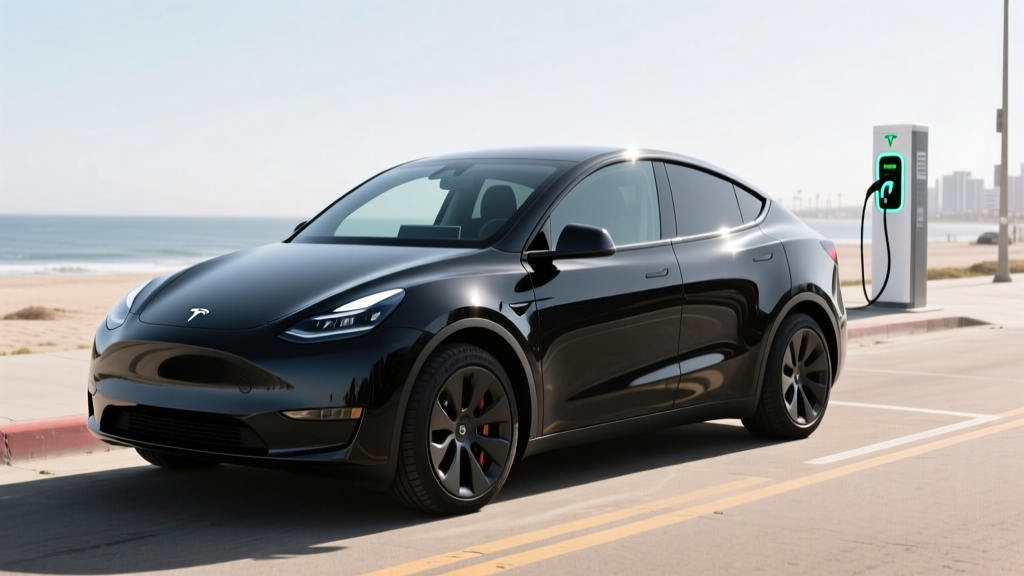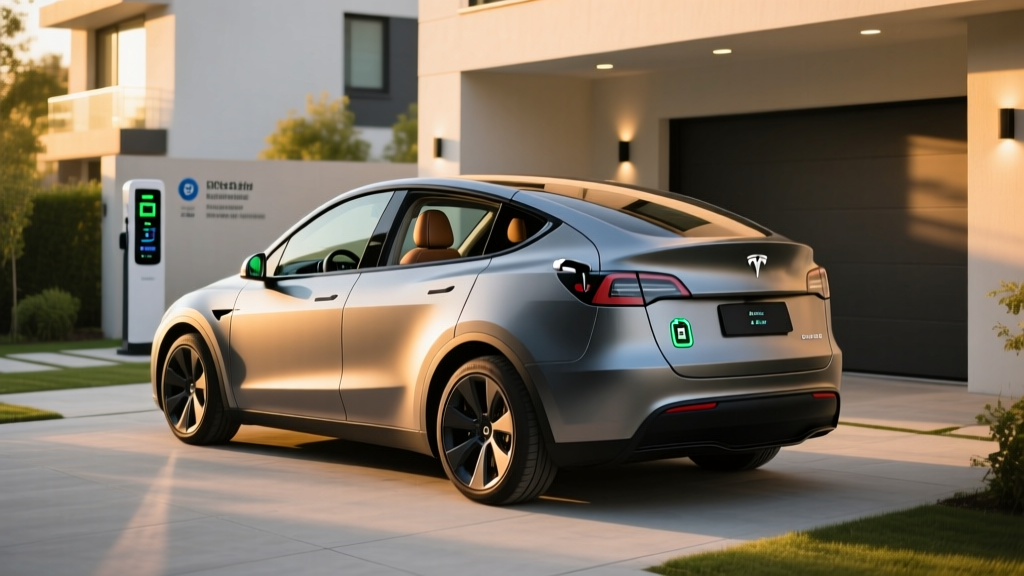
The Tesla Model Y has been Europe's best-selling electric SUV for years, but one configuration has remained elusive for buyers on the continent: a third row. For 2026, the Tesla Model Y 7-seater finally arrives in European markets following the "Juniper" refresh, adding two occasional rear seats to an already compelling package. But does cramming a third row into a midsize crossover actually work — or is it a compromise too far?
After examining the updated specs, real-world efficiency data, and European pricing, we break down exactly what the 7-seat Model Y delivers — and where it falls short compared to purpose-built three-row EVs like the Kia EV9 and Mercedes EQB.
2026 Tesla Model Y 7-Seater: Key Specifications
| Specification | Value |
|---|---|
| WLTP Range | ~533 km (331 mi) |
| Battery Capacity (Usable) | ~75 kWh |
| Battery Chemistry | NMC (Nickel Manganese Cobalt) — Long Range AWD |
| Drivetrain | Dual-Motor AWD |
| Power Output | ~384 hp (286 kW) combined |
| 0–100 km/h (0–62 mph) | ~5.0 seconds |
| Max DC Fast Charge Rate | 250 kW peak |
| 10–80% DC Charge Time | ~25 minutes |
| Level 2 AC Charge Rate | 11 kW (3-phase, European standard) |
| Efficiency (WLTP) | ~14.4 kWh/100 km |
| Cargo (All Rows Up) | ~363 L (12.8 cu ft) |
| Cargo (3rd Row Folded) | ~854 L (30.2 cu ft) |
| Cargo (Max, All Rear Folded) | ~2,040 L (72.0 cu ft) |
| Seating Capacity | 7 (2+3+2) |
| Starting Price (Germany) | €59,990 (~$65,000 USD equivalent) |
| Battery & Drive Unit Warranty | 8 years / 192,000 km (120,000 mi) |
Real-World Range: What the WLTP Sticker Doesn't Tell You
WLTP Sticker: 533 km (331 mi)
Expected Real-World (Mixed Driving, 15°C): ~440–470 km (273–292 mi)
Motorway Sustained (120 km/h, summer): ~380–410 km (236–255 mi)
Cold Weather (0°C, cabin heating): ~340–380 km (211–236 mi)
The WLTP testing cycle is notably more generous than the US EPA cycle, and European buyers should mentally discount the 533 km figure by roughly 12–15% for typical mixed driving. On the Autobahn or French autoroute at sustained 120–130 km/h, energy consumption climbs to 18–20 kWh/100 km, cutting range further.
The addition of the third row adds approximately 40–50 kg to the vehicle's curb weight compared to the 5-seat Long Range, which marginally impacts efficiency — roughly 0.3–0.5 kWh/100 km in real-world conditions. It's not dramatic, but it's measurable on a long trip.
Tesla's heat pump (standard on all 2026 Model Y variants) significantly mitigates cold-weather losses. Without it, you'd see 30–40% range reduction in sub-zero conditions; with it, expect 20–25% loss — still meaningful, but manageable for most European winters.
Charging Speed: Supercharger Network Advantage
| Charging Level | Power / Rate | Speed |
|---|---|---|
| Level 1 (Domestic Socket, 230V) | ~2.3 kW | ~15 km/hr (9 mi/hr) |
| Level 2 (Wall Connector, 3-phase 11 kW) | 11 kW | ~70 km/hr (44 mi/hr) |
| DC Fast Charge (CCS2 / Supercharger V3/V4) | 250 kW peak | 10–80% in ~25 min |
| DC Fast Charge (50 kW public charger) | 50 kW | 10–80% in ~75 min |
The Model Y's charging architecture peaks at 250 kW on Tesla Supercharger V3/V4 stalls and compatible CCS2 chargers. However — and this is critical — the sustained charging curve matters more than the peak number. The NMC battery in the Long Range AWD holds peak rates roughly between 10–45% State of Charge (SoC), then tapers progressively. From 45–80%, average power drops to approximately 120–140 kW.
This means a realistic 10–80% session at a V4 Supercharger takes around 25 minutes, not the theoretical minimum you might calculate from the 250 kW peak alone. Preconditioning the battery via the navigation-routed Supercharger approach is essential — arriving at a fast charger with a cold battery can double your charge time.
For home charging, European 3-phase 11 kW AC is the sweet spot. A full 0–100% charge takes roughly 7–8 hours, making overnight top-ups trivial. Tesla's Wall Connector (€530) or a compatible third-party unit like the Zappi or Easee will handle this well. Installation costs vary by country — expect €800–€2,000 for a professional install depending on your electrical panel and cable run distance.
The Third Row: Practicality vs. Compromise
Let's address the core question: is the Model Y's third row genuinely usable?
For children and short trips: Yes. The 2+3+2 layout works well for school runs, weekend outings, and occasional carpooling with kids. The third-row seats accommodate passengers up to roughly 150 cm (4'11") comfortably. Headroom is tight for anyone taller due to the sloping roofline.
For adults on longer journeys: No. Legroom in the third row is approximately 71 cm (28 inches) — tight even by compact-SUV standards. The seat cushion sits low to the floor (a packaging necessity), creating a knees-up posture that becomes uncomfortable beyond 30 minutes.
Cargo trade-off: With all seven seats occupied, you're left with roughly 363 liters of boot space — enough for a couple of cabin bags and some groceries, but not a family holiday's worth of luggage. Fold the third row flat (a simple 60/40 split), and you recover 854 liters, which is competitive with five-seat rivals.
Compared to the Kia EV9 — a purpose-built three-row electric SUV with 3.1 meters of wheelbase — the Model Y's third row is an afterthought. But the EV9 starts at €69,990 in Europe and is substantially larger to park and maneuver in tight European city streets.
Performance and Driving Dynamics
The dual-motor AWD Long Range powertrain delivers approximately 384 hp and launches the 7-seat Model Y to 100 km/h in about 5.0 seconds. That's a half-second slower than the 5-seat variant due to the added mass, but it remains briskly quick for a family hauler.
Ride quality has improved noticeably with the Juniper refresh. Tesla revised the suspension tuning and added acoustic glass, reducing cabin noise and smoothing out imperfections. The steering remains precise if somewhat devoid of feel — typical Tesla character.
Regenerative braking offers two modes: Standard (aggressive, enabling one-pedal driving in most conditions) and Low (more natural coasting). On European roads with frequent roundabouts and speed changes, Standard mode works exceptionally well and reduces brake wear to near-zero in daily use.
Tech, Autopilot, and the 2026 Interior
The refreshed interior introduces several welcome changes:
- Ventilated front seats — finally available in the European Model Y
- Ambient lighting strip across the dashboard and door panels
- 8-inch rear touchscreen for second-row passengers (climate, media)
- Power-folding second and third rows accessible from the touchscreen or the Tesla app
- Updated 15.4-inch front display with thinner bezels and faster processor
On the driver-assistance front, Tesla's Autopilot (standard) provides adaptive cruise control and lane centering — this is SAE Level 2 driver assistance, meaning you must remain engaged with hands on the wheel and eyes on the road at all times. Enhanced Autopilot (€3,800 option in Europe) adds automatic lane changes, Navigate on Autopilot, and Smart Summon.
Tesla Autopilot and Enhanced Autopilot are SAE Level 2 systems. The driver is fully responsible for vehicle operation at all times. Full Self-Driving (FSD) capability is not currently available in Europe due to regulatory constraints — Tesla has not received UNECE approval for FSD features on European roads. Do not confuse marketing terminology with actual automation capability.
The European-spec Model Y uses a camera-only vision system (Tesla Vision) — no radar or ultrasonic sensors. This has proven competent for highway driving but occasionally struggles with stationary object detection in complex urban environments. According to Euro NCAP, the Model Y achieved a 5-star safety rating with strong scores across all categories.
European Pricing, Incentives, and Value
| Configuration | Price (EUR) | Approx. USD |
|---|---|---|
| Long Range AWD 7-Seat (Base) | €59,990 | ~$65,000 |
| + Enhanced Autopilot | +€3,800 | ~$4,100 |
| + Premium Paint (Ultra Red) | +€2,000 | ~$2,200 |
| + 20" Helix Wheels | +€2,000 | ~$2,200 |
| As-Tested (Fully Optioned) | ~€67,790 | ~$73,500 |
European EV incentives vary enormously by country and change frequently. As of 2026:
- Germany: The federal purchase subsidy (Umweltbonus) ended in December 2023. Company-car tax benefits (0.25% rule for EVs under €70,000 list price) remain the primary incentive — and the 7-seat Model Y qualifies at its base price.
- France: The bonus écologique was reduced to €4,000 for qualifying EVs under €47,000 — the Model Y 7-seater exceeds this threshold and does not qualify for the purchase bonus. The malus penalty avoidance (compared to ICE equivalents) still provides indirect savings.
- Netherlands: SEPP subsidy of €2,950 for private buyers of EVs under €45,000 — the Model Y exceeds the cap. However, the BPM exemption and reduced bijtelling (17% for 2026) for company cars remain significant.
- Norway: VAT exemption removed for EVs above NOK 500,000 (~€43,000) as of 2023 — the Model Y 7-seat pays 25% VAT on the amount above this threshold, adding roughly NOK 30,000–40,000 in tax. Still competitive vs. ICE alternatives due to toll/parking/ferry exemptions.
For US readers cross-shopping: note that the US-market Model Y does not currently offer a 7-seat option. The 7-seat configuration is exclusive to certain international markets. US buyers seeking a 7-seat Tesla would need to look at the Model X (starting ~$79,990), which qualifies for the §30D federal tax credit (up to $7,500, subject to MSRP caps of $80,000 for SUVs, buyer income limits of $300,000 MFJ, and battery critical-mineral sourcing requirements).
Pros and Cons: The Honest Assessment
✓ Pros
- Access to Tesla Supercharger network — still the most reliable DC fast-charging network in Europe
- Best-in-class energy efficiency for a 7-seat electric SUV (~14.4 kWh/100 km WLTP)
- Over-the-air updates continuously improve the vehicle
- Strong resale value compared to most EV competitors
- 250 kW peak charging speed is competitive in 2026
- Low running costs — electricity at €0.30/kWh = ~€4.32/100 km vs. €10+/100 km for petrol
✗ Cons
- Third row is child-only — adults will not tolerate it beyond short trips
- Minimal cargo space with all 7 seats in use (363 L)
- No FSD capability available in Europe — regulatory barrier
- Camera-only vision system occasionally struggles in heavy rain and low light
- Exceeds EV subsidy price caps in Germany, France, and the Netherlands
- Build quality, while improved, still inconsistent vs. German OEM benchmarks
Verdict: Who Should Buy the Model Y 7-Seater?
The Tesla Model Y 7-seater in Europe serves a narrow but real use case: families with two or three young children who need occasional extra seating but don't want to step up to a full-size SUV like the Kia EV9 or Mercedes EQB. If your third-row needs are limited to school carpools, weekend sports runs, or the occasional grandparent lift from the airport, the Model Y handles it adequately while delivering outstanding efficiency, access to the best charging network in Europe, and strong tech.
If you regularly need to carry more than five people on longer journeys, or if adult passengers will use the third row, look at the Kia EV9 (more space, but €10K+ more expensive and less efficient) or consider a plug-in hybrid alternative like the Mercedes GLB 250e for mixed-use flexibility.
For the majority of European EV buyers who don't need seven seats, the 5-seat Model Y Long Range remains the better value — more cargo space, slightly better range, and lower pricing. The 7-seat option is best viewed as an occasional-use convenience feature, not a primary reason to buy.
Frequently Asked Questions
What is the real-world range of the Tesla Model Y 7-seater in Europe?
Expect approximately 440–470 km (273–292 mi) in typical mixed driving at moderate temperatures. Sustained motorway driving at 120+ km/h reduces this to roughly 380–410 km. Cold winter conditions (0°C and below) can push range down to 340–380 km. The WLTP-rated 533 km is achievable only under ideal low-speed, warm-weather conditions.
How fast does the Model Y 7-seater charge?
On a Tesla Supercharger V3/V4 or equivalent 250 kW CCS2 charger, the 10–80% charge takes approximately 25 minutes with a preconditioned battery. At home on a 3-phase 11 kW wallbox, a full charge takes 7–8 hours. On a standard 230V domestic outlet, expect roughly 15 km of range per hour of charging — useful for overnight top-ups but not for full charges.
Is the third row suitable for adults?
No, not for anything beyond very short trips. Legroom is approximately 71 cm, headroom is limited by the sloping roofline, and the low seat cushion creates an uncomfortable knees-up position. Children up to roughly 150 cm tall will be reasonably comfortable. Adults should be reserved for the front and second rows.
Does the European Model Y 7-seater qualify for any tax credits or subsidies?
It depends heavily on your country. The base price of €59,990 exceeds the subsidy price caps in Germany (no current purchase subsidy), France (€47,000 cap), and the Netherlands (€45,000 cap). Company-car tax advantages remain the primary financial incentive in most European markets. In Norway, partial VAT applies above the NOK 500,000 threshold. Always check your local government's current EV incentive program, as rules change annually.
How does the Model Y 7-seater compare to the Kia EV9?
The Kia EV9 is a purpose-built three-row electric SUV with genuinely adult-usable third-row seating, more cargo space with all seats up (~333 L, similar to Model Y but in a larger vehicle with better access), and a longer wheelbase. However, the EV9 starts around €69,990 in Europe, weighs significantly more, and consumes roughly 20–22 kWh/100 km — making it 40–50% less efficient. The Model Y is the efficiency and value play; the EV9 is the space and comfort play.
What is the battery warranty on the European Model Y?
Tesla provides an 8-year / 192,000 km (120,000 mi) warranty on the battery and drive units, whichever comes first. The warranty guarantees a minimum 70% capacity retention over that period. Tesla's NMC batteries in the Model Y have demonstrated approximately 10–12% degradation over 160,000 km in fleet data, suggesting the 70% threshold is conservative.
Sources: Tesla Europe specifications, Euro NCAP, IRS §30D tax credit guidance.