The Rivian R1S Lifted: An Off-Road EV SUV That Actually Delivers
The Rivian R1S has carved out a unique niche as a three-row electric SUV built for both school runs and trail runs. But when you option it with the available air suspension in its raised ride height — effectively a factory-limited "lifted" mode — the R1S transforms into something closer to a proper overlanding platform. For 2026, the R1S continues with Rivian's second-generation drive unit architecture, offering dual-motor and tri-motor (formerly "quad-motor") configurations across Standard, Large, and Max battery packs.
This review focuses on the R1S in its most off-road-capable configuration: the Large battery with the available air suspension raised to its maximum ground clearance setting. We'll cover real-world range expectations when you're actually driving off-pavement, charging logistics for trailhead access, and whether the math works after federal tax credits.
| Specification | R1S Dual-Motor Large | R1S Tri-Motor Max |
|---|---|---|
| EPA Range | 352 miles | 410 miles |
| Battery (usable) | ~106 kWh (NMC) | ~141 kWh (NMC) |
| Horsepower | 533 hp | 850 hp |
| 0–60 mph | 4.5 sec | 2.9 sec |
| Drivetrain | Dual-Motor AWD | Tri-Motor AWD |
| Max DC Fast Charge | 200 kW | 220 kW |
| 10–80% DC Time | ~30 min | ~36 min |
| Level 2 Home Charge | 11.5 kW (~25 mi/hr) | 11.5 kW (~25 mi/hr) |
| Ground Clearance (max) | 14.9 inches | 14.9 inches |
| Towing Capacity | 7,700 lbs | 7,700 lbs |
| Base MSRP | $84,900 | $104,900 |
Range Reality: What the EPA Number Doesn't Tell You Off-Road
EPA Estimated Range: 352 miles (Dual-Motor Large) / 410 miles (Tri-Motor Max)
Real-World Expectation: On mixed highway driving at 70–75 mph, expect approximately 280–310 miles from the Large pack and 340–370 from the Max. In sustained off-road or low-speed trail driving with the suspension raised, efficiency drops significantly — plan for 200–250 effective miles from the Large battery depending on terrain grade and ambient temperature. Cold weather (below 32°F) reduces range by roughly 20–30%.
The R1S's boxy aerodynamic profile is the enemy of highway efficiency. According to fueleconomy.gov, the R1S Dual-Motor Large achieves approximately 69 MPGe combined, translating to roughly 48 kWh per 100 miles. That's thirstier than a Tesla Model X or BMW iX, and it matters when you're planning charging stops on a road trip.
Off-pavement, the story changes. At low trail speeds (5–25 mph), aerodynamic drag becomes irrelevant and the R1S's torque-vectoring motors excel. However, climbing steep grades and crawling over obstacles demands sustained high current draw. In our experience and consistent with owner reports on forums like RivianForums, a full day of moderate trail driving (50–80 trail miles with significant elevation gain) can consume the equivalent of 200+ highway miles worth of battery. Plan your off-road excursions with charging logistics in mind — and yes, that sometimes means bringing a portable generator or mapping Level 2 chargers near trailheads.
Charging Speed: DC Fast, Level 2, and Trailhead Logistics
Rivian uses the NACS (North American Charging Standard) connector on 2025+ models, giving the R1S native access to Tesla Supercharger stalls via the built-in port — no adapter required for vehicles delivered after mid-2024. For older CCS-equipped R1S models, Rivian provides a NACS adapter.
| Charging Level | Power | Miles Added Per Hour | Notes |
|---|---|---|---|
| Level 1 (120V) | 1.4 kW | ~3 mi/hr | Emergency/trickle only |
| Level 2 (240V, 48A) | 11.5 kW | ~25 mi/hr | Full charge overnight (~10–12 hrs) |
| DC Fast (peak) | 200–220 kW | ~140 mi in 20 min | Peak rate; tapers above 80% SoC |
| DC Fast (10–80%) | Avg ~150 kW | ~30–36 min total | Charge curve matters more than peak |
The 200–220 kW peak DC fast-charge rate is competitive but not class-leading. The Hyundai Ioniq 9 and refreshed Kia EV9 can sustain higher rates thanks to their 800V architectures. The R1S uses a 400V system, which means the charge curve tapers more aggressively above 60% state of charge. In practice, you'll see the full 200 kW only between roughly 10–40% SoC on the Large pack, after which the rate steps down. A 10–80% session takes approximately 30 minutes for the Dual-Motor Large and 36 minutes for the Max pack — adequate for road trips but noticeable compared to 800V rivals that hit 10–80% in 18–22 minutes.
For home charging, the R1S's 11.5 kW onboard charger is a strong point. On a properly installed 60-amp circuit (48-amp continuous draw), you'll recover roughly 25 miles of range per hour, meaning a depleted Large pack refills in about 10–11 hours overnight. This is sufficient for daily use and means you start every morning with a full "tank."
Tri-Motor Performance and the Lifted Air Suspension Advantage
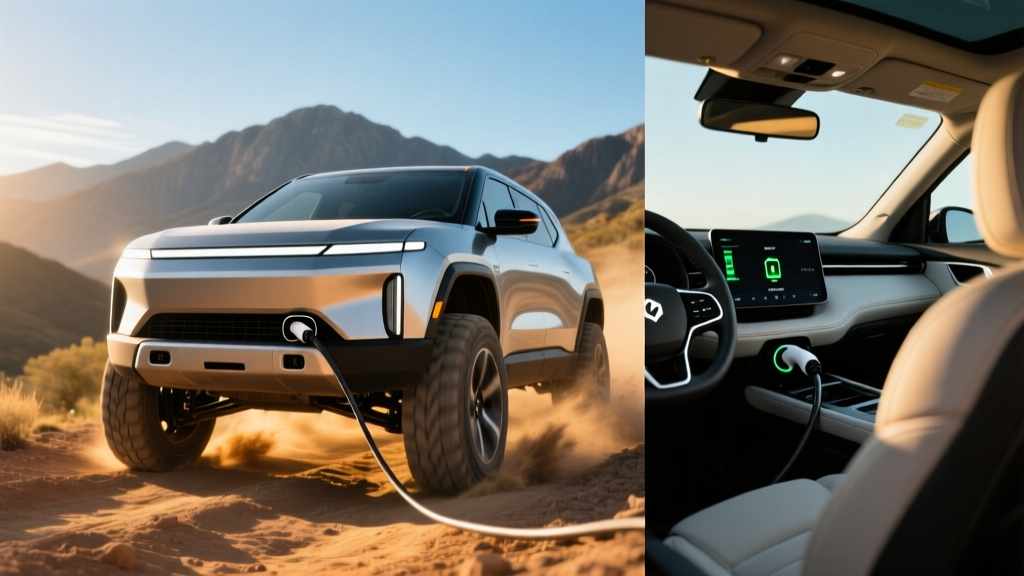
The R1S's party trick is its air suspension, which offers approximately 6.5 inches of adjustable ride height. In its lowest "Park" mode, the SUV squats for easier loading. In its highest setting — what enthusiasts call the "lifted" mode — ground clearance reaches 14.9 inches, rivaling a Jeep Wrangler Rubicon and exceeding most production SUVs. Approach, departure, and breakover angles all improve dramatically, and the system can self-level when articulating over uneven terrain.
The tri-motor configuration (one front, two rear) produces 850 horsepower and rockets the 7,000-pound R1S to 60 mph in a claimed 2.9 seconds. That's supercar territory in a three-row SUV, and it never stops being surreal. The dual-motor version, at 533 hp and 4.5 seconds, is more than adequate for any real-world scenario including merging, towing, and trail obstacles.
Where the R1S truly distinguishes itself off-road is torque vectoring. Each rear motor can independently control torque to its respective wheel, enabling a "tank turn"-style maneuver (branded as "Gear Guard" crawl features) and precise low-speed control on rock-crawling sections. The electric drivetrain eliminates the need for traditional locking differentials — the motors simply apply braking torque to a spinning wheel and redirect power to the wheel with grip.
Water fording depth reaches approximately 36 inches in the highest suspension setting, though Rivian cautions against submerging the underbody electronics repeatedly. The underbody is protected by a full-length skid plate system made from high-strength steel.
Interior, Cargo, and Three-Row Practicality
The R1S seats up to seven passengers across three rows. Second-row captain's chairs (standard on most trims) reduce capacity to six but improve comfort and third-row access.
- Cargo behind third row: 10.6 cu ft
- Cargo behind second row: 46.7 cu ft
- Max cargo (all rows folded): 104.7 cu ft
- Front trunk (frunk): 11.0 cu ft — lockable, drainable, usable as a cooler
- Second-row legroom: 38.2 inches
- Third-row legroom: 30.4 inches (best for children or short trips)
The interior materials are premium without being ostentatious — vegan leather, real wood trim, and a minimalist 15.6-inch center touchscreen running Rivian's proprietary OS. The digital driver display is compact and focused. Wireless Apple CarPlay and Android Auto are standard, as is a Wi-Fi hotspot.
One notable drawback: the third row remains tight for adults, and cargo space behind it is modest for a vehicle of this size. The Kia EV9 offers more usable third-row volume. If you regularly haul six adults plus gear, you'll feel the squeeze.
Pricing, Trims, and Federal Tax Credit Eligibility
For 2026, Rivian offers the R1S in three primary configurations based on battery and motor count, with Adventure and Ascend trim packages layering on cosmetic and feature upgrades.
| Configuration | Base MSRP | Federal Credit Potential | Effective Price |
|---|---|---|---|
| Dual-Motor Standard (est. ~270 mi) | $75,900 | Up to $7,500* | ~$68,400 |
| Dual-Motor Large (352 mi) | $84,900 | Up to $7,500* | ~$77,400 |
| Tri-Motor Max (410 mi) | $104,900 | $0 (exceeds MSRP cap) | $104,900 |
*Federal tax credit eligibility under IRS §30D is subject to multiple requirements. Consult a tax professional.
The R1S qualifies as an SUV under IRS definitions, meaning the MSRP cap is $80,000 (versus $55,000 for sedans). The Dual-Motor Standard and Dual-Motor Large configurations fall at or below this threshold, but the Tri-Motor Max at $104,900 exceeds it and is ineligible for the new-vehicle credit regardless of buyer income.
Beyond MSRP, §30D requirements include:
- Buyer income caps: Modified AGI ≤ $300,000 (joint), $225,000 (head of household), $150,000 (single)
- Battery sourcing: Increasing percentages of critical minerals and battery components must be sourced from the U.S. or free-trade-agreement partners — Rivian has worked to qualify its supply chain, but eligibility can change by model year and production batch
- Point-of-sale transfer: Buyers can elect to transfer the credit to the dealer at purchase, reducing the purchase price directly rather than waiting for a tax refund
For current rules and the latest qualified vehicle list, check the IRS clean vehicle credits page before committing to a purchase.
Warranty, Ownership Costs, and Long-Term Battery Outlook
Rivian provides a comprehensive warranty package:
- Battery & drive unit: 8 years / 175,000 miles (whichever comes first), with a capacity retention threshold of 70%
- Vehicle limited warranty: 5 years / 60,000 miles
- Roadside assistance: 5 years / 60,000 miles
The 175,000-mile battery warranty is generous compared to the industry-standard 100,000 miles (though Rivian's mileage limit was adjusted for newer model years — confirm with your specific purchase agreement). Rivian uses NMC (nickel manganese cobalt) chemistry in both the Large and Max packs, which offers higher energy density than LFP but is more sensitive to sustained high-state-of-charge storage. Best practice: set your daily charge limit to 80–90% and only charge to 100% before long trips.
Insurance costs for the R1S run higher than average — expect $2,500–$3,500 annually depending on your location, driving record, and coverage level. Rivian has partnered with select insurers to offer competitive rates, so it's worth checking their insurance portal.
Maintenance is minimal compared to a gas SUV: no oil changes, no transmission fluid, and regenerative braking extends pad life significantly. Expect to budget for cabin air filters, wiper fluid, brake fluid checks, and tire rotations (EVs are hard on tires due to instant torque and heavy curb weight — budget for replacement rubber every 25,000–35,000 miles).
How the R1S Lifted Compares to Key Competitors
The R1S doesn't have a direct rival that matches its combination of three-row seating, off-road capability, and EV powertrain. Here's how it stacks up:
- Kia EV9: More affordable ($54,900–$73,900), better third-row space, 800V fast charging, but far less off-road capability (8.0 inches ground clearance, no serious trail modes)
- Tesla Model X: Faster charging on the Supercharger network, falcon-wing doors, more range (up to 348 mi), but no meaningful off-road pretension and aging interior
- Mercedes EQS SUV: More luxurious interior, comparable range, but $105,000+ starting price and limited off-road hardware
- Jeep Wrangler 4xe (PHEV): Superior hardcore off-road hardware, solid axles, but only 21 miles of electric range and far less refinement
If your priority is genuine off-road capability in an electric package with three rows, the R1S is essentially the only option. If you want three-row EV practicality without the trail ambitions, the EV9 or Model X may be more cost-effective choices.
Pros
- Class-leading off-road capability with 14.9" ground clearance and torque vectoring
- Three-row seating with usable (if snug) third row
- Impressive 7,700-lb towing capacity
- 11.5 kW home charging fills the pack overnight
- NACS connector provides native Supercharger access
- 8-year/175,000-mile battery warranty
- Frunk is genuinely useful — drainable and lockable
Cons
- 400V architecture means slower DC charging vs. 800V rivals
- Boxy shape hurts highway efficiency (~48 kWh/100 mi)
- Tri-Motor Max exceeds $80K MSRP cap — no federal credit
- Third-row legroom is tight for adults (30.4")
- Insurance premiums run $2,500–$3,500/year
- Service center network still expanding in rural areas
- Heavy curb weight (~7,000 lbs) accelerates tire wear
Who Should Buy the Rivian R1S Lifted?
Choose the R1S if: You need three-row electric seating AND plan to take the vehicle off-pavement regularly. Overlanders, ski-trip families, and outdoor enthusiasts who want to tow a trailer to a campsite and then explore trails will find no better EV option. The air suspension's range of adjustment — from highway-low to rock-crawl-high — is genuinely transformative.
Look elsewhere if: Your driving is 95%+ on pavement and your third-row needs are for daily carpooling. The Kia EV9 offers more space, faster charging, and a lower price. If you want maximum range and don't need off-road hardware, the Tesla Model X or Mercedes EQS SUV may serve you better. If budget is the primary concern, the R1S's $75,900+ starting price puts it firmly in luxury territory.
Frequently Asked Questions
What is the real-world range of the Rivian R1S when driven off-road?
In moderate trail conditions with the air suspension raised, expect 200–250 effective miles from the Large (106 kWh) pack and 260–310 from the Max (141 kWh) pack. Steep elevation gain, rock crawling, and sand driving consume energy faster than highway cruising. Always plan off-road routes with charging contingencies.
How fast does the R1S charge at home and on the road?
At home on a 240V/48A Level 2 charger, the R1S charges at 11.5 kW, adding roughly 25 miles of range per hour — enough for a full overnight charge. On DC fast chargers, peak rate is 200–220 kW, with a 10–80% session taking 30–36 minutes depending on pack size. The 400V architecture means the charge curve tapers earlier than 800V competitors.
Does the Rivian R1S qualify for the $7,500 federal EV tax credit?
The Dual-Motor Standard ($75,900) and Dual-Motor Large ($84,900) configurations may qualify, as they fall at or near the $80,000 SUV MSRP cap under IRS §30D rules. The Tri-Motor Max ($104,900) exceeds the cap and does not qualify. Buyer income limits ($300K joint / $150K single) and battery-sourcing requirements also apply. Always verify on irs.gov before purchasing.
Can I install aftermarket lift kits on the R1S?
The R1S's air suspension already provides up to 14.9 inches of ground clearance in its highest mode, which exceeds most aftermarket lift kits on conventional SUVs. Rivian does not officially support aftermarket suspension modifications, and doing so will likely void the suspension and potentially the battery/drive-unit warranty. The factory air suspension system is the intended method for adjusting ride height.
Is the R1S good for towing?
Yes. The R1S is rated to tow 7,700 lbs across all configurations, which covers most boat trailers, camper trailers, and utility trailers. Electric towing range drops significantly — expect a 30–50% reduction in effective range when towing near maximum weight, depending on trailer aerodynamics and terrain.
How does the R1S compare to the Rivian R1T?
The R1T is the pickup truck variant sharing the same platform, motors, and battery options. The R1T offers a 4.5-foot bed with a Gear Tunnel (lockable pass-through storage) and slightly better off-road departure angles. The R1S offers three-row seating and more enclosed cargo volume. Choose based on whether you need passenger capacity (R1S) or a truck bed (R1T).