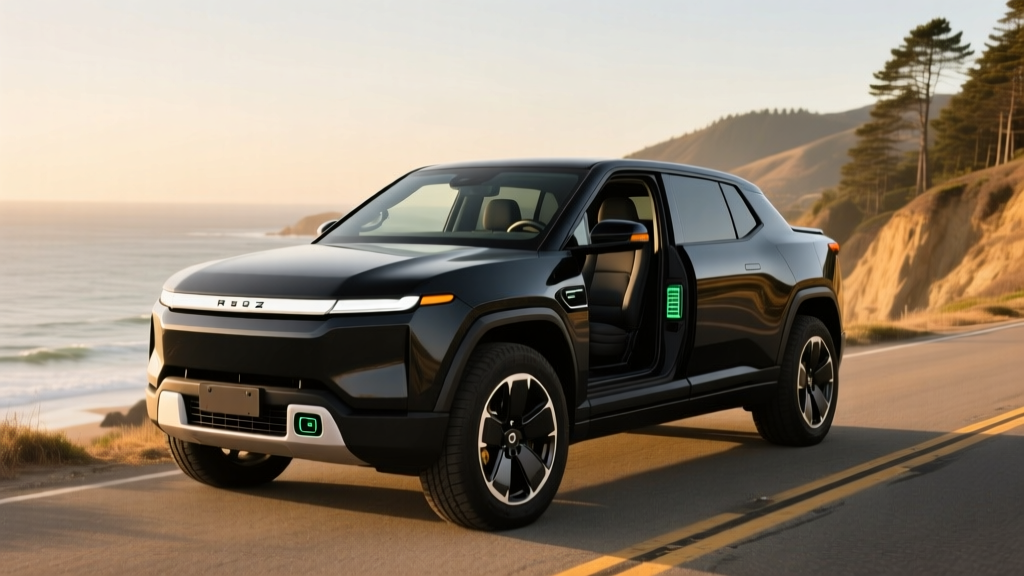
The three-row electric SUV segment is small but fiercely competitive, and the 2025 Rivian R1S sits at its premium end. Built on Rivian's updated Gen 2 platform at the Normal, Illinois factory, the R1S pairs genuine off-road capability with a tech-forward interior and the longest EPA range in its class when equipped with the Max Pack. But with a starting price near $85,000 and a complex tax-credit landscape, buyers need hard numbers before writing a check. Here's everything we know after driving, charging, and analyzing the 2025 R1S lineup.
Quick Verdict: Who Should Buy the 2025 Rivian R1S?
The R1S is engineered for affluent families who tow, camp, and road-trip — not just commute. If you need three rows, air suspension, a frunk, and 400+ miles of EPA range in a single package, nothing else matches it. If your priority is value or the lowest cost-per-mile, a Tesla Model X or a plug-in hybrid like the Kia EV9 may serve you better. The R1S rewards owners who exploit its full capability set: quad-motor torque vectoring, camp kitchen accessories, and 7,700-pound towing.
2025 Rivian R1S Specs at a Glance
| Specification | Dual-Motor Standard | Dual-Motor Max | Quad-Motor Max |
|---|---|---|---|
| Base MSRP | $84,950 | $94,950 | $104,950 |
| Battery (usable) | ~106 kWh (NMC) | ~141 kWh (NMC) | ~141 kWh (NMC) |
| EPA Range | ~270 mi | ~410 mi | ~390 mi |
| Horsepower | 533 hp | 533 hp | 1,025 hp |
| 0–60 mph | ~4.5 sec | ~4.5 sec | ~2.9 sec |
| Drivetrain | Dual-motor AWD | Dual-motor AWD | Quad-motor AWD |
| Max DC Fast Charge | ~190 kW | ~190 kW | ~190 kW |
| 10–80% DC Time | ~30 min | ~42 min | ~42 min |
| Level 2 (11.5 kW) | ~17 mi/hr | ~16 mi/hr | ~16 mi/hr |
| Towing Capacity | 7,700 lb | 7,700 lb | 7,700 lb |
Range and Efficiency: EPA Numbers vs. the Real World
EPA Estimated Range: Up to 410 miles (Dual-Motor Max Pack). Standard Pack models rate around 270 miles.
Real-World Expectation: On 70-mph highway loops in mild weather, expect roughly 340–370 miles from the Max Pack. In freezing temperatures (below 30°F), plan for a 15–25% reduction, dropping effective range to ~280–310 miles. The R1S's boxy aerodynamics and 5,900+ lb curb weight penalize highway efficiency more than city driving, where regenerative braking recovers energy.
Efficiency on the EPA window sticker lands around 69 MPGe combined for Dual-Motor variants, translating to roughly 48–50 kWh per 100 miles. That's thirstier than a Tesla Model X (102 MPGe combined) due to the R1S's heavier, more rugged construction. For buyers who primarily drive in the city and suburbs, the real-world range closely tracks the EPA number. Road-trippers running 80+ mph in winter should plan charging stops around 250–280 miles of usable range to keep a safety buffer.
Charging Speed: DC Fast, Level 2, and the Charge Curve
The 2025 R1S tops out at approximately 190 kW on DC fast chargers using its NACS port (native Tesla Supercharger compatibility is standard on 2025 models). Here's what that means in practice:
| Charging Level | Power / Voltage | Speed (miles of range added) | Notes |
|---|---|---|---|
| Level 1 (120V) | ~1.4 kW | ~3 mi/hr | Emergency/trickle only |
| Level 2 (240V, 48A) | 11.5 kW | ~16–17 mi/hr | Full overnight charge (~9–12 hrs for Max Pack) |
| DC Fast (peak) | ~190 kW | ~140 mi in 20 min (Std Pack) | Peak rate held to ~30–40% SoC, then tapers |
The charge curve matters: the R1S sustains its 190 kW peak only through roughly 30–40% State of Charge, then tapers progressively. A 10–80% session on a 250 kW Supercharger or Electrify America station takes about 30 minutes for the Standard Pack and 42 minutes for the Max Pack. The larger battery takes longer not because it charges slower, but because there are simply more kWh to push through the taper curve above 60%.
At home, the Rivian Wall Charger (or any quality 48-amp Level 2 unit like a ChargePoint Home Flex or Emporia Vue) on a 60-amp circuit delivers 11.5 kW. That replenishes a Standard Pack overnight in roughly 9 hours and a Max Pack in about 12 hours. Most owners wake up full every morning, which is the core advantage of home charging.
Performance and Drivetrain
The Dual-Motor R1S produces 533 horsepower and 610 lb-ft of torque, delivering a 0–60 mph time of approximately 4.5 seconds — brisk for a three-row SUV. The Quad-Motor variant unlocks 1,025 hp and 1,198 lb-ft through four independent motors, one per wheel, enabling torque vectoring that no mechanical AWD system can match. The Quad-Motor hits 60 mph in roughly 2.9 seconds, placing it in supercar territory despite its 6,000-pound mass.
Beyond straight-line speed, the Quad-Motor's individual wheel control provides exceptional traction in mud, snow, and rock-crawling scenarios. Rivian's Tank Turn feature (rotating the vehicle around its center axis) remains exclusive to the Quad-Motor. Air suspension with adjustable ride height — from a low aero mode for highway efficiency to 14.9 inches of ground clearance off-road — is standard across all trims.
Interior, Cargo, and Technology
The R1S seats up to seven passengers in a three-row configuration. Second-row captain's chairs (optional, reducing capacity to six) offer generous legroom. Third-row space accommodates children comfortably on longer trips and adults for short rides. Cargo volume measures approximately 20 cubic feet behind the third row, 58 cu ft with the third row folded, and 104 cu ft with both rear rows flat. The front trunk (frunk) adds roughly 11 cu ft of sealed, drainable storage — ideal for muddy gear or iced coolers.
Rivian's 15.6-inch center touchscreen runs a proprietary interface that's responsive and visually clean, with native navigation that integrates charging stops into route planning. A 12.3-inch digital cluster handles driver information. The R1S includes a Wi-Fi hotspot, over-the-air updates, and phone-as-key functionality. Audio is handled by a premium Rivian-branded system with up to 18 speakers on higher trims.
Driver assistance comes via Rivian's Driver+ suite, which includes adaptive cruise control with lane centering on highways. This is a Level 2 SAE system — the driver must remain attentive with hands on the wheel. It is not autonomous driving, and Rivian does not market it as such. Expect competent highway cruising assist, not hands-off capability.
Pricing, Trims, and Federal Tax Credit Eligibility
The 2025 R1S lineup starts at $84,950 for the Dual-Motor Standard Pack and climbs to $104,950 for the Quad-Motor Max Pack, before options and destination fees. Adventure and Ascend (luxury-oriented) trim packages add $5,000–$10,000 depending on interior materials and wheel selections.
| Configuration | Base MSRP | As-Tested (Typical Options) | Federal Credit Eligibility |
|---|---|---|---|
| Dual-Motor Standard | $84,950 | $89,000–$94,000 | Partial or full, see below |
| Dual-Motor Max | $94,950 | $100,000–$108,000 | Partial or full, see below |
| Quad-Motor Max | $104,950 | $112,000–$120,000 | Partial or full, see below |
Federal tax credit (§30D) eligibility for the R1S is complex and subject to change. Under current IRS rules, the R1S qualifies as an SUV, which carries an $80,000 MSRP cap for the credit — and every R1S trim exceeds that threshold at base price. However, the MSRP cap applies to the manufacturer's suggested retail price including factory options but excluding destination charges. Buyers should verify current eligibility directly on the IRS Clean Vehicle credit page and confirm with their tax professional, as battery-sourcing and critical-mineral requirements also apply. Income caps ($300,000 joint / $150,000 single filer MAGI) further restrict eligibility. The point-of-sale transfer option allows qualified buyers to apply up to $7,500 toward the purchase price at the dealer, reducing out-of-pocket cost at delivery.
Warranty and Long-Term Ownership
Rivian covers the R1S with a 5-year/60,000-mile bumper-to-bumper warranty and an 8-year/175,000-mile battery and drive-unit warranty. The battery warranty guarantees retention of at least 70% of original capacity over that period. This is competitive with Tesla's 8-year/150,000-mile coverage (70% threshold) and exceeds most legacy automakers' battery terms.
NMC (nickel manganese cobalt) chemistry in the R1S battery packs offers high energy density — essential for achieving 400+ miles in a large SUV — but is more sensitive to sustained 100% State of Charge than LFP chemistry. Best practice: charge to 80–90% daily and reserve 100% for road trips. Rivian's software includes a battery-protection buffer that hides some capacity from the user, reducing visible degradation over time.
Pros, Cons, and the Competition
Pros
- Class-leading EPA range with Max Pack (410 mi)
- Quad-motor torque vectoring and genuine off-road capability
- Native NACS port — no adapter needed at Tesla Superchargers
- 7,700-lb towing with integrated trailer-brake controller
- Unique frunk, gear tunnel, and camp-kitchen accessories
- Over-the-air updates continuously add features
Cons
- Starting at $84,950 — expensive even before options
- MSRP exceeds the §30D $80,000 SUV cap at base price
- Efficiency (48–50 kWh/100 mi) trails the Tesla Model X
- Third row is tight for adults on long trips
- Service center network still expanding in rural areas
- 190 kW peak charge rate trails Hyundai/Kia's 800V architecture (~240 kW)
Against the Tesla Model X, the R1S trades some efficiency and charging speed for superior build quality, off-road chops, and a more distinctive design. The Kia EV9 starts nearly $30,000 lower and qualifies more easily for the federal credit, but lacks the R1S's range, towing, and adventure features. The BMW iX is a five-seater and doesn't compete directly on passenger capacity. For three-row electric SUV buyers, the R1S occupies a premium niche with no true equivalent.
Frequently Asked Questions
What is the real-world range of the 2025 Rivian R1S?
The Max Pack's 410-mile EPA estimate translates to roughly 340–370 miles in mixed highway driving in mild weather. In winter or sustained 80+ mph driving, expect 280–310 miles of usable range before needing to charge.
How fast does the R1S charge at home and on the road?
At home on a 48-amp Level 2 charger (11.5 kW), the R1S adds about 16–17 miles of range per hour, fully replenishing overnight. On DC fast chargers, it peaks at ~190 kW, achieving a 10–80% charge in 30–42 minutes depending on battery pack size.
Does the 2025 R1S qualify for the $7,500 federal EV tax credit?
Eligibility is uncertain for most buyers. The R1S's base MSRP exceeds the $80,000 SUV cap set by the IRS under §30D. Some buyers may qualify for a partial credit depending on battery component and critical-mineral sourcing compliance. Always verify current rules at irs.gov and consult a tax professional before relying on the credit in your purchase decision.
Is the R1S worth buying over the Tesla Model X or Kia EV9?
If you value off-road capability, a frunk, adventure accessories, and build quality over pure efficiency and the lowest price, the R1S is the stronger pick. Budget-conscious buyers who don't need 400+ miles of range or 7,700-lb towing will find the EV9 or Model X more practical.
What's the biggest drawback of the 2025 R1S?
Price is the primary barrier. At $85,000+ before options, the R1S is a luxury purchase, and its MSRP likely disqualifies most trims from the full federal tax credit. Service-center availability in rural areas also remains a consideration for remote owners.