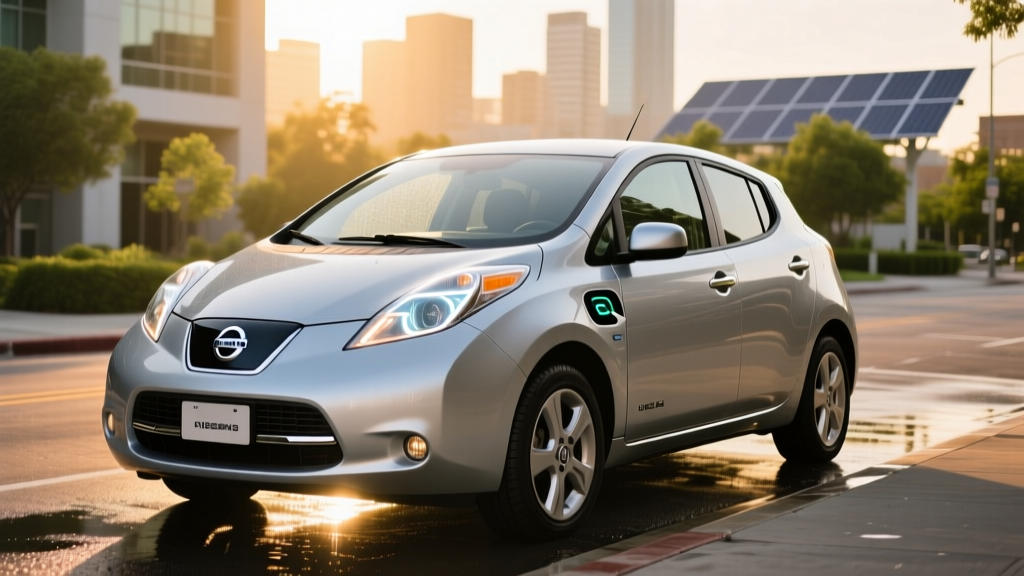
The 2012 Nissan Leaf SL was one of the first mass-market battery-electric vehicles sold in the United States, arriving alongside the Chevrolet Volt to kick off the modern EV era. More than a decade later, this pioneering hatchback is strictly a used-car proposition — Nissan discontinued the Leaf after the 2025 model year — but it remains one of the cheapest entry points into EV ownership on the secondhand market. If you are evaluating a used 2012 Leaf SL today, battery health is the single most important variable. This review covers everything a prospective buyer needs to know: real-world range after more than a decade of degradation, charging limitations, ownership costs, and whether this first-generation Leaf still makes sense in 2026.
2012 Nissan Leaf SL: Core Specifications at a Glance
| Specification | Value |
|---|---|
| EPA Range (Original) | 73 miles |
| Battery Capacity (Usable) | 21.3 kWh (of 24 kWh gross) |
| Battery Chemistry | NMC (nickel manganese cobalt) — passive air cooling |
| Motor Output | 80 kW / 107 hp, 187 lb-ft torque |
| Drivetrain | FWD (front-wheel drive, single motor) |
| 0–60 mph | ~9.9 seconds |
| EPA Efficiency | 99 MPGe combined (34 kWh/100 mi) |
| DC Fast Charge (CHAdeMO) | ~50 kW peak |
| Level 2 Charge Rate | 3.3 kW (2012 model year; J1772 connector) |
| Cargo Volume | 14.5 cu ft (rear seats up); 24.0 cu ft (seats folded) |
| Original Base MSRP (SL trim) | $32,780 (before incentives) |
| Current Used Market Price (2026) | $4,500 – $8,000 depending on battery health |
| Battery Warranty (Original) | 8 years / 100,000 miles (capacity loss below 70%) |
Real-World Range: What to Expect From a 14-Year-Old Battery
Real-World Expectation in 2026: 40–60 miles on a full charge, depending on battery State of Health (SoH), ambient temperature, and driving style. A well-preserved example might return 55–60 miles in mild city driving; expect 35–45 miles in cold weather or sustained highway use.
The original 2012 Leaf's EPA-rated 73 miles was modest even at launch. Today, the limiting factor is battery degradation. The 24 kWh (gross) laminated lithium-ion pack uses NMC chemistry and, critically, relies on passive air cooling rather than active liquid thermal management. This design choice makes the battery far more susceptible to heat-driven degradation, particularly in hot climates like Arizona, Texas, and Southern California.
Nissan's battery health monitoring system displays capacity bars on the dashboard — out of 12 bars. A 2012 Leaf showing 8 bars has lost roughly 30–35% of original capacity, putting usable range around 50 miles. Many 2012 Leafs in warm states now sit at 6–8 bars. Cars in cooler Pacific Northwest or Northeast climates tend to fare better, with some examples still holding 9–10 bars.
Highway driving at 70+ mph reduces range further due to the Leaf's boxy aerodynamics (0.29 Cd drag coefficient). In winter, resistive cabin heating (no heat pump on the 2012 model) can cut range by 25–40%, making a degraded 2012 Leaf a 30–35 mile car in freezing temperatures. This is the reality buyers must accept.
Charging Speed: CHAdeMO, 3.3 kW Level 2, and Infrastructure Reality
| Charging Level | Power (kW) | Connector | Estimated Time / Rate |
|---|---|---|---|
| Level 1 (120V household) | ~1.2 kW | J1772 | ~20+ hours (0–100%); ~4 mi/hr |
| Level 2 (240V) | 3.3 kW | J1772 | ~7 hours (0–100%); ~12 mi/hr |
| DC Fast Charge | ~50 kW peak | CHAdeMO | ~30 min (0–80% on a healthy pack) |
The 2012 Leaf's onboard charger is limited to 3.3 kW — meaning even if you plug into a 7.2 kW or 11.5 kW Level 2 station, the car will only accept 3.3 kW. This was a cost-saving measure; Nissan upgraded to a 6.6 kW onboard charger for the 2013 model year. Overnight home charging is perfectly adequate for daily top-ups, but a full recharge from near-empty takes roughly seven hours.
DC fast charging uses the CHAdeMO connector, which was once widely available but is now being phased out across North America in favor of the NACS (Tesla) and CCS standards. As of 2026, Electrify America and most major networks have removed or reduced CHAdeMO connectors at new stations. Tesla Superchargers do not support CHAdeMO at all. This is a significant practical limitation: finding a functioning CHAdeMO charger in 2026 requires planning and often reliance on legacy PlugShare-listed stations.
Peak DC charge rate is approximately 50 kW, but the charge curve tapers sharply above 80% State of Charge (SoC) to protect the passively-cooled battery. Expect a 10–80% session on a functional CHAdeMO 50 kW station to take roughly 25–35 minutes, though repeated fast charging in hot weather can trigger the Leaf's infamous "Rapidgate" thermal throttling — where the car dramatically reduces charge speed to prevent battery overheating.
Performance and Driving Dynamics
The 2012 Leaf's 80 kW (107 hp) AC synchronous electric motor drives the front wheels through a single-speed reduction gear. Acceleration to 60 mph takes approximately 9.9 seconds — leisurely by modern EV standards but adequate for city merging. The 187 lb-ft of instant torque gives the Leaf a punchy feel from stoplights, even if it runs out of breath above 50 mph.
Top speed is electronically limited to roughly 90 mph. The low-rolling-resistance tires (P215/50R17 on the SL trim) and soft suspension tuning prioritize efficiency over handling. Regenerative braking is moderate — the 2012 Leaf does not offer true one-pedal driving. Lifting off the accelerator provides some regen, but you still need the friction brakes for complete stops. A "B" mode on the shift lever increases regen modestly but falls well short of the strong one-pedal feel in later EVs.
Ride quality is a genuine strength. The Leaf rides on a dedicated EV platform with the battery pack mounted low, giving it a compliant, settled feel around town. At 3,340 lbs, it is relatively light for an EV, which helps efficiency and tire wear. The SL trim includes 17-inch alloy wheels, fog lights, and a rear spoiler for a slightly more finished look than the base SV.
Interior, Technology, and Daily Practicality
The 2012 Leaf SL's interior reflects its early-2010s origins. A 7-inch touchscreen with navigation anchors the center stack, supplemented by physical buttons for climate and audio. The SL trim adds a rearview camera, Bluetooth phone and audio streaming, and a solar panel integrated into the rear spoiler that trickle-charges the 12V auxiliary battery (not the traction battery).
Passenger space is surprisingly generous for a compact hatchback: 39.5 inches of front legroom and 33.3 inches rear. The seats are upholstered in a partially recycled fabric. Cargo volume behind the rear seats is 14.5 cubic feet — enough for a week of groceries — expanding to 24.0 cu ft with the 60/40 split rear seats folded. Note that the folded seats do not form a flat floor due to the battery packaging beneath.
The instrument cluster includes the now-iconic "trees" display showing eco-driving feedback and the all-important battery capacity bar readout. There is no adaptive cruise control, lane-keeping assist, or any modern ADAS features. Anti-lock brakes, stability control, and six airbags are standard. The Leaf earned a Top Safety Pick rating from IIHS in its era.
The SL trim's standout features for 2012 included LED headlights (a rarity at the time), a quick-charge port (CHAdeMO), heated front and rear seats, and a heated steering wheel — all designed to reduce cabin heater load and preserve range in cold weather.
Pricing, Used Market Value, and Tax Credit Eligibility
| Item | Amount |
|---|---|
| Original MSRP (SL trim, 2012) | $32,780 |
| Typical Used Price (2026 market) | $4,500 – $8,000 |
| Federal Used EV Tax Credit (§25E) | Up to $4,000 (30% of sale price, max $4,000) |
| Price After Max Credit | As low as ~$2,000 – $4,000 |
The 2012 Leaf SL originally stickered at $32,780 (plus destination), before the $7,500 federal tax credit and various state incentives that were available at the time. Today, as a used vehicle, the relevant incentive is the IRS §25E Used Clean Vehicle Credit — not the §30D new-vehicle credit.
The §25E credit provides 30% of the sale price, up to a maximum of $4,000, for eligible used EVs. Key eligibility requirements for 2026:
- Sale price cap: The vehicle must sell for $25,000 or less (easily met — used Leafs trade well under this).
- Buyer income limits: Adjusted gross income must not exceed $75,000 (single), $112,500 (head of household), or $150,000 (married filing jointly).
- Model year requirement: The vehicle must be at least two model years old (the 2012 qualifies).
- Dealer requirement: The vehicle must be purchased through a licensed dealer who reports the sale to the IRS. Private-party sales do not qualify.
- First transfer: The credit applies only to the first qualified resale after August 16, 2022. A 2012 Leaf that has already been resold post-2022 may not qualify again — verify with the selling dealer.
- Point-of-sale transfer: The credit can be transferred to the dealer at purchase, reducing your out-of-pocket cost immediately.
On a $6,000 used 2012 Leaf SL, the 30% credit equals $1,800. On an $8,000 example, it would be $2,400. This makes a functional Leaf with decent battery health one of the cheapest ways to access an electric vehicle in America.
Battery Longevity, Warranty, and Replacement Considerations
The original battery warranty — 8 years/100,000 miles against capacity loss below 70% — expired for all 2012 Leafs by the end of 2020 at the latest. Any battery replacement or repair is now entirely an out-of-pocket expense.
Battery degradation on the passively-cooled 24 kWh pack is the defining ownership issue. Data from Leaf owner communities and fleet studies show median capacity loss of approximately 25–40% after 12–14 years, with significant variance driven by climate. Phoenix and Los Angeles cars degrade faster than Seattle and Boston cars due to sustained high ambient temperatures.
If the battery needs replacement, options include:
- OEM replacement (Nissan): Nissan offers refurbished 24 kWh packs at approximately $5,500–$6,500 plus installation (~$1,000–$1,500 labor). This is rarely economical on a car worth $5,000–$8,000.
- Aftermarket/upgraded packs: Some specialty shops install 30 kWh or 40 kWh packs from later Leaf models, restoring range to 100–140 miles. Cost: $8,000–$14,000 depending on source and labor.
- Module-level repair: Individual degraded modules can sometimes be replaced for $1,500–$3,000, extending pack life at lower cost.
Before buying, request a LeafSpy Pro battery report from the seller. This third-party OBD-II tool reads actual battery capacity in amp-hours, State of Health percentage, and individual cell voltages — far more accurate than the dashboard capacity bars.
Pros and Cons: Honest Assessment
Pros
- Extremely low purchase price — one of the cheapest EVs available used
- Low operating cost: ~$0.04–$0.06/mile on home electricity vs. $0.12–$0.18/mile for gas
- Comfortable ride, easy to park, tight turning radius
- Heated seats and steering wheel (SL) reduce winter range loss
- Eligible for up to $4,000 used EV tax credit (§25E)
- Simple mechanics — no transmission, minimal maintenance
Cons
- Severely degraded battery — 40–60 miles real-world range in 2026
- Passive air-cooled battery accelerates degradation, especially in hot climates
- CHAdeMO fast-charging standard is being phased out in North America
- 3.3 kW onboard charger limits Level 2 speed (7-hour full charge)
- No modern driver-assist features (no AEB, no lane-keeping, no adaptive cruise)
- No DC fast-charge adapter ecosystem (NACS/CCS adapters not available for CHAdeMO)
- Battery replacement cost ($5,500+) often exceeds vehicle value
Who Should Buy a 2012 Nissan Leaf SL in 2026?
This car fits a narrow but real use case. The 2012 Leaf SL makes sense if:
- Short-distance commuter: Your round-trip commute is under 30 miles and you can charge at home every night on a standard 120V outlet or a Level 2 station.
- Second-car household: You need a cheap, zero-emission city runabout and have a gas or longer-range EV for road trips.
- Budget-conscious EV adopter: You want to experience electric driving with minimal financial risk — even if the battery fails, you are in for $5,000–$8,000 total.
- Mild-climate resident: You live somewhere with moderate summers (not sustained 100°F+) to minimize further battery degradation.
The 2012 Leaf SL does not make sense for highway commuters, road-trippers, ride-share drivers, single-car households, or anyone in extreme-heat climates. If your daily driving exceeds 50 miles, look at a used 2018+ Leaf (40 or 60 kWh battery, 150–226 mi range) or a used Chevrolet Bolt EV (238 mi range, CCS charging).
Frequently Asked Questions
What is the real-world range of a 2012 Nissan Leaf SL today?
Expect 40–60 miles on a full charge in 2026, depending on battery State of Health. Cold weather and highway driving push that down to 30–45 miles. Always verify battery health with a LeafSpy Pro report before purchasing.
How fast does the 2012 Leaf charge?
On a Level 2 (240V) home charger, the 3.3 kW onboard charger adds about 12 miles of range per hour, taking roughly 7 hours for a full charge. DC fast charging via CHAdeMO peaks at ~50 kW, reaching 80% in about 25–35 minutes — but CHAdeMO stations are increasingly rare.
Does the 2012 Nissan Leaf qualify for any tax credit?
It does not qualify for the §30D new-vehicle credit (it is not new). It may qualify for the §25E used clean vehicle credit — up to $4,000 (30% of sale price) — if purchased through a dealer, the buyer meets income limits, and the vehicle has not already triggered the credit in a prior post-2022 resale. Consult a tax professional and review IRS guidance for your situation.
Is the 2012 Leaf SL worth buying vs. competitors?
Compared to a used 2012 Chevrolet Volt (PHEV, 35 mi electric + gas engine), the Leaf offers pure-EV simplicity but far less total range. Compared to a used 2017+ Bolt EV or 2018+ Leaf, the 2012 model is significantly cheaper upfront but has dramatically less range and a dying charge connector. It is worth buying only as an ultra-budget city commuter with home charging.
Can I replace the 2012 Leaf's battery?
Yes, but the economics are challenging. Nissan refurbished packs cost $5,500–$6,500 plus labor, often exceeding the car's value. Aftermarket upgrades (40 kWh packs) cost $8,000–$14,000. Module-level repair ($1,500–$3,000) is the most cost-effective option for mild degradation.
What are the biggest risks of buying a 2012 Leaf?
The three primary risks are: (1) severe battery degradation leaving you with 30–40 miles of range, (2) inability to find functioning CHAdeMO fast chargers as networks transition to NACS/CCS, and (3) lack of any modern safety technology like automatic emergency braking or lane-keeping assist.