Why Police Departments Are Eyeing Rivian in 2026
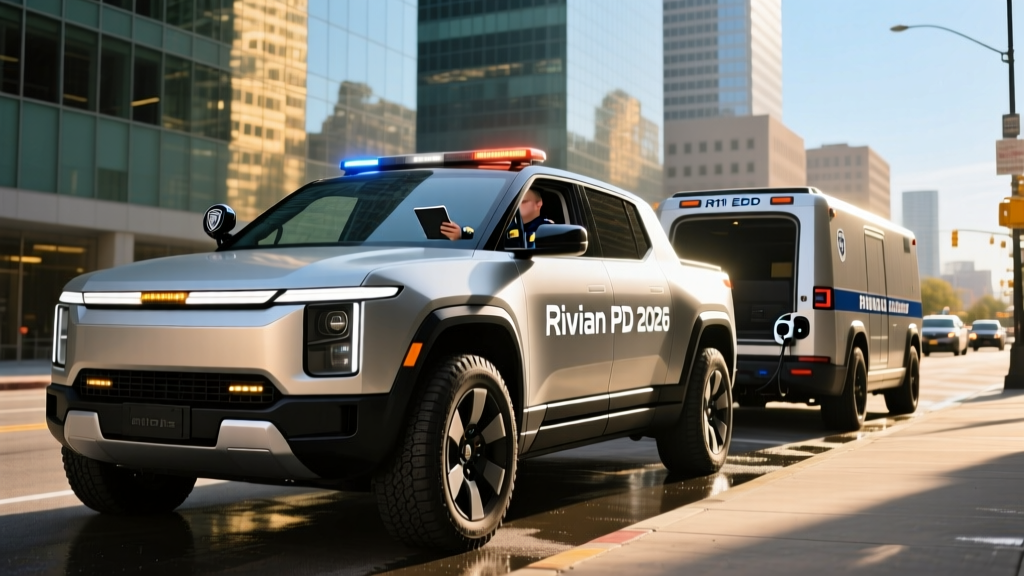
When the Huntington Beach Police Department deployed a modified Rivian R1T as a patrol vehicle in 2022, it made national headlines. Since then, the question of whether a Rivian police car can handle the rigors of law enforcement has moved from novelty to serious fleet evaluation. Rivian now fields two platforms relevant to agencies: the consumer-grade R1T pickup and R1S SUV (increasingly used by smaller departments and specialty units) and the purpose-built EDV (Electric Delivery Van), which Rivian builds for Amazon but has begun offering in adapted configurations to commercial and government fleets.
This review focuses primarily on the 2026 Rivian R1T Dual-Motor Standard Pack — the most common configuration agencies have evaluated or adopted for patrol, K-9, and community liaison roles — while also covering the EDV's relevance to larger fleet buyers. We'll break down the exact range, charging speeds, battery chemistry, total cost, and whether a Rivian makes financial and operational sense versus the Ford Police Interceptor Utility (hybrid) and Chevrolet Tahoe PPV (ICE).
Rivian R1T Dual-Motor: Full Spec Sheet
| Specification | 2026 R1T Dual-Motor Standard Pack |
|---|---|
| EPA Estimated Range | 270 miles |
| Real-World Range (highway/cold) | ~220–245 mi (see callout) |
| Battery Usable Capacity | 95 kWh (NMC lithium-ion) |
| Drivetrain | Dual-Motor AWD |
| Horsepower | 533 hp |
| Torque | 610 lb-ft |
| 0–60 mph | 4.5 seconds |
| Max DC Fast Charge | 220 kW (peak) |
| 10–80% DC Charge Time | ~21 minutes |
| Level 2 Home/Depot Rate | 11.5 kW (~25 mi/hr) |
| Efficiency | 73 MPGe / 46 kWh/100 mi |
| Towing Capacity | 11,000 lbs |
| Cargo Bed Volume | 54.0 cu ft (bed) + 11.0 cu ft (frunk) |
| Passenger Volume | 108.1 cu ft |
| Rear Legroom | 38.5 inches |
| Base MSRP (R1T Dual-Motor) | $69,900 |
| Battery/Powertrain Warranty | 8 years / 175,000 miles |
| Basic Vehicle Warranty | 5 years / 60,000 miles |
Real-World Range: What Patrol Shifts Actually Look Like
For context, most urban patrol shifts cover 80–120 miles per 10-hour shift, according to fleet data published by the National Highway Traffic Safety Administration. This means the R1T Standard Pack can complete a full shift with a comfortable buffer in most climates — but departments in extreme cold or with highway-heavy beats will want the Max Pack (149 kWh, EPA 420 miles) or plan mid-shift depot charging.
Source: EPA Fueleconomy.gov — 2026 Rivian R1T
Charging Speed: Depot and Field Charging for Fleets
Charging infrastructure is the make-or-break factor for any EV fleet adoption. Here's how the R1T charges across all three levels:
| Charging Level | Power (kW) | Miles Added per Hour | Typical Use Case |
|---|---|---|---|
| Level 1 (120V) | 1.4 kW | ~3 mi/hr | Emergency trickle; not viable for fleet |
| Level 2 (240V / 48A) | 11.5 kW | ~25 mi/hr | Overnight depot charging (primary) |
| DC Fast Charge | 220 kW (peak) | ~140 mi in 20 min | Mid-shift top-up; highway chargers |
Charging curve reality: The R1T's 220 kW peak applies between roughly 10–40% state of charge. Above 60%, the curve tapers significantly — by 80% SoC, charge speed drops to approximately 90 kW, and above 90% it slows to under 40 kW. A 10–80% session takes about 21 minutes at a capable 250+ kW charger (such as Electrify America or Tesla Supercharger stalls with NACS adapters). A full 0–100% session takes closer to 55 minutes.
Fleet depot charging: Most police departments installing Level 2 depot chargers use 11.5 kW or 19.2 kW wall units. At 11.5 kW, a fully depleted Standard Pack battery (95 kWh usable) recharges in roughly 8.5 hours — sufficient for overnight turnaround between shifts. For 24/7 operations with hot-seating (multiple officers sharing vehicles), departments need either DC fast chargers on-site or a larger vehicle pool to rotate through charging cycles.
One critical note: Rivian switched to the NACS (North American Charging Standard) connector for 2025+ models, granting native access to Tesla's Supercharger network (17,000+ stalls in the US). For fleet buyers, this dramatically expands reliable fast-charging options compared to CCS-only vehicles.
Performance and Capability for Patrol Duties
The R1T Dual-Motor's 533 horsepower and 4.5-second 0–60 mph time exceed virtually every traditional police pursuit vehicle on the market. The Ford Police Interceptor Utility Hybrid, by comparison, hits 0–60 in approximately 7.5 seconds. For emergency response and pursuit scenarios, the R1T's instant torque delivery provides a meaningful advantage, particularly in urban environments where rapid acceleration from a stop matters more than top-end speed.
The dual-motor AWD system provides torque vectoring across all four wheels, which is valuable in wet, snowy, or off-road conditions — a reason several mountain-west and Pacific Northwest departments have shown interest. The R1T's 11,000-pound towing capacity also makes it suitable for departments that need to tow boats, trailers, or mobile command units.
Drawbacks for patrol use: The R1T is a unibody pickup, not a body-on-frame SUV like the Tahoe PPV. It lacks the rear interior volume to comfortably install a full prisoner transport cage. Most agencies using the R1T have assigned it to non-transport roles: K-9 units (the bed is ideal for kennel installations), community outreach, traffic enforcement, and detective/investigation vehicles. For primary patrol with prisoner transport, the R1S (SUV variant) or a traditional PPV remains more practical.
Pricing, Fleet Cost, and Federal Tax Credit Eligibility
| Trim / Configuration | MSRP | Est. After §30D Credit |
|---|---|---|
| R1T Dual-Motor Standard Pack | $69,900 | See eligibility notes |
| R1T Dual-Motor Large Pack (352 mi) | $79,900 | See eligibility notes |
| R1T Tri-Motor Max Pack (420 mi) | $99,900 | Exceeds MSRP cap |
| R1S Dual-Motor Standard (SUV) | $74,900 | See eligibility notes |
Federal tax credit (§30D) — critical fleet buyer note: The IRS §30D Clean Vehicle Credit offers up to $7,500 for eligible new EV purchases, but several restrictions apply that directly affect Rivian buyers:
- MSRP cap: Pickup trucks (R1T) must have an MSRP at or below $80,000. SUVs (R1S) fall under the same $80,000 cap. The Tri-Motor Max Pack trims exceed this and do not qualify.
- Buyer income cap: Modified adjusted gross income must not exceed $150,000 (single), $225,000 (head of household), or $300,000 (joint). This is irrelevant for government fleet purchases, which typically use the §45W Commercial Clean Vehicle Credit instead.
- Battery sourcing requirements: A percentage of critical minerals and battery components must be sourced from the US or FTA partners. Rivian has worked to increase domestic sourcing, but eligibility shifts annually. Always verify current-year status at IRS.gov qualifying vehicle list.
- Point-of-sale transfer: As of 2024, buyers can transfer the credit to the dealer for an immediate price reduction at purchase. Fleet buyers should coordinate with Rivian's commercial sales team.
For government fleets specifically: Most municipal and state agencies purchase under the §45W Commercial Clean Vehicle Credit, which provides up to $7,500 for vehicles under 14,000 lbs GVWR and does not carry the same income or MSRP caps as §30D. Consult your agency's procurement office and a tax professional for current eligibility. State-level incentives (e.g., California's HVIP voucher program) can stack on top and significantly reduce effective cost.
The EDV: Rivian's Purpose-Built Fleet Van
Beyond the R1T, Rivian's Electric Delivery Van (EDV) — originally designed for Amazon — represents a more relevant platform for many law enforcement applications. Available in three wheelbase lengths (EDV-500, EDV-700, EDV-900), the EDV offers up to 161 miles of EPA range (EDV-700 variant), a low step-in height, and a configurable cargo area that upfitters can convert into mobile command posts, evidence transport, or community service vehicles.
The EDV is sold through Rivian's commercial fleet channel and is not available through consumer retail. Pricing is negotiated per fleet contract. Agencies interested in the EDV should contact Rivian Commercial directly for availability, as production slots remain constrained by Amazon's volume commitments.
Who the Rivian Police Car Suits Best
Best fit: Small-to-mid-size departments looking for a K-9 unit, community liaison vehicle, detective car, or traffic enforcement truck. Departments in temperate climates with depot charging access and shifts under 150 miles. Agencies wanting to reduce fuel and maintenance costs while projecting a modern, sustainability-forward image.
Poor fit: Large metro departments requiring prisoner transport in every vehicle, agencies in extreme cold without access to mid-shift DC fast charging, or departments needing high-volume fleet availability (Rivian's production capacity still limits bulk orders compared to Ford or GM).
Pros and Cons: Rivian R1T as a Police Vehicle
- 533 hp and 4.5s 0–60 — class-leading pursuit performance
- ~$0.04/mi electricity vs ~$0.18/mi gasoline (varies by rate)
- Minimal maintenance: no oil, transmission fluid, or exhaust system
- NACS connector = Tesla Supercharger access for field charging
- Frunk + bed = versatile equipment storage for K-9 and specialty units
- 8-yr / 175,000-mi battery warranty covers most vehicle lifecycles
- No rear prisoner transport capability (pickup bed, not enclosed SUV)
- Cold-weather range loss of 20–30% requires operational planning
- Depot charging infrastructure investment required ($3,000–$8,000 per L2 stall)
- Higher upfront MSRP than a Ford PIU Hybrid (~$45,000)
- Rivian service centers are sparse in rural areas
- Aftermarket police upfit ecosystem still maturing vs Whelen/Code 3 for Ford/Chevy
Frequently Asked Questions
What is the real-world range of the Rivian R1T in police use?
The EPA rates the 2026 R1T Dual-Motor Standard Pack at 270 miles. Real-world patrol driving yields 220–245 miles in moderate weather, dropping to 170–190 miles in sub-freezing temperatures. The Large Pack (352 mi EPA) or Max Pack (420 mi EPA) provides additional buffer for demanding shifts.
How fast does the R1T charge at a depot and on DC fast chargers?
On a Level 2 depot charger at 11.5 kW, a full charge takes about 8.5 hours — suitable for overnight turnaround. On a DC fast charger, the R1T peaks at 220 kW and charges from 10–80% in approximately 21 minutes, adding roughly 140 miles of range.
Does the Rivian R1T qualify for the federal EV tax credit?
The Dual-Motor Standard ($69,900) and Large ($79,900) Pack trims fall under the $80,000 MSRP cap and may qualify for up to $7,500 under §30D, subject to buyer income limits and battery-sourcing requirements. Government fleets typically use the §45W Commercial Clean Vehicle Credit instead, which has different rules. Always verify current eligibility at IRS.gov.
Is the Rivian R1T worth buying vs the Ford Police Interceptor Utility?
It depends on the use case. The R1T wins on performance (4.5s vs 7.5s 0–60), fuel cost savings (~$0.04 vs ~$0.18 per mile), and maintenance reduction. The Ford PIU Hybrid wins on upfront cost (~$45K vs ~$70K), established police upfitter support, prisoner transport capability, and dealer service network breadth. For specialty units (K-9, detective, community), the R1T is compelling. For primary patrol, the PIU remains the pragmatic choice.
Can the Rivian EDV van be used as a police vehicle?
Yes. Rivian's EDV is available through commercial fleet channels and can be upfitted for mobile command, community service, evidence transport, or non-patrol roles. Contact Rivian Commercial for pricing and availability, as production is partially allocated to Amazon.
What happens if the R1T battery degrades during fleet service?
Rivian warranties the battery and powertrain for 8 years or 175,000 miles, guaranteeing a minimum of 70% capacity retention. If the battery falls below that threshold within the warranty period, Rivian will repair or replace it. Real-world fleet data from early adopters (Huntington Beach PD, among others) has not shown significant degradation within the first 50,000 miles of mixed patrol use.