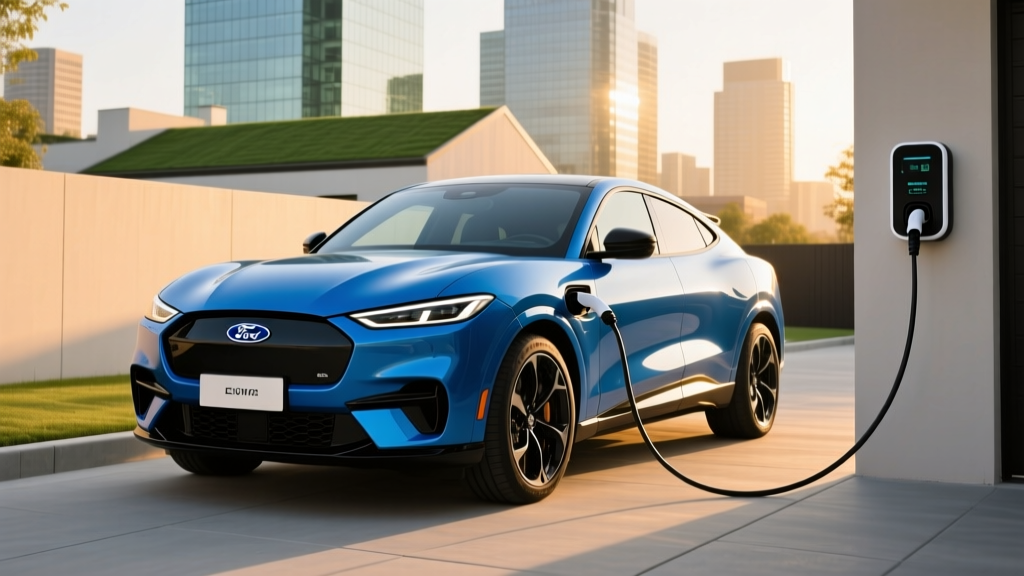
The Ford Mustang Mach-E has matured from a polarizing nameplate into one of the most well-rounded electric crossovers on the market. For 2026, Ford has refined battery chemistry, expanded the NACS native charging port across the lineup, and sharpened pricing to keep it competitive against the Tesla Model Y, Hyundai Ioniq 5, and Kia EV6. But for many buyers, the real question isn't just range or performance — it's how to make the numbers work financially. Let's break down every 2026 Ford Mustang Mach-E finance offer angle, from MSRP and federal tax credits to leasing strategy and total cost of ownership.
2026 Ford Mustang Mach-E: Quick Verdict
The 2026 Mach-E is a practical, tech-forward electric SUV best suited for daily commuters and small families who want strong public charging access via Tesla Superchargers (with a native NACS port now standard) and a comfortable, car-like ride. It isn't the fastest-charging EV in its class, nor does it offer the most cargo space, but its combination of usable range, BlueCruise hands-free highway driving, and aggressive Ford Credit promotions make it a compelling buy in 2026.
| Spec | Select RWD (Std Range) | Premium AWD (Ext Range) | GT |
|---|---|---|---|
| EPA Range | 250 mi | 320 mi | 280 mi |
| Battery (usable) | 70 kWh LFP | 91 kWh NMC | 91 kWh NMC |
| Drivetrain | RWD | Dual-Motor AWD | Dual-Motor AWD |
| Horsepower | 266 hp | 346 hp | 480 hp |
| 0-60 mph | 6.3 sec | 5.1 sec | 3.5 sec |
| Max DC Fast Charge | 135 kW | 150 kW | 150 kW |
| 10-80% DC Time | ~36 min | ~36 min | ~36 min |
| Level 2 Rate | 10.5 kW (~30 mi/hr) | 10.5 kW (~30 mi/hr) | 10.5 kW (~30 mi/hr) |
| MPGe (combined) | 105 MPGe | 98 MPGe | 89 MPGe |
| Base MSRP | $37,995 | $48,995 | $55,995 |
Source: fueleconomy.gov and Ford Motor Company 2026 specifications.
Real-World Range: What to Actually Expect
EPA Sticker: Up to 320 miles (Premium AWD Extended Range)
Real-World Highway (70-75 mph): ~255-275 miles — EVs consume significantly more energy at sustained highway speeds than in city driving, where regenerative braking recaptures kinetic energy.
Cold Weather (below 30°F): Expect a 20-30% reduction, bringing the Extended Range model down to roughly 220-250 miles. The Mach-E's heat pump (standard on Extended Range trims) helps mitigate cabin heating draw, but battery chemistry still suffers in deep cold.
City / Moderate Climate Commute: 300+ miles is achievable on the Extended Range battery with mild temperatures and conservative speeds.
The Select trim's Standard Range 70 kWh LFP (lithium iron phosphate) battery trades range for durability and lower cost. LFP cells tolerate frequent 100% charging better than NMC (nickel manganese cobalt), making the Select a pragmatic pick for drivers with home charging who commute under 80 miles round-trip daily. The Extended Range trims use NMC chemistry for higher energy density — better for road trippers who need every mile.
Charging Speed: DC Fast, Level 2, and Supercharger Access
Charging remains one of the Mach-E's middling traits compared to Hyundai/Kia's E-GMP platform (which peaks above 230 kW), but Ford's native NACS port — standard on all 2026 models — unlocks the largest and most reliable public charging network in the U.S.: Tesla Superchargers.
| Charging Level | Power / Rate | Miles Added per Hour | Use Case |
|---|---|---|---|
| Level 1 (120V household) | 1.4 kW | ~4 mi/hr | Overnight top-up, emergencies |
| Level 2 (240V home / public) | 10.5 kW max | ~30 mi/hr | Daily home charging, full overnight fill |
| DC Fast (CCS/NACS) | 135-150 kW peak | ~180 mi in 30 min (10-80%) | Road trips, public fast-charging |
Charging curve reality: The Mach-E peaks near 150 kW only between roughly 10-30% state of charge (SoC), then tapers progressively. From 80-100%, the rate drops below 30 kW — so plan to unplug at 80% on road trips unless you need the final stretch. A 10-80% session takes approximately 36 minutes at a capable 150+ kW station.
Home charging note: Ford's Mobile Power Cord is included and delivers up to 30 amps on a 240V NEMA 14-50 outlet (~7.2 kW). For the full 10.5 kW Level 2 rate, you'll need a hardwired 48-amp wall charger like the Ford Charge Station Pro or a third-party unit (ChargePoint Home Flex, Emporia Vue). Budget $500-$1,500 for professional installation depending on your electrical panel's capacity — a 200-amp panel upgrade can add $1,500-$3,000 if your home is older.
Pricing, Trims, and Ford Mach-E Finance Offers for 2026
Ford has simplified the Mach-E lineup for 2026 into four trims: Select, Premium, GT, and Rally. Here's how pricing breaks down before incentives:
| Trim | Base MSRP | Drivetrain | Key Features |
|---|---|---|---|
| Select (Std Range) | $37,995 | RWD | 15.5" touchscreen, wireless CarPlay/Android Auto, Ford Co-Pilot360 2.0 |
| Premium (Std Range) | $42,995 | RWD or AWD (+$2,000) | Panoramic roof, Bang & Olufsen audio, BlueCruise prep |
| Premium (Ext Range) | $48,995 | AWD | 320 mi range, heat pump, active park assist |
| GT | $55,995 | AWD | 480 hp, MagneRide suspension, performance seats |
| Rally | $59,995 | AWD | Rally-tuned suspension, underbody protection, 1-inch lift |
Federal Tax Credit Eligibility (§30D)
The 2026 Mach-E is assembled in Cuautitlán, Mexico, which has historically complicated §30D eligibility. However, Ford has worked to meet battery component and critical mineral sourcing thresholds. As of early 2026, certain Mach-E configurations may qualify for up to $7,500 — but eligibility depends on:
- MSRP cap: SUVs must be under $80,000 — all Mach-E trims qualify.
- Buyer income cap: AGI must not exceed $150,000 (single), $225,000 (head of household), or $300,000 (joint). Per IRS §30D guidelines.
- Battery sourcing: A percentage of critical minerals and battery components must be sourced from the U.S. or FTA partners — verify current-year compliance on Ford's incentive page or the IRS approved vehicles list.
- Point-of-sale transfer: If eligible, you can transfer the credit to the dealer at purchase, reducing your out-of-pocket cost immediately rather than waiting for tax filing.
Always confirm eligibility with your dealer and a tax professional before relying on the credit. Rules and approved vehicle lists update periodically.
Ford Credit Finance Offers
Ford regularly rotates promotional APR and lease offers on the Mach-E. As of early 2026, common structures include:
- 0.0%-1.9% APR for 36-48 months for well-qualified buyers through Ford Credit (Tier A credit, typically 720+ FICO).
- Lease offers: Select RWD leases have appeared in the $299-$379/month range with $3,500-$4,500 due at signing for 36 months / 10,500 miles annually — varies by region.
- Cash-back alternatives: In some markets, Ford offers $2,000-$4,000 in bonus cash in lieu of low-APR financing.
- X-Plan pricing: If you're eligible through a Ford partner company, X-Plan or Z-Plan pricing can shave $500-$1,500 off MSRP.
These offers fluctuate monthly and by region. Check Ford's current incentive page and compare against third-party lender rates before committing.
Performance, Efficiency, and Daily Drivability
The base Select with its 266-hp RWD motor is perfectly adequate for commuting — 0-60 in 6.3 seconds is quicker than most gas-powered compact SUVs. The Premium AWD steps up to 346 hp and a 5.1-second sprint, which provides confident highway merging. The GT's 480 hp and 3.5-second 0-60 puts it in genuine sports-car territory, though at the cost of efficiency (89 MPGe combined vs. 105 MPGe for the base RWD).
Efficiency breakdown:
- Select RWD: 105 MPGe combined / ~32 kWh/100 mi
- Premium AWD Ext Range: 98 MPGe combined / ~34 kWh/100 mi
- GT: 89 MPGe combined / ~38 kWh/100 mi
For context, at a national average electricity rate of $0.16/kWh, the Select RWD costs roughly $5.12 per 100 miles to charge at home — compared to $12-$14 per 100 miles for a 28 MPG gas crossover at $3.50/gallon.
Interior, Cargo, and Technology
The Mach-E's cabin prioritizes a minimalist, screen-centric layout. The 15.5-inch portrait touchscreen running SYNC 4A dominates the dash, with wireless Apple CarPlay and Android Auto standard across all trims. Physical buttons are sparse — even the glovebox opens via the touchscreen, a design choice that frustrates some owners.
Space and cargo:
- Front legroom: 43.3 inches
- Rear legroom: 38.9 inches
- Cargo behind rear seats: 29.7 cu ft
- Cargo with rear seats folded: 59.7 cu ft
- Front trunk (frunk): 4.7 cu ft (drainable — useful for tailgating or wet gear)
Compared to the Tesla Model Y (30.2 cu ft cargo, 72.1 cu ft folded), the Mach-E gives up some utility. If maximum cargo volume is your priority, the Model Y or Hyundai Ioniq 5 (which offers a flat-load floor) may suit you better.
Standout tech:
- BlueCruise (SAE Level 2): Hands-free driving on over 130,000 miles of pre-mapped divided highways. This is not self-driving — you must remain attentive, and a driver-facing camera monitors your eyes. BlueCruise works well on long interstate stretches but disengages on unmapped roads and in construction zones.
- Phone-as-a-Key: Your smartphone unlocks and starts the car via Bluetooth. Backup keycard included.
- Over-the-air updates: Ford regularly pushes software updates that have added features like improved charge scheduling and range estimation.
Battery Warranty and Long-Term Ownership
Ford covers the Mach-E's high-voltage battery and electric powertrain components for 8 years / 100,000 miles, whichever comes first. The warranty guarantees the battery will retain a minimum capacity threshold (typically 70% of original capacity) during that period. The standard limited bumper-to-bumper warranty is 3 years / 36,000 miles.
Degradation expectations: Real-world data from early 2021-2022 Mach-E owners shows average annual battery degradation of approximately 1.5-2.5% — meaning after 5 years, most owners retain 88-93% of original capacity. LFP batteries (Select trim) may show even slower degradation due to their chemistry's inherent cycle-life advantages.
Insurance note: EV insurance premiums tend to run 15-25% higher than comparable gas vehicles due to higher repair costs and specialized parts. Get quotes from multiple carriers before purchase — Geico, Progressive, and State Farm all vary significantly on EV pricing by ZIP code.
Pros and Cons
Pros
- Native NACS port — direct Supercharger access without adapters
- Comfortable ride quality and low cabin noise
- BlueCruise is one of the best Level 2 highway systems available
- LFP battery option (Select) offers excellent long-term durability
- Competitive pricing after incentives
- Drainable frunk is genuinely useful
Cons
- DC fast-charging speed (150 kW peak) trails Ioniq 5 / EV6 (230+ kW)
- Cargo space smaller than Model Y
- Touchscreen-heavy interface — no physical knobs for climate
- GT and Rally trims push past $55K-$60K, reducing value proposition
- Rear seat headroom tight for passengers over 6'2"
- Mexico assembly has complicated tax credit eligibility in prior years
Who Should Buy the 2026 Ford Mustang Mach-E?
Choose the Mach-E if:
- You want Tesla Supercharger access without buying a Tesla
- You primarily commute and take occasional road trips under 400 miles
- BlueCruise hands-free highway driving appeals to you
- You prefer a car-like crossover ride over truck-like SUV dynamics
- You can charge at home and want low daily operating costs
Look elsewhere if:
- You need maximum cargo volume (consider Model Y or Ioniq 5)
- You road-trip frequently and want the fastest possible DC charging (Ioniq 5/EV6)
- You need 3 rows of seating (consider Kia EV9 or a PHEV minivan)
- You tow frequently — the Mach-E is rated for only 2,200 lbs max
Frequently Asked Questions
What is the real-world range of the 2026 Ford Mustang Mach-E?
The EPA rates the Extended Range AWD at 320 miles, but expect 255-275 miles on the highway at 70-75 mph, and 220-250 miles in freezing temperatures. City commuters in moderate climates can approach or exceed the EPA figure thanks to regenerative braking.
How fast does the Mach-E charge at home and on the road?
On a Level 2 home charger (240V, 48A), the Mach-E charges at up to 10.5 kW, adding roughly 30 miles of range per hour — a full charge takes about 9-10 hours for the Extended Range battery. On DC fast chargers, it peaks at 150 kW and goes from 10-80% in approximately 36 minutes.
Does the 2026 Mach-E qualify for the $7,500 federal EV tax credit?
Certain configurations may qualify under IRS §30D rules, but eligibility depends on battery sourcing compliance, your adjusted gross income (caps of $150K single / $300K joint), and the vehicle's MSRP (all trims are under the $80K SUV cap). Confirm current eligibility on the IRS clean vehicle credits page and with your tax professional before purchasing.
Is the Mach-E worth buying vs. the Tesla Model Y or Hyundai Ioniq 5?
The Mach-E offers a more traditional driving feel and interior layout than the Model Y, with competitive range and Supercharger access. The Ioniq 5 charges significantly faster (10-80% in ~18 min) and has a more spacious interior, but lacks native NACS. If charging speed is your top priority, the Ioniq 5 wins. If Supercharger network access and ride comfort matter most, the Mach-E is a strong pick.
What are Ford Credit's typical finance offers for the Mach-E?
Ford frequently offers promotional APRs (0.0%-1.9% for 36-48 months) and competitive lease deals. These vary by region, credit tier, and month. Always compare Ford Credit's offer against your own bank or credit union's EV loan rates, which may be lower — especially if you have an existing relationship.
How long will the Mach-E battery last?
Ford warranties the battery for 8 years / 100,000 miles with a minimum capacity retention guarantee. Real-world degradation data from early owners suggests 1.5-2.5% annual loss, meaning the battery should remain well above 80% capacity at the 8-year mark under normal use. LFP batteries in the Select trim may degrade even more slowly.