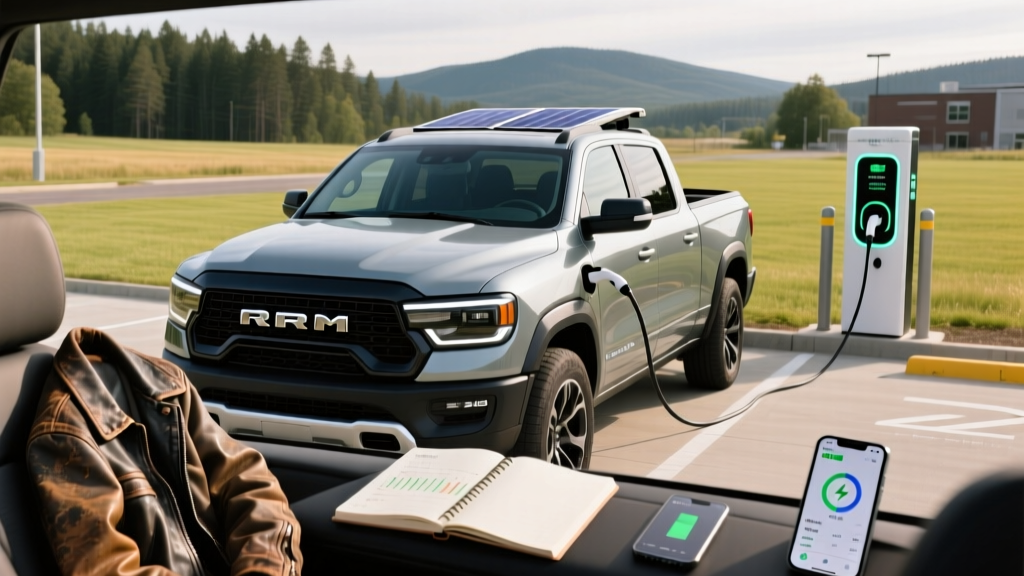
The Ram 1500 Ramcharger is the first mainstream pickup to bring extended-range electric vehicle (EREV) architecture to the American truck market. Unlike a plug-in hybrid that mechanically couples its engine to the wheels, the Ramcharger's 3.6-liter Pentastar V6 never drives the axles directly. It functions solely as a generator, charging the 92-kWh lithium-ion battery pack that powers two electric motors. The result is a truck that drives like a battery-electric vehicle (BEV) — instant torque, one-pedal regen, silent cruising — but carries an onboard generator to eliminate range anxiety on long hauls or remote job sites.
As EREV trucks gain attention from fleet buyers and outdoor enthusiasts who can't reliably depend on public charging infrastructure, the Ramcharger sets the benchmark for the segment in 2026. Here's everything you need to know about its real-world range, charging behavior, ownership costs, and whether the EREV formula makes sense for your driving pattern.
Spec Overview: 2026 Ram 1500 Ramcharger at a Glance
| Specification | Value |
|---|---|
| Powertrain | Dual-motor AWD + 3.6L V6 onboard generator (EREV) |
| Combined Horsepower | 663 hp |
| Combined Torque | 615 lb-ft |
| 0–60 mph | 4.4 seconds |
| Battery Capacity (Usable) | 92 kWh (NMC chemistry) |
| EPA Electric-Only Range | 69 miles |
| Total Range (EV + Generator) | ~690 miles |
| Max DC Fast Charge Rate | 150 kW peak |
| 10–80% DC Fast Charge | ~28 minutes |
| Level 2 Home Charging | 11 kW (~22 miles of EV range per hour) |
| MPGe (EV Mode, Combined) | 58 MPGe |
| Generator-Mode Efficiency | ~18 MPG combined (gasoline) |
| Max Towing Capacity | 14,000 lbs (properly equipped) |
| Max Payload | 1,800 lbs |
| Battery/Powertrain Warranty | 8 years / 100,000 miles |
| Base MSRP (Tradesman) | $59,995 |
Electric-Only Range and Real-World Efficiency
The EPA rates the Ramcharger at 69 miles of pure electric range before the onboard generator kicks in. That figure assumes a blend of city and highway driving at moderate temperatures with no accessory load. In practice, your results will vary significantly based on conditions.
Real-World Expectations:
• City / suburban commuting (stop-and-go regen): 65–72 miles
• Sustained 70-mph highway driving: 52–58 miles
• Cold weather (below 32°F) with cabin heat: 40–50 miles
• Towing a 5,000-lb trailer in EV mode: 25–35 miles
The NMC battery pack's usable 92 kWh is generous for an EREV — larger than many dedicated BEV crossovers. However, the Ramcharger's 6,100-pound curb weight and brick-like aerodynamic profile mean highway efficiency suffers. Expect roughly 2.0–2.2 kWh per mile at highway speeds, compared to 1.4–1.6 kWh per mile around town where regenerative braking recaptures energy. The EPA's fueleconomy.gov listing provides the official 58 MPGe combined figure for electric-only operation.
Once the battery depletes to its programmed buffer (roughly 10–12% state of charge), the V6 generator activates. The transition is nearly imperceptible from the driver's seat — the electric motors continue to provide all propulsion, and the engine runs at optimized RPM for electrical generation rather than following throttle demand. In generator mode, expect around 18 MPG combined, though towing drops that to 12–14 MPG.
Charging Speed: DC Fast Charging and Home Level 2
Charging infrastructure compatibility is where EREV trucks require a different mindset than pure BEVs. Because the Ramcharger has a generator as a backup, DC fast charging is a convenience rather than a necessity — but it still matters for daily EV-mode commuting.
| Charging Level | Power / Voltage | Rate | Time (10–80%) |
|---|---|---|---|
| Level 1 (120V outlet) | ~1.4 kW | ~3 miles EV range per hour | ~38 hours (full) |
| Level 2 (240V, 48A) | 11 kW | ~22 miles EV range per hour | ~7.5 hours (full) |
| DC Fast Charge (CCS) | 150 kW peak | Varies by SoC | ~28 minutes (10–80%) |
The Ramcharger uses a CCS1 connector for DC fast charging, not the Tesla NACS standard. Ram has not announced a NACS adapter timeline as of early 2026, so Tesla Supercharger access remains limited to third-party adapter solutions where available.
The 150-kW peak charge rate is moderate by 2026 BEV standards (where 250–350 kW is common), but for a 92-kWh pack it's adequate. The charge curve holds near peak from roughly 10% to 55% state of charge, then tapers progressively. Expect 80–100% to take an additional 25–30 minutes due to cell-balancing requirements at high SoC. For daily driving, Level 2 home charging on a 48-amp circuit is the sweet spot — plug in overnight and wake to a full battery for your 69-mile EV commute.
Home Level 2 installation typically costs $800–$2,500 depending on panel capacity and run length. The Ramcharger's 11-kW onboard charger means a 48-amp hardwired wall connector maximizes your charging speed. Consult a licensed electrician to confirm your panel can handle the 60-amp dedicated circuit.
Performance, Towing, and Drivetrain
The dual-motor all-wheel-drive system produces 663 combined horsepower and 615 lb-ft of torque, available instantly from zero RPM. The 4.4-second 0–60 mph time makes the Ramcharger quicker than most V8-powered half-ton trucks, and the linear power delivery feels effortless when merging or passing.
Towing is where the EREV architecture shows both promise and compromise. The 14,000-pound max tow rating is competitive with conventional half-tons, and the electric motors provide smooth, surge-free torque for trailer launches. However, towing in EV mode drains the battery rapidly — expect 25–35 electric miles at best with a heavy trailer. Once the generator activates, fuel economy drops to 12–14 MPG, and the V6 must work continuously at high output to sustain both propulsion and battery charge on grades.
For occasional tower who primarily commute light, the Ramcharger is excellent. For daily heavy-tow commercial use, a diesel remains more efficient over distance.
Pricing, Trims, and Federal Tax Credit Eligibility
The Ramcharger launches across four trims for the 2026 model year:
| Trim | MSRP | Est. After §30D Credit* |
|---|---|---|
| Tradesman | $59,995 | $52,495 |
| Laramie | $68,595 | $61,095 |
| Limited | $78,095 | $70,595 |
| Platinum | $85,095 | $77,595 |
*Federal tax credit estimates assume buyer eligibility. Actual credit depends on IRS §30D rules.
The Ramcharger qualifies for partial or full federal tax credit under IRS §30D clean vehicle rules. Because it is classified as a plug-in hybrid/EREV with a battery exceeding 7 kWh, it is eligible for up to $7,500 — but several conditions apply:
- MSRP Cap: Trucks/vans/SUVs must have an MSRP at or below $80,000. The Tradesman, Laramie, and Limited trims qualify; the Platinum trim exceeds the cap.
- Buyer Income Limits: Modified adjusted gross income must not exceed $150,000 (single), $225,000 (head of household), or $300,000 (joint filers).
- Battery Sourcing: The $7,500 credit splits into two $3,750 halves — one for critical minerals sourcing and one for battery component manufacturing. As of 2026, the Ramcharger's battery sourcing qualifies for at least one half ($3,750), with full $7,500 eligibility pending final supplier verification per IRS guidance.
- Point-of-Sale Transfer: Eligible buyers can transfer the credit to the dealer at purchase, reducing the out-of-pocket price immediately rather than waiting for tax filing.
Consult a tax professional before relying on credit estimates. Sourcing requirements tighten annually, and state-level incentives vary by jurisdiction — check your state's energy office for additional rebates.
Interior, Cargo, and Technology
The Ramcharger uses the same cab architecture as the conventional Ram 1500 DT, meaning interior dimensions are familiar: 40.9 inches of front legroom, 45.2 inches of rear legroom in the Crew Cab, and a 61.5-cubic-foot bed (5.7-foot box). The absence of a traditional transmission tunnel creates a flat rear floor, improving middle-seat comfort.
There is no front trunk (frunk) — the V6 generator and power electronics occupy the space where a BEV's frunk would be. This is a notable trade-off versus the Ford F-150 Lightning or Rivian R1T, both of which offer substantial front cargo volumes.
The infotainment system runs Stellantis's Uconnect 5 on a 14.5-inch center touchscreen (12-inch on Tradesman). Wireless Apple CarPlay and Android Auto are standard. The Ramcharger adds an EV-specific energy-flow display showing real-time power distribution between battery, motors, and generator. Available driver-assist features include adaptive cruise control with stop-and-go, lane-centering assist, and a trailer-reverse-guidance camera system. These are SAE Level 2 driver-assist features — the driver must remain engaged and hands-on at all times.
Pros, Cons, and Who Should Buy an EREV Truck
Pros
- 690+ mile total range eliminates charging-desert anxiety
- 69-mile EV range covers most daily commutes gas-free
- 663 hp with instant electric torque
- 14,000-lb tow rating competitive with conventional half-tons
- Drives like a BEV — smooth, quiet, one-pedal regen
- Generator provides off-grid power potential (future V2L expected)
Cons
- No frunk — engine bay occupied by generator
- 150-kW DC charge rate lags behind 2026 BEV trucks (250–350 kW)
- CCS connector only — no native NACS / Supercharger access
- Heavy curb weight (6,100+ lbs) hurts highway EV efficiency
- Generator-mode fuel economy (~18 MPG) trails diesel alternatives on highway
- Platinum trim exceeds $80K tax-credit MSRP cap
Best for: Truck buyers who commute 40–60 miles daily and want EV-mode savings on weekdays but need unlimited range for weekend towing, remote job sites, or rural living where DC fast chargers are scarce. The EREV formula excels when you have reliable home Level 2 charging but unpredictable long-distance needs.
Look elsewhere if: You tow heavy loads daily over long distances (a diesel is more efficient), you prioritize access to the Tesla Supercharger network, or you want the lowest possible operating cost with no gasoline dependency.
Competitive Landscape: EREV Trucks vs. BEV Trucks vs. PHEVs
The Ramcharger occupies a unique position in the 2026 truck market. The Ford F-150 Lightning and Chevrolet Silverado EV are pure BEVs with 230–400 miles of EPA range but no generator backup. The Ford F-150 PowerBoost is a conventional hybrid (no plug). No other mainstream EREV truck competes directly, though the concept is gaining traction — several Chinese-market EREV pickups (from brands like BYD and Range Automobile) exist but are not sold in the US.
The Ramcharger's advantage is operational flexibility: it never strands you. Its disadvantage is mechanical complexity — you're maintaining both an electric powertrain and an internal-combustion generator, with associated fluid changes, spark plugs, and emissions equipment. For buyers who value simplicity, a BEV with a reliable charging routine remains lower-maintenance.
Frequently Asked Questions
What is the real-world range of the Ramcharger?
In electric-only mode, expect 65–72 miles in city driving, 52–58 miles on the highway, and 40–50 miles in freezing temperatures. Once the generator activates, total range extends to approximately 690 miles before needing gasoline or a plug.
How fast does the Ramcharger charge at home and on the road?
On a 48-amp Level 2 home charger, the Ramcharger adds about 22 miles of EV range per hour, fully recharging overnight in roughly 7.5 hours. DC fast charging peaks at 150 kW, reaching 10–80% in approximately 28 minutes at compatible CCS stations.
Does the Ramcharger qualify for the $7,500 federal EV tax credit?
The Ramcharger is eligible for up to $7,500 under IRS §30D, subject to buyer income caps ($150K single / $300K joint), MSRP limits ($80K for trucks), and battery-sourcing requirements. Tradesman through Limited trims fall under the MSRP cap; Platinum does not. Verify current-year sourcing eligibility with your dealer and a tax professional.
Can I tow with the Ramcharger in electric-only mode?
Yes, but EV-only range drops dramatically under tow load — expect 25–35 miles with a 5,000-lb trailer. For longer towing trips, the generator will activate automatically, and fuel economy will drop to approximately 12–14 MPG.
How does the EREV system differ from a plug-in hybrid?
In a traditional PHEV, the gasoline engine can mechanically drive the wheels. In the Ramcharger's EREV system, the engine only generates electricity — the wheels are always driven by the electric motors. This means the driving experience is identical to a BEV at all times, with the engine functioning as a mobile power plant.
What is the battery warranty on the Ramcharger?
Stellantis covers the high-voltage battery and electric powertrain for 8 years or 100,000 miles, whichever comes first. The warranty guarantees the battery will retain a minimum percentage of its original capacity (typically 70%) over that period. The onboard V6 generator is covered under the standard 5-year / 60,000-mile powertrain warranty.
Are EREV trucks worth buying over a BEV truck?
EREV trucks make sense if you lack reliable access to DC fast charging on your typical routes, frequently drive to remote areas, or need unlimited range without trip planning. If you have home charging and your longest regular trip falls within a BEV's range (or you're comfortable with fast-charge stops), a pure BEV like the F-150 Lightning offers lower maintenance costs and simpler ownership.