The Story Behind the Rivian Name
If you've ever searched Rivian name meaning and come up short, you're not alone. Unlike Tesla (Nikola Tesla), Ford (Henry Ford), or Ferrari (Enzo Ferrari), Rivian doesn't trace its name to a founder, a place, or an engineering concept — at least not in any conventional sense. The company's founder and CEO, R.J. Scaringe, has explained in interviews that "Rivian" is essentially an invented word. It was chosen to evoke a sense of flow, movement, and connection to the natural world — themes central to the brand's outdoor-adventure identity — without being tied to any specific language or literal translation.
Some linguistic observers have noted that the name phonetically recalls words like "river" and the Latin rīvus (stream), reinforcing the brand's nature-forward ethos. Scaringe originally founded the company in 2009 under the name Mainstream Motors, later pivoting to Avera Automotive before settling on Rivian Automotive around 2011. The rebrand reflected a strategic shift away from mainstream sedans toward electric adventure vehicles built for off-road capability and exploration.
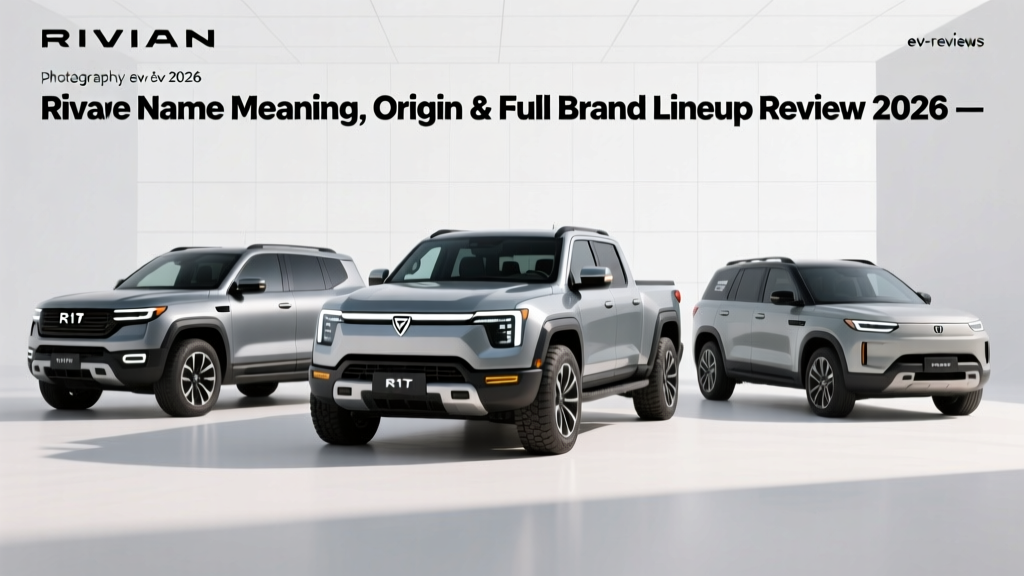
Today, Rivian operates out of Irvine, California, with manufacturing in Normal, Illinois. The brand has grown from an ambitious startup to a publicly traded automaker (NASDAQ: RIVN) producing two core vehicles: the R1T electric pickup and the R1S electric SUV. Below, we profile the current 2026 lineup with the exact specs, pricing, and ownership data you need.
2026 Rivian R1T: Full Spec Breakdown
The R1T is a mid-size electric pickup built on Rivian's skateboard platform. For 2026, Rivian offers the R1T with Standard, Large, and Max battery packs, available in Dual-Motor, Performance Dual-Motor, and Tri-Motor configurations. Here are the core specifications:
| Spec | Dual-Motor (Large Pack) | Tri-Motor (Max Pack) |
|---|---|---|
| EPA Range | ~342 miles | ~420 miles |
| Battery Capacity (usable) | ~106 kWh (NMC) | ~141 kWh (NMC) |
| Horsepower | 533 hp | 850 hp |
| 0–60 mph | 4.5 sec | 2.9 sec |
| Drivetrain | AWD (Dual-Motor) | AWD (Tri-Motor) |
| Max DC Fast Charge | ~200 kW | ~220 kW |
| 10–80% DCFC Time | ~30 min | ~36 min |
| Level 2 Home Charging | 11.5 kW (~25 mi/hr) | 11.5 kW (~25 mi/hr) |
| Towing Capacity | 11,000 lbs | 11,000 lbs |
| MPGe (combined) | ~70 MPGe | ~65 MPGe |
| Base MSRP | ~$69,900 | ~$99,000 |
2026 Rivian R1S: SUV Specs at a Glance
The R1S shares the R1T's skateboard platform but wraps it in a three-row SUV body. It seats up to seven passengers and offers serious off-road chops with Rivian's quad-motor torque-vectoring system available on higher trims.
| Spec | Dual-Motor (Large Pack) | Tri-Motor (Max Pack) |
|---|---|---|
| EPA Range | ~330 miles | ~410 miles |
| Battery Capacity (usable) | ~106 kWh (NMC) | ~141 kWh (NMC) |
| Horsepower | 533 hp | 850 hp |
| 0–60 mph | 4.6 sec | 3.1 sec |
| MPGe (combined) | ~69 MPGe | ~63 MPGe |
| Cargo Volume (behind 3rd row) | ~20 cu ft | ~20 cu ft |
| Cargo (all seats folded) | ~104 cu ft | ~104 cu ft |
| Base MSRP | ~$74,900 | ~$104,000 |
The R1S's 106 kWh and 141 kWh NMC (nickel manganese cobalt) battery packs are sourced from Samsung SDI cells assembled at Rivian's Normal, Illinois plant. Rivian has not announced an LFP (lithium iron phosphate) option for the R1 lineup as of 2026 — the brand prioritizes energy density for its adventure-oriented range targets, and NMC chemistry delivers that advantage despite being more expensive and requiring careful thermal management.
Charging Speed: DC Fast and Home Level 2
Charging speed is where Rivian has made significant generational improvements. The second-generation R1 platform (introduced for 2025 models) features upgraded electrical architecture that supports faster DC charging rates.
| Charging Level | Power / Rate | Speed | Notes |
|---|---|---|---|
| Level 1 (120V household) | ~1.4 kW | ~3–4 mi/hr | Emergency/trickle only |
| Level 2 (240V home) | 11.5 kW | ~25 mi/hr | Full charge overnight (~10–14 hrs for Max Pack) |
| DC Fast Charge | Up to 220 kW peak | 10–80% in ~30–36 min | Peak rate sustained to ~60% SoC, then tapers |
| Rivian Adventure Network | Up to 200+ kW | Varies by station | Proprietary network at trailheads & parks |
A critical ownership note: Rivian's DC fast-charging curve is not flat. The peak 220 kW rate applies roughly between 10% and 55–60% State of Charge (SoC). Above 60%, the rate tapers progressively — dropping to roughly 100 kW around 70% and further to 50 kW or below past 85%. This is standard NMC battery behavior to protect cell longevity, but it means a 10–90% session takes considerably longer than a 10–80% session. For road trips, plan your stops around 80% charges to minimize time at the plug.
Rivian uses the NACS (North American Charging Standard) connector for all 2026 models, giving R1T and R1S owners native access to the Tesla Supercharger network — a significant advantage for road-trip charging coverage. No adapter is needed for Superchargers or any NACS-equipped station.
Pricing, Trims & Federal Tax Credit Eligibility
Rivian's pricing has stabilized after several adjustments in recent years. Here's where the 2026 lineup stands:
| Model & Trim | Base MSRP | As-Tested (Typical) | §30D Federal Credit | Effective Price |
|---|---|---|---|---|
| R1T Dual-Motor (Standard Pack) | ~$64,900 | ~$68,000 | Up to $7,500* | ~$57,400–$60,500 |
| R1T Dual-Motor (Large Pack) | ~$69,900 | ~$74,000 | Up to $7,500* | ~$62,400–$66,500 |
| R1T Tri-Motor (Max Pack) | ~$99,000 | ~$105,000 | Up to $7,500* | ~$91,500–$97,500 |
| R1S Dual-Motor (Large Pack) | ~$74,900 | ~$80,000 | Up to $7,500* | ~$67,400–$72,500 |
| R1S Tri-Motor (Max Pack) | ~$104,000 | ~$110,000 | Up to $7,500* | ~$96,500–$102,500 |
*Federal tax credit eligibility under IRS §30D is subject to multiple requirements that change annually:
- MSRP Cap: Vans, SUVs, and pickups must be below $80,000 MSRP. Sedans below $55,000. The R1T qualifies as a pickup (so the $80,000 cap applies), but Tri-Motor/Max Pack trims exceed this threshold and are ineligible.
- Buyer Income Cap: Modified AGI must not exceed $300,000 (joint), $225,000 (head of household), or $150,000 (individual).
- Battery Sourcing: A percentage of critical minerals and battery components must be sourced from the U.S. or free-trade-agreement partners. These thresholds increase annually. Consult the IRS clean vehicle credit page for current-year sourcing requirements.
- Point-of-Sale Transfer: As of 2024, eligible buyers can transfer the credit to the dealer at purchase, reducing the out-of-pocket price immediately rather than waiting for a tax refund.
In practice, R1T Dual-Motor and R1S Dual-Motor trims priced below $80,000 MSRP generally qualify for the full $7,500 credit if the buyer meets income and sourcing requirements. Tri-Motor Max Pack trims at $99,000+ do not qualify due to the MSRP cap. Always confirm eligibility with a tax professional before purchase.
Warranty, Tech & Driver Assistance
Rivian's warranty coverage for the 2026 model year includes:
- Battery & Drive Unit: 8 years / 175,000 miles (whichever comes first), covering defects and capacity degradation below 70% of original capacity.
- Vehicle Limited Warranty: 5 years / 60,000 miles bumper-to-bumper.
- Corrosion Warranty: 12 years, unlimited miles.
The 8-year/175,000-mile battery warranty is among the most generous in the industry, exceeding the standard 8-year/100,000-mile coverage offered by most competitors. The 70% capacity retention threshold is standard for the segment.
Standout tech features include:
- Rivian Driver+: A Level 2 (SAE) driver-assistance system with adaptive cruise control, lane centering, and highway assist. The driver must remain engaged at all times — this is not autonomous driving.
- 15.6-inch center touchscreen running Rivian's proprietary OS with over-the-air (OTA) updates, integrated trail mapping, and camping/outing features.
- Gear Tunnel (R1T exclusive): A lockable, weather-sealed cross-body storage compartment behind the cab — ideal for skis, fishing rods, or camping gear.
- Camp Kitchen option: A slide-out kitchen system designed to integrate with the Gear Tunnel.
- V2L (Vehicle-to-Load): Power output capability to run appliances and tools from the truck's battery.
- Off-road modes: Including All-Purpose, Sport, Conserve, Snow, and dedicated Off-Road modes with adjustable air suspension (up to 14.9 inches of ground clearance).
Pros, Cons & Verdict
Pros
- Class-leading off-road capability with air suspension and quad-motor torque vectoring
- NACS connector = native Tesla Supercharger access
- 8-yr/175,000-mi battery warranty exceeds most rivals
- Gear Tunnel and Camp Kitchen are genuinely unique utility features
- Strong OTA update cadence keeps the vehicle improving post-purchase
- Tri-Motor delivers supercar-level acceleration (2.9 sec 0–60) in a pickup
Cons
- Tri-Motor/Max Pack trims exceed the $80K MSRP cap for federal tax credit
- Real-world highway range is 15–20% below EPA estimates (common for boxy trucks/SUVs)
- Charging tapers significantly above 60% SoC — 10–90% takes much longer than 10–80%
- Service center network still expanding; some owners face long wait times for repairs
- Premium pricing — even base trims start near $65K before options
- No LFP battery option for buyers prioritizing longevity over range
Who is the Rivian R1T/R1S best for? The R1T suits outdoor enthusiasts, adventure travelers, and truck buyers who want serious off-road capability, innovative storage solutions, and daily-driver comfort — without burning fuel. The R1S targets families who need three rows, cargo versatility, and trail capability. Neither is a budget EV; both reward buyers who prioritize capability and tech over lowest cost per mile. If you tow heavy loads regularly, commute long distances at highway speed, or live in a region with sparse charging infrastructure, carefully evaluate whether the real-world range and charging infrastructure meet your needs before committing.
Frequently Asked Questions
What is the real-world range of the Rivian R1T?
The EPA estimates 342 miles for the Dual-Motor Large Pack and 420 miles for the Tri-Motor Max Pack. In real-world highway driving at 70+ mph, expect roughly 280–310 miles (Large) or 350–380 miles (Max). Cold weather can reduce these figures by an additional 15–25%.
How fast does the R1T charge at home and on the road?
At home on a Level 2 (240V) charger, the R1T charges at 11.5 kW, adding about 25 miles of range per hour. A full charge from near-empty takes 10–14 hours depending on pack size. On DC fast chargers, the R1T peaks at up to 220 kW, achieving a 10–80% charge in roughly 30–36 minutes. Expect slower rates above 60% SoC due to taper.
Does the Rivian R1T qualify for the $7,500 federal EV tax credit?
Dual-Motor trims with MSRP below $80,000 generally qualify, provided the buyer meets IRS §30D income limits ($300K joint / $150K individual) and battery-sourcing requirements. Tri-Motor Max Pack trims exceed the MSRP cap and are ineligible. Confirm with a tax professional before purchase.
Is the Rivian R1T worth buying over the Ford F-150 Lightning or Chevy Silverado EV?
The R1T excels in off-road capability, tech integration, and adventure-oriented features like the Gear Tunnel. The F-150 Lightning offers a more traditional truck experience with a lower starting price and broader dealer network. The Silverado EV targets fleet and work-truck buyers. If off-road performance and unique utility features are priorities, the R1T has no direct rival. If you need a work truck with maximum dealer support, the Lightning may be more practical.
What battery chemistry does Rivian use?
Rivian uses NMC (nickel manganese cobalt) lithium-ion cells sourced from Samsung SDI. NMC offers higher energy density than LFP, enabling the R1T's 342–420 mile range, but it requires careful thermal management and does not offer the same cycle-life longevity as LFP. Rivian's 8-year/175,000-mile battery warranty provides strong long-term coverage.
What does the name "Rivian" actually mean?
Rivian is an invented word chosen by founder R.J. Scaringe to evoke movement, nature, and exploration. It is not derived from a person's name or a specific language, though it phonetically suggests "river" — aligning with the brand's outdoor identity. The company was originally called Mainstream Motors (2009) before rebranding to Rivian around 2011.