Quick Answer: Is the Freightliner eCascadia Right for Your Fleet?
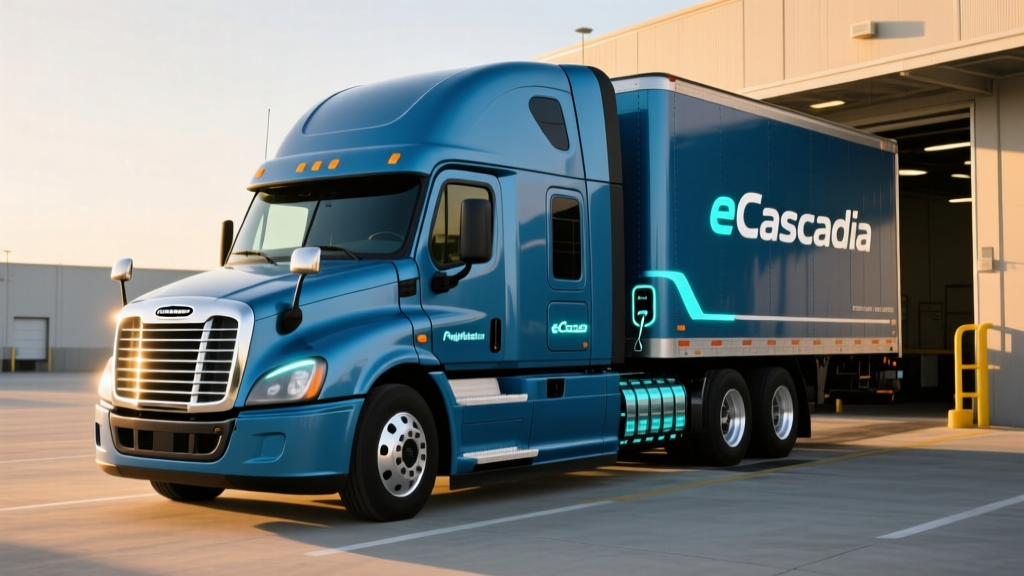
The Freightliner eCascadia is a Class 8 battery-electric semi truck designed for regional haul, drayage, and last-mile freight. It offers up to 230 miles of range from a 475 kWh usable battery pack, peaks at 320 hp (peak) / 470 hp, and supports DC fast charging from 10–80% in approximately 90 minutes at 180 kW. Base pricing starts around $400,000–$450,000 before incentives — roughly 2.5× the cost of a diesel Cascadia. It makes economic sense for fleets running predictable sub-200-mile daily routes with depot-based overnight charging, where diesel savings ($0.40–$0.55/mile fuel cost vs. $0.12–$0.18/mile electricity) and lower maintenance offset the higher upfront capital outlay over 3–5 years.
What the Freightliner eCascadia Actually Is
The Freightliner eCascadia is the battery-electric variant of Daimler Truck North America's best-selling Class 8 platform. Now in its second generation (production from 2022 onward, with ongoing updates through 2026), it targets vocational, drayage, and regional distribution routes — not long-haul cross-country freight. The truck uses a Detroit ePowertrain with integrated electric axles, eliminating the traditional driveshaft and improving efficiency.
Freightliner positions the eCascadia alongside competitors like the Tesla Semi, Volvo VNR Electric, Peterbilt 579EV, and Kenworth T680E. Where the eCascadia wins is dealer support infrastructure — Freightliner has the largest Class 8 service network in North America, which matters when uptime is revenue.
Specs That Matter: Range, Battery, and Charging
For fleet buyers, the spec sheet determines whether the truck fits your route map. Here's what the current eCascadia delivers:
| Specification | Freightliner eCascadia (2026) |
|---|---|
| Battery Capacity (usable) | 475 kWh (NMC lithium-ion) |
| EPA Estimated Range | Up to 230 miles (varies by config) |
| Real-World Range (loaded, mixed) | ~150–200 miles |
| Motor Type | Detroit ePowertrain, dual e-axle |
| Power (Peak / Continuous) | 470 hp peak / 320 hp continuous |
| Torque | ~1,600 lb-ft at wheels |
| DC Fast Charge (Peak) | 180 kW (CCS Type 1) |
| 10–80% DC Charge Time | ~90 minutes at 180 kW |
| Level 2 AC Charging | 19.2 kW (~25 hours full charge) |
| GCWR (Gross Combination Weight) | 82,000 lbs |
| Base MSRP (approx.) | $400,000–$450,000 |
| Warranty (Battery) | 5 years / 400,000 miles (70% retention) |
| Warranty (Powertrain) | 5 years / 400,000 miles |
Real-World Range vs. Sticker
The 230-mile figure assumes optimal conditions: moderate temperatures, flat terrain, partial load, and steady speeds under 55 mph. In real fleet operations, expect 150–200 miles with a full 80,000-lb GCW load on mixed terrain. Cold weather (below 32°F) can reduce range by 20–35%, and sustained highway speeds above 65 mph cut efficiency sharply due to aerodynamic drag on the box trailer. Route planning should target a 170-mile maximum daily loop to preserve a 30-mile buffer.
Charging Infrastructure: What Depots Need to Know
The eCascadia's viability depends entirely on charging infrastructure. Unlike passenger EVs, a Class 8 electric truck cannot rely on public charging networks — the 180 kW CCS connector is compatible with heavy-duty public chargers, but most fleet operations require dedicated depot charging.
| Charging Level | Power | Miles Added/Hour | Use Case |
|---|---|---|---|
| Level 2 (AC) | 19.2 kW | ~9 mi/hr | Overnight depot top-off |
| DC Fast (single truck) | 60–180 kW | ~30–85 mi/hr | Midday opportunity charge |
| DC Fast (megawatt-ready) | Up to 500 kW (future MCS) | ~150+ mi/hr | Next-gen corridor charging |
Depot charging costs vary dramatically by utility rate and infrastructure build-out:
| Item | Cost Range (per stall) |
|---|---|
| DC Fast Charger (60–180 kW unit) | $80,000–$180,000 |
| Electrical Infrastructure (transformer, switchgear, trenching) | $50,000–$200,000 |
| Utility Service Upgrade (if needed) | $30,000–$500,000+ |
| Permitting & Engineering | $10,000–$40,000 |
| Software / Fleet Management Integration | $5,000–$20,000 |
| Total Per Stall (typical) | $175,000–$940,000 |
Utility demand charges can add $10–$25/kW/month on top of energy costs. Smart charging software that staggers charge sessions to avoid peak demand periods is not optional — it's essential for cost control. Fleets should contact their utility early; some offer make-ready programs covering 50–100% of infrastructure costs.
Total Cost of Ownership: eCascadia vs. Diesel Cascadia
The purchase price gap is real — but so are the operational savings. Here's a side-by-side 5-year TCO comparison for a truck running 200 miles/day, 260 days/year:
| Cost Category | eCascadia (Electric) | Diesel Cascadia |
|---|---|---|
| Purchase Price | $425,000 | $170,000 |
| Federal/State Incentives | –$40,000 to –$120,000* | $0 |
| Net Acquisition Cost | $305,000–$385,000 | $170,000 |
| Fuel/Energy (5 years, 260k mi) | $42,000–$62,000 | $208,000–$260,000 |
| Maintenance (5 years) | $15,000–$25,000 | $45,000–$65,000 |
| DEF / Emissions Systems | $0 | $8,000–$12,000 |
| Charging Infrastructure (amortized) | $30,000–$80,000 | $0 |
| Insurance (5 years) | $35,000–$50,000 | $30,000–$45,000 |
| 5-Year TCO (approx.) | $427,000–$602,000 | $461,000–$552,000 |
*Incentive note: Federal IRC §45W Commercial Clean Vehicle Credit offers up to $40,000 for qualified commercial EVs. Additional state incentives (e.g., California's HVIP, New York's Truck Voucher Incentive) can stack to $80,000–$120,000+ in some jurisdictions. Always verify current program availability with your state air quality board.
The breakeven point typically arrives between years 3 and 5, depending on local electricity rates, diesel prices, route efficiency, and incentive stacking. Fleets in California, Oregon, and New York — where incentive programs are richest and diesel is most expensive — see the fastest payback.
Common Misconceptions About Electric Semi Trucks
| Myth | Fact |
|---|---|
| "Electric semis can't pull full loads" | The eCascadia is rated for 82,000 lbs GCWR — the same as a diesel Class 8. Torque delivery is instant and flat, which actually improves grade performance. |
| "Batteries won't last" | Detroit's warranty guarantees 70% capacity retention at 5 years / 400,000 miles. NMC cells in commercial applications with managed charging typically retain 80%+ at 500,000 miles based on early fleet data. |
| "You can't charge in cold weather" | The eCascadia has active battery thermal management with preconditioning. Charging is slower in extreme cold (expect 20–30% longer sessions below 20°F), but it works. |
| "Public charging will work for trucks" | Most public DC chargers are designed for passenger vehicles — inadequate power, wrong connector height, and no pull-through lanes. Depot charging is the primary model. |
| "Electric trucks are zero-maintenance" | No oil changes or DPF/SCR service, but tire wear increases (heavier axle loads, instant torque), brake maintenance is lower (regen handles ~80% of deceleration), and HVAC/coolant systems still need service. |
Who Should Buy the eCascadia — and Who Shouldn't
Fleet Decision Framework
Choose the Freightliner eCascadia if:
- Your daily routes are under 200 miles round-trip with predictable schedules
- You operate drayage, port, or regional distribution routes
- You have depot space for dedicated charging infrastructure
- You operate in a state with strong commercial EV incentives (CA, NY, OR, WA, NJ)
- Your fleet has ESG/carbon-reduction mandates from shippers or regulators
- You plan to hold the truck 5+ years to reach TCO breakeven
Stick with diesel (or wait) if:
- Your routes regularly exceed 250 miles per day
- You run long-haul or irregular OTR routes
- Your depot lacks three-phase power or utility upgrade timelines exceed 18 months
- You need to tow heavy specialized loads in mountainous terrain in winter
- You lease trucks on 3-year cycles (won't capture TCO advantage)
First-Time Electric Fleet Buyer Checklist
Transitioning even a portion of your fleet to electric requires planning that goes beyond vehicle purchase:
- Audit your routes. Pull GPS/ELD data for 90 days. Identify trucks running under 200 miles/day with at least 8 hours of overnight dwell time. These are your electrification candidates.
- Talk to your utility NOW. Depot charging for 5+ trucks may require a new transformer or feeder upgrade. Lead times of 12–24 months are common. Ask about make-ready incentive programs.
- Model your energy costs. Calculate your effective $/kWh including demand charges. Target a blended rate under $0.20/kWh for viable economics. Time-of-use rates and managed charging are essential.
- Stack incentives. Combine federal §45W with state vouchers, utility rebates, and EPA Clean Truck or CARB funding where available. Total incentive packages of $100,000+ per truck are achievable in some markets.
- Plan driver training. Regen braking, range management, and charge-session planning require new habits. Budget 2–4 hours of training per driver.
- Start small. Deploy 2–5 trucks on your best-fit routes before committing to a larger order. Validate real-world range and charging logistics with your specific freight profiles.
How the eCascadia Compares to Competitors
| Model | Range | Battery | DC Charge (Peak) | 10–80% Time | Approx. Price |
|---|---|---|---|---|---|
| Freightliner eCascadia | 230 mi | 475 kWh | 180 kW | ~90 min | $400–450K |
| Tesla Semi | 300–500 mi | ~500–900 kWh (est.) | ~1,000 kW (Megacharger) | ~30 min | $250–290K* |
| Volvo VNR Electric | 275 mi | 565 kWh | 250 kW | ~60 min | $380–430K |
| Peterbilt 579EV | 150 mi | 396 kWh | 150 kW | ~90 min | $350–400K |
*Tesla Semi pricing reflects announced figures; availability remains limited to select fleet customers. Range and battery specs are manufacturer-estimated and may vary by production batch.
The eCascadia's advantage isn't raw range or charge speed — it's service network density. Freightliner's 400+ dealer locations across North America mean warranty work, parts, and roadside support are more accessible than any EV-specific startup. For fleets that can't afford extended downtime, that matters as much as the spec sheet.
Frequently Asked Questions
Can the eCascadia handle winter operations?
Yes, with planning. Battery preconditioning warms the pack before charging and driving. Expect 20–35% range reduction in sustained sub-freezing temperatures. Fleets in cold climates should spec routes to 150 miles maximum in winter and use block heaters during overnight dwell.
What's the actual cost per mile to charge vs. diesel fuel?
At a blended depot rate of $0.15/kWh and an efficiency of 2.0 kWh/mile (loaded), electricity costs approximately $0.30/mile. Diesel at $4.00/gallon and 6.5 MPG costs approximately $0.62/mile. That's roughly a 50% per-mile fuel savings, though actual savings depend on local utility rates and diesel prices.
How long before battery replacement is needed?
Detroit warranties the battery at 70% capacity retention for 5 years / 400,000 miles. Based on early fleet data from Detroit Diesel and third-party monitoring, batteries are tracking toward 600,000+ miles before reaching 70% SoH. A full pack replacement (if ever needed) is estimated at $80,000–$120,000, though individual module replacement is possible at lower cost.
Does the eCascadia qualify for any tax credits?
Yes. The IRS §45W Commercial Clean Vehicle Credit provides up to $40,000 for qualified heavy-duty electric trucks. Unlike the consumer §30D credit, §45W has no MSRP cap or buyer income limit, but the vehicle must meet domestic battery-component and critical-mineral sourcing thresholds. Consult a tax professional for eligibility specifics — incentive stacking with state programs can reduce net cost by $100,000+.
What maintenance does an electric semi actually save?
Eliminated: engine oil changes, fuel filters, DEF fluid, DPF/SCR emissions systems, transmission fluid (single-speed reduction gear), and exhaust system repairs. Reduced: brake wear (regenerative braking handles most deceleration). Retained: tire rotation/replacement (heavier axle loads), suspension, HVAC, coolant system, windshield wipers, and 12V electrical. Net maintenance savings run approximately 40–55% vs. diesel over 5 years.