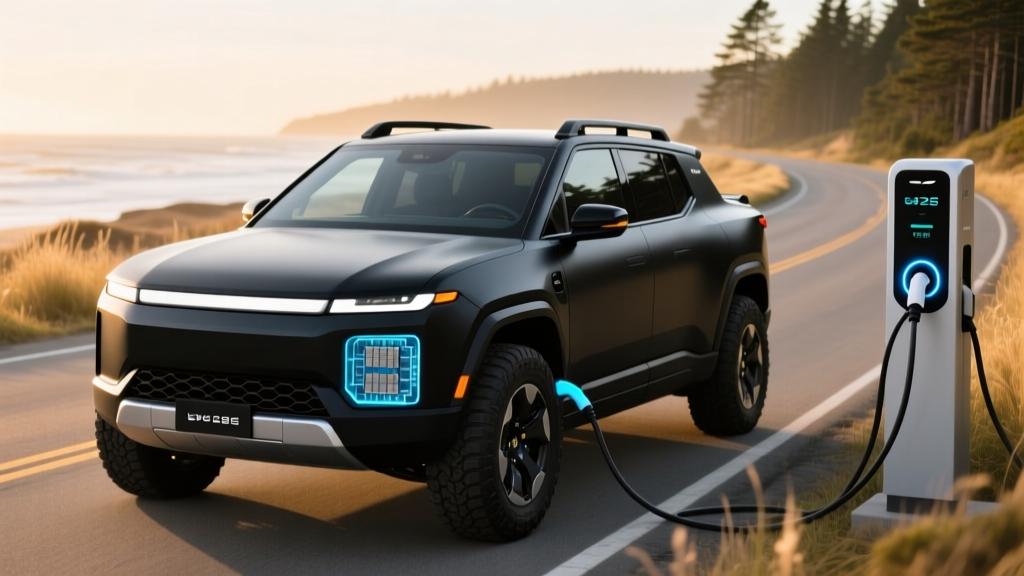
What the Rivian Motorway Edition Actually Is
If you've been searching for Rivian Motorway specs, you're likely encountering the R1S (SUV) or R1T (truck) equipped with Rivian's Motorway driver-assist and highway-tuned configuration. Motorway is Rivian's proprietary hands-on, eyes-on highway driving system — their Level 2 ADAS suite — bundled across recent R1 build configurations that prioritize long-range dual-motor setups, aerodynamic wheel options, and over-the-air software enhancements for sustained interstate travel.
For 2026, Rivian continues to offer the R1S and R1T on a Gen 2 architecture with a Dual-Motor AWD Standard battery and an available Max battery pack. The Motorway-equipped builds target buyers who spend serious time on interstates and want a calibrated adaptive cruise, lane-centering, and automated lane-change experience without stepping into Tesla's FSD or GM's Super Cruise territory.
Rivian Motorway is a driver-assist system, not self-driving. You must keep your hands on the wheel and eyes on the road at all times. It does not navigate unmapped roads, handle construction zones autonomously, or operate without an attentive driver. Only Level 4 robotaxi services like Waymo operate without a human driver.
Range and Efficiency: EPA vs. the Real World
The 2026 R1S Dual-Motor AWD with the Max Pack (large battery) carries an EPA-estimated 410 miles of range, while the Standard Pack (base battery) is rated at approximately 270 miles. The R1T Dual-Motor Max Pack is EPA-rated at roughly 420 miles. Efficiency for the R1S Max Pack lands around 73 MPGe combined, or approximately 46 kWh per 100 miles, according to fueleconomy.gov.
EPA Sticker: 410 mi (R1S Max Pack) / 420 mi (R1T Max Pack)
Highway at 75 mph: Expect ~320–350 mi — large SUVs and trucks lose efficiency at sustained high speed due to aerodynamic drag.
Cold Weather (below 32°F): Plan for a 15–25% reduction, yielding ~260–310 mi on the Max Pack depending on cabin heat usage and battery preconditioning.
Mixed Commute (city + suburban): Closest to EPA — regenerative braking recovers energy in stop-and-go traffic, often achieving 380–410 mi.
The Standard Pack's 270-mile EPA rating drops to roughly 200–220 miles at sustained highway speeds in winter. If your typical drive involves 200+ mile interstate stretches in cold climates, the Max Pack is strongly recommended.
Battery Chemistry, Capacity, and Longevity
Rivian's Gen 2 Standard Pack uses a ~92 kWh usable LFP (lithium iron phosphate) battery, while the Max Pack uses a ~141 kWh usable NMC (nickel manganese cobalt) pack. This chemistry split matters:
| Attribute | Standard Pack (LFP) | Max Pack (NMC) |
|---|---|---|
| Usable Capacity | ~92 kWh | ~141 kWh |
| EPA Range (R1S) | ~270 mi | ~410 mi |
| Cycle Life | Higher (3,000+ cycles) | Moderate (1,500–2,000 cycles) |
| Recommended SoC | Can charge to 100% daily | Best kept 20–80% daily |
| Cold Performance | Reduced in extreme cold | Better low-temp output |
| Energy Density | Lower (heavier per kWh) | Higher (lighter per kWh) |
The LFP pack's ability to charge to 100% regularly without accelerated degradation makes it ideal for daily commuters who can charge at home nightly. The NMC Max Pack's higher energy density is the road-trip and towing choice, but owners should follow the 80% daily charge recommendation and only push to 100% before long drives.
Charging Speed: DC Fast, Level 2, and the Curve
Rivian's Gen 2 architecture supports DC fast charging up to 220 kW peak on NACS-equipped vehicles (all 2026 models ship with the North American Charging Standard port, granting native Tesla Supercharger access). Here's what that looks like in practice:
| Charging Level | Power / Rate | Time or Miles Added |
|---|---|---|
| Level 1 (120V household) | ~1.4 kW | ~3–4 miles per hour |
| Level 2 (240V home, 48A) | ~11.5 kW | ~25–28 miles per hour |
| DC Fast Charge (peak) | Up to 220 kW | 10–80% in ~30 min (Max Pack) |
| DC Fast Charge (Standard) | Up to 200 kW | 10–80% in ~25 min |
| Tesla Supercharger V3 | Up to 150 kW (shared) | ~20 min for 10–80% (varies) |
Charging curve reality check: The 220 kW peak only sustains between roughly 10–40% state of charge. Above 50%, the rate tapers to ~120 kW, and above 80%, it drops sharply to ~50 kW or less. This is normal lithium-ion behavior to protect cell health, but it means a 10–90% session takes considerably longer than a 10–80% session. On a road trip, plan your stops around 10–80% increments for the best time efficiency.
For home charging, Rivian recommends a hardwired 48-amp Level 2 wall connector on a 60-amp circuit. Installation costs typically run $800–$2,500 depending on your electrical panel's capacity and the distance from panel to garage. If your home has a 100-amp main panel, you may need a $1,500–$3,000 panel upgrade to 200 amps — factor this into your budget. Always consult a licensed electrician for final specs.
Performance and Drivetrain
The 2026 R1S and R1T Dual-Motor Motorway configuration delivers 533 horsepower and 610 lb-ft of torque through a permanent-magnet dual-motor AWD system. Rivian quotes a 0–60 mph time of 4.5 seconds for the Dual-Motor — brisk for a vehicle weighing over 6,800 pounds (R1S Max Pack curb weight).
| Spec | R1S Dual-Motor (Max) | R1T Dual-Motor (Max) |
|---|---|---|
| Horsepower | 533 hp | 533 hp |
| Torque | 610 lb-ft | 610 lb-ft |
| 0–60 mph | 4.5 sec | 4.5 sec |
| Drivetrain | Dual-Motor AWD | Dual-Motor AWD |
| Towing Capacity | 7,700 lbs | 11,000 lbs |
| Ground Clearance | Up to 14.9 in | Up to 14.9 in |
| EPA Range | ~410 mi | ~420 mi |
| Battery (usable) | ~141 kWh (NMC) | ~141 kWh (NMC) |
| MPGe (combined) | ~73 MPGe | ~73 MPGe |
Towing is where real-world range takes the biggest hit. Expect a 40–55% range reduction when pulling a loaded trailer at highway speeds. The R1T's 11,000-lb tow rating is class-leading among electric pickups, but a 5,000-lb camper will compress that 420-mile EPA figure to roughly 200–240 miles between charges.
Pricing, Trims, and Federal Tax Credit Eligibility
For 2026, Rivian's pricing starts at approximately $75,900 for the R1S Dual-Motor Standard Pack and climbs to roughly $94,500 for the R1S Dual-Motor Max Pack with premium options. The R1T follows a similar ladder, starting near $69,900 and reaching past $89,000 fully optioned.
| Trim / Config | Base MSRP | Federal Credit Potential | Effective Price |
|---|---|---|---|
| R1T Dual-Motor Standard | $69,900 | Up to $7,500* | ~$62,400 |
| R1T Dual-Motor Max | $89,000 | Up to $7,500* | ~$81,500 |
| R1S Dual-Motor Standard | $75,900 | Up to $7,500* | ~$68,400 |
| R1S Dual-Motor Max | $94,500 | Up to $7,500* | ~$87,000 |
*Critical tax credit caveats: The IRS §30D federal EV tax credit of up to $7,500 is subject to multiple eligibility gates that change frequently. As of 2026, key requirements include:
- MSRP Cap: SUVs (R1S) must have an MSRP ≤ $80,000; trucks (R1T) must be ≤ $80,000. Max Pack configurations may exceed this cap — verify the specific build's MSRP.
- Buyer Income Limits: Modified AGI must not exceed $150,000 (single), $225,000 (head of household), or $300,000 (joint filers).
- Battery Sourcing: Critical minerals and battery components must meet phased-in domestic/FtA-sourcing thresholds. Rivian's supply chain has been evolving — confirm current-year compliance on irs.gov.
- Point-of-Sale Transfer: Eligible buyers can transfer the credit to the dealer at purchase for an immediate price reduction rather than waiting for a tax refund.
Because the R1S Max Pack's MSRP often exceeds $80,000, many R1S configurations will not qualify for the federal credit. The R1T Dual-Motor Standard at $69,900 is the most credit-friendly configuration. Always verify your specific build and personal tax situation with a qualified tax professional before relying on the credit.
Interior Space, Tech, and Daily Livability
The R1S seats up to seven across three rows. Cargo volume measures approximately 21 cu ft behind the third row, expanding to 57 cu ft with the third row folded and 105 cu ft with both rear rows down. Second-row legroom is a generous 39.5 inches, while the third row suits children or short trips at ~32 inches of legroom.
The R1T offers a 4.5-foot bed with a unique Gear Tunnel (lockable, pass-through storage) and a front trunk (frunk) providing roughly 11 cu ft of secure, weatherproof cargo space — more usable than most competitors' frunks.
Infotainment runs on Rivian's proprietary 15.6-inch center touchscreen with native navigation, streaming apps, and over-the-air updates. The Motorway driver-assist suite includes:
- Adaptive cruise control with stop-and-go
- Lane-centering assist with automated lane changes (on supported highways)
- Blind-spot monitoring with rear cross-traffic alert
- Highway assist with driver-monitoring alerts
Warranty Coverage
Rivian provides a 5-year / 60,000-mile limited vehicle warranty and an 8-year / 175,000-mile battery and drive-unit warranty. The battery warranty guarantees retention of at least 70% of original capacity during the coverage period. This is competitive with the industry standard and reflects confidence in both the LFP and NMC cell suppliers Rivian uses.
Pros and Cons
- Class-leading electric range (410+ mi EPA with Max Pack)
- Native NACS — full Tesla Supercharger network access
- Exceptional off-road capability with adjustable air suspension
- Best-in-class electric truck towing (11,000 lbs, R1T)
- Spacious, thoughtfully designed interior with massive frunk and Gear Tunnel
- Over-the-air updates continuously improve the vehicle
- High base price; Max Pack pushes past $90K
- R1S Max Pack likely exceeds the $80K MSRP cap for federal tax credit
- Towing severely compresses range (expect 200–240 mi loaded)
- DC fast charging at 220 kW is good but trails Hyundai/Kia's 800V systems (~350 kW)
- Third row in R1S is tight for adults
- Service center network still expanding in rural areas
Who Should Buy the Rivian Motorway Configuration?
Choose the Rivian R1T Motorway if: You need an electric pickup for towing or hauling, want the Gear Tunnel for adventure gear, and prioritize range over seating capacity.
Look elsewhere if: You're budget-constrained and need the full $7,500 credit (consider the Ford F-150 Lightning or Chevy Silverado EV), you want the fastest DC charging available (look at Hyundai Ioniq 5 or Kia EV9), or you need a true hands-free driving system like GM's Super Cruise for long commutes.
Frequently Asked Questions
What is the real-world range of the Rivian Motorway edition?
The Max Pack R1S delivers approximately 320–350 miles at sustained 75 mph highway speeds, versus the 410-mile EPA sticker. In cold weather (below 32°F), expect 260–310 miles. The Standard Pack yields roughly 200–220 highway miles in winter conditions. City driving with regenerative braking gets closest to EPA figures.
How fast does the Rivian Motorway charge at home and on the road?
At home on a 48-amp Level 2 charger, you'll add about 25–28 miles per hour, fully recharging the Max Pack overnight in roughly 14–16 hours. On a DC fast charger, the Max Pack goes from 10–80% in about 30 minutes at peak rates up to 220 kW, though sustained rates taper significantly above 50% SoC.
Does the Rivian Motorway qualify for the $7,500 federal EV tax credit?
It depends on the specific build. The IRS §30D credit requires the vehicle MSRP to be ≤ $80,000 for both SUVs and trucks, plus buyer income limits and battery-sourcing rules. The R1T Dual-Motor Standard at $69,900 is most likely eligible; the R1S Max Pack at $94,500 exceeds the cap. Verify your exact build on irs.gov and consult a tax professional.
Is the Rivian Motorway worth it versus competitors?
Against the Tesla Model X, the R1S offers more rugged capability, better interior materials, and a more practical third row, but the Model X charges faster and has a more mature Supercharger ecosystem (though Rivian now has native access). Against the Ford F-150 Lightning, the R1T offers more range and a more premium interior, but the Lightning is cheaper and more likely to qualify for the full tax credit. Against the BMW iX, the R1S is far more capable off-road and offers more cargo versatility, while the iX is more refined on pavement.
What are the biggest drawbacks of the Rivian Motorway?
Price is the primary barrier — most configurations exceed $75,000 and many blow past the tax-credit MSRP cap. Towing range loss is severe (40–55%). DC fast charging at 220 kW peak is solid but not segment-leading. And while Rivian's service network is growing, owners in rural areas may face longer wait times for repairs compared to legacy automaker dealer networks.
Is Motorway the same as self-driving?
No. Motorway is an SAE Level 2 driver-assist system. It can manage lane centering and adaptive cruise on mapped highways, but you must remain fully engaged — hands on the wheel, eyes on the road. It is not autonomous. Rivian does not currently offer any Level 3 or Level 4 system.