If you've ever watched a Tesla navigate a roundabout without driver input and wondered, does Tesla use artificial intelligence? — the answer is an emphatic yes, and nowhere is that more apparent than in the 2026 Tesla Model Y. The refreshed compact electric SUV pairs Tesla's latest neural-network-driven Full Self-Driving (Supervised) software with a mature, high-volume EV platform that remains one of the best-selling electric vehicles in the United States.
But AI features alone don't pay the bills or get you through a winter road trip. This review digs into what actually matters to buyers: real-world range versus the EPA sticker, DC fast-charging speed and taper, battery chemistry trade-offs, cabin space, and whether the 2026 Model Y still qualifies for the federal EV tax credit under current IRS §30D rules. Let's get into the numbers.
Quick Verdict: The Model Y in 2026
The 2026 Tesla Model Y Long Range AWD remains the default benchmark in the electric compact SUV segment. It delivers strong EPA range, best-in-class DC charging infrastructure access via the Supercharger network, and the most widely deployed vision-based driver-assistance system on the road. Its weaknesses — a firm ride, minimalist interior that won't suit everyone, and the ongoing supervision requirement for FSD — haven't changed. For tech-forward buyers who prioritize charging speed and software capability over luxury trim materials, the Model Y is still the one to beat.
Range, Battery, and Efficiency
| Spec | Value |
|---|---|
| EPA Estimated Range | 320 miles |
| Battery Capacity (usable) | ~78 kWh |
| Battery Chemistry | NMC (Nickel Manganese Cobalt) |
| Combined MPGe | 111 MPGe |
| Energy Consumption | 28 kWh / 100 mi |
| Drivetrain | Dual-Motor AWD |
The EPA rates the 2026 Model Y Long Range AWD at 320 miles. In real-world highway driving at 70–75 mph in moderate temperatures (60–75°F), expect approximately 270–290 miles before needing to charge. In cold weather (below 30°F), range can drop to 220–250 miles due to cabin heating demands and reduced battery efficiency. City driving with heavy regenerative braking use can push range slightly above the EPA figure, sometimes reaching 330–340 miles in stop-and-go traffic.
Tesla uses NMC (nickel manganese cobalt) chemistry in the Long Range AWD variant, which provides higher energy density than LFP (lithium iron phosphate) — critical for fitting 78 usable kWh into the Model Y's skateboard platform without excessive weight. The trade-off: NMC batteries are more sensitive to sustained 100% state-of-charge storage, so Tesla recommends daily charging to 80–90% for longevity. The base RWD Model Y, by contrast, uses LFP chemistry and can (and should) be charged to 100% regularly.
Charging Speed: DC Fast Charge and Home Level 2
| Charging Level | Max Power | Speed / Time |
|---|---|---|
| DC Fast Charge (Supercharger V4) | 250 kW peak | 10–80% in ~25 minutes |
| DC Fast Charge (Supercharger V3) | 250 kW peak | 10–80% in ~27 minutes |
| Home Level 2 (Tesla Wall Connector, 48A) | 11.5 kW | ~37 miles per hour of charging |
| Level 1 (120V standard outlet) | ~1.4 kW | ~4 miles per hour |
The Model Y's peak DC fast-charge rate of 250 kW is well-established, and it remains competitive in 2026 even as rivals like the Hyundai Ioniq 5 (peak 350 kW on 800V architecture) push higher. The key differentiator for Tesla isn't peak speed — it's the charging curve and network reliability. Tesla's battery preconditioning, activated when you navigate to a Supercharger, warms the pack to optimal temperature and sustains higher charge rates longer. In practice, a 10–80% session takes about 25 minutes at a V4 Supercharger, with the curve tapering noticeably above 60% SoC.
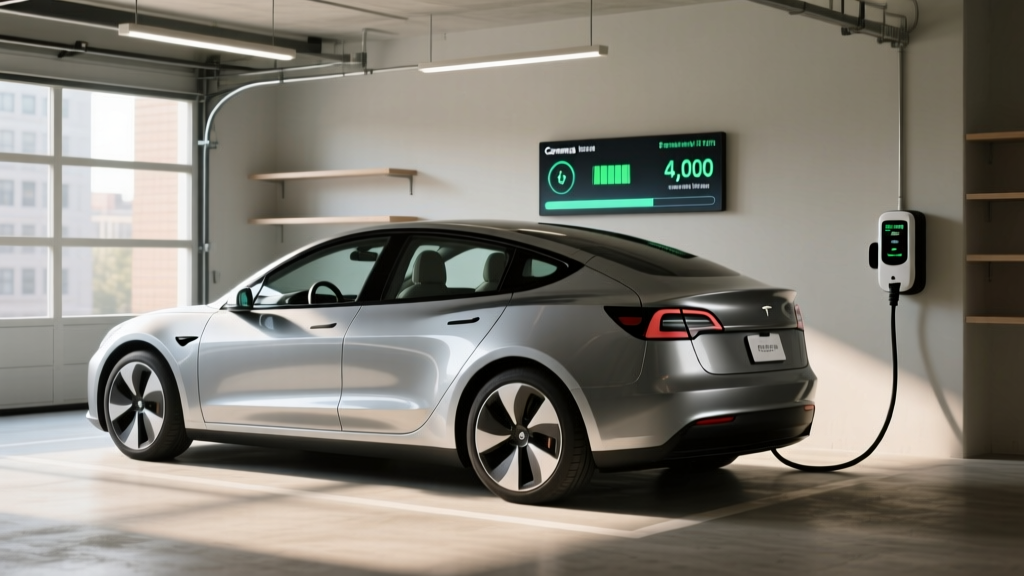
For home charging, the Tesla Wall Connector at 48 amps (11.5 kW on a 240V/60A circuit) adds roughly 37 miles of range per hour. An overnight 8-hour session from 20% to full yields approximately 280 miles — more than enough for most daily driving. Installation costs for a Level 2 home setup typically range from $500 to $2,000 depending on your electrical panel capacity and run distance, per Tesla's home charging guide. If your home has a 100-amp service panel, budget for a potential panel upgrade ($1,500–$3,000) before installation.
How Tesla Uses Artificial Intelligence in the Model Y
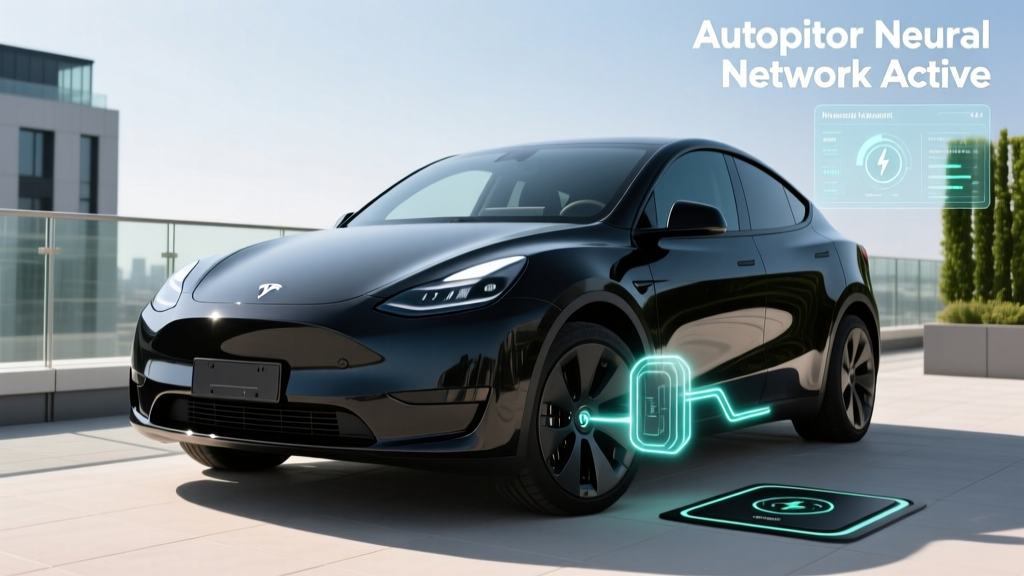
To directly answer the question: yes, Tesla uses artificial intelligence extensively across the Model Y's driving, safety, and energy-management systems. Here's where AI shows up in your daily drive:
- FSD (Supervised) — Vision-Based Neural Networks: Tesla's Full Self-Driving system relies entirely on camera inputs processed through deep neural networks. These networks handle lane detection, traffic light recognition, pedestrian prediction, and path planning. The system is trained on billions of miles of fleet-driving data, processed through Tesla's Dojo supercomputer and external GPU clusters.
- Autopilot (Standard): Even the base Autopilot system — which includes adaptive cruise control and lane-keeping — uses AI-driven perception models to identify vehicles, lane markings, and road edges in real time.
- Thermal Management: Tesla's heat pump and battery thermal system use predictive algorithms to precondition the battery based on navigation route, ambient temperature, and driving style — improving both range and charging speed.
- Energy Routing (AWD): The dual-motor system continuously adjusts torque distribution between front and rear motors using real-time traction and efficiency models, an AI-optimized process that happens hundreds of times per second.
- Cabin and Voice: Tesla's voice command system uses natural-language processing, and the cabin camera-based driver monitoring uses computer vision to detect driver attention.
Despite the advanced AI under the hood, Tesla's FSD (Supervised) and Autopilot are classified as SAE Level 2 driver-assistance systems. This means the driver must remain fully engaged, hands on or near the wheel, and eyes on the road at all times. The system does not make the car "self-driving." Only Level 4 services like Waymo's robotaxi operate without a human driver in defined areas. Tesla's AI is powerful, but the legal and functional responsibility remains with you.
Performance and Driving Dynamics
| Trim | 0–60 mph | Horsepower | Drivetrain |
|---|---|---|---|
| Long Range AWD | 4.8 seconds | 384 hp | Dual-Motor AWD |
| Performance AWD | 3.5 seconds | 456 hp | Dual-Motor AWD |
| RWD (Base) | 6.6 seconds | 295 hp | Rear-Wheel Drive |
The Long Range AWD's 4.8-second 0–60 time puts it ahead of most gas-powered compact SUVs and delivers the instant torque response EV buyers expect. The Performance trim drops that to 3.5 seconds — genuinely quick by any standard. The RWD base model, while slower, is still responsive for daily commuting and offers the best efficiency of the lineup.
Ride quality is the Model Y's most common criticism. The suspension tuning is firm, and while the 2025 refresh improved damping, it still transmits more road imperfections than a Hyundai Ioniq 5 or Ford Mustang Mach-E. Road noise at highway speeds is noticeable, though the absence of engine noise keeps overall cabin decibels competitive.
Interior, Cargo, and Tech Features
The Model Y's interior is a study in minimalism. A single 15.4-inch touchscreen handles infotainment, climate, navigation, and vehicle settings. There are no physical buttons on the dashboard — a design choice that some buyers love and others find frustrating, especially for simple tasks like adjusting fan speed while driving.
| Dimension | Measurement |
|---|---|
| Cargo Volume (rear seats up) | 30.2 cu ft |
| Cargo Volume (rear seats folded) | 72.1 cu ft |
| Front Legroom | 41.8 inches |
| Rear Legroom | 37.8 inches |
| Frunk (front trunk) | 4.1 cu ft |
| Seating Capacity | 5 (optional 7-seat on LR AWD) |
Cargo capacity is a genuine strength: 30.2 cubic feet behind the second row beats most compact SUV rivals, and the flat load floor with seats folded makes the Model Y practical for hauling. The 4.1-cubic-foot frunk is useful for charging cables and small bags. The optional third row (available only on Long Range AWD) is best suited for small children — adults will find it cramped.
Standout tech: Over-the-air updates that add features post-purchase, the Tesla app for remote preconditioning and charging monitoring, a built-in dashcam and Sentry Mode security system, and the vast Supercharger network with automatic plug-and-charge billing.
Notable drawbacks: No Apple CarPlay or Android Auto, no physical climate controls, no heads-up display, and the panoramic glass roof can make the cabin uncomfortably warm in summer without the included sunshade.
Pricing, Trims, and Federal Tax Credit Eligibility
| Trim | Base MSRP | Federal Tax Credit (§30D) | Effective Price* |
|---|---|---|---|
| RWD (LFP) | $44,990 | Up to $7,500 | ~$37,490 |
| Long Range AWD (NMC) | $48,990 | Up to $7,500 | ~$41,490 |
| Performance AWD | $53,990 | Up to $7,500 | ~$46,490 |
*Effective price assumes full §30D credit eligibility. Destination fee ($1,390) and options not included.
All 2026 Model Y trims are assembled at Tesla's Fremont, California, and Austin, Texas factories, and as of the current tax year, all trims qualify for the full $7,500 federal EV tax credit under IRS §30D — provided the buyer meets income requirements. However, eligibility is not automatic. Here's what you need to know:
- MSRP Cap: SUVs must have an MSRP at or below $80,000. All Model Y trims clear this threshold.
- Buyer Income Cap: Modified adjusted gross income (MAGI) must not exceed $150,000 (single), $225,000 (head of household), or $300,000 (joint filers).
- Battery Sourcing: The credit is split into two halves — $3,750 for meeting critical-minerals sourcing requirements and $3,750 for battery-component manufacturing requirements. Tesla's supply chain currently satisfies both for the Model Y, but these rules tighten annually. Verify current-year eligibility on IRS.gov §30D.
- Point-of-Sale Transfer: As of 2024, buyers can transfer the credit to the dealer at purchase, reducing the upfront cost rather than waiting for a tax refund. Tesla supports this through its checkout process.
Always confirm eligibility with a tax professional before purchase — rules change, and your individual tax situation may affect qualification.
Warranty Coverage
| Coverage | Term |
|---|---|
| Basic Vehicle | 4 years / 50,000 miles |
| Battery & Drive Unit | 8 years / 120,000 miles (Long Range/Performance) |
| Battery & Drive Unit (RWD) | 8 years / 100,000 miles |
| Battery Capacity Retention | Minimum 70% over warranty period |
Tesla's battery warranty guarantees at least 70% capacity retention over the warranty period. Based on fleet data aggregated by sources like fueleconomy.gov and independent Tesla fleet analyses, most Model Y batteries degrade approximately 5–8% in the first 100,000 miles, well within the warranty threshold. NMC batteries in the Long Range benefit from Tesla's active thermal management, which slows degradation compared to passively cooled packs.
How the Model Y Compares to Key Competitors
The 2026 Model Y's primary rivals are the Hyundai Ioniq 5, Ford Mustang Mach-E, and Kia EV6. Here's how they stack up on the metrics that matter:
| Spec | Tesla Model Y LR AWD | Hyundai Ioniq 5 LR AWD | Ford Mach-E ER AWD |
|---|---|---|---|
| EPA Range | 320 mi | 290 mi | 290 mi |
| Peak DC Charge | 250 kW | 350 kW (800V) | 150 kW |
| 10–80% DC Time | ~25 min | ~18 min | ~36 min |
| 0–60 mph | 4.8 sec | 5.1 sec | 5.1 sec |
| Cargo (seats up) | 30.2 cu ft | 27.2 cu ft | 29.7 cu ft |
| Base MSRP (AWD) | $48,990 | $50,100 | $48,995 |
| Charging Network | Supercharger (native) | NACS adapter / Ionna | NACS adapter |
The Ioniq 5 charges faster on paper (350 kW peak, 18-minute 10–80%), but it requires access to 350 kW chargers and, as of 2026, a NACS adapter for Supercharger access. The Mach-E lags in charging speed. The Model Y's advantage is the native Supercharger network — still the most reliable and widespread DC fast-charging network in the U.S., with plug-and-charge simplicity that third-party networks still struggle to match consistently.
- Class-leading EPA range (320 mi) for AWD SUV
- Native Supercharger network access — no adapter needed
- Spacious cargo area (30.2 cu ft) with practical frunk
- Strong OTA update track record — car improves over time
- Competitive pricing with $7,500 tax credit eligibility
- Advanced AI-driven driver assist and thermal management
- Firm ride quality — feels harsh on rough roads
- No Apple CarPlay / Android Auto
- All-screen interface frustrates some drivers
- FSD (Supervised) requires constant driver attention — not self-driving
- DC charge peak (250 kW) trails 800V rivals like Ioniq 5
- Glass roof causes cabin heat in summer
Who the 2026 Model Y Is Best For
Choose the Model Y Long Range AWD if: You want maximum range in an AWD electric SUV, value the Supercharger network for road trips, need strong cargo capacity, and want Tesla's AI-driven software ecosystem including FSD (Supervised).
Choose the Model Y RWD if: You live in a mild climate, primarily commute under 50 miles daily, want the lowest price point with LFP battery durability, and don't need AWD traction.
Look elsewhere if: You prioritize a plush ride (consider the Ioniq 5), need Apple CarPlay (Mach-E or EV6), or want the absolute fastest DC charging available (Ioniq 5 on 800V).
Frequently Asked Questions
Does Tesla use artificial intelligence in its vehicles?
Yes. Tesla uses AI extensively in the Model Y for its Autopilot and FSD (Supervised) driver-assistance systems, which rely on deep neural networks processing camera data in real time. AI also manages battery thermal preconditioning, dual-motor torque distribution, and voice-command natural language processing. Tesla trains its driving models on fleet data using its Dojo supercomputer.
What is the real-world range of the 2026 Tesla Model Y?
The EPA rates the Model Y Long Range AWD at 320 miles. In real-world highway driving at 70–75 mph, expect 270–290 miles. In cold weather below 30°F, range may drop to 220–250 miles. City driving with regenerative braking can sometimes exceed the EPA estimate.
How fast does the Model Y charge?
On a DC fast charger (Tesla Supercharger V3/V4), the Model Y peaks at 250 kW and charges from 10–80% in approximately 25 minutes. At home on a Level 2 Tesla Wall Connector (11.5 kW / 48A), it adds about 37 miles of range per hour, fully charging overnight in roughly 8 hours.
Does the 2026 Tesla Model Y qualify for the federal EV tax credit?
Yes, all 2026 Model Y trims currently qualify for up to $7,500 under IRS §30D, subject to buyer income caps ($150K single / $300K joint), the $80,000 SUV MSRP cap, and battery-sourcing requirements that Tesla currently meets. The credit can be transferred at point of sale to reduce your purchase price. Always verify on IRS.gov and consult a tax professional.
Is the Model Y worth buying over the Hyundai Ioniq 5 or Ford Mach-E?
The Model Y wins on EPA range (320 mi vs. 290 mi), cargo space (30.2 vs. 27.2 cu ft), and native Supercharger access. The Ioniq 5 charges faster (350 kW peak, ~18 min 10–80%) and offers a more comfortable ride. The Mach-E offers Apple CarPlay and a more traditional interior. If Supercharger reliability and range are your top priorities, the Model Y is the stronger pick.
Is Tesla's FSD actually self-driving?
No. Tesla's Full Self-Driving (Supervised) is an SAE Level 2 driver-assistance system. Despite the name and the sophisticated AI behind it, the driver must remain fully attentive with hands on or near the steering wheel and eyes on the road. The system assists with steering, lane changes, and navigation but does not replace the driver. Only Level 4 robotaxi services like Waymo operate without a human driver.