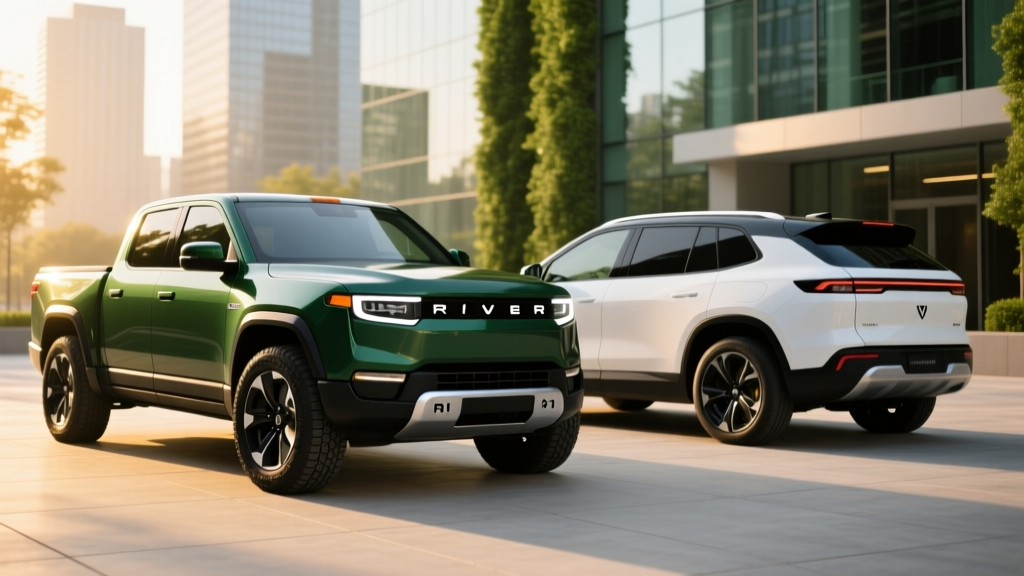
Quick Verdict: Is Leasing a Rivian the Smart Move in 2026?
Rivian's R1T pickup and R1S SUV remain two of the most capable electric adventure vehicles on the market, but their premium pricing pushes many buyers toward leasing. Understanding current Rivian lease details — including monthly costs, mileage allowances, and how the federal tax credit factors in — is essential before signing. This guide breaks down the 2026 R1T and R1S lineup with exact EPA range figures, charging speeds, battery specs, and real-world ownership data to help you decide whether to lease, buy, or walk away.
| Spec | R1T Dual-Motor | R1T Tri-Motor | R1S Dual-Motor | R1S Tri-Motor |
|---|---|---|---|---|
| EPA Range | 352 mi | 328 mi | 352 mi | 321 mi |
| Battery (usable) | 106 kWh (NMC) | 149 kWh (NMC) | 106 kWh (NMC) | 149 kWh (NMC) |
| Horsepower | 533 hp | 850 hp | 533 hp | 850 hp |
| 0–60 mph | 4.5 sec | 2.9 sec | 4.6 sec | 3.0 sec |
| Max DC Fast Charge | 220 kW | 220 kW | 220 kW | 220 kW |
| 10–80% DC Time | ~30 min | ~42 min | ~30 min | ~42 min |
| Level 2 Rate | 11.5 kW (~25 mi/hr) | 11.5 kW (~25 mi/hr) | 11.5 kW (~25 mi/hr) | 11.5 kW (~25 mi/hr) |
| Drivetrain | AWD (dual-motor) | AWD (tri-motor) | AWD (dual-motor) | AWD (tri-motor) |
| MPGe (combined) | 73 MPGe | 65 MPGe | 73 MPGe | 64 MPGe |
| Towing Capacity | 11,000 lb | 11,000 lb | 7,700 lb | 7,700 lb |
| Base MSRP | $69,900 | $99,900 | $75,900 | $104,900 |
Source: fueleconomy.gov, Rivian official specifications.
EPA Range vs. Real-World Expectations
EPA Sticker: 352 miles (Dual-Motor, Max Pack) | 328 miles (Tri-Motor)
Real-World Expectation: Plan for 280–310 miles on highway road trips at 75 mph. In cold weather (below 30°F), expect a 20–30% reduction — roughly 220–260 miles effective range. The larger 149 kWh Max Pack partially offsets cold-weather loss, but its added weight (over 9,000 lb curb weight) hurts highway efficiency compared to the Standard battery.
Rivian publishes range figures for multiple battery configurations. The Dual-Motor with the Max Pack delivers the longest legs, but efficiency drops noticeably with the Tri-Motor's extra mass and power draw. In our experience, mixed suburban driving at moderate speeds gets you closer to the EPA number than sustained interstate travel. If you tow — the R1T's party trick — expect range to plummet to 150–180 miles with a 5,000 lb trailer in tow.
Charging Speed: DC Fast Charging and Home Level 2
Rivian's charging architecture peaks at 220 kW on DC fast chargers using the NACS (Tesla-style) connector, which Rivian adopted starting with the 2025 model year. This grants R1T and R1S owners access to Tesla Superchargers via native compatibility — a significant advantage over CCS-only competitors.
| Charging Level | Power / Rate | Miles Added per Hour | Notes |
|---|---|---|---|
| Level 1 (120V) | ~1.4 kW | ~3 mi/hr | Emergency/top-up only |
| Level 2 (240V, 48A) | 11.5 kW | ~25 mi/hr | Full overnight charge in 10–14 hrs |
| DC Fast Charge | Peak 220 kW | ~140 mi in 15 min (peak) | 10–80% in ~30 min (Dual-Motor); tapers above 80% |
The charge curve matters. Rivian sustains near-peak rates between 10–50% State of Charge (SoC), then tapers progressively. Charging from 80–100% on DC fast charge is painfully slow — plan your road trips around 10–80% stops. At home, a 48-amp Level 2 wall connector on a 60-amp circuit fully replenishes the Standard Pack overnight. The Max Pack needs roughly 14 hours, so partial charges between drives are the norm.
Installation note: Most homes need a 60-amp dedicated circuit for optimal Level 2 charging. Budget $800–$2,500 for professional installation, or up to $4,000+ if your electrical panel requires an upgrade to 200-amp service. Always consult a licensed electrician for your specific situation.
2026 Rivian Lease Details: Monthly Costs and Structure
Rivian offers leasing through partnered financial institutions, and lease structures vary by trim, battery configuration, and current incentives. Here is what typical 2026 Rivian lease details look like based on current market offerings:
| Model / Trim | MSRP | Est. Monthly Lease | Due at Signing | Lease Cash / Incentives |
|---|---|---|---|---|
| R1T Dual-Motor (Standard) | $69,900 | $799–$899 | $3,500–$5,000 | Varies by region |
| R1T Dual-Motor (Max Pack) | $83,900 | $949–$1,099 | $4,000–$6,000 | Varies by region |
| R1T Tri-Motor | $99,900 | $1,199–$1,399 | $5,000–$7,500 | Varies by region |
| R1S Dual-Motor (Standard) | $75,900 | $849–$999 | $3,500–$5,500 | Varies by region |
| R1S Tri-Motor | $104,900 | $1,299–$1,499 | $5,500–$8,000 | Varies by region |
Key lease considerations:
- Mileage allowances: Most Rivian leases default to 10,000 or 12,000 miles per year. Excess mileage penalties typically run $0.20–$0.30 per mile — steep for an adventure vehicle you may want to road-trip.
- Lease-end purchase option: Confirm whether your lease includes a purchase option at residual value. Some EV leases set residuals aggressively, making buyout attractive if battery health remains strong.
- Wear-and-tear: Rivian's adventure positioning means you may return the vehicle with trail pinstripes or minor undercarriage wear. Clarify the lessor's standards before signing.
Federal Tax Credit Eligibility and Lease Implications
Under IRS §30D, the federal EV tax credit provides up to $7,500 for qualifying new EV purchases. However, leasing changes the equation significantly:
- MSRP Cap: Vans, SUVs, and pickups must have an MSRP at or below $80,000. The R1T Dual-Motor Standard qualifies; the R1T Tri-Motor ($99,900) and R1S Tri-Motor ($104,900) exceed the cap and are ineligible for purchase credits.
- Buyer Income Limits: Modified adjusted gross income must not exceed $150,000 (single), $225,000 (head of household), or $300,000 (joint filers).
- Battery Sourcing: Critical minerals and battery components must meet phased-in domestic-content thresholds. Rivian has worked to increase North American sourcing, but verify current-year compliance on the specific build you order.
- Point-of-Sale Transfer: Eligible buyers can transfer the credit to the dealer at purchase, reducing the upfront price by $7,500 rather than waiting for a tax refund.
The lease loophole: When you lease, the lessor (the financial institution) technically "purchases" the vehicle and may claim the commercial clean vehicle credit under §45W. Many lessors pass this savings to the lessee as "lease cash" — a capitalized-cost reduction that lowers your monthly payment. This means even Tri-Motor models that exceed the §30D MSRP cap can effectively benefit from the credit when leased. Always ask the dealer whether the $7,500 is factored into the quoted lease payment.
For the latest rules, consult IRS.gov §30D guidance or speak with a tax professional.
Performance, Cargo Space, and Standout Technology
Rivian's performance credentials are serious. The Tri-Motor R1T hits 60 mph in 2.9 seconds — supercar territory in a 7,000+ lb pickup. The Dual-Motor's 4.5-second run is more than adequate for merging and passing. Both use an AWD system with individual motor torque vectoring, giving the R1T legitimate off-road capability with a ground clearance of up to 14.4 inches on the adaptive air suspension.
Cargo and passenger space:
- R1T bed: 4.5 feet long (with midgate open: ~6.5 ft), plus the signature Gear Tunnel — a lockable, pass-through compartment behind the cab offering 11 cu ft of secure storage.
- R1S cargo: 46.7 cu ft behind the second row; 104.7 cu ft with rows folded (two-row config).
- Frunk: Both models offer an 11 cu ft front trunk — large enough for charging cables, a weekend bag, or groceries.
- Legroom: 41.3 inches front / 38.2 inches rear (R1T crew cab).
Tech highlights:
- 15.6-inch center touchscreen with Rivian's in-house OS — responsive, clean UI, but limited third-party app support compared to Android Automotive.
- Rivian Driver+ (Level 2 ADAS): Adaptive cruise control and lane centering on highways. Competent but not class-leading — Tesla Autopilot and GM Super Cruise offer more polished lane-change and hands-off experiences.
- Over-the-air updates, built-in navigation with charging-route planning, and a camp kitchen accessory that slides from the Gear Tunnel.
- Vehicle-to-Load (V2L) capability: Power tools, camp appliances, or tailgate setups directly from the truck's battery via bed and frunk outlets.
Warranty Coverage and Long-Term Battery Outlook
Rivian's warranty structure is competitive for the premium EV segment:
- Battery & Drive Units: 8 years / 175,000 miles (whichever comes first), with a capacity retention threshold of 70%.
- Limited Vehicle Warranty: 5 years / 60,000 miles bumper-to-bumper.
- Roadside Assistance: 5 years / 60,000 miles.
The 175,000-mile battery warranty is generous — most competitors offer 100,000 miles. Rivian uses NMC (nickel manganese cobalt) chemistry in both Standard and Max Packs, which provides high energy density but is more sensitive to frequent 100% charging. For daily use, charge to 80–90% and reserve full charges for road trips. Long-term degradation data on Rivian's packs is still maturing (the R1T launched in late 2021), but early fleet data suggests 5–8% loss over the first 60,000 miles — in line with NMC industry averages.
Pros and Cons: The Honest Assessment
Pros
- Best-in-class adventure utility: Gear Tunnel, V2L, 11,000-lb towing (R1T)
- Native NACS connector — seamless Tesla Supercharger access
- Tri-Motor performance (2.9 sec 0–60) is extraordinary for a pickup
- Air suspension with 14.4" ground clearance for real off-road use
- 175,000-mile battery warranty exceeds most competitors
- Lease "loophole" can apply tax credit to high-MSRP Tri-Motor trims
Cons
- Highway range drops significantly — expect 280 mi real-world, less when towing
- Service center network is still thin outside major metro areas
- 220 kW peak DC charge rate trails Hyundai/Kia's 800V architecture (~240 kW)
- Driver+ ADAS is functional but less refined than Super Cruise or Autopilot
- Premium pricing: even the base R1T starts near $70K before options
- Max Pack adds ~600 lb, reducing efficiency and increasing tire wear
Who Should Lease a Rivian — and Who Should Look Elsewhere?
Lease the R1T if: You need a pickup that doubles as an adventure rig, you value the Gear Tunnel and V2L for camping, and you want Supercharger access without adapters. Leasing makes sense if you want the Tri-Motor's performance but don't want to absorb depreciation on a $100K+ electric truck.
Lease the R1S if: You want a three-row electric SUV with genuine off-road chops and don't need the R1T's bed. The R1S competes with the Tesla Model X and BMW iX but offers more rugged capability.
Look elsewhere if: Your priority is maximum highway range (consider the Lucid Air or Tesla Model S), lowest cost of entry (Hyundai Ioniq 5, Chevy Equinox EV), or the most polished hands-free driving system (GM Super Cruise vehicles). If you drive over 15,000 miles per year, lease mileage penalties may make purchasing or choosing a different vehicle more economical.
Frequently Asked Questions
What is the real-world range of the Rivian R1T and R1S?
The EPA rates the Dual-Motor Max Pack at 352 miles, but real-world highway driving at 75 mph typically yields 280–310 miles. Cold weather (below 30°F) can drop effective range to 220–260 miles. Towing a 5,000 lb trailer cuts range roughly in half.
How fast does a Rivian charge at home and on the road?
At home on a 240V Level 2 charger (11.5 kW), the R1 adds about 25 miles per hour — a full Standard Pack charge takes roughly 10 hours, while the Max Pack needs about 14 hours. On DC fast chargers, Rivian peaks at 220 kW, delivering a 10–80% charge in approximately 30 minutes for the Standard Pack and 42 minutes for the Max Pack.
How much does a Rivian cost after tax credits?
For purchase, the $7,500 federal credit (IRS §30D) applies only to trims under the $80,000 MSRP cap, subject to buyer income limits and battery-sourcing rules. The R1T Dual-Motor Standard ($69,900) qualifies; the Tri-Motor does not. However, when leasing, the lessor may pass the credit through as lease cash, effectively reducing monthly payments on any trim.
Does the Rivian R1T or R1S qualify for the federal EV tax credit?
The R1T Dual-Motor and R1S Dual-Motor in Standard configuration qualify for up to $7,500 under §30D, provided the buyer meets income caps and the vehicle's battery components satisfy current-year domestic sourcing thresholds. Always verify eligibility on fueleconomy.gov for the specific model year and build date.
Is it better to buy or lease a Rivian in 2026?
Leasing is advantageous if you want a Tri-Motor (above the purchase credit MSRP cap), prefer lower monthly payments, or want to avoid long-term depreciation risk on a rapidly evolving EV market. Buying makes sense if you drive fewer than 10,000 miles per year, plan to keep the vehicle 5+ years, and qualify for the full $7,500 purchase credit.
How does Rivian compare to the Ford F-150 Lightning and Tesla Cybertruck?
The R1T is more premium and off-road-capable than the F-150 Lightning, with superior ground clearance and the Gear Tunnel, but at a significantly higher price. Against the Cybertruck, the R1T offers a more conventional (and practical) interior, better build-quality reputation, and NACS Supercharger access — though the Cybertruck's stainless-steel exoskeleton and 48V architecture appeal to different buyers. For a family-oriented SUV, the R1S competes with the Kia EV9 (lower price, less range) and the Tesla Model X (more range, less off-road utility).
What happens if I exceed my Rivian lease mileage?
Most Rivian leases set excess mileage penalties between $0.20 and $0.30 per mile. If you drive 15,000 miles per year on a 10,000-mile lease, you could owe $3,000–$4,500 at lease end. Negotiate a higher mileage allowance upfront (12K or 15K mi/yr) if your driving patterns demand it — the per-mile cost is lower when built into the lease than paid as a penalty.