The Tesla Model Y has dominated European EV sales charts for years, and nowhere is that more evident than in Norway — the world's most electrified car market per capita. When buyers search for the Tesla Model Y Norway configuration, they're usually asking one of two things: How does the Norwegian-spec Model Y differ from the US version, and what can American buyers learn from how this SUV performs in brutal Scandinavian winters? This review covers the 2026 Tesla Model Y as sold in the US market, with direct comparisons to the Norwegian/European specification where they diverge — and hard data on cold-weather range loss that every prospective buyer needs to see.
2026 Tesla Model Y: Core Specs at a Glance
The current-generation Model Y (refreshed internally as the "Juniper" update that rolled out globally through 2025) carries into 2026 with meaningful efficiency gains over the pre-refresh platform. Here's what US buyers are working with:
| Spec | Long Range AWD | Performance AWD | Rear-Wheel Drive |
|---|---|---|---|
| EPA Range | 320 miles | 295 miles | 280 miles |
| Battery (usable) | ~75 kWh (NMC) | ~75 kWh (NMC) | ~57.5 kWh (LFP) |
| Drivetrain | Dual-Motor AWD | Dual-Motor AWD | Single-Motor RWD |
| Horsepower | 384 hp | 456 hp | 295 hp |
| 0-60 mph | 4.8 sec | 3.5 sec | 6.5 sec |
| MPGe (combined) | 111 MPGe | 103 MPGe | 116 MPGe |
| Efficiency | 30 kWh/100mi | 33 kWh/100mi | 29 kWh/100mi |
| Base MSRP | $47,990 | $52,490 | $39,990 |
| Destination Fee | $1,390 | ||
Sources: EPA fueleconomy.gov, Tesla US configurator (2026 model year).
Real-World Range: What the EPA Sticker Doesn't Tell You
EPA Sticker: 320 miles (Long Range AWD)
Real-World Highway (70-75 mph): ~265–285 miles
Real-World City/Mixed: ~295–310 miles
Cold Weather (below 30°F / -1°C): ~210–250 miles (20–35% loss depending on cabin heating and preconditioning)
The Model Y's efficiency is among the best in the compact electric SUV class, but EPA estimates assume a mix of city and highway driving at moderate temperatures. On a flat 75-mph highway run in 70°F weather, expect to use roughly 32–34 kWh/100mi, which pulls real range down to around 270 miles on the Long Range AWD.
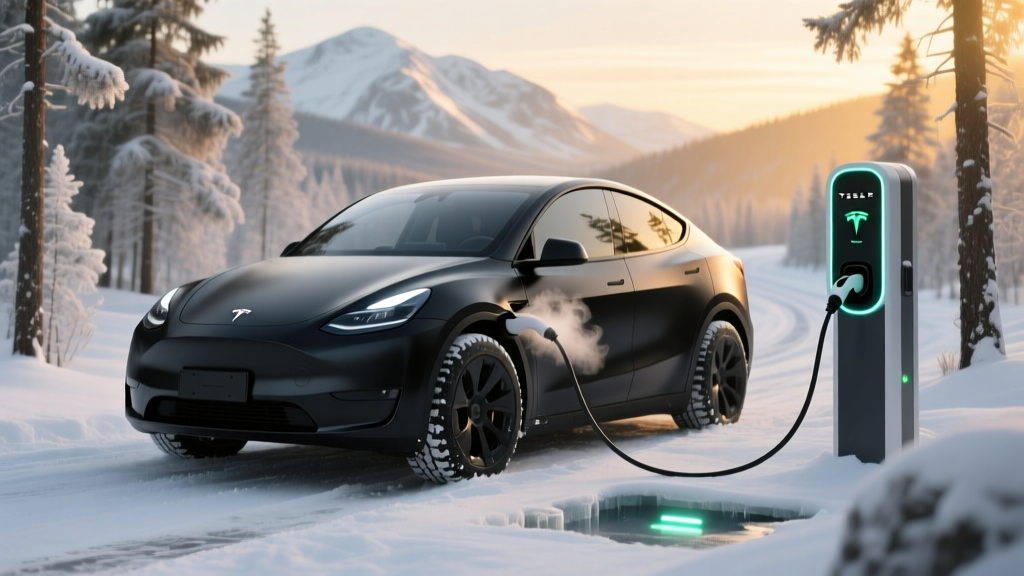
Cold weather is where the Norway comparison becomes essential. Norwegian Model Y owners routinely report 25–30% range reduction in January and February, where temperatures hover between -5°C and -15°C (23°F to 5°F). Tesla's standard heat pump — included on all 2026 trims — recovers significant efficiency compared to resistive heating, but the laws of thermodynamics are unforgiving. Battery preconditioning (automatic when navigating to a Supercharger) helps preserve fast-charge speeds in cold weather, but does not recover lost range.
For US buyers in northern states — Minnesota, Wisconsin, Maine, Colorado — plan for a usable winter range of roughly 220–250 miles on the Long Range AWD. If your daily round-trip commute exceeds 150 miles in winter, the Long Range is a near-mandatory upgrade over the RWD.
Charging Speed: DC Fast, Level 2, and the Norwegian Supercharger Network
Charging speed is where the Model Y continues to lead most competitors, and it's a major reason the platform dominates in Norway's dense Supercharger network — over 1,200 stalls across the country as of late 2025.
| Charging Level | Max Power | Speed | Notes |
|---|---|---|---|
| Level 1 (120V household) | 1.4 kW | ~3–4 miles/hour | Emergency/trickle only |
| Level 2 (240V home, 48A) | 11.5 kW | ~37 miles/hour | Full charge overnight in ~8 hrs |
| DC Fast Charge (V3 Supercharger) | 250 kW peak | 10–80% in ~25 min | Peak sustained only to ~52% SoC |
| DC Fast Charge (V4 Supercharger) | 250 kW (cable-limited) | 10–80% in ~23 min | Newer stations, CCS adapter not needed for Tesla |
| Third-Party DC (Electrify America, etc.) | Up to 150–250 kW | Varies | Requires NACS-to-CCS adapter (included with 2026 models) |
A critical detail on the DC fast-charge curve: the Model Y Long Range peaks at 250 kW only at low state-of-charge (below 30%) and tapers progressively. From 50% to 80%, expect sustained rates closer to 80–110 kW. The published "10–80% in 25 minutes" figure reflects this taper — don't expect 250 kW for the full session.
Norwegian owners benefit from Tesla's densest Supercharger network outside of California and China, with most stations offering V3 or V4 stalls at 250 kW. In the US, Supercharger coverage is strong along major interstates but can be sparse in rural Mountain West and parts of the Deep South — a real consideration for road-trippers.
Battery Chemistry: LFP vs. NMC in the Model Y Lineup
The 2026 Model Y uses two distinct battery chemistries depending on trim:
- RWD (base): ~57.5 kWh usable, Lithium Iron Phosphate (LFP) — heavier but more cycle-life durable, can be charged to 100% daily without degradation concerns. Tesla recommends periodic 100% charges to recalibrate the BMS on LFP packs.
- Long Range & Performance: ~75 kWh usable, Nickel Manganese Cobalt (NMC) — higher energy density, lighter, but Tesla recommends daily charge limit of 80% for longevity. Reserve 100% for road trips.
Norwegian-market Model Y vehicles are predominantly Long Range AWD and Performance variants (NMC), reflecting buyer preference for maximum range and all-wheel-drive traction in snow. The RWD/LFP trim is less common in Scandinavia but available in other European markets.
Battery warranty across all trims: 8 years / 120,000 miles (Long Range/Performance) or 8 years / 100,000 miles (RWD), whichever comes first, with a minimum 70% capacity retention threshold. This is consistent globally, including Norway.
Norway Spec vs. US Spec: What's Actually Different?
Buyers searching for the "Tesla Model Y Norway" configuration often assume a special cold-weather package exists. The reality is more nuanced:
- Heat pump: Standard on all 2026 Model Y trims globally — not a Norway-exclusive option.
- Heated seats and steering wheel: Standard in both markets.
- WLTP vs. EPA range: Norwegian/European Model Y Long Range is rated at ~533 km (331 miles) under WLTP testing, which is more generous than the US EPA's 320-mile figure. The car is identical; the test cycle differs.
- Tow hitch: Available as a factory option in both markets (3,500 lb max tow rating in the US).
- Charging port: Norwegian models use CCS2 (the European standard). US 2026 models use NACS (Tesla's native connector, now the North American standard adopted by Ford, GM, Rivian, and others).
- VAT and pricing: Norway's EV tax exemptions (no VAT, no import duty, no registration tax on qualifying BEVs) make the Model Y significantly cheaper relative to ICE vehicles there than in the US. A Long Range AWD in Norway costs roughly 530,000 NOK (~$49,000 USD equivalent), but without the additional state/local taxes US buyers may face.
Pricing, Tax Credits, and Total Cost
| Trim | MSRP + Destination | §30D Federal Credit | Net Price (if eligible) |
|---|---|---|---|
| RWD | $41,380 | Up to $7,500 (point-of-sale) | ~$33,880 |
| Long Range AWD | $49,380 | Up to $7,500 (point-of-sale) | ~$41,880 |
| Performance AWD | $53,880 | Up to $7,500 (point-of-sale) | ~$46,380 |
Not every buyer qualifies. Per IRS §30D, you must meet ALL of the following:
- Income cap: Modified AGI ≤ $150,000 (single) / $300,000 (joint)
- MSRP cap: Vehicle base price ≤ $55,000 (SUVs/trucks, which includes Model Y)
- Battery sourcing: Critical minerals and battery components must meet phased-in domestic/free-trade-agreement thresholds (2026 thresholds are stricter than 2024)
- Point-of-sale transfer: You can apply the credit at purchase to reduce the transaction price directly
Interior, Cargo, and Technology
The 2026 Model Y carries forward the minimalist interior introduced with the Juniper refresh: a single 15.4-inch center touchscreen, no instrument cluster, a rear 8-inch passenger screen, and ventilated front seats (now standard on all trims).
Cargo volume: 30.2 cu ft behind the second row, 72.1 cu ft with rear seats folded. The front trunk (frunk) adds 4.1 cu ft — useful for charging cables and groceries. Rear legroom measures 40.5 inches, adequate for adults on longer trips.
Driver assistance: Tesla Autopilot (SAE Level 2) is standard, including Traffic-Aware Cruise Control and Autosteer. Full Self-Driving (Supervised) remains a $8,000 option or $99/month subscription — and despite the branding, this is still a Level 2 system requiring constant driver attention. It does not make the vehicle autonomous. Only Level 4 systems like Waymo's driverless robotaxi operate without a human in the loop.
Infotainment: Tesla's native OS handles navigation, media (Spotify, Apple Music, Tidal native), and vehicle settings without Apple CarPlay or Android Auto. The navigation system routes through Superchargers automatically on road trips and includes preconditioning — a genuine advantage for long-distance charging efficiency.
- Class-leading efficiency (29-33 kWh/100mi)
- Dense Supercharger network access
- Standard heat pump for cold-weather efficiency
- Strong cargo capacity (72.1 cu ft max)
- Over-the-air updates add features post-purchase
- Point-of-sale tax credit transfer reduces upfront cost
- No Apple CarPlay / Android Auto
- FSD (Supervised) is expensive and still Level 2
- Rear visibility is compromised (no rear wiper on pre-2025 builds; added in Juniper refresh)
- Insurance premiums run 15–30% above class average
- Firm ride quality on 20-inch wheels
- LFP RWD trim has limited winter range headroom
Who Should Buy the Tesla Model Y (and Who Shouldn't)?
- You want maximum range-per-dollar in a compact electric SUV
- You road-trip frequently and value Supercharger reliability
- You live in a cold climate and need a heat pump with AWD traction
- You have home Level 2 charging access and can charge overnight
- Cargo flexibility matters (folding rear seats + frunk)
- You need Apple CarPlay for phone integration
- You prefer traditional dealership service over Tesla mobile/service-center model
- You want a more compliant ride on rough roads
- You need a longer battery warranty (Hyundai offers 10yr/100,000mi)
Frequently Asked Questions
What is the real-world range of the Tesla Model Y in cold weather?
Based on aggregated owner data from Norwegian and northern US drivers, the Long Range AWD delivers approximately 210–250 miles in sustained below-freezing temperatures. The heat pump mitigates losses compared to resistive heating, but expect a 20–35% reduction from the 320-mile EPA sticker depending on cabin temperature settings, trip length (short trips lose more to initial battery warmup), and terrain.
Does the Tesla Model Y qualify for the $7,500 federal tax credit in 2026?
Yes, the Model Y is currently listed as eligible on the IRS clean vehicle credit page, and the credit can be transferred at point of sale to reduce your purchase price directly. However, eligibility depends on your income (≤$150K single / ≤$300K joint), the vehicle's MSRP (≤$55K for SUVs), and battery component/critical-mineral sourcing thresholds that tighten annually. Verify current status at irs.gov before committing.
How fast does the Model Y charge at home on Level 2?
At 11.5 kW (48 amps on a 240V/60A circuit, like a Tesla Wall Connector), the Long Range AWD adds approximately 37 miles of range per hour. A full 10–100% charge takes roughly 8 hours — easily overnight. Installation of a dedicated 60A circuit typically costs $800–$2,000 depending on panel capacity and run length; budget for a possible panel upgrade ($1,500–$3,000) if your home has a 100A main panel.
Is the Tesla Model Y Norway spec different from the US version?
Mechanically, no — the same battery, motors, and heat pump ship globally. The differences are regulatory and cosmetic: WLTP range ratings (higher numbers, same car), CCS2 charge port in Europe vs. NACS in the US, and Norway's EV tax incentives that make the Model Y price-competitive with ICE vehicles in a way that varies significantly by US state.
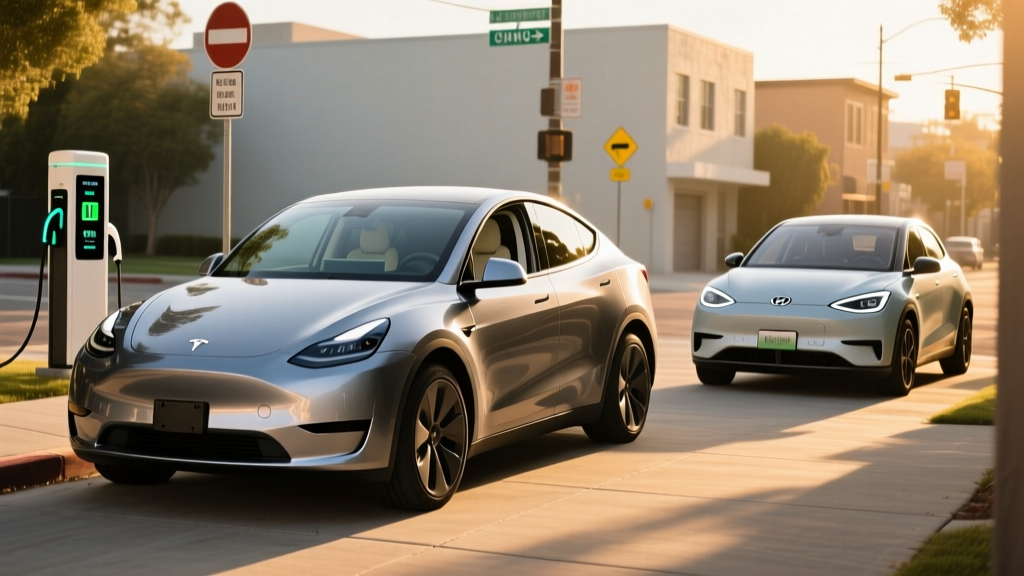
How does the Model Y compare to the Hyundai Ioniq 5 and Ford Mustang Mach-E?
The Model Y leads on efficiency (kWh/100mi) and Supercharger network access. The Ioniq 5 offers faster peak DC charging (up to 350 kW on 800V architecture, 10–80% in ~18 min) and a 10-year battery warranty. The Mach-E offers a more traditional crossover driving feel and Ford dealership service. All three qualify for the federal credit, but specific eligibility varies by battery sourcing — check the IRS list for each model year.
Data sources: EPA fueleconomy.gov, IRS §30D Clean Vehicle Credit, Tesla US and Norway configurators, IIHS safety ratings.