Why the Rivian Corporate Office Matters to EV Buyers
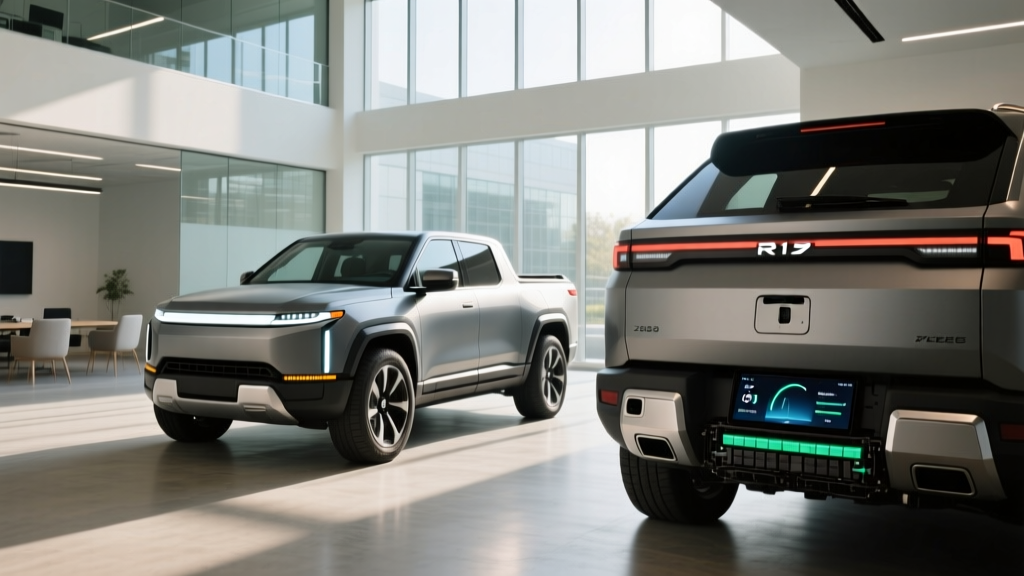
Searches for the rivian corporate office have surged as the company's Normal, Illinois headquarters doubles as both a manufacturing hub and the nerve center for its R1T pickup and R1S SUV programs. For buyers, that concentration of engineering and production under one roof translates into rapid over-the-air updates, tightly integrated battery packs, and a vertically owned service network. Below, we break down the 2026 R1T and R1S—the two vehicles that define Rivian's consumer lineup—with the exact numbers you need to decide.
2026 Rivian R1T & R1S Spec Snapshot
| Spec | R1T Dual-Motor | R1T Tri-Motor | R1S Dual-Motor | R1S Quad-Motor |
|---|---|---|---|---|
| EPA Range | 352 mi (Max Pack) | 328 mi | 355 mi (Max Pack) | 321 mi |
| Battery (usable) | 141 kWh (NMC) | 109 kWh (NMC) | 141 kWh (NMC) | 109 kWh (NMC) |
| 0-60 mph | 4.5 sec | 3.0 sec | 4.6 sec | 2.6 sec |
| Horsepower | 533 hp | 850 hp | 533 hp | 1,025 hp |
| Max DC Charge | 220 kW | 220 kW | 220 kW | 220 kW |
| 10-80% Time | ~36 min | ~26 min | ~36 min | ~26 min |
| Level 2 Rate | 19.2 kW / ~51 mi/hr | 19.2 kW / ~51 mi/hr | 19.2 kW / ~51 mi/hr | 19.2 kW / ~51 mi/hr |
| Base MSRP | $79,900 | $105,900 | $84,900 | $110,900 |
| MPGe (combined) | 70 MPGe | 65 MPGe | 69 MPGe | 63 MPGe |
Source: EPA fueleconomy.gov and Rivian 2026 spec sheets.
Real-World Range vs. EPA Sticker
EPA sticker: Up to 355 miles (R1S Max Pack). Real-world expectation: Highway cruising at 75 mph typically yields 270–295 miles on the Max Pack; cold-weather (below 32°F) highway driving can drop to 230–260 miles. The Standard Pack (~270 mi EPA) realistically delivers 210–240 miles in mixed use.
Rivian's NMC chemistry delivers strong energy density but is more temperature-sensitive than LFP. Preconditioning the battery before DC fast charging is essential—without it, peak charge rates can be 30–40% lower in cold weather. The Max Pack's 141 kWh usable capacity is among the largest in any production EV, which partially offsets its 2.6–2.8 kWh/mi consumption at highway speeds.
Charging: DC Fast, Level 2, and the Rivian Adventure Network
| Charging Level | Power | Miles Added per Hour | Typical Use Case |
|---|---|---|---|
| Level 1 (120V) | 1.4 kW | ~3–4 mi/hr | Emergency top-up |
| Level 2 (240V, 80A) | 19.2 kW | ~51 mi/hr | Home daily charging |
| DC Fast (peak) | 220 kW | ~300+ mi/hr (initial) | Road trips |
The 220 kW peak is sustained only up to roughly 35% State of Charge (SoC), after which the charge curve tapers progressively—expect an average of ~140 kW across a full 10–80% session. The Max Pack's larger battery means longer absolute charge times despite the same peak rate. Home charging at 19.2 kW requires a 100-amp dedicated circuit; budget $1,200–$2,800 for panel-ready installations (electrician + permit + hardware).
Rivian's Adventure Network operates 350+ chargers near national parks and outdoor destinations, supplementing Electrify America and Tesla Supercharger access (with adapter). NACS compatibility is now standard on 2026 models, eliminating the adapter requirement for Tesla stalls.
Performance & Drivetrain
The Dual-Motor AWD powertrain (one motor per axle) delivers 533 hp and 610 lb-ft of torque, with a 4.5-second 0–60 in the R1T—adequate for any real-world scenario including highway merging with a trailer. The Tri-Motor adds a rear axle motor for 850 hp and a 3.0-second sprint, while the Quad-Motor R1S (individual motors at each wheel) produces 1,025 hp and a 2.6-second 0–60, rivaling supercars in a 6,800-pound SUV.
Towing capacity peaks at 11,000 lbs (R1T) and 7,700 lbs (R1S)—class-leading for EVs. Expect range to drop 40–55% when towing near max capacity at highway speeds. Rivian's integrated trailer brake controller and tow-assist cameras are standard on Adventure and Ascend trims.
Pricing, Tax Credits & Ownership Cost
| Trim / Pack | MSRP | §30D Credit Potential | Effective Price |
|---|---|---|---|
| R1T Dual-Motor Standard | $69,900 | Up to $3,750* | ~$66,150 |
| R1T Dual-Motor Max | $79,900 | Up to $3,750* | ~$76,150 |
| R1T Tri-Motor | $105,900 | $0 (above MSRP cap) | $105,900 |
| R1S Dual-Motor Standard | $74,900 | Up to $3,750* | ~$71,150 |
| R1S Quad-Motor | $110,900 | $0 (above MSRP cap) | $110,900 |
*Under IRS §30D rules, the R1T qualifies as a "pickup" (MSRP cap $80,000) and the R1S as an SUV (MSRP cap $80,000 for 2026). Buyer income caps apply: $300k joint / $225k head of household / $150k single. Battery critical-mineral and component sourcing rules may reduce the credit to $3,750 or eliminate it entirely. Always verify at IRS.gov §30D and consult a tax professional. Point-of-sale transfer is available at participating dealers.
Five-year total cost of ownership runs $62,000–$78,000 depending on trim, including depreciation (~48% over 5 years), electricity ($0.13/kWh national avg), insurance ($2,400–$3,200/yr), and maintenance. Rivian's 8-year/175,000-mile battery and drivetrain warranty exceeds the federal 8-year/100,000-mile minimum, with a 70% capacity retention threshold.
Tech, Interior & Drawbacks
Standout features: 15.6-inch center display with Rivian OS 3.0, wireless CarPlay/Android Auto, camp kitchen (R1T gear tunnel option), integrated air compressor, Driver+ (Level 2 ADAS with hands-on-wheel monitoring), and over-the-air updates that have added features like pet mode and range-optimizing heat pump scheduling.
Notable drawbacks: The second-row seat in the R1T is upright and less comfortable than competitors on long drives. Service center density remains limited outside major metros—mobile service handles minor issues, but body work can take weeks. The 2.6–2.8 kWh/mi efficiency is poor by EV standards (the Tesla Model X achieves ~2.0 kWh/mi), meaning higher electricity costs per mile.
Who Should Buy a Rivian?
Buy if: You need a true truck (11,000-lb tow rating, 6-foot bed, gear tunnel) or a 3-row electric SUV with off-road capability, and you value adventure-oriented design over efficiency.
Skip if: Your priority is lowest cost-per-mile (the Model X or Ioniq 5 are far more efficient), you lack home charging access, or you live far from a Rivian service hub.
Pros & Cons
Pros
- Class-leading tow rating (11,000 lbs R1T)
- 141 kWh Max Pack delivers 350+ mi EPA
- 8-yr/175,000-mi battery warranty
- Adventure Network chargers at trailheads
- Quad-Motor performance (1,025 hp, 2.6s 0–60)
Cons
- 2.6–2.8 kWh/mi efficiency is poor
- Tri/Quad trims exceed $80k MSRP cap (no tax credit)
- Service centers sparse outside major metros
- Second-row comfort lags competitors
- Charge curve tapers early above 35% SoC
FAQ
What is the real-world range of the Rivian R1T/R1S?
Highway driving yields 270–295 miles on the Max Pack; cold weather reduces that to 230–260 miles. The Standard Pack delivers 210–240 miles in mixed use.
How fast does it charge at home and on the road?
Level 2 at 19.2 kW adds ~51 miles per hour (full charge in ~7.5 hours for Max Pack). DC fast charging peaks at 220 kW, with a 10–80% session taking 26–36 minutes depending on pack size.
Does the Rivian qualify for the federal EV tax credit?
Base Dual-Motor trims under the $80,000 MSRP cap may qualify for up to $3,750, subject to buyer income limits and battery-sourcing rules. Tri-Motor and Quad-Motor trims exceed the cap and are ineligible. Verify at IRS.gov.
Is the Rivian worth buying vs. the Ford F-150 Lightning or Tesla Model X?
The R1T outperforms the F-150 Lightning in range (352 vs. 320 mi Max), tow rating (11,000 vs. 10,000 lbs), and off-road capability. The Model X is more efficient and has better Supercharger access, but lacks a bed and true off-road hardware. Choose Rivian for adventure/truck utility; choose Tesla for efficiency and charging convenience.
Where is the Rivian corporate office and can I visit?
Rivian's headquarters and factory are in Normal, Illinois. The campus includes a public-facing "Rivian Outpost" showroom and test-track experiences by appointment. Production tours are occasionally offered to reservation holders.