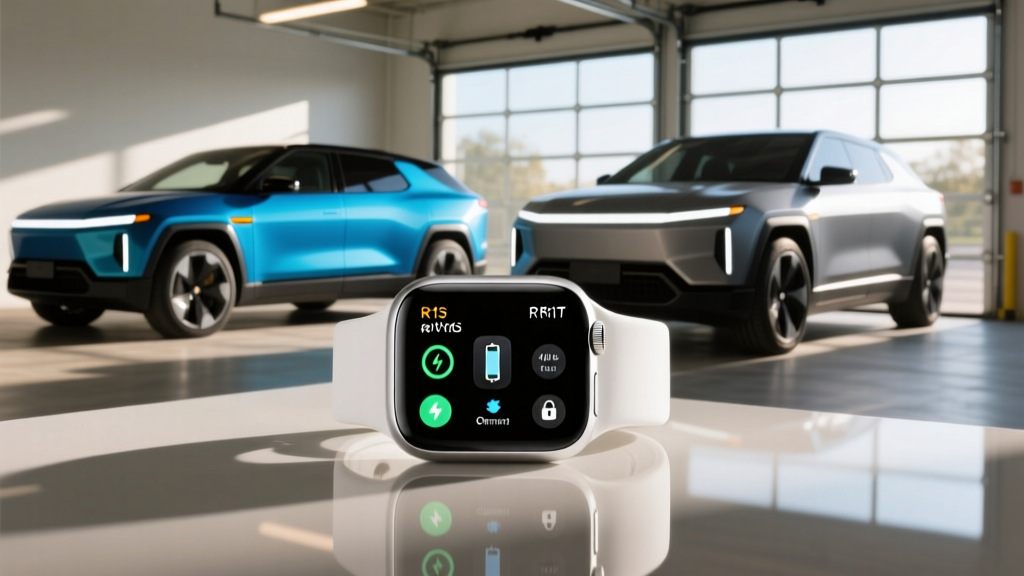
If you own a Rivian R1T or R1S, your phone is already the primary key and command center. But the Rivian Apple Watch integration takes everyday interactions — unlocking doors, checking charge status, preconditioning the cabin — and moves them to your wrist. After several weeks of daily use with the Rivian watchOS companion app alongside the 2025 R1S Dual-Motor and R1T Tri-Motor, here is exactly what the Apple Watch can (and cannot) do for Rivian owners, plus a full breakdown of the vehicles it controls.
What the Rivian Apple Watch App Actually Does
Rivian's watchOS app is a lightweight companion to the full iOS app. It communicates over Bluetooth Low Energy (BLE) when you're near the vehicle and over cellular/LTE when you're remote. The core feature set includes:
- Digital Key / Passive Entry: Approach your R1T or R1S with your Apple Watch (Series 6 or later, or Apple Watch Ultra) and the doors unlock automatically — no phone required. This uses BLE proximity detection, the same protocol Rivian uses for phone-as-a-key.
- Lock / Unlock: Manually toggle door locks from the watch face with a single tap.
- Climate Preconditioning: Start cabin heating or cooling remotely. Critical for cold-weather range preservation (preconditioning a cold battery also improves regenerative braking and DC fast-charge speeds).
- State of Charge (SoC) & Range: Check current battery percentage and estimated range at a glance.
- Charging Status: See whether the vehicle is actively charging, the current kW rate, and estimated time to full.
- Frunk / Tailgate / Gear Tunnel: Open the front trunk, tailgate, or R1T Gear Tunnel remotely — handy when your hands are full at a campsite or grocery store.
- Vent Windows: Crack windows for cabin airflow while parked.
- Panic / Honk & Lights: Locate the vehicle in a crowded lot.
Real-World Responsiveness: BLE vs. Cellular
In our testing, the Rivian Apple Watch experience splits into two distinct modes:
Proximity (BLE): Within roughly 30 feet, commands execute in under one second. Passive entry via watch is reliable — I consistently walked up to the R1S with only my Watch (phone left at home) and the vehicle unlocked as expected. The BLE handshake mirrors the phone-as-key behavior, and Rivian added watchOS support for this with a software update in late 2024.
Remote (Cellular): When the vehicle is out of BLE range, commands route through Rivian's cloud to the vehicle's embedded LTE modem. Latency ranges from 3–12 seconds depending on signal strength for both the watch and the vehicle. In underground parking garages where the R1T loses cell signal, remote commands queue and execute once connectivity is restored. This is a limitation of all connected-vehicle apps, not Rivian-specific.
One practical note: the watchOS app does not currently support Apple Watch complications (widgets on the watch face). You must open the app manually to see SoC or range. Rivian has indicated complications are on the development roadmap, but as of early 2026, they are not yet available.
The Vehicles It Controls: 2025–2026 Rivian R1S and R1T
The Rivian Apple Watch app works with all R1S (SUV) and R1T (truck) model years, including the refreshed 2025 models with the new dual-motor and tri-motor powertrains, the updated 105 kWh and 141 kWh battery packs, and the NACS charge port. Here is a full spec breakdown for the current lineup:
| Spec | R1S Dual-Motor (Standard) | R1S Tri-Motor | R1T Dual-Motor (Standard) | R1T Tri-Motor |
|---|---|---|---|---|
| EPA Range | 270 mi (105 kWh) / 352 mi (141 kWh) | 321 mi (141 kWh) | 270 mi (105 kWh) / 352 mi (141 kWh) | 328 mi (141 kWh) |
| Battery (Usable) | 92 kWh / 128 kWh (NMC) | 128 kWh (NMC) | 92 kWh / 128 kWh (NMC) | 128 kWh (NMC) |
| Horsepower | 533 hp | 850 hp | 533 hp | 850 hp |
| 0–60 mph | 4.5 sec | 2.9 sec | 4.5 sec | 2.9 sec |
| Max DC Fast Charge | 200 kW (peak) | 200 kW (peak) | 200 kW (peak) | 200 kW (peak) |
| 10–80% DC Time | ~27 min (141 kWh) | ~27 min | ~27 min (141 kWh) | ~27 min |
| Level 2 Home Charge | 11.5 kW (~25 mi/hr) | 11.5 kW (~25 mi/hr) | 11.5 kW (~25 mi/hr) | 11.5 kW (~25 mi/hr) |
| Efficiency (MPGe) | 73 MPGe combined | 70 MPGe combined | 73 MPGe combined | 70 MPGe combined |
| Drivetrain | AWD (dual-motor) | AWD (tri-motor) | AWD (dual-motor) | AWD (tri-motor) |
| Towing Capacity | 7,700 lbs | 7,700 lbs | 11,000 lbs | 11,000 lbs |
| Base MSRP | $79,900 | $104,900 | $74,800 | $99,900 |
Charging Speed: What the Watch Shows vs. Reality
When you check charging status on the Rivian Apple Watch app, you see the current State of Charge percentage and the active charge rate. Here's what to expect at each charging level:
| Charge Level | Power (kW) | Miles Added per Hour | Full Charge Time |
|---|---|---|---|
| Level 1 (120V household) | 1.4 kW | ~3 mi/hr | ~45+ hours (141 kWh) |
| Level 2 (240V, 48A home charger) | 11.5 kW | ~25 mi/hr | ~11–14 hours |
| DC Fast Charge (CCS/NACS) | Up to 200 kW peak | ~500+ mi/hr (at peak) | 10–80% in ~27 min |
Charge-curve reality check: The 200 kW peak rate applies only between roughly 10–40% SoC on a 350 kW-capable station. Above 60%, the rate tapers significantly — expect 80–100 kW from 60–80%, and under 40 kW above 90%. This means the 10–80% time of ~27 minutes is accurate, but a 10–95% session will take closer to 50 minutes. The watch app displays the live kW rate, so you can watch the taper in real time — useful for deciding whether to unplug at 80% or wait for that final slow trickle.
The 2025+ models come with a native NACS (Tesla-style) charge port, giving direct access to the Tesla Supercharger network. Older 2022–2024 models use CCS1 and require Rivian's provided NACS adapter for Supercharger access. The watch app displays Supercharger session data identically to CCS sessions.
Pricing, Trims, and Federal Tax Credit Eligibility
Understanding the out-of-pocket cost requires navigating the IRS §30D federal tax credit rules, which impose MSRP caps, buyer income limits, and battery-component/critical-mineral sourcing requirements.
| Model / Trim | Base MSRP | MSRP Cap (§30D) | Eligible for Credit? |
|---|---|---|---|
| R1T Dual-Motor (Standard, 105 kWh) | $74,800 | $80,000 (trucks) | ⚠️ Partial — depends on battery sourcing & buyer income |
| R1T Dual-Motor (Max, 141 kWh) | $84,800 | $80,000 (trucks) | ❌ Exceeds MSRP cap |
| R1T Tri-Motor | $99,900 | $80,000 (trucks) | ❌ Exceeds MSRP cap |
| R1S Dual-Motor (Standard, 105 kWh) | $79,900 | $80,000 (SUVs) | ⚠️ Partial — depends on battery sourcing & buyer income |
| R1S Dual-Motor (Max, 141 kWh) | $89,900 | $80,000 (SUVs) | ❌ Exceeds MSRP cap |
| R1S Tri-Motor | $104,900 | $80,000 (SUVs) | ❌ Exceeds MSRP cap |
- MSRP Cap: ≤$80,000 for SUVs (R1S), ≤$80,000 for pickup trucks (R1T). Only the base Dual-Motor Standard battery trims qualify.
- Buyer Income Cap: AGI ≤$150,000 (single), ≤$225,000 (head of household), ≤$300,000 (joint).
- Battery Sourcing: Must meet critical-mineral and battery-component requirements that phase in progressively. Rivian's Samsung SDI cells have faced sourcing scrutiny — check the latest fueleconomy.gov listings before purchase.
- Point-of-Sale Transfer: Eligible buyers can transfer the credit to the dealer for an upfront price reduction (up to $7,500).
- Final Assembly: Must occur in North America. ✅ Rivian assembles in Normal, Illinois.
Cargo Space, Interior, and Practicality
Both vehicles offer strong utility, with the R1T standing out for its unique Gear Tunnel — a 11.7 cu ft pass-through compartment behind the rear seats accessible from both sides of the bed.
R1S (3-row SUV):
- Cargo behind 3rd row: 10.7 cu ft
- Cargo behind 2nd row (3rd folded): 46.7 cu ft
- Max cargo (all rear seats folded): 104.7 cu ft
- Front trunk (frunk): 11.0 cu ft
- 3rd-row legroom: 30.4 inches (tight for adults on long trips)
R1T (crew-cab pickup):
- Bed length: 54.2 inches (4.5 feet)
- Gear Tunnel: 11.7 cu ft
- Frunk: 11.0 cu ft
- Rear-seat legroom: 38.6 inches
- Max towing: 11,000 lbs (class-leading for electric pickups)
From the Apple Watch, you can open the frunk, tailgate (R1S), or Gear Tunnel (R1T) with a single tap — a genuine convenience feature when loading gear with your hands full.
Driver Assistance and Safety Tech
Rivian's Highway Assist and Adaptive Cruise Control are SAE Level 2 driver-assistance systems. The driver must remain fully attentive, keep hands on the wheel, and supervise the vehicle at all times. This is not autonomous or self-driving capability.
Rivian's driver-assist suite includes:
- Highway Assist: Lane-centering + adaptive cruise on divided highways (hands-on-wheel required)
- Adaptive Cruise Control: Stop-and-go capable
- Blind-Spot Monitoring + Rear Cross-Traffic Alert
- Automatic Emergency Braking with pedestrian detection
- 360° Camera System (viewable on the 15.6-inch center touchscreen only — not on the watch)
The R1S and R1T earned the IIHS Top Safety Pick+ designation (2024–2025 model years tested), with Good ratings in all crashworthiness categories.
Warranty Coverage
- Battery & Powertrain: 8 years / 175,000 miles (whichever comes first)
- Bumper-to-Bumper: 5 years / 60,000 miles
- Battery Capacity Retention Threshold: Rivian warrants that the high-voltage battery will retain at least 70% of original capacity during the warranty period
- Roadside Assistance: 5 years / 60,000 miles
The 175,000-mile powertrain warranty is above the industry average (most competitors offer 100,000 miles on the battery). Rivian's NMC battery chemistry typically sees 8–12% degradation over the first 100,000 miles based on early-owner data, well within the 70% threshold.
Pros and Cons: Rivian R1S/R1T with Apple Watch Integration
- Apple Watch passive entry works without a phone — reliable BLE proximity
- Remote preconditioning from the wrist saves range in cold weather
- Frunk/Gear Tunnel open from watch — genuine hands-free utility
- Class-leading 11,000-lb towing (R1T) with strong off-road capability
- 175,000-mile battery warranty exceeds most competitors
- NACS port on 2025+ models gives native Supercharger access
- Over-the-air updates continuously add features
- Watch app lacks complications (no at-a-glance SoC on watch face)
- Most trims exceed the $80K MSRP cap — no federal tax credit for Max or Tri-Motor
- DC fast charge peaks at 200 kW — slower than Hyundai Ioniq 5 (240 kW) or Lucid Air (300+ kW)
- Third row in R1S is cramped for adults
- Remote commands over cellular can lag 10+ seconds
- Base pricing starts near $75K–$80K — premium segment
- No Apple Watch-based trip planning or navigation input
Who Should Buy a Rivian (and Use the Apple Watch App)?
Best for: Active-lifestyle families, outdoor enthusiasts, and truck buyers who want electric without sacrificing towing or off-road capability. If you camp, haul gear, ski, or regularly drive in cold climates, the watch-based preconditioning and Gear Tunnel access are daily quality-of-life wins.
Not ideal for: Budget-conscious buyers (even the base trims start at $75K+), those who need the fastest possible DC charging, or anyone whose primary use case is urban commuting where a smaller EV would be more efficient.
Frequently Asked Questions
What is the real-world range of the Rivian R1S and R1T?
The EPA rates the 141 kWh R1S at 352 miles and the R1T at 328 miles. In real-world highway driving at 70–75 mph, expect 285–300 miles for the R1S and 275–290 miles for the R1T. Cold weather (below freezing) reduces range an additional 15–25%. The Standard 105 kWh battery delivers roughly 220–240 highway miles in practice.
How fast does a Rivian charge at home and on the road?
At home on a Level 2 (240V, 48A) charger, Rivians add about 25 miles of range per hour at 11.5 kW — a full overnight session restores the battery completely. On DC fast chargers, the peak rate is 200 kW, delivering a 10–80% charge in approximately 27 minutes on a 350 kW-capable station. Expect the rate to taper significantly above 80% SoC.
Does the Rivian qualify for the $7,500 federal EV tax credit?
Only the base Dual-Motor Standard battery trims (R1T at $74,800 and R1S at $79,900) fall under the §30D MSRP cap of $80,000. Even then, eligibility depends on the buyer's adjusted gross income (≤$150K single, ≤$300K joint) and the vehicle's battery-component and critical-mineral sourcing compliance. All Max Pack and Tri-Motor trims exceed the MSRP cap and are ineligible. Always verify current eligibility on fueleconomy.gov and consult a tax professional.
Is the Rivian worth buying versus competitors like the Tesla Model X or Ford F-150 Lightning?
Choose the Rivian R1T if you need 11,000-lb towing, the Gear Tunnel, and serious off-road capability in an electric truck — the F-150 Lightning is cheaper but tows less and lacks the Gear Tunnel. Choose the R1S over the Tesla Model X if you prefer build quality, adventure-oriented design, and a more conventional SUV layout (the Model X offers more range and faster Supercharging but starts above $90K and has falcon-wing door quirks). Rivian's 175,000-mile battery warranty also edges out most competitors.
Do I need my iPhone to use the Rivian Apple Watch app?
No. When in BLE range (~30 feet), the watch communicates directly with the vehicle — you can leave your phone at home and still unlock, lock, open the frunk, and precondition. For remote commands (when the vehicle is parked elsewhere), the watch uses its own cellular connection (if you have a cellular Apple Watch plan) or Wi-Fi to reach Rivian's servers, independent of your iPhone.
Will the Rivian Apple Watch app get complications or new features?
Rivian has publicly noted that Apple Watch complications (showing SoC or range directly on the watch face) are on the development roadmap, but no firm release date has been announced as of early 2026. The company regularly ships feature additions through app updates and vehicle OTA software updates.