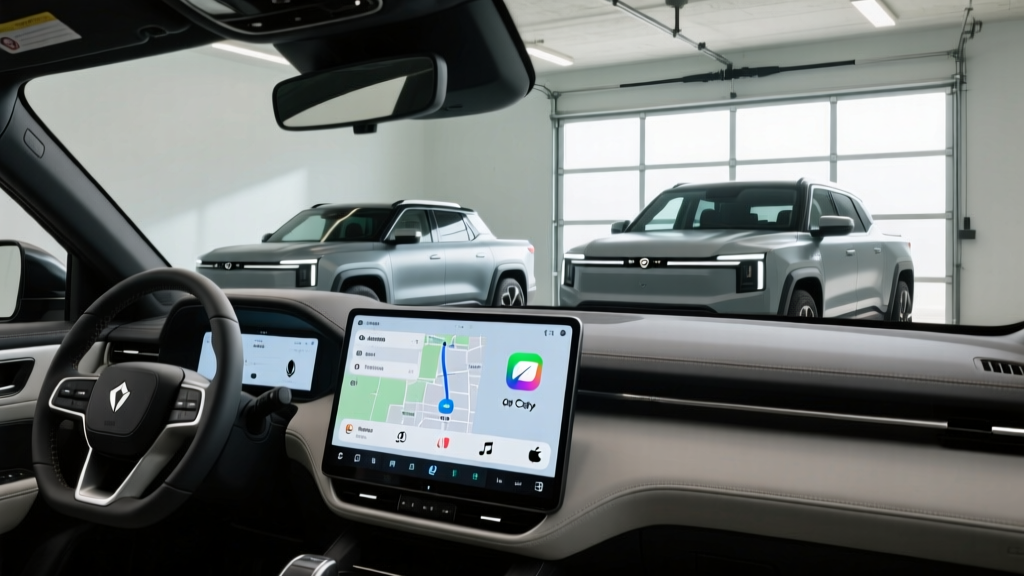
If you're cross-shopping electric trucks and SUVs, you've likely typed "does Rivian have Apple CarPlay" into a search bar. The short answer for the 2026 model year: no, Rivian does not support Apple CarPlay or Android Auto on the R1T pickup or R1S SUV. Instead, Rivian runs a proprietary, in-house developed infotainment platform that handles navigation, media, phone integration, and vehicle controls through a single 15.6-inch center touchscreen and a 12.3-inch driver display.
Whether that's a dealbreaker depends on how deeply you rely on CarPlay's interface — and whether Rivian's native system does the job. In this review, we'll unpack exactly what you get (and don't get) from Rivian's software stack, then dive into the full ownership picture: real-world range, DC fast-charging speeds, pricing after federal tax credits, and how the R1T and R1S stack up against the Ford F-150 Lightning, Tesla Cybertruck, and Chevrolet Silverado EV.
Rivian's Infotainment: What Replaces CarPlay?
Rivian designed its infotainment system from scratch, running on a custom Linux-based operating system. The company argues that deep vehicle integration — controlling suspension height, drive modes, battery preconditioning, and camping features — requires tighter software-hardware coupling than CarPlay or Android Auto allow.
Here's what the native system includes:
- Navigation: Built-in mapping with real-time traffic, EV-aware route planning that factors in battery state of charge (SoC), terrain elevation, and weather. The system automatically suggests charging stops and preconditions the battery for DC fast charging when a charger is set as a waypoint.
- Phone integration: Bluetooth for calls, contacts sync, and text-message read-back. You won't get Siri Eyes Free or the CarPlay widget grid, but core phone functions work wirelessly.
- Streaming media: Native Spotify, Tidal, and TuneIn apps run directly on the head unit. A built-in Wi-Fi hotspot (via an embedded LTE modem) keeps the system connected without tethering to your phone.
- Voice assistant: Rivian's native voice commands handle navigation, climate, and media. It's functional but not as conversational as Siri or Google Assistant.
- Over-the-air (OTA) updates: Rivian pushes software updates regularly, adding features and refining the UI. Recent updates have improved route-planning accuracy and added new camping-mode presets.
The tradeoff: If your daily workflow depends on CarPlay's familiar grid of apps, Waze for navigation, or a specific podcast app that Rivian doesn't natively support, you'll feel the gap. Rivian's UI is clean and responsive, but it's a walled garden. Third-party app availability is limited to what Rivian chooses to integrate.
2026 Rivian R1T and R1S: Range, Battery, and Efficiency
For the 2026 model year, Rivian offers the R1T (truck) and R1S (three-row SUV) with two battery pack sizes and multiple drivetrain configurations. Here's what the EPA says — and what you should actually expect.
| Model / Config | Battery (kWh usable) | EPA Range | MPGe (combined) | kWh/100mi |
|---|---|---|---|---|
| R1T Dual-Motor (Standard Pack) | 92 kWh (NMC) | 270 mi | 73 MPGe | 46 |
| R1T Dual-Motor (Large Pack) | 128 kWh (NMC) | 352 mi | 70 MPGe | 48 |
| R1T Tri-Motor (Large Pack) | 128 kWh (NMC) | 328 mi | 65 MPGe | 52 |
| R1S Dual-Motor (Large Pack) | 128 kWh (NMC) | 341 mi | 69 MPGe | 49 |
Source: fueleconomy.gov
All Rivian packs use NMC (nickel manganese cobalt) lithium-ion chemistry, which offers higher energy density than LFP (lithium iron phosphate) but requires more careful state-of-charge management. Rivian recommends daily charging to 85–90% and saving 100% for road trips. The battery management system includes a buffer, so the usable kWh figures above already account for top/bottom protection.
Charging Speeds: DC Fast Charging and Home Level 2
Rivian's charging architecture has evolved significantly. The 2026 R1T and R1S (second-generation models built on the updated platform) support substantially faster DC fast charging than the original 2022–2024 vehicles.
| Charging Level | Max Rate | Speed / Time |
|---|---|---|
| Level 1 (120V household) | 1.4 kW | ~3–4 mi/hr |
| Level 2 (240V home, 48A) | 11.5 kW | ~25–28 mi/hr; full charge in ~11–13 hrs |
| DC Fast Charge (Large Pack) | Peak 220 kW | 10–80% in ~28 min |
| DC Fast Charge (Standard Pack) | Peak 190 kW | 10–80% in ~25 min |
Charging-curve reality: The 220 kW peak on the Large Pack is just that — a peak. In real-world DC fast charging, the R1T sustains roughly 180–200 kW from 10% to about 40% SoC, then tapers progressively. From 60% to 80%, expect rates closer to 80–110 kW. Battery preconditioning is automatic when you navigate to a Rivian Adventure Network charger or a compatible third-party station, which helps you hit peak rates sooner. Skip preconditioning on a cold morning and your peak may not exceed 130 kW.
Connector: All 2026 Rivians ship with a NACS (North American Charging Standard) port, giving native access to the Tesla Supercharger network (now open to Rivian). A CCS1 adapter is available for Electrify America and other legacy networks. The Rivian Adventure Network — the company's own charger deployment — remains relatively sparse but is expanding along key adventure corridors.
Home charging setup: Rivian sells a Wall Charger rated for up to 11.5 kW (48 amps) on a 60-amp circuit. Installation costs typically range from $500 to $2,000 depending on whether your electrical panel needs an upgrade. Most R1 owners charge overnight on Level 2 and wake up to a full battery — the math works out to roughly $0.04–$0.06 per mile on a national-average electricity rate of $0.16/kWh.
Performance: Dual-Motor and Tri-Motor Drivetrains
Rivian offers two drivetrain layouts for 2026, both with standard all-wheel drive:
- Dual-Motor AWD: One motor per axle, producing a combined 533 horsepower and 610 lb-ft of torque. The 0–60 mph time is 4.5 seconds for the R1T and 4.6 seconds for the R1S.
- Tri-Motor AWD: One front motor and two rear motors, delivering 850 horsepower and 1,103 lb-ft of torque. The 0–60 time drops to 2.9 seconds (R1T) — putting it in supercar territory despite a curb weight north of 7,000 pounds.
The tri-motor setup also enables tank turns (spinning the vehicle in place by driving left and right wheels in opposite directions) and more precise torque vectoring off-road. For most buyers, the dual-motor is the pragmatic choice: it's lighter, more efficient, and still genuinely quick.
Towing: The R1T is rated to tow up to 11,000 pounds (dual-motor) or 10,000 pounds (tri-motor, due to the higher curb weight eating into GCWR). The R1S tows up to 7,700 pounds. Be aware that towing a 5,000+ pound trailer will cut range roughly in half — plan for 130–170 miles between charging stops when towing heavy.
Pricing, Trims, and Federal Tax Credit Eligibility
Rivian simplified its trim structure for 2026. Here's where pricing stands before any incentives:
| Model | Base MSRP | Typical As-Tested |
|---|---|---|
| R1T Dual-Motor Standard Pack | $69,900 | $73,000–$76,000 |
| R1T Dual-Motor Large Pack | $75,900 | $79,000–$84,000 |
| R1T Tri-Motor Large Pack | $89,900 | $94,000–$99,000 |
| R1S Dual-Motor Standard Pack | $74,900 | $78,000–$82,000 |
| R1S Dual-Motor Large Pack | $79,900 | $84,000–$89,000 |
Federal Tax Credit: Does the Rivian R1T/R1S Qualify?
This is where Rivian buyers hit a wall. Under IRS §30D rules for the clean vehicle credit, the R1T and R1S face two critical barriers:
- MSRP cap: Pickup trucks qualify up to an $80,000 MSRP cap, and SUVs/vans up to $80,000. The R1T Dual-Motor Standard Pack at $69,900 base clears this, but once you add popular options (Lunar White paint, 21-inch wheels, camp kitchen), the as-tested price can push past $80,000. The R1S Large Pack and all tri-motor configurations exceed the cap outright.
- Income cap: Modified adjusted gross income (MAGI) must not exceed $150,000 (single), $225,000 (head of household), or $300,000 (married filing jointly).
- Battery sourcing: The credit is split into two $3,750 halves — one for critical minerals sourcing and one for battery component manufacturing. Rivian sources cells from Samsung SDI, and the percentage of qualifying content varies by build date. As of early 2026, qualifying R1T Standard Pack configurations may receive up to $3,750 (one half of the credit), though this is subject to change as sourcing requirements tighten annually.
Rivian does offer the credit as a point-of-sale transfer where eligible, reducing your purchase price at delivery rather than waiting for tax filing. State incentives (California, Colorado, Massachusetts, and others) may stack on top — check your state's energy office for current programs.
Cargo, Passenger Space, and Practicality
The R1T is a midsize truck with a 4.5-foot bed, while the R1S is a three-row SUV. Here are the key dimensions:
| Measurement | R1T | R1S |
|---|---|---|
| Front legroom | 41.3 in | 41.3 in |
| Rear legroom | 38.2 in | 38.2 in (2nd row) |
| Bed / rear cargo | 54.0 cu ft (bed) | 46.7 cu ft (behind 2nd row) |
| Frunk (front trunk) | 11.0 cu ft | 11.0 cu ft |
| Gear Tunnel (R1T only) | 11.7 cu ft | N/A |
| Max towing | 11,000 lbs | 7,700 lbs |
The R1T's Gear Tunnel — a full-width pass-through storage compartment between the cab and bed — is a standout feature unique to Rivian. It's ideal for skis, camping gear, or groceries you want to keep out of the cab and bed. The optional camp kitchen slides out of the Gear Tunnel on the driver side, integrating a two-burner induction cooktop and sink.
The R1S offers a usable third row (best for kids or shorter adults on trips under an hour) and folds flat for up to 104.8 cu ft of total cargo volume behind the front seats.
Driver Assistance and Safety
Rivian's driver-assistance suite is branded as Rivian Driver+. It includes:
- Adaptive cruise control with stop-and-go
- Lane centering assist
- Automatic emergency braking
- Blind-spot monitoring with rear cross-traffic alert
- Highway assist (combined lane centering + adaptive cruise)
Safety ratings: The NHTSA awarded the R1T a 5-star overall rating. The IIHS has tested the R1T and awarded it Top Safety Pick+ status with Good ratings across all crash tests (see iihs.org for detailed scores).
Warranty and Long-Term Ownership
| Coverage | Term |
|---|---|
| Basic (bumper-to-bumper) | 5 years / 60,000 miles |
| Battery & drivetrain | 8 years / 175,000 miles |
| Battery capacity retention | ≥70% of original capacity within 8 yr / 175,000 mi |
Rivian's 8-year/175,000-mile battery warranty is competitive with Tesla's (8 yr/120,000–150,000 mi depending on model) and exceeds Ford's Lightning warranty (8 yr/100,000 mi). The 70% capacity retention threshold is industry standard. Based on early degradation data from 2022–2024 R1 owners, NMC packs are tracking at roughly 3–5% loss over the first 50,000 miles, which projects to well within the warranty threshold at 175,000 miles.
Service network caveat: Rivian operates its own service centers and a mobile service fleet. Coverage is expanding but remains thinner than legacy automaker dealer networks, especially in rural areas. Wait times for collision repair and some parts can be longer than with Ford or Chevrolet. Factor this into your ownership calculus if you live outside a major metro area.
Rivian vs. the Competition: Is It Worth Buying?
Pros
- Best-in-class off-road capability with air suspension and quad-motor torque vectoring
- Innovative storage (Gear Tunnel, frunk, camp kitchen)
- 352-mile EPA range on Large Pack (R1T dual-motor)
- Strong build quality and premium materials
- Active OTA updates improving the vehicle over time
- 8-yr/175,000-mi battery warranty
Cons
- No Apple CarPlay or Android Auto
- High starting price; most configs exceed tax credit MSRP cap
- Service network still limited outside major metros
- Towing cuts range dramatically (expect ~50% loss at max load)
- Third row in R1S is tight for adults
- Driver+ is competent but not class-leading vs. Super Cruise or FSD
Choose the Rivian R1T if: you want a premium electric truck that excels off-road, offers innovative storage solutions, and you can accept the lack of CarPlay. It's ideal for outdoor enthusiasts, weekend campers, and tech-forward buyers who value Rivian's adventure-oriented ethos.
Choose the Ford F-150 Lightning instead if: you need a full-size truck bed, want Apple CarPlay/Android Auto, prefer a wider dealer service network, and want a lower entry price (starting ~$55,000). The Lightning also qualifies more readily for the full $7,500 federal credit.
Choose the Tesla Cybertruck if: you prioritize DC fast-charging speed (peak 250+ kW on V3/V4 Superchargers), want access to the most mature Supercharger network, and don't mind the polarizing design. Cybertruck does support a form of phone integration but also lacks traditional CarPlay.
Frequently Asked Questions
Does Rivian have Apple CarPlay in 2026?
No. Neither the R1T nor the R1S supports Apple CarPlay or Android Auto for the 2026 model year. Rivian uses its own proprietary infotainment system with built-in navigation, streaming apps, and Bluetooth phone integration. Rivian has not publicly announced plans to add CarPlay support.
Can I use my iPhone with a Rivian at all?
Yes, via Bluetooth. You can make and receive calls, sync contacts, and have text messages read aloud. You can also use your phone as a key fob (phone-as-key) to lock, unlock, and start the vehicle. What you can't do is mirror your phone's screen or use CarPlay-specific apps like Waze or Apple Maps on the vehicle display.
What is the real-world range of the Rivian R1T?
The EPA rates the R1T Dual-Motor Large Pack at 352 miles. In real-world highway driving at 70–75 mph, expect 290–310 miles. In cold weather (below 30°F), plan for 240–260 miles. Towing a heavy trailer reduces range further, to roughly 130–170 miles depending on load and terrain.
How fast does the Rivian R1T charge?
On a DC fast charger, the 2026 R1T Large Pack peaks at 220 kW, reaching 10–80% in approximately 28 minutes with proper battery preconditioning. At home on a 240V Level 2 charger (11.5 kW), a full charge takes about 11–13 hours, adding roughly 25–28 miles of range per hour.
Does the Rivian R1T qualify for the $7,500 federal tax credit?
Partially, and only in specific configurations. The R1T Dual-Motor Standard Pack (base MSRP $69,900) may qualify for up to $3,750 — one half of the credit — depending on battery-sourcing compliance and buyer income. Most R1T Large Pack and all tri-motor configurations exceed the $80,000 MSRP cap and receive no federal credit. Verify current eligibility at irs.gov.
Is the Rivian R1T worth it vs. the F-150 Lightning?
The R1T offers superior off-road capability, more innovative storage (Gear Tunnel), higher EPA range on the Large Pack, and a more premium interior. The F-150 Lightning wins on price (starts ~$15,000 lower), full-size bed length, CarPlay/Android Auto support, broader dealer service access, and easier federal tax credit qualification. Your priorities determine the winner.