Quick Verdict: The Delivery EV That Redefined the Last Mile
The Rivian Electric Delivery Van (EDV) — widely known as the Amazon van — is not a consumer vehicle you can walk into a dealership and buy. It is a commercial, fleet-only electric van built under an exclusive agreement between Rivian and Amazon. But with Amazon beginning to deploy EDVs through partner delivery service providers (DSPs) and third-party fleets gaining limited access via Rivian Commercial, the EDV's specs, interior layout, and real-world performance matter to a growing audience of fleet operators, last-mile logistics professionals, and EV analysts.
This review covers the 2026-model-year EDV 700 (the mid-size variant most commonly seen on Amazon routes), including its interior design, EPA range, battery and charging architecture, and total-cost-of-ownership profile. If you've been searching for Rivian Amazon van interior details — the cargo dimensions, driver ergonomics, and tech stack — this is the deep-dive spec breakdown you need.
| Spec | Value |
|---|---|
| EPA Estimated Range | ~150 miles (EDV 700) |
| Battery Capacity | ~149 kWh usable (LFP chemistry) |
| Max DC Fast Charge | ~150 kW peak |
| 10–80% DC Charge Time | ~45–55 minutes |
| Level 2 AC Charge Rate | ~19.2 kW (~35–40 mi/hr) |
| Drivetrain | Rear-wheel drive (single motor) |
| Horsepower | ~275 hp |
| 0–60 mph | ~8.0 seconds (estimated) |
| Cargo Volume (EDV 700) | ~660 cu ft |
| Efficiency | ~2.0–2.3 kWh/mile (real-world delivery route) |
| Battery Warranty | 8 years / 100,000 miles (commercial terms vary) |
| Starting Price (Fleet) | Not publicly listed — estimated $85,000–$100,000 per unit at volume |
Rivian Amazon Van Interior: Built for Route Efficiency
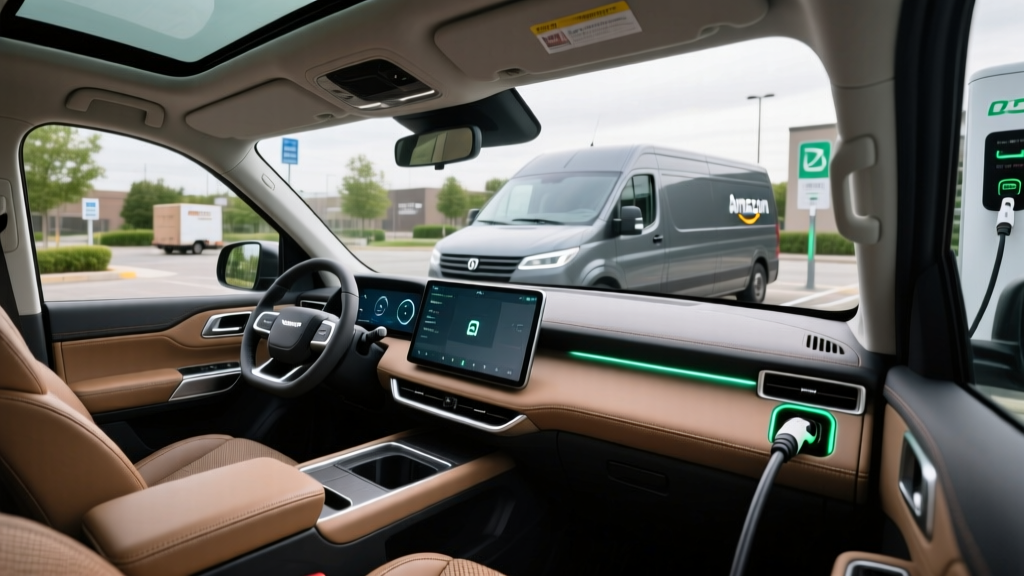
The EDV's interior is where Rivian's ground-up EV architecture diverges most dramatically from a converted Sprinter or Transit. Every surface, control, and compartment was designed in partnership with Amazon's delivery operations team to minimize driver fatigue and maximize package throughput.
Cab and Driver Ergonomics
The driver's compartment uses a low, flat floor made possible by the skateboard-style battery pack beneath the chassis. The driver's seat is a manually adjustable, high-visibility bucket positioned upright — optimized for the 150+ daily ingress/egress cycles a delivery driver performs. The steering wheel is a flat-bottom, commercial-grade unit with integrated regen-braking paddles. There is no traditional instrument cluster; instead, a ruggedized 15.6-inch central touchscreen handles navigation (pre-loaded with Amazon's Mentor routing software), vehicle telemetry, and climate controls.
Visibility is exceptional. The windshield is steeply raked and expansive, and the passenger-side "curb view" window extends low into the door panel, giving the driver a direct sightline to the curb and sidewalk when pulling over — a feature that reduces cyclist and pedestrian conflicts in dense urban routes.
Cargo Area: 660 Cubic Feet of Optimized Space
The EDV 700 offers approximately 660 cubic feet of cargo volume (the larger EDV 900 pushes closer to 840 cu ft). The cargo floor is flat and uninterrupted by wheel wells thanks to the EV skateboard platform. Amazon uses a modular shelving system — configurable in multiple shelf-height arrangements — that allows drivers to pre-sort packages by delivery stop before leaving the warehouse.
The bulkhead between the cab and cargo area is a full-height, reinforced partition with a pass-through hatch. A sliding door on the passenger side provides the primary cargo access, with an optional rear roll-up door available on the EDV 900. Interior LED lighting is motion-activated, and the cargo floor is lined with a durable, low-friction composite material designed to let heavy packages slide easily.
Climate and Comfort
The EDV uses a high-voltage heat pump for cabin heating and cooling — critical for preserving range in cold climates. The cargo area has supplemental ventilation but is not actively climate-controlled, which is standard for last-mile delivery vehicles. The cab reaches set temperature quickly due to its compact volume relative to the HVAC system's capacity.
Range, Battery, and Real-World Efficiency
Real-World Expectation: On a typical urban/suburban delivery route with 150–200 stops, expect 110–135 miles of usable range before needing to return to base. Highway-speed empty-return legs at 65 mph reduce range to ~120 miles. In cold weather (below 30°F), LFP chemistry and cabin heating demands can reduce range by 15–25%, yielding 90–115 miles. Route planners at Amazon DSPs typically cap daily routes at 100–110 miles to maintain a 20% buffer.
Battery Chemistry: Why LFP?
The EDV uses a lithium iron phosphate (LFP) battery pack with approximately 149 kWh of usable capacity. Rivian selected LFP for the commercial van for several engineering reasons:
- Cycle life: LFP cells tolerate 3,000–5,000+ full charge cycles before reaching 80% capacity — essential for a vehicle charged daily over a 10-year fleet life.
- Thermal stability: LFP is inherently more resistant to thermal runaway than NMC, reducing fire risk in a densely packed urban vehicle.
- Cost: LFP cells are cheaper per kWh than NMC, keeping per-unit fleet pricing competitive with diesel Sprinter vans.
- Trade-off: LFP has lower energy density than NMC, which is why the EDV's pack is physically large and heavy — but for a van that returns to the same depot nightly, the weight penalty is acceptable.
According to fueleconomy.gov, commercial electric vans in this class typically achieve 2.0–2.5 kWh per mile in mixed delivery driving. The EDV 700's efficiency falls in the ~2.0–2.3 kWh/mile range depending on route density, payload weight, and ambient temperature.
Charging Speed: Depot-First Architecture
The EDV was designed to charge at a fleet depot, not at public fast-charging stations. This is a critical distinction that shapes its charging hardware.
| Charge Level | Power (kW) | Time (10–80%) | Miles Added per Hour |
|---|---|---|---|
| Level 1 (120V) | ~1.4 kW | Not practical (6+ days) | ~3–4 mi/hr |
| Level 2 (240V AC, 80A) | ~19.2 kW | ~5–6 hours | ~35–40 mi/hr |
| DC Fast Charge (CCS) | ~150 kW peak | ~45–55 minutes | ~120–140 mi/hr (peak) |
Depot Charging Reality
Most Amazon DSP depots install Level 2 chargers rated at 19.2 kW (240V, 80 amps). At this rate, an EDV returning with 30% state of charge can reach 80% in roughly 4 hours — well within an overnight window. Fleet operators typically charge to 80–90% rather than 100% to extend LFP cycle life, though LFP tolerates 100% charges better than NMC.
The DC fast-charge capability (CCS connector, ~150 kW peak) exists for mid-route top-ups or rapid turnarounds, but the LFP charge curve tapers significantly above 80%. Peak 150 kW is sustained roughly from 10–50% SoC, after which the rate drops to ~90 kW through 70%, and ~40 kW from 80–100%. This is normal LFP behavior and is why the 10–80% time is quoted at 45–55 minutes rather than a linear calculation from peak kW.
For public charging, the EDV uses a CCS1 connector. It is compatible with Electrify America, EVgo, and ChargePoint DC stations — though the van's 8-foot height and 28-foot length make many retail-located chargers physically impractical.
Performance and Drivetrain
The EDV 700 is rear-wheel drive with a single electric motor producing approximately 275 horsepower and an estimated 350 lb-ft of torque. The 0–60 mph time is roughly 8.0 seconds — quick for a 10,000-pound GVWR van and dramatically faster than the diesel Mercedes-Benz Sprinter it replaces on most routes.
Regenerative braking is aggressive and configurable. Most DSP drivers use the highest regen setting for one-pedal-style driving in stop-heavy urban routes, which reduces brake wear substantially. Rivian reports that EDV brake pad replacement intervals are 2–3x longer than comparable ICE vans.
The turning circle is tight for its size (~45 feet curb-to-curb), aided by the lack of a front engine and the resulting short front overhang. This matters enormously on narrow residential streets and in loading-dock maneuvers.
Pricing, Tax Credits, and Fleet Economics
| Item | Estimated Value |
|---|---|
| Base Unit Price (Fleet Volume) | $85,000–$100,000 |
| Federal Commercial Clean Vehicle Credit (§45W) | Up to $40,000 (vehicles >14,000 lb GVWR) or $7,500 (under 14,000 lb) |
| Depot Charger Install (per stall) | $8,000–$25,000 (Level 2, electrical upgrade dependent) |
| Estimated 5-Year Fuel Savings vs. Diesel Sprinter | $18,000–$28,000 (route dependent) |
| Estimated 5-Year Maintenance Savings vs. Diesel | $6,000–$12,000 |
Fleet Buyers: §45W, Not §30D
The consumer federal EV tax credit (IRS §30D) does not apply to the EDV because it is not sold to individual consumers. Fleet operators purchasing the EDV may qualify for the Commercial Clean Vehicle Credit (§45W), which offers up to $7,500 for vehicles under 14,000 pounds GVWR and up to $40,000 for vehicles over 14,000 pounds. The EDV 700 sits near the 10,000-pound GVWR threshold, and the EDV 900 exceeds 14,000 pounds — making the larger variant potentially eligible for the full $40,000 credit per unit.
Eligibility depends on battery-component and critical-mineral sourcing requirements, which tighten annually through 2032. Rivian has not published full EDV supply-chain compliance documentation publicly, so fleet buyers should verify §45W eligibility with their tax professional and Rivian Commercial directly before finalizing purchase orders.
Total Cost of Ownership
On a per-mile basis, the EDV costs approximately $0.12–$0.16/mile to "fuel" (at commercial electricity rates of $0.10–$0.14/kWh and 2.1 kWh/mile efficiency), compared to $0.35–$0.50/mile for a diesel Sprinter at $4.50/gallon and 14 mpg. Over a 5-year, 125,000-mile fleet lifecycle, the fuel savings alone can offset 20–30% of the EDV's purchase premium. Combined with reduced maintenance (no oil changes, fewer brake replacements, no diesel exhaust fluid), the break-even point versus a diesel van is typically 3–4 years for high-utilization routes.
Warranty and Long-Term Durability
Rivian provides the EDV with a commercial warranty package that differs from its consumer R1T/R1S terms:
- Battery: 8 years / 100,000 miles (retaining at least 70% of original capacity)
- Powertrain (motor, inverter, reduction gear): 8 years / 100,000 miles
- Vehicle limited warranty: 5 years / 75,000 miles bumper-to-bumper
- Corrosion perforation: 12 years / unlimited miles
The LFP chemistry's superior cycle life means that most EDV packs should retain well above 80% capacity at 100,000 miles under typical daily-cycling conditions. Fleet operators who have run EDVs since 2022 report minimal degradation — consistent with LFP's reputation in commercial applications.
Standout Tech and Notable Drawbacks
Pros
- Purpose-built EV architecture — no conversion compromises; flat floor, low step-in height
- LFP battery offers exceptional cycle life for daily depot charging
- Exceptional driver visibility with curb-view window
- Heat pump preserves range in cold climates better than resistive heating
- One-pedal regen driving reduces brake wear 2–3x vs. ICE vans
- Integrated Amazon routing software eliminates third-party telematics hardware
- Near-silent operation reduces noise complaints on residential routes
Cons
- Not available for individual purchase — fleet-only through Amazon DSP or Rivian Commercial
- ~150-mile range limits use to urban/suburban routes; not viable for long-haul
- LFP cold-weather range loss (15–25%) requires conservative winter route planning
- 150 kW DC fast-charge peak is modest vs. consumer EVs (250–350 kW); not designed for road-trip charging
- Cargo area is not climate-controlled — temperature-sensitive deliveries require insulated packaging
- Depot charger installation can require facility electrical panel upgrades ($15,000–$50,000+ for multi-stall)
- Rivian's commercial service network is still scaling — some regions lack rapid mobile-repair coverage
Who the Rivian EDV Suits Best
The EDV is purpose-built for high-frequency, short-route, depot-based last-mile delivery. Its ideal operator is an Amazon DSP running 80–120 mile daily routes in suburban or urban environments with overnight Level 2 depot charging. It is also well-suited for any fleet operator (outside Amazon) that can access Rivian Commercial's sales program and has the depot infrastructure to support overnight charging.
The EDV is not suited for long-haul or regional delivery (range is insufficient), cold-climate routes without route-length adjustment, or operators without access to depot charging infrastructure. It is also not a consumer vehicle — there is no path to individual ownership at this time.
EDV vs. Key Competitors
The EDV's direct competitors in the electric commercial van space include:
- Ford E-Transit: ~126-mile EPA range, 68 kWh battery, ~$55,000 MSRP. Lower range and smaller battery, but widely available and lower upfront cost. Better for shorter routes with lighter payloads.
- Mercedes-Benz eSprinter: ~200-mile estimated range (2026 model, 113 kWh battery), ~$75,000+. More range, but NMC chemistry trades cycle life for energy density. More expensive per unit.
- BrightDrop Zevo 600: ~250-mile range, ~165 kWh battery, fleet pricing. GM-backed, strong range, but newer platform with less real-world fleet data than the EDV.
The EDV's advantage is its LFP durability, Amazon-optimized interior, and proven high-volume deployment (10,000+ units on the road as of early 2026). Its disadvantage is exclusivity — you cannot simply order one from a dealer.
Frequently Asked Questions
What is the real-world range of the Rivian Amazon delivery van?
The EPA-estimated range is approximately 150 miles for the EDV 700. In real-world delivery driving with 150+ stops, expect 110–135 usable miles. Cold weather (below 30°F) reduces this to 90–115 miles. Amazon DSPs typically plan routes at 100–110 miles to maintain a safety buffer.
How fast does the Rivian EDV charge?
On a Level 2 depot charger (19.2 kW), a full charge takes 5–6 hours — ideal for overnight turnaround. On a DC fast charger (CCS, ~150 kW peak), 10–80% takes approximately 45–55 minutes, though the LFP charge curve tapers significantly above 80%.
Can I buy a Rivian Amazon van as an individual?
No. The EDV is currently available only to Amazon Delivery Service Providers and select fleet operators through Rivian Commercial. There is no consumer purchase path as of 2026.
Does the Rivian EDV qualify for the federal EV tax credit?
The consumer §30D credit does not apply. However, fleet purchasers may qualify for the Commercial Clean Vehicle Credit (§45W) — up to $7,500 for the EDV 700 (under 14,000 lb GVWR) or up to $40,000 for the EDV 900 (over 14,000 lb GVWR). Eligibility depends on battery sourcing requirements; consult a tax professional.
What battery chemistry does the Rivian EDV use?
The EDV uses lithium iron phosphate (LFP) cells in a ~149 kWh pack. LFP was chosen for its superior cycle life (3,000–5,000+ cycles), thermal stability, and lower cost — all critical for daily-charged commercial fleet vehicles.
How does the EDV interior compare to a Ford E-Transit or Mercedes eSprinter?
The EDV's interior is more purpose-built for delivery than either competitor. The curb-view window, integrated Amazon routing software, modular shelving system, and low step-in height are features neither the E-Transit nor eSprinter match. However, the E-Transit is available through standard Ford commercial dealers, making it more accessible for non-Amazon fleets.
What is the Rivian EDV battery warranty?
Rivian warrants the EDV battery for 8 years or 100,000 miles, whichever comes first, with a minimum 70% capacity retention threshold. The LFP chemistry's longevity suggests most packs will exceed this threshold comfortably under normal fleet use.