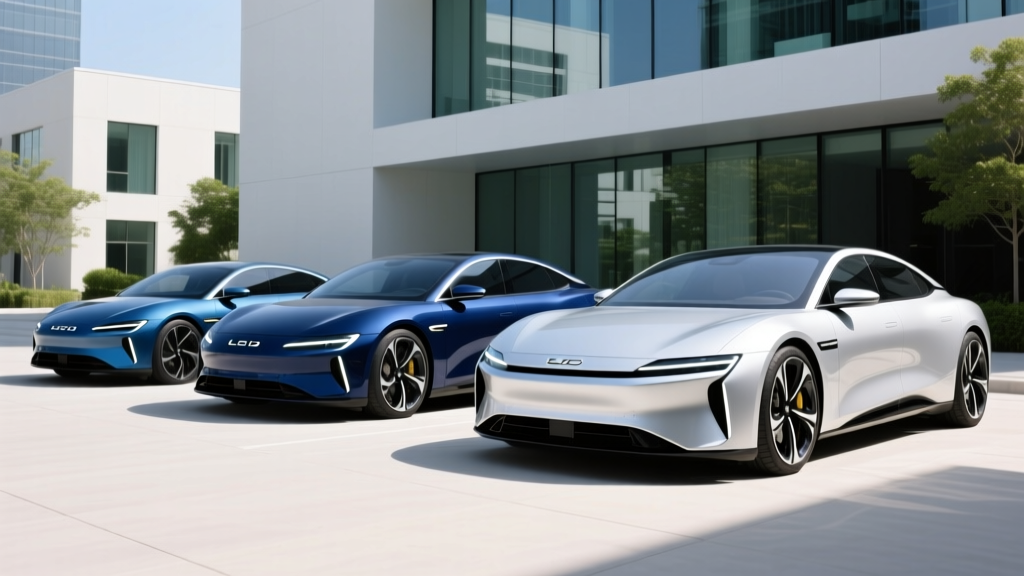
If you have been searching for who makes the Lucid electric car, the answer is Lucid Group, Inc. — an American automaker headquartered in Newark, California, with its production factory in Casa Grande, Arizona. Originally founded in 2007 as Atieva (a battery technology company), Lucid pivoted to full vehicle manufacturing and launched its first car, the Lucid Air sedan, for the 2021 model year. As of 2026, the Lucid Air remains the brand's sole production vehicle, though the Gravity SUV has entered production.
This review focuses on the Lucid Air sedan lineup: the entry-level Pure, the mid-tier Touring, the performance-oriented Grand Touring, and the range-topping Sapphire. We will break down real-world range, charging speed, pricing after federal tax credits, and whether Lucid's engineering justifies the premium.
Lucid Air Quick Verdict
The Lucid Air is the most energy-efficient production sedan on the market, with the Grand Touring achieving an EPA-estimated 512 miles of range — a figure no competitor currently matches. Its 900V+ electrical architecture enables some of the fastest DC charging curves available, and the interior space rivals full-size luxury sedans despite a mid-size footprint. The trade-offs include a service network still expanding, software that trails Tesla's polish, and a price point that pushes well into six figures for upper trims. For buyers who prioritize range efficiency and charging speed above brand cachet, the Air is a compelling choice.
Range, Battery, and Efficiency
Lucid's efficiency advantage comes from its proprietary miniaturized drive units, low-drag aerodynamics (Cd of 0.197 for the Air), and a high-voltage architecture that reduces resistive losses. All trims use nickel-manganese-cobalt (NMC) lithium-ion cells supplied primarily by Samsung SDI and LG Energy Solution. The usable battery capacity varies by trim:
| Trim | Battery (Usable kWh) | EPA Range | Efficiency (MPGe) | kWh/100mi |
|---|---|---|---|---|
| Pure RWD | 88 kWh | 419 mi | 146 MPGe | 23 |
| Touring AWD | 112 kWh | 411 mi | 131 MPGe | 26 |
| Grand Touring AWD | 112 kWh | 512 mi | 143 MPGe | 24 |
| Sapphire AWD | 118 kWh | 427 mi | 115 MPGe | 29 |
The Grand Touring's 512-mile EPA figure benefits from its dual-motor setup with a disconnecting front motor — under light-load cruising, the Air runs on the rear motor alone, cutting parasitic drag. According to fueleconomy.gov, this efficiency translates to roughly $550–$700 in annual electricity costs (at 15,000 miles/year and $0.16/kWh), significantly less than a comparable BMW 5 Series or Mercedes E-Class.
Charging Speed: DC Fast and Home Level 2
Lucid's 900V+ electrical architecture (nominally 924V) is one of the highest voltage platforms in production, rivaled only by Porsche's Taycan and Hyundai's E-GMP vehicles. This high voltage allows the Air to accept high power at lower current, reducing heat and improving charge-curve sustainability.
| Charge Level | Power (kW) | Speed | Notes |
|---|---|---|---|
| Level 1 (120V) | ~1.4 kW | ~4 mi/hr | Emergency/overnight trickle only |
| Level 2 (240V, 48A) | 11.5 kW | ~38 mi/hr | Full charge in ~10–12 hours |
| DC Fast Charge (peak) | ~300 kW | 10–80% in ~20 min | Requires 350 kW+ station; tapers above 80% |
On a 350 kW Electrify America or Tesla Supercharger V4 station (with NACS adapter), the Grand Touring can sustain approximately 250–300 kW through the 10–50% state-of-charge window before tapering. Expect to add roughly 200 miles of range in the first 15 minutes under ideal thermal conditions. Battery preconditioning activates automatically when navigating to a DC fast charger, but cold-soak in winter will still reduce peak rates by 20–40% until the pack warms.
For home charging, the Air's onboard charger accepts up to 11.5 kW (48 amps at 240V). With a properly installed Level 2 wall connector on a 60-amp circuit, you will recover roughly 38 miles of range per hour of charging — enough to fully replenish overnight for most daily driving. Note: kW measures charging power (how fast energy flows); kWh measures battery energy capacity (how much the tank holds).
Performance and Drivetrain
| Trim | Horsepower | 0–60 mph | Drivetrain | Top Speed |
|---|---|---|---|---|
| Pure RWD | 430 hp | 5.0 sec | RWD | 145 mph |
| Touring AWD | 620 hp | 3.4 sec | Dual-Motor AWD | 145 mph |
| Grand Touring AWD | 819 hp | 3.0 sec | Dual-Motor AWD | 168 mph |
| Sapphire AWD | 1,234 hp | 1.89 sec | Tri-Motor AWD | 205 mph |
Even the base Pure delivers 430 hp from its single rear motor — enough for confident highway merging and passing. The Grand Touring's 819 hp and 3.0-second 0–60 time place it firmly in supercar territory, while the tri-motor Sapphire's 1,234 hp makes it one of the quickest production sedans ever built, rivaling the Tesla Model S Plaid and Porsche Taycan Turbo GT.
Lucid's drive units are remarkably compact — each weighs under 70 kg and fits in a carry-on-sized enclosure. This miniaturization frees up cabin and cargo space while keeping weight lower than you would expect for a 5,000+ lb sedan. Regenerative braking is adjustable through multiple levels but does not offer true one-pedal driving to a complete stop in all modes — a notable omission compared to Tesla and Chevrolet's implementations.
Interior Space, Cargo, and Technology
The Air's cabin blends minimalist luxury with generous space. Key interior dimensions:
- Front legroom: 45.3 inches
- Rear legroom: 45.1 inches (class-leading for the segment)
- Trunk (rear): 22.1 cu ft
- Frunk (front): 10.1 cu ft
- Total cargo: 32.2 cu ft
The rear seat legroom is genuinely limousine-like — more than a BMW 7 Series — thanks to the compact drive units and flat floor. The glass canopy roof (standard on Grand Touring, optional on Touring) creates an airy cabin but can increase solar heat gain in summer; the available sunshade is recommended for hot climates.
Technology highlights include a 34-inch curved glass cockpit display (5K resolution), Lucid's custom UX operating system, over-the-air updates, and a 21-speaker Surreal Sound system by Dolby Atmos on upper trims. The infotainment system is responsive but lacks native Apple CarPlay and Android Auto — Lucid relies on its own app ecosystem and phone integration. This is a dealbreaker for some luxury buyers accustomed to phone projection.
Driver assistance comes via Lucid's DreamDrive Pro system, which uses 32 sensors including LiDAR (on Grand Touring and Sapphire). Features include adaptive cruise control, lane-centering, automated parking, and highway assist. DreamDrive Pro is an SAE Level 2 system — the driver must remain fully engaged and supervising at all times. It is not autonomous or self-driving.
Pricing, Trims, and Federal Tax Credit Eligibility
| Trim | Base MSRP (2025/2026) | §30D Credit Eligible? | Est. After Credit |
|---|---|---|---|
| Pure RWD | $69,900 | MSRP under $55K cap — No | $69,900 |
| Touring AWD | $87,400 | Exceeds $55K sedan cap — No | $87,400 |
| Grand Touring AWD | $125,600 | Exceeds $55K sedan cap — No | $125,600 |
| Sapphire AWD | $249,000 | Exceeds $55K sedan cap — No | $249,000 |
The Pure RWD at $69,900 positions the Air against the Tesla Model S ($74,990 base), BMW i5 ($66,800), and Mercedes EQE ($74,900). While the Pure undercuts the Model S on price and exceeds it on range, it lacks the Supercharger network's native integration (though NACS adapters are now available) and Tesla's more mature service infrastructure.
Warranty, Ownership, and Service
| Coverage | Term |
|---|---|
| Basic Vehicle Warranty | 4 years / 50,000 miles |
| Battery & Drive Unit | 8 years / 100,000 miles |
| Battery Capacity Retention | ≥70% over warranty period |
| Roadside Assistance | 4 years / 50,000 miles |
Lucid's battery warranty guarantees at least 70% capacity retention over 8 years or 100,000 miles — industry-standard and matching Tesla, BMW, and Mercedes. Real-world degradation data from early 2022–2023 Air owners shows approximately 5–8% loss over the first 30,000 miles, which is typical for NMC chemistry. The battery management system (BMS) maintains a top and bottom buffer to protect long-term health.
The service network remains a concern for buyers outside major metro areas. As of 2026, Lucid operates approximately 25 service centers nationwide, supplemented by mobile service vans in select markets. Wait times for collision repair and body panels have been reported as longer than legacy luxury brands. If you live more than 100 miles from a Lucid service center, factor in potential logistics friction.
Pros, Cons, and Who Should Buy
Pros
- Class-leading 512-mile EPA range (Grand Touring)
- Best-in-class energy efficiency (143+ MPGe)
- 300 kW peak DC fast charging
- Massive rear-seat legroom (45.1 in)
- Standard NACS adapter access to Tesla Superchargers
- LiDAR-equipped DreamDrive Pro on upper trims
Cons
- No federal §30D tax credit (MSRP exceeds $55K cap)
- Limited service center footprint (~25 nationwide)
- No native Apple CarPlay / Android Auto
- No true one-pedal driving to full stop
- Software UX less polished than Tesla or BMW iDrive
- Cold-weather range loss of 20–30% at highway speeds
- Long-distance commuters who want 400+ real-world miles between charges
- Luxury sedan buyers prioritizing rear-seat comfort and efficiency over brand badge
- Tech-forward owners who value engineering innovation (900V architecture, miniaturized motors)
- Not ideal for: Buyers who need a dense service network, rely on CarPlay, or want a sub-$55K credit-eligible EV
Frequently Asked Questions
What is the real-world range of the Lucid Air?
The Grand Touring's EPA-estimated 512 miles translates to roughly 380–430 miles in real-world highway driving at 70–80 mph. The Pure RWD delivers approximately 310–350 highway miles. Cold weather (below freezing) reduces range by 20–30% due to cabin heating demand and battery chemistry limitations.
How fast does the Lucid Air charge?
On a 350 kW DC fast charger, the Air peaks at approximately 300 kW and charges from 10–80% in about 20 minutes, adding roughly 200 miles in 15 minutes. At home on a Level 2 (240V, 48A) charger, it adds about 38 miles per hour, fully recharging overnight.
Does the Lucid Air qualify for the federal EV tax credit?
No. Under IRS §30D rules, new EV sedans must have an MSRP at or below $55,000 to be eligible. Every Lucid Air trim starts above $69,900, disqualifying the entire lineup from the up-to-$7,500 federal credit. State incentives may still apply depending on your jurisdiction.
Is the Lucid Air worth buying over a Tesla Model S or BMW i5?
If maximum range and energy efficiency are your top priorities, the Air Grand Touring has no equal at 512 EPA miles. The Tesla Model S offers a more established service network, native Supercharger access, and a more polished software experience but less range (402 mi EPA). The BMW i5 is more affordable and has superior build quality and CarPlay but offers only 295 miles of range. The right choice depends on whether you value range above all else.
Where are Lucid cars manufactured?
Lucid Air sedans are assembled at the company's AMP-1 (Advanced Manufacturing Plant) in Casa Grande, Arizona. The facility began production in late 2021 and has been expanding capacity. Lucid Group, Inc. is headquartered in Newark, California, and trades publicly on NASDAQ under the ticker LCID.
Does the Lucid Air have self-driving capabilities?
No. Lucid's DreamDrive Pro is an SAE Level 2 driver-assistance system, meaning the driver must remain fully attentive and in control at all times. It offers adaptive cruise, lane-centering, and highway assist but does not drive the car autonomously. Only Level 4 services like Waymo operate without a human driver in defined areas.