Quick Answer: Can You Buy a Toyota Electric Truck Right Now?
No. As of early 2026, Toyota does not sell a fully electric pickup truck in the United States. The Tacoma is available only as a turbo-four gas model or the i-FORCE MAX hybrid powertrain. The Tundra likewise offers a hybrid option but no battery-electric variant. Toyota has announced a next-generation battery-electric pickup concept, but no production timeline, pricing, or EPA-certified specs have been published. If you need a Toyota truck today, your electrified option is the i-FORCE MAX hybrid — not a BEV.
For buyers specifically searching for Toyota electric trucks, the landscape requires some honesty. Toyota has been slower to electrify its truck lineup than competitors, and while the company has signaled intent to build a battery-electric pickup, concrete details remain scarce. This guide breaks down exactly what exists, what's announced, and how to make a practical decision if you want an electrified Toyota truck in 2026.
Toyota's Current Truck Lineup: Gas, Hybrid, and the EV Gap
Toyota sells two pickup trucks in the US for the 2026 model year: the midsize Tacoma and the full-size Tundra. Neither is available as a battery-electric vehicle (BEV). Here's the powertrain reality:
| Model | Powertrain | HP / LB-FT | EPA MPG (Combined) | Towing (max) | Base MSRP |
|---|---|---|---|---|---|
| Tacoma SR | 2.4L Turbo-4 | 228 hp / 243 lb-ft | ~22 MPG | 6,500 lbs | ~$33,000 |
| Tacoma i-FORCE MAX | 2.4L Turbo Hybrid | 326 hp / 465 lb-ft | ~24 MPG | 6,500 lbs | ~$41,000 |
| Tundra SR5 | 3.4L Twin-Turbo V6 | 389 hp / 479 lb-ft | ~19 MPG | 12,000 lbs | ~$42,000 |
| Tundra i-FORCE MAX | 3.4L Twin-Turbo V6 Hybrid | 437 hp / 583 lb-ft | ~22 MPG | 12,000 lbs | ~$56,000 |
The i-FORCE MAX hybrid powertrains are conventional (non-plug-in) hybrids. They use a small battery pack to assist the gas engine, improving torque and modestly boosting fuel economy. They do not offer electric-only driving range and cannot be plugged in. This is a critical distinction from plug-in hybrids (PHEVs) like the Ford Maverick hybrid or the Toyota RAV4 Prime.
The Announced Toyota Battery-Electric Pickup: What We Know
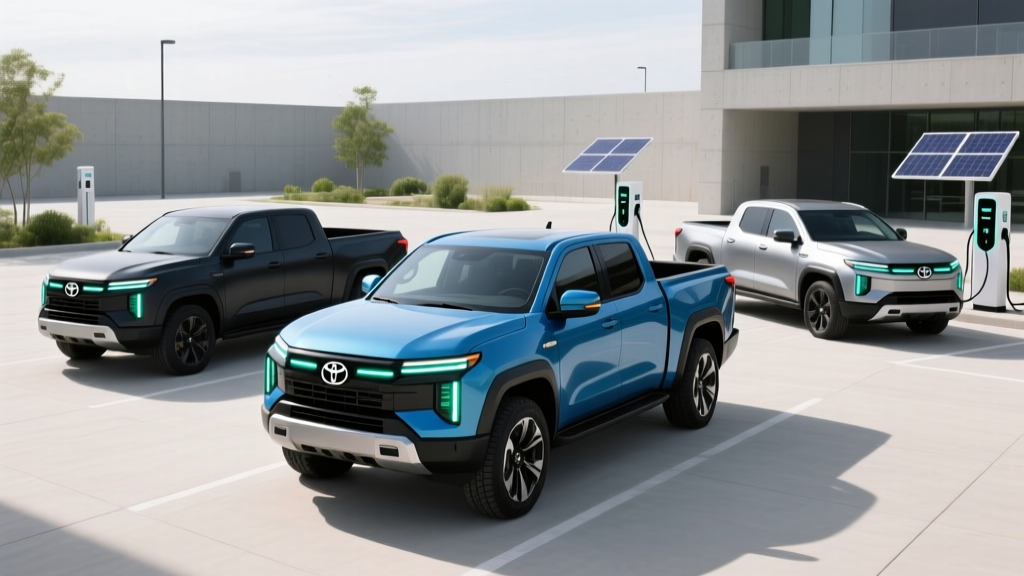
Toyota revealed an electric pickup concept in late 2023 alongside its broader EV roadmap update, and the company has referenced a production battery-electric truck in investor briefings. However, as of 2026:
- No production date has been confirmed for a US-market Toyota electric pickup.
- No battery capacity (kWh), EPA range estimate, or charging specs have been published.
- No pricing or trim structure has been announced.
- No federal §30D tax credit eligibility can be evaluated since the vehicle does not exist for sale.
Toyota's EV strategy has shifted repeatedly. The bZ4X crossover — Toyota's only current US-market BEV — launched with an EPA range of up to 252 miles and a 71.4 kWh battery, but sales have been modest and real-world reception mixed. Toyota has also invested heavily in hydrogen fuel-cell technology (the Mirai) and continues to advocate for a "multi-pathway" approach including hybrids, PHEVs, BEVs, and hydrogen.
For truck buyers specifically, this means a Toyota electric truck is at least 1–2 model years away, likely longer. Treat any range or pricing figures you see online as speculative.
Competitor Comparison: Electric Trucks You Can Actually Buy in 2026
If an electric pickup is a priority, several competitors are already on the road with real EPA numbers, known pricing, and established charging profiles:
| Model | Battery (kWh usable) | EPA Range | Max DC Charge (kW) | 10–80% Time | 0–60 mph | Base MSRP |
|---|---|---|---|---|---|---|
| Ford F-150 Lightning (Std Range) | ~98 kWh (LFP) | ~240 mi | 150 kW | ~32 min | ~4.0 sec | ~$55,000 |
| Ford F-150 Lightning (Ext Range) | ~131 kWh (NMC) | ~320 mi | 150 kW | ~41 min | ~4.0 sec | ~$70,000 |
| Rivian R1T (Dual-Motor, Standard) | ~92 kWh (LFP) | ~270 mi | 200 kW | ~27 min | ~4.5 sec | ~$70,000 |
| Chevrolet Silverado EV (WT 4WT) | ~200 kWh (NMC) | ~440 mi | 350 kW | ~28 min | ~4.5 sec | ~$78,000 |
| GMC Sierra EV (Denali Ed. 1) | ~200 kWh (NMC) | ~440 mi | 350 kW | ~28 min | ~4.3 sec | ~$97,000 |
A few observations from this data:
- Range varies enormously — from 240 miles (F-150 Lightning Standard) to 440 miles (Silverado EV with the largest pack). Real-world highway range at 70+ mph typically drops 15–25% below EPA, and cold weather (below 30°F) can reduce range by an additional 20–30%.
- Charging speed matters for road trips. The Silverado EV's 350 kW peak rate on compatible chargers (like Electrify America's newest 350 kW stalls) is significantly faster than the Lightning's 150 kW cap. However, peak kW is sustained only briefly — expect the charge curve to taper substantially above 80% State of Charge.
- Pricing starts high. Even the most affordable electric truck (F-150 Lightning Standard Range at ~$55,000) is pricier than a base gas Tacoma or Tundra. Tax credit eligibility under IRS §30D can offset up to $7,500, but buyer income caps, MSRP caps (trucks: $80,000), and battery-sourcing requirements all apply. Check the fueleconomy.gov tax credit tool for current eligibility by VIN.
Real Costs: Hybrid Toyota Truck vs. Electric Competitor
Since a Toyota electric truck isn't available, the practical comparison is between the Tundra i-FORCE MAX hybrid (what you can buy) and a Ford F-150 Lightning (the most accessible electric truck). Here's a 5-year ownership snapshot:
| Cost Category | Tundra i-FORCE MAX (~$56K) | F-150 Lightning Std (~$55K) |
|---|---|---|
| Purchase Price (MSRP) | $56,000 | $55,000 |
| Federal Tax Credit (§30D) | $0 (hybrid, not eligible) | Up to $7,500 (if eligible) |
| Fuel / Electricity (75K mi) | ~$12,800 (gas, $3.50/gal, 22 MPG) | ~$4,200 (home L2, $0.14/kWh, 2.1 kWh/mi) |
| Maintenance (5 yr) | ~$3,500 | ~$1,500 |
| Insurance (avg, 5 yr) | ~$9,000 | ~$10,500 |
| Estimated Depreciation | ~$22,000 | ~$25,000 |
| Total 5-Year Cost (est.) | ~$103,300 | ~$96,200 |
Key takeaways from this breakdown:
- Fuel savings are the EV's biggest advantage. At national-average electricity and gas prices, the Lightning saves roughly $8,600 over 5 years on energy alone. This gap widens if you have access to cheap overnight home charging or solar.
- Maintenance favors the EV. No oil changes, no transmission fluid, fewer moving parts. Brake pad life is extended by regenerative braking.
- Insurance is typically higher for EVs — expect 10–20% higher premiums due to repair costs and battery replacement exposure.
- Depreciation remains uncertain for EVs. Used EV values have been volatile. The Lightning's depreciation may improve as the market matures, but current data shows steeper initial drops than comparable gas trucks.
- The tax credit is not guaranteed. §30D eligibility depends on your modified adjusted gross income (single: $150K cap; joint: $300K), the truck's MSRP (must be ≤$80,000), and battery component/mineral sourcing. The credit can now be transferred to the dealer at point of sale, reducing your out-of-pocket cost immediately.
Real-World Ownership Considerations for Electric Trucks
Before committing to any electric pickup — Toyota's future offering or a current competitor — evaluate these practical factors:
Home Charging Access
Electric trucks have large batteries (98–200 kWh). Charging on a standard 120V outlet (Level 1, ~1.4 kW) would add roughly 3–5 miles of range per hour — meaning a full charge could take multiple days. A Level 2 home charger (240V, 9.6–11.5 kW) is essentially mandatory for daily truck use. Installation costs range from $800 (simple outlet near the panel) to $3,000+ (long wire runs, panel upgrades). If you live in an apartment, condo, or street-parking situation without dedicated charging, an EV truck is significantly less practical.
Towing and Payload Range Loss
Electric trucks lose range dramatically when towing. Real-world testing by multiple outlets shows 40–60% range reduction when towing a 5,000+ lb trailer at highway speeds. An F-150 Lightning with 320 miles of EPA range may deliver only 130–180 miles while towing. If you tow frequently or over long distances, this is a serious constraint compared to gas/diesel trucks, which can refuel in 5 minutes anywhere.
Cold-Weather Impact
Lithium-ion batteries lose efficiency in cold temperatures. Expect 15–30% range reduction in sustained sub-freezing conditions, depending on whether the truck uses a heat pump (which mitigates cabin-heating energy draw) or resistive heating. Preconditioning the battery while plugged in helps, but only if you have home charging.
Charging Infrastructure on Routes
If you drive in rural areas or take road trips through regions with sparse DC fast-charging coverage, an electric truck requires careful planning. The Ford F-150 Lightning uses the NACS connector (Tesla Supercharger access), which significantly expands available infrastructure. Rivian uses NACS as well. The Silverado EV and Sierra EV also use NACS for 2026. Verify charger availability along your typical routes using apps like PlugShare or A Better Routeplanner before purchasing.
Common Misconceptions About Toyota Electric Trucks
| Myth | Fact |
|---|---|
| "The Toyota Tacoma EV is available now." | No Tacoma BEV exists. The Tacoma offers a turbo gas engine and i-FORCE MAX hybrid only. |
| "The Tundra hybrid is a plug-in EV." | The i-FORCE MAX is a conventional hybrid — it cannot plug in and has no electric-only range. |
| "Toyota electric trucks will qualify for the full $7,500 tax credit." | Credit eligibility depends on battery sourcing, MSRP caps, and buyer income. No Toyota BEV truck exists to evaluate yet. |
| "Electric trucks can't tow." | They can tow — the F-150 Lightning is rated for up to 10,000 lbs. But towing cuts range by 40–60%, which is the real limitation. |
| "Hybrid trucks are the same as electric trucks." | Hybrids (HEVs) still burn gasoline 100% of the time. BEVs run solely on electricity. The ownership experience, fueling, and maintenance are fundamentally different. |
Decision Framework: What Should You Actually Buy?
Choose the Tundra i-FORCE MAX Hybrid If:
- You need a Toyota truck now and want the most fuel-efficient option available.
- You tow frequently (5,000+ lbs) over long distances and can't afford 50% range loss.
- You lack reliable home charging access (apartment, street parking, rural area).
- You drive in extreme cold regularly and don't want range unpredictability.
- You prefer Toyota's dealer network, resale reputation, and parts availability.
Choose a Ford F-150 Lightning or Rivian R1T If:
- You want a true zero-tailpipe-emission electric truck today.
- You have Level 2 home charging (or can install it).
- Your daily driving is under 200 miles round-trip, and you tow only occasionally or locally.
- You want to eliminate gas spending and reduce maintenance costs.
- You qualify for the §30D federal tax credit (check IRS guidelines for income and sourcing rules).
Wait for the Toyota Electric Truck If:
- You're committed to the Toyota brand and can delay your purchase 1–3 years.
- Your current truck is functional and doesn't need immediate replacement.
- You want to see real EPA range, pricing, and tax-credit data before committing.
What to Watch: Toyota's EV Truck Timeline
Toyota has committed to launching 30 BEV models globally by 2030, and a pickup is widely expected to be part of that lineup for the North American market. Key milestones to monitor:
- Production announcement: Toyota will likely reveal a specific model name, battery specs, and plant location before the vehicle goes on sale.
- Battery chemistry: Toyota has invested in both LFP (lithium iron phosphate — cheaper, longer cycle life, lower energy density) and NMC (nickel manganese cobalt — higher energy density) chemistries, as well as solid-state battery R&D. The chemistry choice will affect range, charging speed, and long-term degradation.
- Charging standard: With the industry rapidly converging on NACS (the Tesla connector standard, now SAE J3400), expect any future Toyota EV truck sold in the US to use NACS.
- Platform: Whether Toyota builds on a dedicated EV skateboard platform (like its e-TNGA architecture) or adapts an existing truck frame will affect interior packaging, range efficiency, and driving dynamics.
Until Toyota publishes official specs, treat all range and pricing estimates for a future Toyota electric truck as preliminary. Bookmark toyota.com and fueleconomy.gov for verified data when it arrives.
Frequently Asked Questions
Does Toyota make an electric truck in 2026?
No. Toyota's 2026 Tacoma and Tundra are available with gas and hybrid (i-FORCE MAX) powertrains only. No fully electric Toyota pickup is currently for sale in the US.
Is the Toyota Tundra hybrid a plug-in?
No. The Tundra i-FORCE MAX is a conventional hybrid (HEV). It charges its small battery through regenerative braking and the gas engine. It cannot be plugged in and does not have electric-only driving capability.
When will Toyota release an electric pickup truck?
Toyota has not announced a specific date. Industry estimates suggest 2027–2028 at the earliest for a US-market production model, but this is unconfirmed.
Which electric truck has the best range in 2026?
The Chevrolet Silverado EV with the largest battery pack offers an EPA-estimated ~440 miles of range — the highest of any production electric pickup. Real-world highway and cold-weather range will be lower.
Can I get a federal tax credit for a Toyota hybrid truck?
No. The §30D federal clean vehicle credit applies only to battery-electric vehicles (BEVs), plug-in hybrids (PHEVs), and hydrogen fuel-cell vehicles (FCEVs) that meet battery-sourcing and MSRP requirements. The Tundra and Tacoma i-FORCE MAX are conventional hybrids and do not qualify.
How much does it cost to charge an electric truck at home?
At the US average residential electricity rate of ~$0.14/kWh, fully charging a 100 kWh battery costs about $14. For a truck averaging 2.0 kWh/mile, that's roughly $0.28 per mile — compared to $0.16–$0.20/mile for a gas truck at $3.50/gallon and 20 MPG. Over 15,000 annual miles, home charging an EV truck saves roughly $1,200–$1,800 per year versus gas.