The Rivian Advertising Promise Meets the Spec Sheet
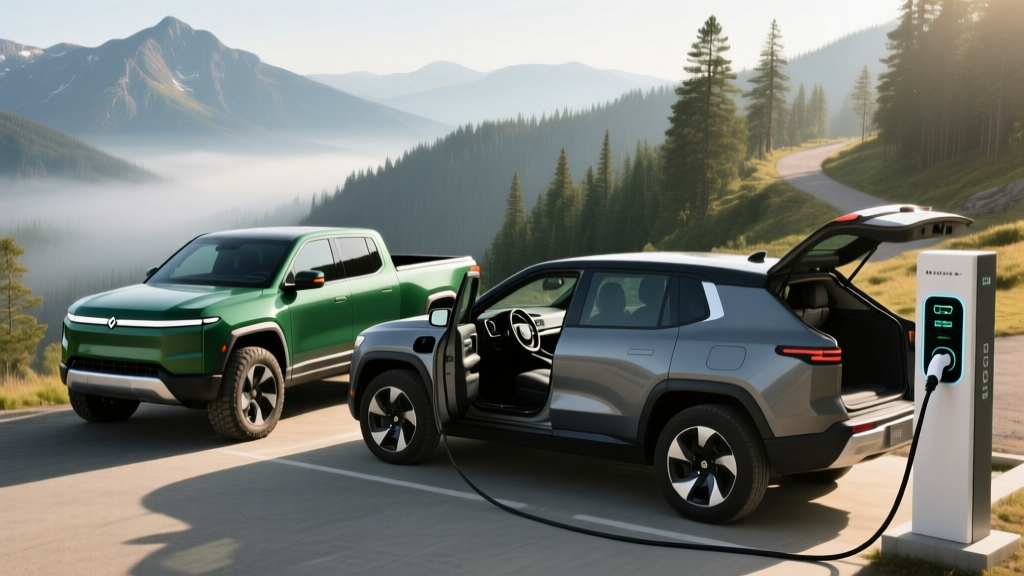
Rivian's marketing has always leaned heavily on adventure-lifestyle imagery — trucks cresting mountain passes, families camping off-grid, and the subtle promise that an electric pickup can do everything a body-on-frame ICE truck does, minus the tailpipe. But as the R1T pickup and R1S SUV enter their 2026 model year on the updated Gen 2 platform, buyers deserve a hard look past the cinematography. What are the real numbers? Does the range hold up at 75 mph in January? How fast does the pack actually charge once you're past the peak-kW marketing figure?
This review dissects the core claims embedded in Rivian advertising and matches them against EPA data, real-world driving physics, and current 2026 ownership economics. We'll cover both the R1T and the three-row R1S, since they share the same skateboard platform and powertrain options.
Range Reality Check: EPA Stickers vs. Highway and Cold-Weather Truth
Rivian offers three battery packs for 2026, and the advertising typically spotlights the largest. Here's the full picture:
| Battery Pack | Usable Capacity | Chemistry | EPA Range (R1T) | EPA Range (R1S) | Efficiency (kWh/100mi) |
|---|---|---|---|---|---|
| Standard (LFP) | ~95 kWh | LFP (prismatic) | 270 mi | 260 mi | ~37 |
| Large (NMC) | ~109 kWh | NMC (2170 cells) | 342 mi | 330 mi | ~34 |
| Max (NMC) | ~141 kWh | NMC (2170 cells) | 420 mi | 400 mi | ~35 |
Real-World Range Expectations
EPA 420 mi (Max Pack R1T) — expect ~330–350 mi at sustained 75 mph highway speeds in mild weather. In freezing temperatures (below 32°F), plan for a 20–30% reduction from the EPA figure, bringing a Max Pack down to roughly 290–310 highway miles. The Standard LFP pack, rated at 270 mi EPA, will realistically deliver 200–220 mi on a cold highway run. These figures align with independent testing from fueleconomy.gov and are typical for a 7,000+ lb electric truck with the aerodynamic profile of a pickup.
Rivian advertising often leads with the 420-mile Max Pack figure. That number is legitimate — it's the EPA combined cycle. But the combined cycle includes substantial low-speed city driving where regenerative braking recaptures energy and aerodynamic drag is minimal. If your use case is interstate road trips, multiply that headline number by roughly 0.80 for a realistic planning figure.
Charging Speed: Peak kW vs. Sustained Reality
This is where Rivian advertising and real-world physics diverge most noticeably. Rivian's Gen 2 platform (introduced for the 2025 model year and carried into 2026) supports peak DC fast-charging rates up to 220 kW on the Large and Max packs, and approximately 175 kW on the Standard LFP pack.
| Charge Level | Standard (LFP) | Large (NMC) | Max (NMC) |
|---|---|---|---|
| DC Fast Peak Rate | ~175 kW | ~220 kW | ~220 kW |
| 10–80% DC Fast Time | ~32 min | ~24 min | ~30 min |
| Level 2 (240V, 48A) | ~11.5 kW / ~22 mi/hr | ~11.5 kW / ~25 mi/hr | ~11.5 kW / ~27 mi/hr |
| Level 2 (240V, 32A mobile) | ~7.7 kW / ~15 mi/hr | ~7.7 kW / ~17 mi/hr | ~7.7 kW / ~18 mi/hr |
The critical nuance: peak kW is not sustained kW. A Max Pack R1T hitting 220 kW at 10% state of charge will taper progressively — by 50% SoC, you're likely seeing 150–160 kW, and above 80%, the rate drops sharply to protect cell longevity. The 30-minute 10–80% time for the Max Pack reflects this charge curve. The smaller Large Pack, with less total capacity to fill, completes 10–80% in roughly 24 minutes despite the same peak rate.
For home charging, Rivian's Wall Connector at 48 amps (requiring a 60-amp circuit) delivers roughly 11.5 kW. That translates to a full overnight replenishment for most daily driving. The mobile charger included with the vehicle on a standard NEMA 14-50 outlet at 32 amps adds about 15–18 miles of range per hour — adequate for overnight top-ups but slow for a depleted Max Pack.
Performance, Platform, and Drivetrain Specs
The 2026 R1T and R1S share Rivian's Gen 2 skateboard, which reduced part count and weight versus the original platform. Three powertrain configurations are available:
| Powertrain | Drivetrain | Horsepower | Torque (lb-ft) | 0–60 mph |
|---|---|---|---|---|
| Dual-Motor | AWD | 533 hp | 610 | 4.5 sec |
| Performance Dual-Motor | AWD | 665 hp | 826 | 3.5 sec |
| Quad-Motor | AWD (torque vectoring) | 1,025 hp | 1,100+ | 2.7 sec |
The Quad-Motor's 2.7-second 0–60 time is legitimately supercar territory and frequently appears in Rivian advertising. It's real — but it's also a $10,000+ option that most buyers will never fully exploit. The Dual-Motor at 4.5 seconds is already quicker than the vast majority of body-on-frame trucks and SUVs on the road, and it's the volume configuration.
Towing capacity stands at 11,000 lb for the R1T (properly equipped) and 7,700 lb for the R1S. However, towing at max capacity will slash range by roughly 40–50%, a reality that no manufacturer's advertising emphasizes. Plan for 180–220 miles between charges when towing near the limit with the Max Pack.
Cargo, Passenger Space, and Daily Practicality
For the R1T, the 4.5-foot bed is shorter than a full-size pickup's, but Rivian compensates with the Gear Tunnel — a lockable, pass-through storage compartment behind the cab that holds roughly 11 cu ft. The front trunk (frunk) adds another 11 cu ft with a drain, useful for muddy gear or ice. Total enclosed cargo capacity across bed, tunnel, and frunk is competitive with midsize trucks.
The R1S offers three rows seating up to seven. Second-row legroom is generous at 38.9 inches; the third row is best suited for children or short trips at 30.4 inches of legroom. Behind the third row, you get 10.5 cu ft of cargo — tight for a three-row SUV. Fold the third row and that expands to roughly 45 cu ft, and folding both rear rows opens up over 90 cu ft.
Interior materials and build quality have improved noticeably on Gen 2 vehicles. Rivian moved to a more minimalist dashboard with a 15.6-inch center touchscreen and a 12.3-inch driver display, running their custom Rivian OS. Wireless Apple CarPlay and Android Auto are supported. The software is generally responsive, though some owners report occasional lag in the navigation and climate menus — an area where Rivian has issued multiple OTA updates to address.
2026 Pricing, Trim Levels, and Federal Tax Credit Eligibility
| Model / Trim | Base MSRP | As-Tested (Typical Config) | §30D Credit Eligibility |
|---|---|---|---|
| R1T Dual-Motor Standard Pack | $69,900 | $74,000–$78,000 | Up to $7,500 (if MSRP ≤ $80K, income/sourcing met) |
| R1T Dual-Motor Large Pack | $75,900 | $80,000–$87,000 | Base may qualify; loaded configs exceed $80K MSRP cap |
| R1T Quad-Motor Max Pack | $99,000 | $105,000+ | Exceeds $80K MSRP cap — no §30D credit |
| R1S Dual-Motor Standard Pack | $74,900 | $79,000–$84,000 | Up to $7,500 (if MSRP ≤ $80K, income/sourcing met) |
| R1S Dual-Motor Large Pack | $79,900 | $85,000–$92,000 | Base may qualify; most configs exceed $80K cap |
| R1S Quad-Motor Max Pack | $104,000 | $110,000+ | Exceeds $80K MSRP cap — no §30D credit |
The IRS §30D federal tax credit offers up to $7,500 for qualifying new EVs, but eligibility for Rivian vehicles depends on several factors that Rivian advertising typically simplifies. Per IRS guidelines:
- MSRP cap: Pickup trucks (R1T) must have an MSRP at or below $80,000; SUVs (R1S) also fall under the $80,000 cap. Once you add options that push the sticker above $80K, the credit is lost entirely — there is no partial credit.
- Buyer income limits: Modified adjusted gross income must not exceed $300,000 (joint), $225,000 (head of household), or $150,000 (single).
- Battery sourcing: A percentage of critical minerals and battery components must be sourced from the U.S. or free-trade-agreement countries. These thresholds increase annually. Rivian has worked to qualify, but verify current-year compliance at purchase.
- Point-of-sale transfer: As of 2024, buyers can transfer the credit to the dealer at purchase, reducing the out-of-pocket price directly — assuming all requirements are met.
Practical takeaway: The base R1T Dual-Motor Standard Pack at $69,900 is the safest bet for the full $7,500 credit, bringing the effective price to roughly $62,400 before state incentives. Once you select the Large or Max Pack, or add the Performance or Quad-Motor powertrain, you will almost certainly exceed the MSRP cap. Always confirm eligibility with your tax professional before relying on the credit.
Battery Longevity, Warranty, and Degradation
Rivian's battery and powertrain warranty covers 8 years or 175,000 miles (whichever comes first), with a capacity retention threshold of 70%. This is competitive with — and in the mileage dimension, slightly better than — the industry-standard 8-year/100,000-mile coverage from most competitors.
The Standard Pack uses LFP (lithium iron phosphate) chemistry, which trades energy density for exceptional cycle life and thermal stability. LFP cells tolerate regular 100% charging without the degradation concerns that NMC packs carry, and they generally outlast NMC cells over 10–15 years of use. The trade-off is lower range per pound — hence the 270-mile EPA rating versus 420 for the Max NMC pack.
The Large and Max packs use NMC (nickel manganese cobalt) chemistry in 2170 cylindrical cells. NMC offers superior energy density (more kWh in the same physical space) but benefits from being charged to 80–90% for daily use and only taken to 100% for long trips. Rivian's software allows you to set charge limits to manage this.
Battery replacement cost out of warranty remains a concern for long-term owners. While Rivian has not published a flat replacement figure, industry estimates for a pack of this size range from $15,000 to $25,000+ depending on the configuration. Module-level repair may be possible for partial failures, reducing cost, but this is still an evolving area for Rivian's service network.
Driver Assistance and Tech: SAE Level 2, Not Self-Driving
SAE Automation Level: Level 2
Rivian's Driver+ system is an SAE Level 2 driver-assistance feature. It combines adaptive cruise control and lane-centering for hands-on-wheel highway driving. The driver must remain fully attentive and is legally responsible for vehicle operation at all times. This is not autonomous or "self-driving" capability. No consumer vehicle sold in the U.S. today offers SAE Level 3 or above for general public use.
Driver+ works well on divided highways and has improved through OTA updates. It handles gentle curves and maintains following distance competently. However, it does not support hands-off driving (unlike GM's Super Cruise or Ford's BlueCruise on approved highways), and its performance in construction zones, faded lane markings, or heavy rain remains limited. Rivian has been more conservative in its marketing language around driver assists compared to some competitors — a point in their favor for honesty, even if it's less flashy in advertising.
The 15.6-inch infotainment system runs Rivian's proprietary OS. It's generally well-regarded for its clean interface, integrated trip planner with charging stops, and over-the-air update capability. The camp kitchen accessory (a slide-out electric kitchen for the Gear Tunnel) and the built-air compressor remain unique differentiators that genuinely appeal to the overlanding demographic Rivian targets.
Competitor Comparison and Decision Framework
Pros
- Class-leading off-road capability for an EV (air suspension, tank turns on Quad-Motor)
- Gear Tunnel and frunk add practical cargo versatility no competitor matches
- Up to 420 mi EPA range (Max Pack) is among the highest of any electric truck
- LFP option on Standard Pack provides long-life, daily-charge-friendly chemistry
- 8-yr/175,000-mi battery warranty exceeds most competitors
- Strong OTA update track record improving the vehicle post-purchase
Cons
- MSRP cap on §30D credit eliminates most mid-to-high trims from tax credit eligibility
- Real-world highway range is 15–20% below EPA combined figure
- Service center network still limited outside major metro areas
- Bed length (4.5 ft) is shorter than midsize ICE trucks like the Tacoma or Ranger
- Third-row R1S space is tight for adults
- Quad-Motor configurations push price well past $100K with no tax credit
Who Should Buy the 2026 Rivian R1T / R1S?
Choose the R1T if: You need an electric pickup with genuine off-road chops, you value enclosed Gear Tunnel storage, you mostly drive in areas with access to DC fast charging (or can charge at home), and you can configure within the $80K MSRP cap for the tax credit.
Choose the R1S if: You need three rows for family duty, you want EV efficiency with SUV practicality, and you accept that the third row is best for kids. The R1S competes most directly with the Tesla Model X, Kia EV9, and the upcoming electric Explorer — it wins on adventure features and range, loses on third-row space and price.
Look elsewhere if: You need a full-size 6.5-foot truck bed (consider the Ford F-150 Lightning or Chevrolet Silverado EV), you need the lowest possible cost of entry (the Hyundai Ioniq 5 or Tesla Model Y offer far more affordable EV ownership), or you live in an area with minimal Rivian service infrastructure.
Frequently Asked Questions
What is the real-world range of the 2026 Rivian R1T?
The EPA rates the R1T Max Pack at 420 miles combined. In real-world highway driving at 70–75 mph in mild conditions, expect 330–350 miles. In freezing weather, plan for 290–310 miles. The Standard LFP Pack delivers roughly 200–220 highway miles in cold weather from its 270-mile EPA rating.
How fast does the Rivian R1T charge on DC fast chargers and at home?
The Large and Max Packs peak at 220 kW DC fast charging, with 10–80% taking 24–30 minutes depending on pack size. The Standard LFP Pack peaks around 175 kW with a 10–80% time of about 32 minutes. At home on a 48-amp Level 2 charger, expect roughly 22–27 miles of range added per hour.
How much does a 2026 Rivian cost after the federal tax credit?
The base R1T Dual-Motor Standard Pack starts at $69,900 MSRP. If you qualify for the full $7,500 §30D credit (meeting income, MSRP, and sourcing requirements), the effective price drops to approximately $62,400. Most higher trims exceed the $80,000 MSRP cap and do not qualify.
Does the 2026 Rivian R1T qualify for the federal EV tax credit?
It depends on configuration. Base R1T models under $80,000 MSRP can qualify for up to $7,500 under IRS §30D, provided the buyer meets income limits and battery sourcing requirements are satisfied. Configurations exceeding $80,000 MSRP — which includes most Large Pack, all Max Pack, and all Quad-Motor builds — do not qualify. Verify current rules at IRS.gov and consult a tax professional.
Is the Rivian R1T worth buying over the Ford F-150 Lightning or Tesla Cybertruck?
The R1T wins on off-road capability, build quality, and adventure-specific features (Gear Tunnel, camp kitchen, air suspension). The F-150 Lightning offers a larger bed, a more established dealer/service network, and lower entry pricing. The Cybertruck undercuts on price for its AWD trim and offers comparable range. Your decision should weigh service proximity, bed-size needs, and whether you value Rivian's lifestyle features enough to justify the premium.
What is Rivian's battery warranty?
Rivian covers the battery pack and drive unit for 8 years or 175,000 miles, whichever comes first, with a guaranteed minimum capacity retention of 70%. This mileage threshold is notably higher than the 100,000-mile coverage offered by most competitors.
Can I charge a Rivian at Tesla Superchargers?
As of 2026, Rivian vehicles are equipped with NACS (North American Charging Standard) ports, enabling direct access to Tesla's Supercharger network without an adapter. This significantly expands DC fast-charging availability for Rivian owners, particularly on road trips through areas where Electrify America or EVgo coverage is sparse.